 Skip to content
A wastewater lift station should not size its BESS from the sum of every installed pump motor.
The design must start with usable wet-well storage, incoming flow, minimum emergency pumping capacity, motor-starting demand and generator response time.
MegSolid separates the requirement into:
- PCS power: operating and transient demand from selected pumps and controls
- Battery energy: how long those loads must operate
The BESS may support PLCs, SCADA, level sensors, alarms, valves and one duty pump. It does not automatically need to energize every standby pump and building load.
Request a Preliminary Pump Station Assessment
Submit the pump schedule, motor-starting method, pump curves, wet-well levels, usable emergency volume, design inflow, generator response time, site voltage and single-line diagram.
The review can return a preliminary PCS range, battery capacity, emergency sequence and missing RFQ data.
Is BESS Suitable for the Station?
EPA recommends assessing the power required by essential infrastructure and key pumping stations rather than classifying every connected load as critical.
| Project Condition | BESS Suitability | Direction |
|---|---|---|
| Generator needs 30 seconds to 10 minutes | High | BESS bridge |
| Frequent short outages | High | Battery-led pumping |
| One duty pump controls inflow | High | Tiered-load BESS |
| Pump flow remains below inflow | Conditional | Calculate net accumulation |
| Whole plant must run 12–24 hours | Low alone | BESS-generator hybrid |
| Wet-well storage is unknown | Cannot size | Hydraulic assessment |
| Starting demand exceeds PCS capability | Unsuitable design | VFD, soft starter or larger PCS |
| Station is flood-prone | Conditional | Review elevation and access |
The selected C&I Energy Storage system should support the verified emergency mode, not total connected horsepower.
Use the Four-Layer Sizing Method
| Layer | Engineering Question | Output |
|---|---|---|
| Hydraulic risk | When will the wet well reach its limit? | Maximum response time |
| Critical load | Which pump and controls must operate? | Operating kW |
| Transient power | What happens during pump starting? | PCS kW and kVA |
| Energy duration | How long must loads run? | Usable and nominal kWh |
Use the commercial energy storage procurement guide to define responsibility for the battery, PCS, EMS, switchgear, protection and commissioning.
Calculate No-Pump Holdover Time
Use only the storage between the selected starting level and maximum permitted level. Exclude sump volume, required pump submergence, sediment allowance and freeboard.
TxDOT guidance similarly separates usable storage from sump and freeboard.
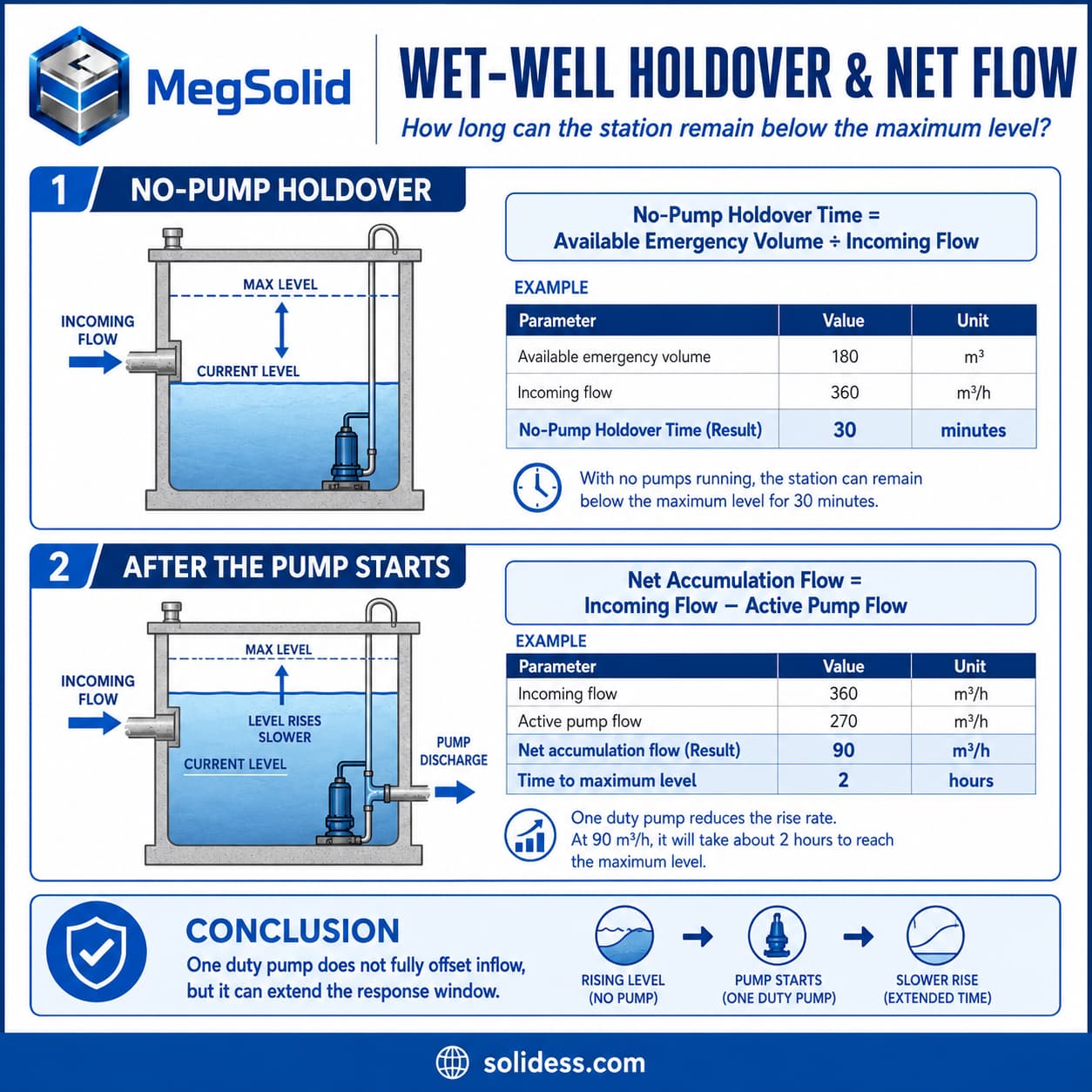
No-Pump Holdover Time = Available Emergency Volume ÷ Incoming Flow
| Hydraulic Input | Value |
|---|---|
| Available emergency volume | 180m³ |
| Outage inflow | 360m³/h |
| No-pump holdover | 30 minutes |
This is a response deadline, not automatically the required battery duration.
Calculate Net Flow After the Pump Starts
Once a pump starts, storage accumulation depends on inflow minus active pump flow. Hydraulic design should evaluate inflow and outflow over time.
Net Accumulation Flow = Incoming Flow − Active Pump Flow
With 360m³/h inflow and 270m³/h pump flow:
Net Accumulation = 90m³/h
Time to Maximum Level = 180m³ ÷ 90m³/h = 2 hours
The pump does not fully offset inflow, but it extends the original 30-minute window to two hours.
If verified pump flow equals or exceeds inflow at the actual head, the level should stabilize or fall.
Size Energy From Actual Pump Duty
Assume:
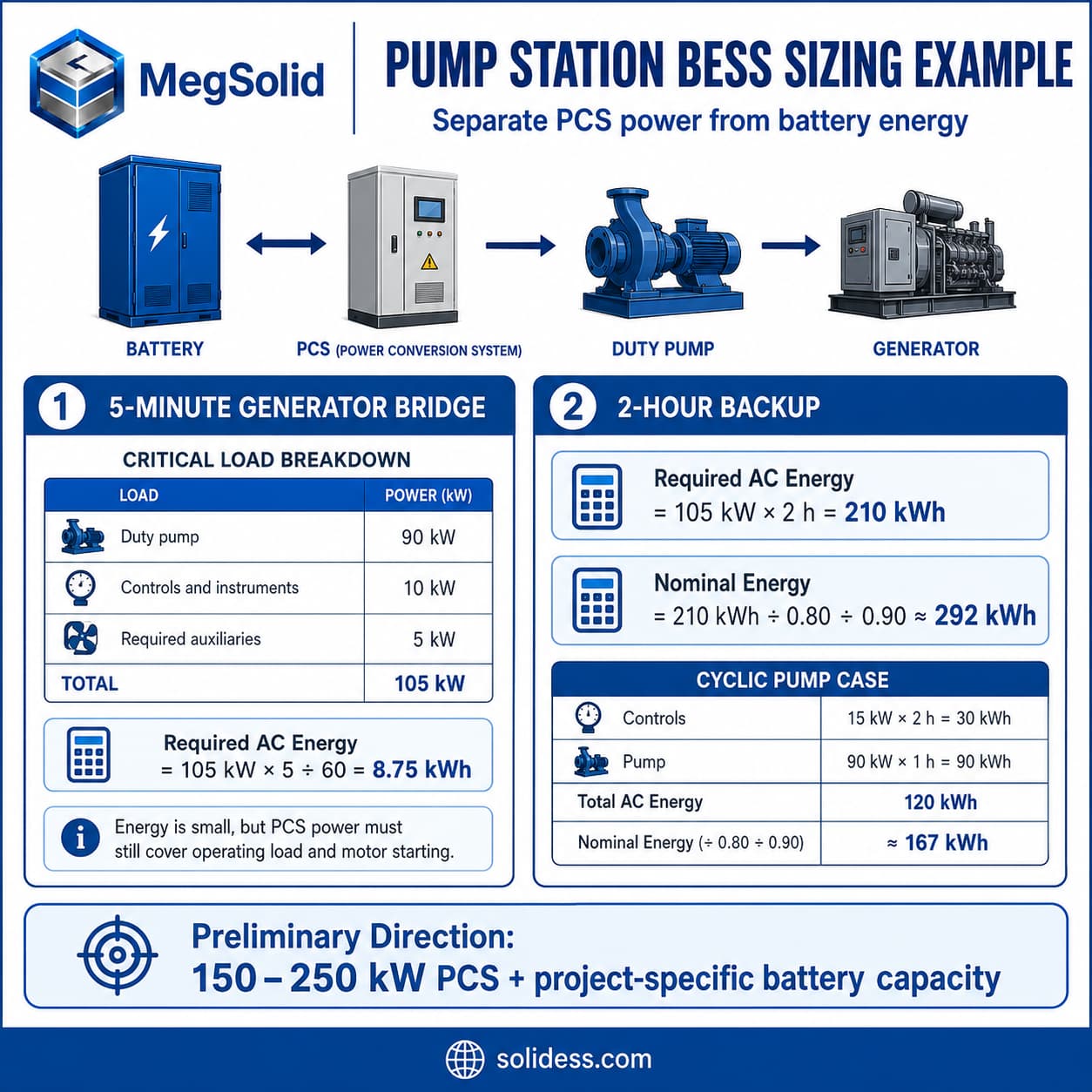
| Critical Load | Power |
|---|---|
| One duty pump | 90kW |
| Controls and instruments | 10kW |
| Required auxiliaries | 5kW |
| Total | 105kW |
Five-Minute Generator Bridge
Required AC Energy = 105kW × 5 ÷ 60 = 8.75kWh
Energy is small, but the PCS must carry 105kW plus the starting transient. A 100kW PCS is already below the continuous requirement.
Two-Hour Continuous-Pump Case
Required AC Energy = 105kW × 2h = 210kWh
At an illustrative 80% usable SOC window and 90% conversion factor:
Nominal Energy = 210kWh ÷ 0.80 ÷ 0.90 ≈ 292kWh
Two-Hour Cyclic-Pump Case
If 15kW of controls runs for two hours and the 90kW pump runs for one hour:
Total AC Energy = (15kW × 2h) + (90kW × 1h) = 120kWh
Nominal Energy = 120kWh ÷ 0.80 ÷ 0.90 ≈ 167kWh
| Operating Model | AC Energy | Nominal Energy |
|---|---|---|
| Continuous pump | 210kWh | About 292kWh |
| 50% pump duty | 120kWh | About 167kWh |
Use the lower value only when the hydraulic model and level-control sequence validate the duty cycle.
Verify Pump Starting Separately
A 90kW motor may require substantially more than 90kVA during acceleration.
Review:
- Starting method
- Locked-rotor current
- Starting power factor
- Acceleration time
- Concurrent auxiliary loads
- PCS overload capability
A larger battery cannot correct an undersized PCS.
Review the BESS motor-starting engineering guide and PCS and inverter engineering guide before selecting converter power.
Coordinate the Emergency Sequence
- Maintain PLC, level sensors, SCADA and alarms.
- Confirm wet-well level and incoming flow.
- Start the minimum required duty pump.
- Verify current, pressure and flow.
- Add another pump only if the level continues rising.
- Start and synchronize the generator.
- Transfer long-duration pumping where required.
- Recharge after adequate headroom returns.
The control hierarchy should follow the BMS and EMS communication architecture.
EPA documents a 1MW battery at a wastewater treatment plant capable of approximately 15 minutes of whole-plant backup before transfer to generators, illustrating the bridge role of storage.
Preliminary MegSolid Product Direction
| Critical Requirement | Preliminary Direction |
|---|---|
| Up to 100kW | ESSA0100B-0215 |
| Around 125kVA | 261.24kWh liquid-cooled system |
| 150–250kW | MEGA0150TS or MEGA0250TS |
| 250–500kW | MEGA0250TS or MEGA0500TS |
| 500kW–1MW | ESSC containerized BESS |
| Multiple stations | Distributed cabinets or centralized system |
Projects within 100kW can evaluate the ESSA outdoor cabinet energy storage system.
The ESSA0100B-0215 is rated at 100kW/215.04kWh and uses intelligent air cooling with IP54 protection.
Review the 215kWh outdoor cabinet ESS guide for model-level context.
Higher-power stations can evaluate the MEGA power conversion system, with 150kW/165kVA, 250kW/275kVA and 500kW/550kVA ratings.
Large plants can evaluate the ESSC containerized energy storage system, including 500kW/1.0752MWh and 1MW/2.1504MWh configurations.
Utilities with several sites should compare modular cabinets versus containerized ESS.
Product selection remains subject to starting kVA, usable energy, ambient conditions, flood elevation, cable distance, protection coordination and the approved operating sequence.
FAT and SAT Requirements
FAT should simulate:
- Grid failure
- High wet-well level
- Pump-start demand
- Failed pump start
- Generator-ready status
- Minimum SOC
- Communication loss
SAT should verify starting current, PCS response, pump flow, wet-well control, SCADA alarms, generator transfer and recharge logic.
Use the BESS Factory Acceptance Testing guide to define witnessed pass/fail criteria.
Final Procurement Recommendation
The design must prove that:
- The wet well remains below its permitted level.
- Selected pump flow matches the studied inflow.
- PCS power covers operating and starting demand.
- Battery energy covers the verified duty cycle.
- Generator and BESS responsibilities are clearly separated.
- The complete sequence passes FAT and SAT.
Submit the pump schedule, wet-well levels, flow data and single-line diagram through the MegSolid project inquiry page.
FAQ
Q1: Should BESS power every pump?
No. It should support the minimum pumping capacity required to protect the process.
Q2: How is no-pump holdover calculated?
Divide usable emergency storage by incoming flow.
Q3: What if pump flow is lower than inflow?
Subtract pump flow from inflow and calculate time from the net accumulation rate.
Q4: Can BESS bridge generator startup?
Yes. Battery energy covers duration; PCS power covers operating and starting demand.
Q5: Can a 100kW BESS run a 90kW pump?
Possibly, but controls, auxiliaries, power factor and starting demand must also fit.
Q6: Can a VFD reduce PCS requirements?
It may reduce starting current, subject to compatibility and harmonic review.
Q7: Is wet-well storage a substitute for backup power?
No. It delays the response deadline but does not stop inflow.
Q8: Can the BESS also perform peak shaving?
Yes, if emergency SOC remains reserved.
Q9: Can one BESS support several stations?
Potentially, but cable distance and simultaneous outage risk may favor distributed systems.
Q10: What is required for a quotation?
Pump curves, motor data, wet-well levels, inflow, emergency volume, generator data and a single-line diagram.
Q11: How do you size BESS for a wastewater lift station?
Calculate hydraulic holdover, minimum pump capacity, starting power and energy from the actual duty cycle.
Q12: Is BESS or a generator better?
BESS provides immediate response; generators usually provide longer runtime. Critical stations often need both.
Q13: What is the key sizing input?
Incoming flow, usable emergency volume, active pump flow, starting demand and backup duration.
