 Skip to content

Industrial battery storage in Gqeberha should be sized around the production process it must protect. Select the operating objective before selecting PCS power or battery energy:
- ⚡ Ride-through: Protect production against short grid disturbances.
- 🛑 Controlled shutdown: Provide enough time to stop equipment safely.
- 🏭 Critical-load backup: Maintain selected production lines and auxiliary systems.
- 📉 Demand reduction: Reduce grid peaks or generator operating hours.
What the Public 4 MWh Project Proves—and What It Does Not
The reference project proves that large behind-the-meter solar, battery storage and a generator can be combined at an automotive manufacturing site in Gqeberha under a long-term commercial arrangement. It also highlights a buyer priority that generic BESS pages often miss: the battery may create more value by protecting a safe process stop than by attempting to operate every machine through a long outage.
| Publicly disclosed fact | What a buyer may conclude | What remains unverified |
|---|---|---|
| Gqeberha automotive manufacturing site | The application and location are real | Confidential production and electrical loads |
| More than 5 MWp solar PV | PV is material to the energy strategy | Hourly yield, clipping, curtailment and export limits |
| 4 MWh BESS | The published energy class is 4 MWh | PCS MW, usable AC energy, duration and end-of-life obligation |
| Generator integration | The design includes another dispatchable source | Start time, minimum loading, synchronization and charging rules |
| 20-year green-power agreement | Long-term commercial delivery is part of the project | BESS availability, degradation, dispatch rights and performance damages |
A public “4 MWh BESS” figure is not enough to prepare a project quotation. MegSolid first confirms six engineering inputs:
- ⚡ PCS power: Maximum load, motor-starting demand and required kW/kVA.
- 🔋 Delivered energy: Usable MWh required at the agreed AC or PCC boundary.
- ⏱️ Supply window: Seconds of ride-through, shutdown time or hours of backup.
- ☀️ Charging sources: Available grid, solar PV and generator capacity.
- 🧠 EMS sequence: Protected loads and charge/discharge priorities.
- 📋 Scope boundary: EPC, supplier and site-owner responsibility for the SLD, controls, FAT and SAT.
Choose the Operating Objective Before Choosing the Battery
Automotive plants contain processes with very different interruption consequences. A brief voltage dip may stop a PLC-controlled line even though total plant energy consumption barely changes. A casting, heat-treatment, coating, compressed-air or cooling-water process may require enough power and time to reach a safe state. Other loads can wait for the generator or remain disconnected.
- 🛡️ Controlled shutdown: Keep the approved controls, drives, pumps, extraction and process auxiliaries energized until each production area confirms a safe state.
- ⚡ Short ride-through: Prevent contactor drop-out, PLC reset or drive trips during disturbances within the approved transfer envelope.
- 🏭 Selective continuity: Operate only the lines whose avoided scrap or restart cost justifies the required battery power and energy.
- ☀️ Solar utilization: Store otherwise curtailed or low-value PV after process and interconnection constraints are satisfied.
- ⛽ Generator optimization: Use the BESS to manage step loads, start delays and inefficient generator operating zones without making unsupported fuel-savings promises.
- 📉 Peak control: Dispatch against the actual tariff and measured demand interval, not a generic South African demand-charge assumption.
Write these objectives in priority order. If backup reserve is mandatory, the EMS must not spend the same reserved state of charge on peak shaving unless the contract defines how and when that reserve will be restored. The BESS EMS priority-logic guide provides the control-conflict framework; the automotive plant must add process-specific permissives and safe-state confirmations.
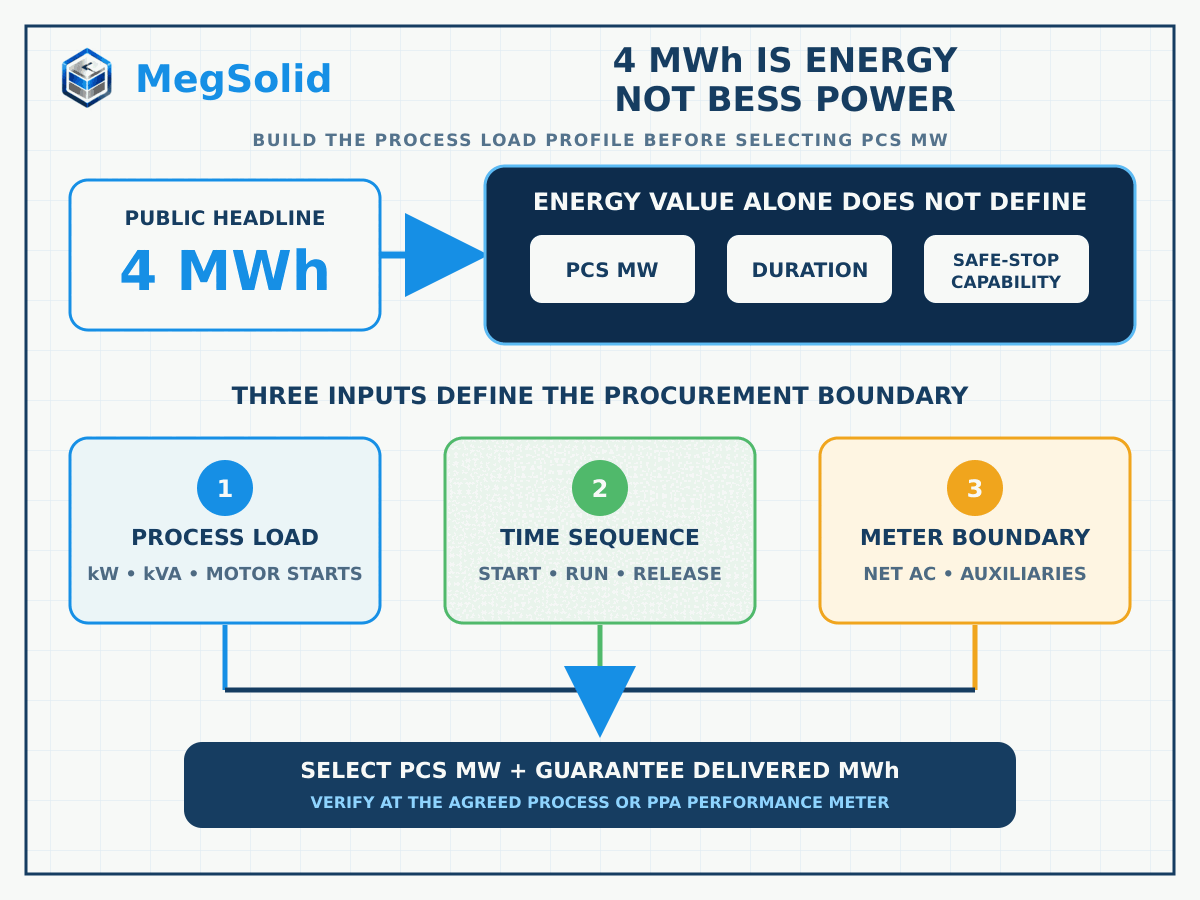
Four Megawatt-Hours Is Energy, Not PCS Power
A 4 MWh value cannot tell the EPC whether the site needs 500 kW, 2 MW or 4 MW of conversion power. Duration equals energy divided by power only after the measurement boundary and usable-energy conditions are defined. For example, 4 MWh divided by 2 MW equals two hours as arithmetic, but that is not a two-hour plant guarantee because auxiliaries, operating SOC, conversion losses, temperature, ageing and availability still have to be allocated.
The buyer should build a time-sequenced load model rather than a flat rectangle. Each process group receives an initial kW or kVA requirement, a start time, a run time, a ramp or motor-start requirement, and a release condition. The sum changes throughout the shutdown event.
| Required input | Why it changes the BESS | Evidence for the RFQ |
|---|---|---|
| One-second or faster event data | Reveals dips, trips, peaks and restart transients | Power-quality recorder export |
| 15-minute interval load history | Supports energy, peak and PV modeling | At least 12 months where available |
| Motor and VFD schedule | Defines starting kVA, ramp time and voltage tolerance | Motor datasheets and protection settings |
| Process shutdown sequence | Defines which loads run and for how long | Approved cause-and-effect matrix |
| Generator operating data | Defines start delay, minimum load and charge authority | Genset controller, fuel and synchronization data |
| Electrical SLD and fault study | Defines voltage, transformer, protection and island boundary | Current controlled drawings and study files |
If the objective is transformer-capacity relief rather than production resilience, use the BESS transformer-upgrade decision guide. Do not let that business case silently replace the process-shutdown obligation; they use different load windows and acceptance criteria.
Build an Automotive Critical-Load Hierarchy
The production owner—not the battery vendor—must classify every feeder. The list below is a decision structure, not a statement about Borbet SA or any named facility. Actual automotive processes vary by plant, product and equipment.
- 🔴 Tier 1—must not drop: Safety PLCs, emergency controls, critical instrumentation and loads whose immediate loss creates personnel, equipment or process hazards.
- 🟠 Tier 2—safe-shutdown duty: Selected pumps, extraction, cooling, drives and controls required for a documented stopping sequence.
- 🟡 Tier 3—restart support: Utilities and process loads that return only after the bus, generator and production authority are stable.
- 🟢 Tier 4—commercial dispatch: Flexible loads used for solar self-consumption or peak management when backup reserve is healthy.
- ⚪ Noncritical: Loads that remain isolated throughout the event unless a separate continuity case approves them.
The SLD should place these tiers behind controlled feeders. If the BESS connects to an undivided plant bus, a low-priority compressor or charger can consume the reserve intended for a controlled shutdown. The BESS SCADA point-list guide helps identify the measurements, commands, permissives and feedback signals required to enforce the hierarchy.
EMS Sequence: From Grid Disturbance to Safe Process State
A credible EMS narrative names the authority for each transition. It does not merely state ‘automatic backup.’ The plant control system owns process safety; the BESS EMS owns storage limits and dispatch; the PCS owns electrical conversion; protection relays own electrical isolation; and the generator controller owns generator readiness. Interfaces between these authorities must be explicit.
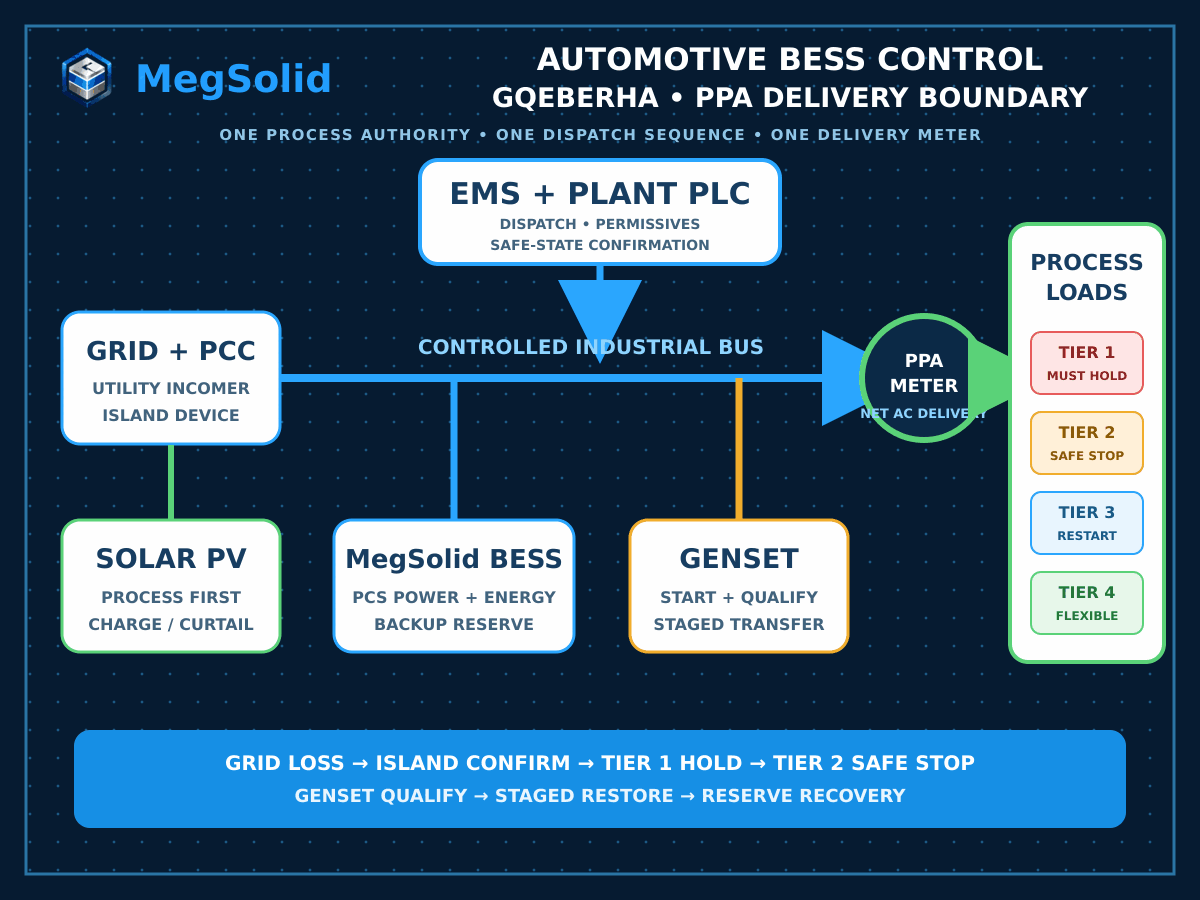
- Detect and validate: Confirm voltage or frequency disturbance using the approved protection logic and debounce time.
- Separate the island: Open the defined device and confirm position before energizing an islanded bus.
- Hold Tier 1: Maintain safety controls and essential auxiliaries within their voltage and frequency tolerances.
- Run the shutdown sequence: Release Tier 2 loads only after the plant PLC confirms each process safe state.
- Start and qualify the generator: Accept generator power only after voltage, frequency, phase and protection conditions are satisfied.
- Restore in stages: Reconnect approved loads using ramp limits that the generator, PCS and transformer can support.
- Recover reserve: Recharge according to PV availability, generator limits, tariff rules and the next resilience window.
Communication loss requires its own state table. Define the last-valid-command timeout, fallback power, SOC reserve, local/remote authority, alarm destination and recovery handshake. Use the BESS communication-failure guide rather than assuming a network fault will fail safely by itself.
Turn a 20-Year PPA Headline Into Measurable Delivery Capability
The public Gqeberha reference identifies a 20-year green-power agreement, but it does not disclose its detailed battery-performance terms. A new buyer should not copy an unseen contract. The RFQ and PPA schedule should instead translate business outcomes into meter-based obligations.
| PPA or service obligation | Required definition | Acceptance evidence |
|---|---|---|
| Available BESS power | Net AC kW or kVA, power factor, duration and meter | Commissioning power test and interval data |
| Delivered energy | Net AC kWh, starting SOC, ending SOC and auxiliary treatment | Calibrated-meter discharge test |
| Safe-shutdown availability | Required reserve, response state and excluded events | Timestamped event and PLC sequence report |
| PV and BESS dispatch rights | Who may charge, discharge, curtail or preserve reserve | EMS permissions and audit log |
| Degradation and augmentation | Guarantee year, energy threshold and responsible party | Annual capacity-test method |
| Availability and cure | Planned maintenance, exclusions, response time and remedy | Monthly availability calculation and incident record |
The delivery meter must match the promise. If the contract promises energy at the process bus, transformer, cable and auxiliary losses upstream of that point cannot be ignored. The BESS capacity-test diagnostic guide explains why systems can miss a contractual energy test without an obvious battery alarm.
MegSolid Product Screening for a 4 MWh-Class Requirement
Product screening can begin only after power, delivered energy and site voltage are defined. The table below uses ratings verified in the latest MegSolid technical knowledge base. It does not claim that any model was used at Borbet SA, and it is not a final selection for another automotive plant.
| MegSolid platform | Verified published rating | Procurement interpretation |
|---|---|---|
| ESSC0500B-1075 | 500 kW / 1.0752 MWh; 400 V; LFP; intelligent temperature-controlled air cooling | Modular MWh-class reference; unit count and parallel architecture require project engineering |
| ESSC1000B-2150 | 1,000 kW / 2.1504 MWh; 400 V; LFP; intelligent temperature-controlled air cooling | Two units equal 2 MW / 4.3008 MWh by arithmetic only; delivered energy, redundancy and process duty remain unproven |
| MegSolid Energon 5000INTL | 2.7 MW / 5.0159 MWh; 690 V; smart liquid cooling; IP55 | Single-container MWh-class option; chemistry is not publicly defined and plant-voltage integration must be engineered |
Compare the MegSolid ESSC containerized BESS range with the 5000INTL liquid-cooled platform. Ask MegSolid to return a compliance matrix against the project SLD, load sequence, usable-energy boundary, environmental data, availability target and PPA schedule rather than a brochure-only quote.
How to Evaluate Solid-State Safety Without Relabeling Products
MegSolid develops hybrid solid-state battery technology, but the electrolyte classification must be confirmed for the exact ordered system. The public ESSC specifications identify LFP cells; LFP cathode chemistry alone does not prove a liquid, semi-solid or solid-state electrolyte. The current 5000INTL public page does not define its electrolyte architecture. Neither platform should be called solid-state unless the quotation, signed datasheet and BOM support that classification.
A verified solid-state or hybrid configuration may improve specific cell-level thermal characteristics and reduce reliance on free liquid electrolyte, but it does not eliminate thermal runaway or replace system controls. Automotive buyers should request cell evidence, propagation evidence, BMS limits, cooling design, gas and smoke detection, fire suppression, isolation, emergency response and installation requirements for the quoted model. Review the MegSolid solid-state energy storage portfolio, then require model-level evidence before awarding the project.
FAT and SAT Must Prove the Process Boundary
Factory testing can prove the ordered PCS, BMS, EMS, protection and simulated I/O behavior. It cannot prove an automotive process sequence that has not been connected. Site acceptance must therefore combine electrical measurements with plant PLC confirmations and an approved production-risk method.
- 🧪 FAT power test: Verify rated operating points, alarms, limits and raw data at the agreed factory boundary.
- 🔌 I/O simulation: Exercise grid-loss, generator-ready, safe-state, feeder feedback and emergency-stop signals.
- 🕒 Common time base: Synchronize relay, EMS, PCS, meter, SCADA and PLC timestamps so event order is defensible.
- 🏭 SAT sequence: Demonstrate the approved plant transition with production authority and safety controls present.
- 📊 Energy test: Measure net delivered AC energy using the PPA starting SOC, auxiliaries and meter boundary.
- 🔁 Recovery test: Prove generator transfer, staged load restoration, reserve recharge and communication recovery.
Use the BESS FAT witness guide to assign evidence before shipment. Also verify civil, cable-entry and service-clearance inputs with the outdoor BESS foundation input guide before the container arrives in Gqeberha.
Put These Fields in the Automotive BESS RFQ
| RFQ section | Minimum buyer input | Required supplier return |
|---|---|---|
| Business objective | Safe shutdown, continuity, solar, peak or generator priority | Operating modes and benefit boundary |
| Electrical system | SLD, voltage, transformer, fault level, protection and earthing | Proposed SLD, PCS rating and protection philosophy |
| Process loads | Feeder list, kW/kVA, motor starts, sequence and safe-state time | Time-sequenced power and energy compliance |
| PV, grid and generator | PV model, export rule, genset data and utility requirements | EMS dispatch, interlocks and fallback states |
| PPA performance | Meter, availability, delivered energy, degradation and dispatch rights | Guaranteed values, exclusions, test method and remedies |
| Site conditions | Layout, ambient, altitude, coastal exposure, access and fire constraints | GA, foundation loads, clearances and environmental derating |
| Controls | Protocols, point list, network ownership and cybersecurity policy | Cause-and-effect, point list and communication-failure matrix |
| Testing and handover | Witnesses, tolerances, raw-data format and responsible parties | FAT/SAT procedures, reports, training and as-built package |
Before issuing the RFQ, use the commercial BESS supplier qualification guide and the South Africa BESS regulatory guide. The EPC must still confirm current Nelson Mandela Bay, utility, fire, environmental and building requirements for the actual site.
Five Red Flags Before Awarding a 4 MWh BESS
- 🚩 4 MWh with no MW: The proposal cannot prove process support, transfer behavior or duration.
- 🚩 Whole-plant backup with no feeder hierarchy: Unapproved loads can consume the shutdown reserve.
- 🚩 PPA savings with no meter boundary: Availability, delivered energy and losses cannot be settled consistently.
- 🚩 Generic automatic-backup statement: No device authority, process permissive or communication fallback is defined.
- 🚩 Portfolio-level solid-state claim: The quoted model lacks a signed chemistry and electrolyte classification.
The best quotation is not the one with the largest battery label. It is the one that proves the plant's operating outcome at a defined meter, under a defined event, with responsibilities that remain measurable through the PPA term.
This article provides a baseline procurement framework. To receive an editable Automotive Plant BESS RFQ Worksheet—including safe-shutdown load sequencing, PCS power, delivered-energy boundary, EMS states, generator coordination, PPA guarantees and FAT/SAT responsibility fields—email [email protected]. Include the site SLD, interval load data, power-quality event files, motor list, generator data, PV information and approved process shutdown sequence.
FAQ
What does a 4 MWh BESS rating tell an automotive buyer?
It identifies nominal stored energy only. It does not define PCS power, usable AC energy, duration, process loads, starting duty, degradation or the contractual meter boundary.
Can two ESSC1000B-2150 containers create a 4 MWh system?
Two published units equal 2 MW and 4.3008 MWh by arithmetic. That is only a screening calculation; parallel architecture, usable energy, redundancy, site voltage and process performance require project engineering and signed documents.
Should a BESS back up every load in an automotive plant?
Usually not without a specific full-plant business case. Separate safety controls, shutdown loads, restart utilities, flexible loads and noncritical feeders so reserve is used for the approved production outcome.
How is PCS power selected for a safe-shutdown application?
Use the maximum coincident kW or kVA in the time-sequenced shutdown model, then verify motor acceleration, voltage dip, power factor, transformer impedance, overload duration and generator transfer conditions.
Which process data should an automotive plant provide?
Provide controlled SLDs, interval loads, high-speed disturbance records, motor and VFD data, feeder priorities, safe-state sequence, generator controls, protection settings and the production owner's acceptance criteria.
How should the EMS coordinate a BESS and generator?
Define grid-loss detection, island confirmation, critical-load support, generator start and qualification, staged transfer, charging authority, minimum generator loading, reserve recovery and communication-failure states.
What should a BESS PPA guarantee?
State net available power, delivered AC energy, meter location, starting SOC, auxiliary treatment, availability, degradation, dispatch rights, maintenance exclusions, cure periods and performance remedies.
Which tests belong in FAT and SAT?
FAT should verify the ordered system and simulated interfaces. SAT should prove the installed electrical transition, process safe-state sequence, generator coordination, delivered energy, alarms, recovery and timestamped evidence.
Does a solid-state BESS eliminate thermal runaway risk?
No. A verified solid-state or hybrid configuration may improve specific cell-level thermal characteristics, but system safety still depends on BMS, PCS, cooling, detection, suppression, isolation, installation and operating controls.
What should be sent to MegSolid for a quotation?
Send the site location, SLD, voltage, transformer and protection data, load files, process shutdown sequence, motor list, PV and generator data, required PPA boundary, site conditions and delivery schedule.
What is industrial battery storage in Gqeberha used for?
Industrial battery storage in Gqeberha can support controlled process shutdown, selective continuity, solar utilization, generator coordination and measured peak control for manufacturing sites when designed from plant-specific electrical and production data.
Is the public Gqeberha automotive project a MegSolid installation?
No. It is cited as an independently documented market reference. This article does not claim MegSolid supplied that project and does not transfer its undisclosed design details to another plant.
Which MegSolid platform can be evaluated for a 4 MWh-class project?
Evaluate the ESSC1000B-2150 and 5000INTL capacity classes after PCS power, delivered energy, site voltage, redundancy and operating sequence are defined. Final selection requires a project quotation, signed datasheet, BOM and compliance matrix.
