 Skip to content
South Africa’s Mafikeng Provincial Hospital provides a useful public reference for healthcare microgrid design.
The project combines a 200kW AC solar PV system, 400kWh of battery storage and an estimated 170kW critical load supporting areas including the ICU, operating theatres and Emergency Department. These are publicly disclosed project figures, not MegSolid product specifications.
However, these three numbers do not establish the guaranteed backup duration, PCS rating, battery usable energy or solar recharge time.
As MegSolid’s Mfg & Supply Chain Director with 15 years of battery manufacturing and ESS supply experience, I recommend sizing a hospital system in this sequence:
Medical load classification → Simultaneous AC power → Guaranteed usable AC energy → Backup duration → Solar recharge → Generator coordination
The MegSolid hybrid solid-state energy storage portfolio can support project-specific battery, PCS and microgrid engineering after these operating requirements are defined.
Start with Medical Load Classification
The disclosed 170kW figure should be treated as the estimated critical-load boundary—not as proof that every connected circuit requires uninterrupted power for the same duration.
Hospital EPCs should divide the critical-load schedule according to clinical consequence and interruption tolerance.
| Medical load class | Typical circuits | Required design decision |
|---|---|---|
| No-break clinical loads | Selected ICU equipment, theatre circuits, medical controls, emergency lighting and clinical IT | Can any transfer interruption be accepted? |
| Essential support loads | Selected ventilation, laboratory, pharmaceutical refrigeration, water and communications | How quickly must the circuit recover? |
| Controlled sheddable loads | Non-immediate support circuits approved by the hospital | At what SOC may the EMS disconnect them? |
The exact classification must be approved by the hospital’s clinical, electrical and facilities teams.
No universal percentage should be assigned to each class without feeder measurements.
South African health-establishment regulations and infrastructure guidance establish the importance of dependable engineering services and continuous electrical provision in healthcare facilities.

Size PCS Power Before Battery Capacity
A 400kWh battery cannot support a hospital if the PCS cannot carry the simultaneous critical load.
For a disclosed 170kW load, a PCS rated below 170kW cannot provide the full continuous load by itself.
The EPC must then add project-specific checks for:
- Apparent power in kVA
- Measured power factor
- Reactive-power demand
- Three-phase imbalance
- Ventilation and pump starting
- Transformer energisation
- Harmonic loads
- Step-load response
- Redundancy requirement
- Operation after one PCS block becomes unavailable
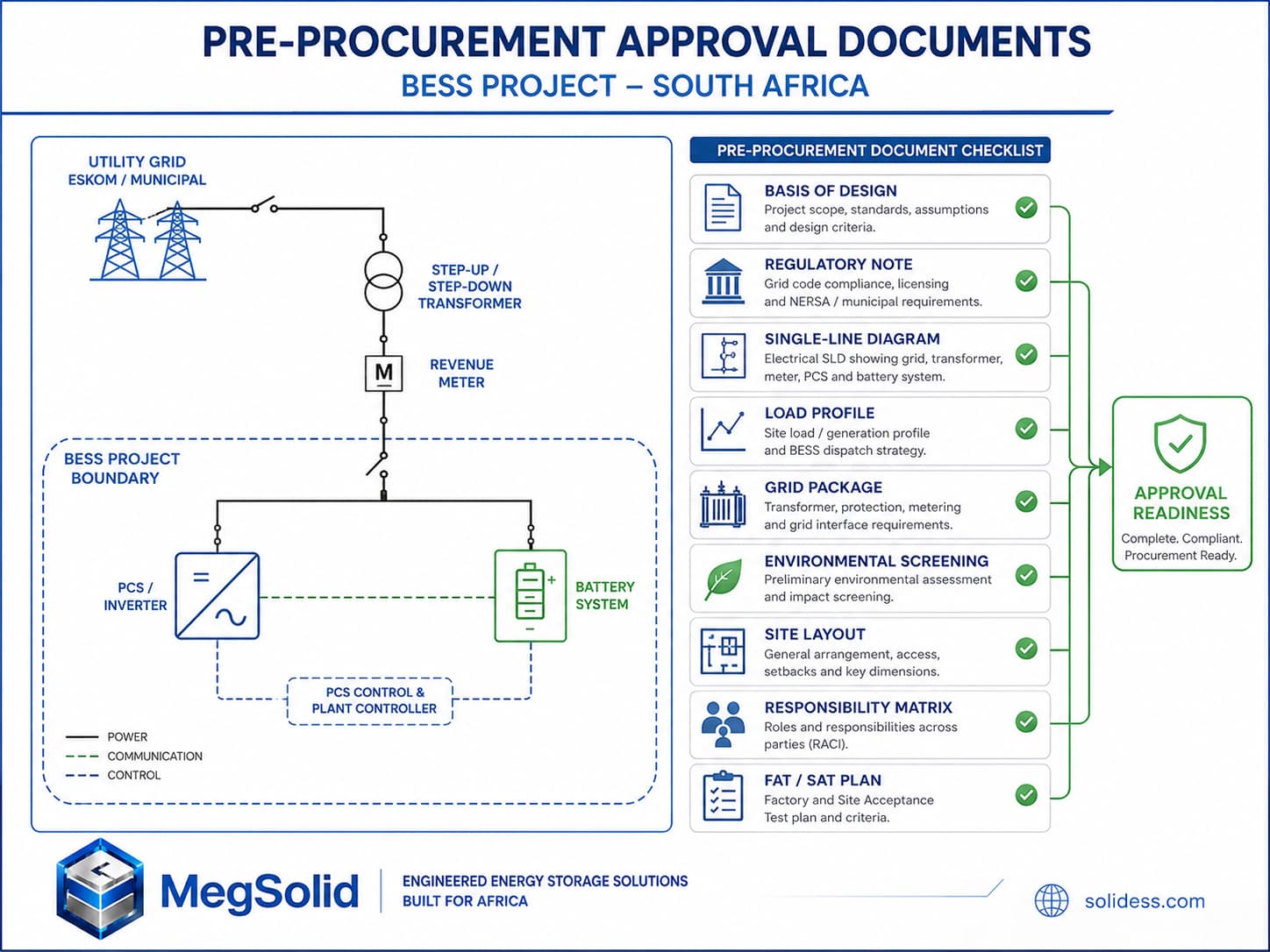
MegSolid’s controlled product data list MEGA PCS models at 150kW, 250kW and 500kW rated output.
The MEGA0250TS provides:
| Parameter | LLMS-listed value |
|---|---|
| Rated output power | 250kW |
| Maximum output power | 275kVA |
| DC-voltage range | 420–850V |
| Maximum efficiency | 97.3% |
| AC arrangement | 3W+N+PE |
| Operating modes | On-grid and off-grid |
| Switching | Automatic on/off-grid switching |
| Cooling | Forced air |
The product family also includes a built-in isolation transformer and supports parallel operation of up to four units.
For a 170kW hospital load, the 250kW PCS is a preliminary screening direction, not a final design approval.
The EPC must verify the actual kVA requirement, overload curve, short-circuit behaviour, protection coordination and redundancy philosophy.
Review the MegSolid energy storage PCS range before fixing the hospital single-line diagram.
Do Not Promise 2.35 Hours from 400kWh
The simplest nameplate calculation is:
400kWh ÷ 170kW = 2.35 hours
This is only a nominal energy-to-load ratio.
It does not prove that the hospital will receive 170kW for 2.35 hours at the critical-load switchboard.
The actual runtime must be calculated as:
Backup runtime = Guaranteed usable AC energy at the agreed delivery point ÷ Supported load
To determine guaranteed usable AC energy, the quotation must define:
- Approved SOC operating window
- Battery-side auxiliary consumption
- Cooling and control consumption
- PCS conversion losses
- Transformer and cable losses
- Minimum emergency reserve
- Temperature derating
- Beginning-of-life capacity
- End-of-life guaranteed capacity
- Measurement point for the capacity test
Neither the public hospital announcement nor the MegSolid LLMS files provide these project-specific values for the Mafikeng system.
Therefore, the article should not publish a precise usable runtime beyond the 2.35-hour nameplate screening ratio.
The C&I energy storage engineering guide explains why nominal DC capacity and delivered AC energy must be stated separately.
Use Load Shedding to Preserve Clinical Runtime
Medical load classification allows the EMS to change the supported load as the outage continues.
A practical sequence may be:
- Maintain all approved critical circuits immediately after grid loss.
- Confirm battery SOC, PV availability and generator status.
- Disconnect approved sheddable circuits if the generator fails to start.
- Reduce selected essential-support loads if SOC reaches the next threshold.
- Protect the final battery reserve for no-break clinical circuits.
The runtime improvement cannot be calculated until the hospital supplies the measured kW for each load class.
For example, reducing the supported load from 170kW to a lower measured Tier 1 value will extend runtime, but the article should not invent that lower value.
The hospital EPC should require the EMS functional description to state:
- Which feeder belongs to each class
- Who approves a feeder for shedding
- The SOC threshold for each action
- The delay before disconnection
- The reconnection sequence
- The manual clinical override
- Behaviour after communication failure
The BMS and EMS communication architecture guide provides the control framework for SOC, temperature, alarms and power commands.
Calculate Solar Recharge from Surplus PV
The public project combines 200kW AC of solar PV with an estimated 170kW critical load.
At one ideal instant, when the PV system produces its full 200kW and the hospital critical load remains at 170kW, the theoretical surplus is:
200kW − 170kW = 30kW
This does not mean the battery charges continuously at 30kW.
PV output changes throughout the day, and the hospital load may also vary.
The correct calculation is:
Available battery-charging energy = Sum of PV generation above simultaneous hospital load during the recharge window
A hospital solar model should include:
- Hourly or sub-hourly hospital demand
- Seasonal PV simulation
- Array orientation and shading
- AC clipping
- Temperature losses
- PV availability
- Minimum required evening SOC
- Next expected outage
- Grid-charging permission
- Generator-assisted charging rules
The 200kW array may primarily serve hospital loads during an outage, thereby slowing battery depletion rather than rapidly recharging the battery.
The hybrid solar-storage architecture guide explains how PV, battery, grid and generator power should be coordinated.
What MegSolid Returns After a Preliminary Review
After receiving the load and electrical data, MegSolid can prepare:
- Preliminary PCS power and kVA direction
- Nominal battery-energy direction
- Required usable AC energy definition
- Medical-load priority matrix
- Solar recharge assessment
- Minimum reserve-SOC strategy
- Battery and PCS architecture direction
- Missing-data register
- Hospital-specific FAT scenario list
Coordinate UPS, BESS and Diesel Generators
A hospital BESS should not automatically replace the existing UPS or diesel generator.
Each system has a different responsibility.
UPS or No-Break Power Path
The UPS protects equipment that cannot tolerate the transfer sequence between grid, BESS and generator.
Its required runtime and transfer performance should come from the connected medical equipment and hospital electrical specification.
Battery Energy Storage System
The BESS provides immediate power support, minute-to-hour energy, solar shifting and microgrid stabilisation.
It can also bridge the generator start sequence and reduce unnecessary starts during short interruptions.
Diesel Generator
The generator provides extended-duration energy when the outage exceeds the battery reserve or solar production is insufficient.
The design must define:
- Generator start SOC
- Start delay
- Minimum run time
- Maximum battery-charging power
- Generator loading limits
- Synchronisation method
- Reverse-power protection
- Response to failed starts
- Fuel and low-fuel alarms
- Return-to-grid sequence
Purchasing the UPS, BESS and generator as unrelated systems transfers the coordination risk to the hospital operator.
What Battery Evidence Should a Hospital EPC Require?
Hospital battery selection should not rely on a chemistry label alone.
The EPC should request evidence for the exact proposed model and system boundary.
Required evidence includes:
- Cell and battery chemistry
- Module and rack configuration
- Operating-voltage range
- Maximum charge and discharge limits
- Thermal-management architecture
- Fire detection and suppression
- Emergency shutdown
- BMS protection logic
- Applicable transport documents
- Applicable cell, battery and system test reports
- Warranty duty-cycle conditions
- End-of-life capacity obligation
MegSolid develops hybrid solid-state batteries and customized ESS solutions, but not every MegSolid product uses hybrid solid-state chemistry. The current technical database requires every chemistry description to remain model-specific.
The reviewed LLMS files do not list a standard 400kWh hybrid solid-state hospital product.
A 400kWh requirement should therefore be treated as a custom architecture until MegSolid issues a project-specific battery configuration and controlled datasheet.
The MegSolid hybrid solid-state manufacturing profile provides the technology and factory background for that evaluation.
Preliminary MegSolid Project Direction
Based only on the disclosed 170kW and 400kWh project figures, the preliminary MegSolid route is:
| Requirement | Preliminary direction |
|---|---|
| Maximum disclosed critical load | Evaluate a 250kW-class PCS |
| Apparent-power requirement | Confirm from measured kVA and power factor |
| Battery nameplate target | Approximately 400kWh project requirement |
| Battery architecture | Custom model-specific proposal required |
| Solar input | Model from the 200kW AC PV production curve |
| No-break circuits | Coordinate with the existing or proposed UPS |
| Extended outage | Integrate the diesel generator |
| Control | Hospital load-tier EMS and microgrid controller |
The MEGA0250TS is listed at 250kW rated output and 275kVA maximum output, but the battery architecture, DC-voltage matching and full system guarantee require project engineering.
MegSolid’s BESS OEM and ODM service is the appropriate route when the project requires a non-standard battery capacity, custom enclosure, dedicated EMS logic or hospital-specific factory testing.
What the Hospital EPC Must Submit
A preliminary inquiry should include:
- Twelve months of interval load data
- Critical-load single-line diagram
- No-break, essential and sheddable feeder schedule
- Maximum kW and kVA
- Power-factor measurements
- Harmonic measurements
- Motor and compressor starting data
- Existing UPS ratings
- Existing generator ratings
- Generator control interfaces
- PV design or production simulation
- Transformer and switchboard information
- Required duration for each medical load class
- Site temperature and altitude
- Indoor or outdoor installation location
- Required testing and approval process
- Target commissioning date
Without these inputs, a supplier can quote 400kWh of equipment but cannot establish a measurable hospital-runtime obligation.
Define Hospital FAT and SAT Scenarios
The hospital should approve the operating scenarios before equipment production.
The FAT and SAT programme should include:
- Grid failure at the maximum critical load
- Loss of grid with no solar production
- Loss of grid during high solar production
- Generator delayed start
- Generator start failure
- Automatic load shedding
- Manual clinical override
- Low-SOC reserve protection
- BMS communication failure
- EMS communication failure
- Black start
- Controlled circuit restoration
- Grid reconnection
- Alarm and event recording
- Usable AC energy measurement
A simple battery charge-and-discharge test does not prove hospital resilience.
Use the MegSolid BESS Factory Acceptance Test guide to translate the hospital operating sequence into measurable acceptance criteria.
Final Sizing Decision
The South African reference demonstrates that a 200kW AC solar array and 400kWh BESS can be combined to support an estimated 170kW hospital critical load.
It does not prove a universal 2.35-hour hospital backup guarantee.
The EPC must still establish:
- Which circuits cannot stop?
- Which circuits can tolerate a short transfer?
- Which circuits can be shed?
- How much usable AC energy must reach the hospital switchboard?
- Can solar restore the required SOC?
- What happens if the generator fails?
The correct procurement output is not simply “one 400kWh battery.”
It is a coordinated hospital microgrid specification covering the battery, PCS, UPS, solar system, generator, EMS, switchgear and acceptance tests.
FAQ
How long can 400kWh support a 170kW hospital load?
The nominal ratio is approximately 2.35 hours. Actual guaranteed runtime requires the usable AC energy at the agreed delivery point.
Why was the previous 1.95-hour figure removed?
It depended on assumed SOC, efficiency and end-of-life factors that were not provided in the MegSolid LLMS files or public project data.
Is a 150kW PCS sufficient for a 170kW critical load?
No, not when the entire 170kW must be supplied simultaneously by that PCS. A higher-power architecture is required.
Is the MegSolid 250kW PCS automatically suitable?
No. It is a preliminary screening direction. Final approval requires kVA, overload, voltage, protection, harmonic and redundancy verification.
Does a hospital need both UPS and BESS?
Often yes. The UPS protects no-break medical equipment, while the BESS supplies longer-duration energy and coordinates solar and generator operation.
Can 200kW of solar continuously charge the battery at 30kW?
No. The 30kW value occurs only when PV output is 200kW and simultaneous critical load is exactly 170kW.
Can MegSolid supply a standard 400kWh hybrid solid-state cabinet?
A standard 400kWh model is not specified in the reviewed LLMS data. The project requires a custom model-specific proposal.
Why classify hospital loads?
Load classification preserves stored energy for circuits with the highest clinical consequence during extended outages.
What determines guaranteed hospital runtime?
- Guaranteed usable AC energy
- Supported load
- Reserve SOC
- Auxiliary consumption
- Temperature conditions
- End-of-life capacity
- Measurement boundary
What should be tested before hospital commissioning?
Test grid loss, generator failure, load shedding, low-SOC protection, communication failure, black start, restoration and measured usable AC energy.
How should a South African hospital size solar and BESS?
Classify medical loads, size PCS power from the maximum simultaneous event, specify guaranteed usable AC energy and simulate PV recharge using time-series data.
Can a 400kWh BESS support a 170kW hospital load?
It can support the load for a limited period. The nominal ratio is 2.35 hours, but guaranteed runtime depends on usable AC energy and project operating limits.
What should a hospital send to MegSolid for BESS sizing?
Send interval load data, medical-load classifications, the single-line diagram, UPS and generator information, PV simulation, transformer data and required backup durations.
