
Irish data centre BESS sizing starts with MIC, the current CRM de-rating factor and the contracted storage duration. Divide the required de-rated capacity by the applicable CRM factor to calculate installed MW. Then calculate MWh from the usable SOC window and discharge losses, and verify the recharge limit and EirGrid fault ride-through requirements.
A data centre developer in Ireland can no longer treat battery storage as an optional sustainability feature added after the grid connection is designed.
For new projects covered by Ireland’s updated connection policy, dispatchable generation and/or storage forms part of the connection strategy itself.
The procurement problem is not simply:
How many megawatt-hours of batteries should the data centre install?
The project must first establish:
- Which Maximum Import Capacity category applies
- How much capacity remains after technology-specific de-rating
- Whether the BESS is onsite or proximate
- How it will participate in the Single Electricity Market
- How long the storage must sustain its contracted duty
- Whether recharging creates another local grid constraint
- How the BESS interacts with the UPS and standby generators
- How storage delivery follows the data centre’s phased load growth
The MegSolid equipment configuration should only be selected after these regulatory and operating boundaries have been converted into installed MW, required MWh and an approved connection architecture.
Why Ireland’s New Connection Policy Changes BESS Procurement
The Commission for Regulation of Utilities published its final Large Energy Users connection-policy decision on 12 December 2025.
The policy requires new data centres to provide generation and/or storage, onsite or locally proximate, to match the requested maximum import demand. The associated asset must participate in the wholesale electricity market. Projects must also meet at least 80% of annual electricity demand with additional renewable generation located in the Republic of Ireland, subject to a six-year glide path. See the CRU data centre connection-policy decision.
EirGrid implemented the decision through DCCOPP Version 3 on 20 May 2026. A qualifying application now connects three related workstreams:
- The data centre demand application.
- The Nominated Generation or storage application.
- The Nominated Renewables application.
The demand project cannot be assessed as an isolated building load while the nominated energy assets remain undefined.
Determine Which MIC Category Applies
Maximum Import Capacity, or MIC, is the maximum capacity the customer proposes to draw from the electricity system.
It is a connection value, not the data centre’s average IT load and not necessarily the same as its generator or BESS MW rating.
| Requested MIC | Current EirGrid Requirement |
|---|---|
| Below 1MVA | DCCOPP Version 3 does not apply, but locational constraints may still be assessed |
| 1MVA to below 10MVA | Autoproducer unit sufficient to cover MIC after de-rating |
| 10MVA or above | New, separately connected dispatchable onsite or proximate generation and/or storage sufficient to cover MIC after de-rating |
For 1MVA to below 10MVA, the autoproducer must participate in the Single Electricity Market and remain operational for the connection duration.
For projects at or above 10MVA, the nominated asset must be separately connected and metered, participate in the SEM as a standalone market unit and remain available throughout the connection period.
The network application route also matters. EirGrid directs facilities below 20MVA at one location to ESB Networks, while applications of 20MVA or above are normally submitted to EirGrid. This routing threshold should not be confused with the 1MVA and 10MVA policy categories. See the EirGrid demand-connections page.

What Does Matching 100% of MIC Mean?
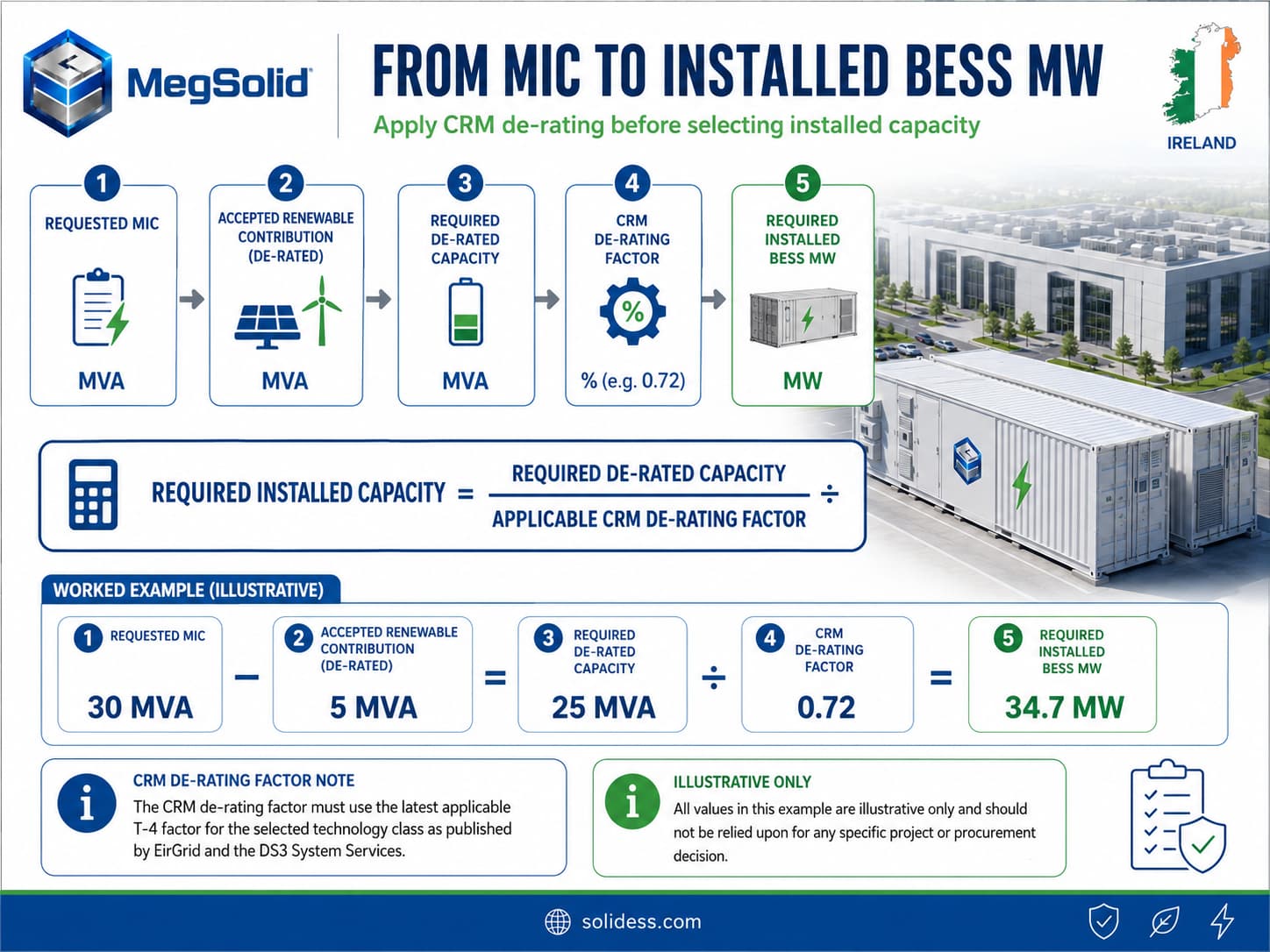
The requirement is based on de-rated capacity, not equipment nameplate capacity.
A project with a 30MVA MIC cannot order a 30MW BESS and assume compliance.
EirGrid requires:
De-rated Nominated Capacity ≥ Ramped or Enduring MIC
The installed capacity must therefore be calculated using the current Capacity Remuneration Mechanism de-rating factor for the selected technology class.
EirGrid provides an indicative example in which a 30MVA data centre requires approximately 34.8MW of dispatchable generation before renewable contribution is recognised. That example illustrates the effect of de-rating, but it is not a universal battery-storage ratio. A BESS must use the prevailing factor applicable to its storage class and duration.
Apply CRM De-Rating Before Selecting Installed MW
The preliminary compliance equation is:
Required Installed Capacity = Required De-rated Capacity ÷ Applicable CRM De-rating Factor
Where:
- Required De-rated Capacity is the MIC not already offset by an accepted de-rated renewable contribution.
- CRM De-rating Factor is the current factor for the proposed generation or storage technology.
- Installed Capacity is the nameplate MW required before equipment redundancy and project margin.
The applicable factor must come from the latest relevant SEM Capacity Market T-4 auction information. It should not be copied from an old project, another battery duration or a gas-generation example.
EirGrid states that storage used to support a data centre must be sized using the most recent technology-specific T-4 de-rating factors. It may also reassess capacity where actual unit availability persistently underperforms the applicable technology benchmark.
The RFQ should therefore state:
- Requested MIC
- Ramped MIC by phase
- Required de-rated contribution
- Proposed storage-duration class
- Applicable CRM factor and source
- Installed PCS MW
- Redundancy arrangement
- Expected availability
- Maintenance strategy
CRU Policy Does Not Define One Universal Battery Duration
Matching MIC determines the required capacity contribution. It does not by itself define how many hours the battery must discharge.
Battery duration depends on:
- CRM qualification requirements
- SEM dispatch obligations
- Required availability period
- State-of-charge recovery rules
- Project emergency reserve
- Local connection constraints
- Storage degradation
- Whether another dispatchable source shares the obligation
Consider an illustrative project whose approved operating study requires 10MW of sustained battery discharge.
| Required Duration | AC Energy Delivered |
|---|---|
| 1 hour | 10MWh |
| 2 hours | 20MWh |
| 4 hours | 40MWh |
Using an illustrative 80% usable SOC window and 90% discharge-path factor:
| Required Duration | Preliminary Nominal Capacity |
|---|---|
| 1 hour | 13.9MWh |
| 2 hours | 27.8MWh |
| 4 hours | 55.6MWh |
These figures explain the electrical relationship. They are not CRU-mandated storage durations.
Separate Grid-Compliance BESS From UPS Backup
A data centre normally contains several distinct power responsibilities.
| System | Primary Responsibility |
|---|---|
| IT UPS | No-break continuity for defined critical loads |
| Standby generators | Longer-duration site resilience |
| Nominated BESS | Grid-visible dispatchable capacity and market participation |
| Renewable assets | Annual renewable-energy obligation |
| Campus EMS | Coordination of import, export, reserve and recharge |
| BMS | Battery safety, SOC, SOH and operating limits |
A grid-compliance BESS should not automatically replace the existing UPS.
UPS architecture is selected from allowable interruption, redundancy level, IT topology and battery autonomy. The nominated storage asset is selected from MIC, market availability, de-rating and dispatch requirements.
The same physical battery might support both roles only where the switchgear, market rules, reserve policy and failure analysis prove that neither responsibility compromises the other.
Review the data centre UPS and critical-power engineering guide before combining the two functions.
Check Whether BESS Recharging Creates a New Grid Constraint
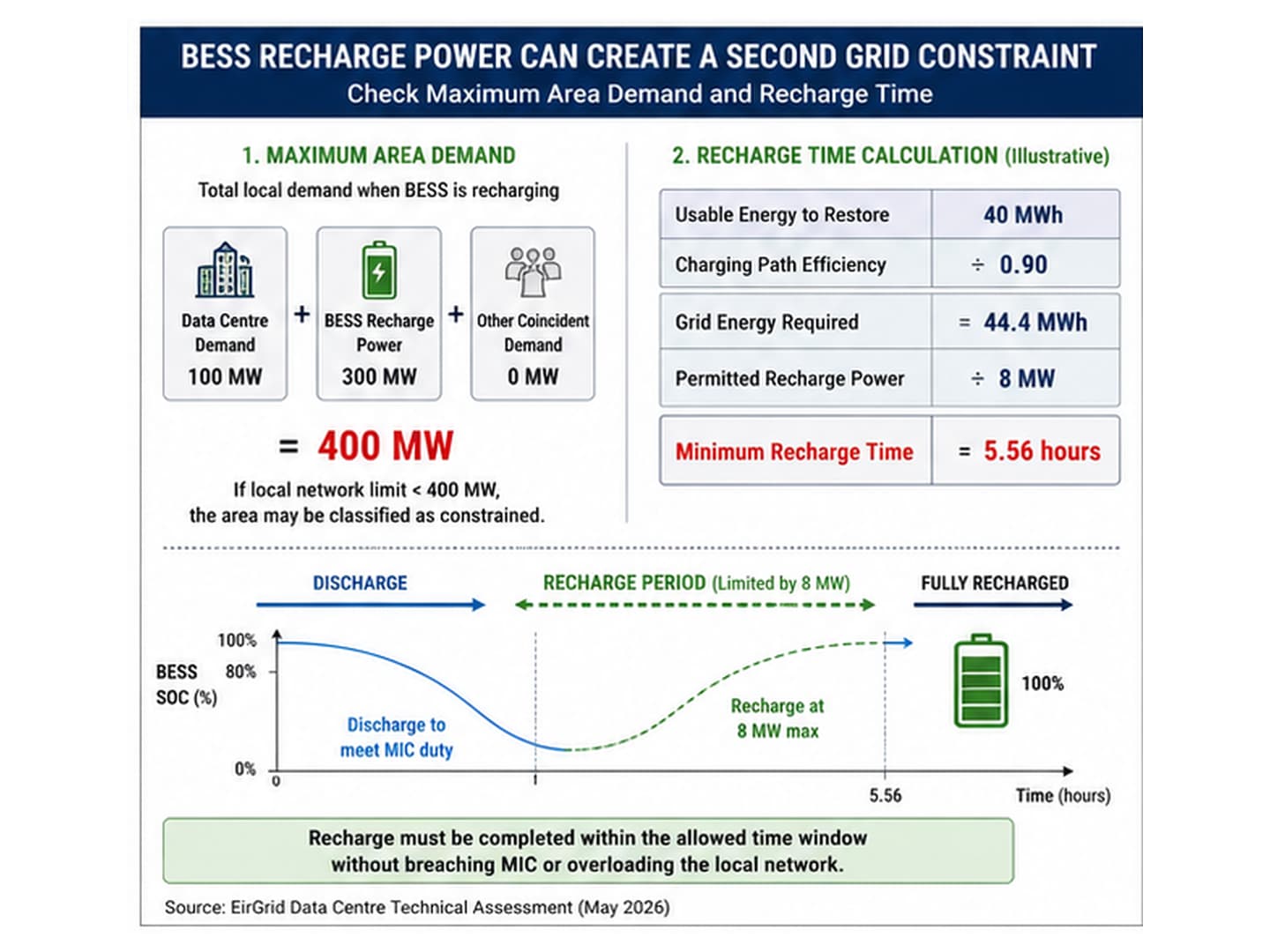
A large BESS can reduce an adequacy problem during discharge and create a network problem during recharge.
EirGrid’s technical assessment provides a direct example: if a 100MW data centre uses a 300MW storage facility, total local demand could reach 400MW when the data centre remains operational while the storage recharges. If that condition overloads equipment, the project may be classified as being in a constrained area. See the EirGrid Data Centre Technical Assessment.
The project must calculate:
Maximum Area Demand = Data Centre Demand + BESS Recharge Power + Other Coincident Demand
It must also determine:
Recharge Time = Energy Required From the Grid ÷ Permitted Recharge Power
Assume a BESS must restore 40MWh of usable energy.
With a 90% charging-path factor:
Grid Energy Required = 40MWh ÷ 0.90 = 44.4MWh
If the connection study permits only 8MW of recharge power:
Minimum Recharge Time = 44.4MWh ÷ 8MW = 5.56 hours
A four-hour recovery window would therefore be insufficient, regardless of battery nameplate capacity.
Align Storage Delivery With the Campus Ramp-Up Plan
Data centre campuses are normally energised in phases.
The nominated capacity must arrive with the corresponding MIC. EirGrid states that the data centre cannot become operational or ramp beyond the level supported by delivered de-rated capacity.
| Campus Phase | Illustrative IT Load | Illustrative MIC | Storage Procurement Action |
|---|---|---|---|
| Phase 1 | 8MW | 10MVA | Install initial PCS and battery blocks |
| Phase 2 | 16MW | 20MVA | Add parallel PCS and energy containers |
| Phase 3 | 25MW | 30MVA | Complete medium-voltage pooled system |
A phased architecture can prevent unused capacity from sitting idle during early construction.
However, the first-phase design must reserve:
- Medium-voltage switchgear bays
- Transformer capacity
- Cable routes
- EMS communication points
- Fire separation
- Auxiliary power
- Future container foundations
- Protection settings for later blocks
The comparison between distributed cabinets and centralised systems is covered in the modular cabinets versus containerized ESS guide.
Onsite vs. Proximate Storage
For larger projects, the nominated generation or storage may be onsite or proximate.
The decision affects more than land availability.
| Issue | Onsite BESS | Proximate BESS |
|---|---|---|
| Electrical boundary | Within or adjacent to campus | Separate energy site |
| Land requirement | Competes with data halls and utilities | Requires separate site control |
| Cable and network dependency | Shorter internal connection | Depends on external grid path |
| Metering | Separate metering still required | Separate market and connection interfaces |
| Fire and access control | Integrated with campus planning | Separate emergency-response plan |
| Market participation | Standalone unit | Standalone unit |
| Delivery programme | Linked to campus construction | Linked to generation connection process |
EirGrid requires the nominated asset to be separately connected and metered from the data centre connection, with mandatory SEM participation for projects at or above 10MVA.
Market Participation and Emergency SOC Cannot Share Unlimited Energy
A battery assigned to SEM dispatch cannot simultaneously promise that its entire capacity remains reserved for a data centre outage.
The operating specification should define separate energy responsibilities:
| SOC Responsibility | Purpose |
|---|---|
| Market operating window | SEM and capacity obligations |
| Grid-support reserve | Approved system response |
| Data centre emergency reserve | Project-specific resilience duty |
| Degradation margin | Capacity fade across the contract period |
| Maintenance and fault margin | Unplanned module or PCS unavailability |
Percentages should not be inserted into the article or RFQ until the market duty and resilience study are complete.
The control philosophy should be documented through the BMS and EMS communication architecture, including:
- Market dispatch command
- MIC and import-limit measurement
- BESS SOC availability
- UPS and generator status
- Data centre load forecast
- Recharge power limit
- Communications timeout
- Fallback operating mode
- Emergency reserve override
Ireland Data Centre BESS Sizing Example
Assume a new campus has:
| Input | Illustrative Value |
|---|---|
| Phase 1 MIC | 10MVA |
| Phase 2 MIC | 20MVA |
| Phase 3 MIC | 30MVA |
| Project-selected dispatch duration | 2 hours |
| Usable SOC window | 80% |
| Discharge-path factor | 90% |
| Maximum permitted recharge power | 10MW |
The project must first obtain the current storage de-rating factor and calculate the installed MW needed at each phase.
Assume the final approved study ultimately specifies 30MW of installed discharge capability for illustration.
Required AC Energy = 30MW × 2h = 60MWh
Preliminary Nominal Capacity = 60MWh ÷ 0.80 ÷ 0.90 ≈ 83.3MWh
To restore 60MWh usable energy with a 90% charging-path factor:
Required Grid Energy = 60MWh ÷ 0.90 ≈ 66.7MWh
At a 10MW recharge limit:
Recharge Time ≈ 6.67 hours
The project is not design-ready until the operating model confirms that such a recovery window is available without breaching MIC or creating a constrained-area condition.
EirGrid Fault Ride-Through Requirements and Dynamic Models
Under EirGrid fault ride-through requirements, project models must show how the data centre, UPS, generators and BESS respond to voltage and frequency disturbances.
During transmission faults, data centres may rapidly reduce grid consumption and move to temporary backup supplies. The resulting sudden demand change can affect system stability. EirGrid therefore requires dynamic models showing how the facility responds to voltage and frequency disturbances, together with normal operating profiles and details of proposed mitigation equipment.
The study must define how the BESS behaves during:
- Voltage dips
- Frequency excursions
- UPS transfer
- Generator startup
- Sudden IT load rejection
- Load restoration
- BESS charge recovery
- Loss of EMS communication
- Loss of a PCS block
Grid-forming or grid-following operation should be selected from the approved system study, not used as a general marketing claim.
Preliminary MegSolid Product Direction
| Verified Project Requirement | Preliminary MegSolid Direction |
|---|---|
| Custom 30–500kW PCS blocks | MEGA PCS |
| 500kW/approximately 1MWh block | ESSC 500kW/1.0752MWh |
| 1MW/approximately 2MWh block | ESSC 1MW/2.1504MWh |
| 2.7MW/approximately 5MWh block | 5000INTL |
| 10–30MW campus | Multiple containerized blocks with central EMS |
| 50MWh-plus requirement | Phased medium-voltage pooled architecture |
The MEGA energy storage PCS range covers 30–500kW models with built-in isolation transformers. Its IP21 enclosure requires installation inside an appropriate room or container.
The ESSC containerized energy storage system includes 500kW/1.0752MWh and 1MW/2.1504MWh air-cooled LFP configurations.
The 5000INTL containerized BESS is rated at 2.7MW/5.0159MWh and uses liquid cooling. The current public product data does not explicitly classify its battery chemistry, so the model must not be described as LFP or hybrid solid-state without a controlled project document.
These blocks are product directions, not confirmation of Irish policy compliance. The final design must verify:
- Required CRM de-rated capacity
- SEM registration architecture
- Medium-voltage connection
- PCS parallel operation
- Grid Code compliance
- Dynamic models
- Recharge limits
- Availability guarantee
- Planning and fire requirements
Application Data Required by EirGrid
For a data centre planning application or grid connection request, DCCOPP Version 3 requires the project team to provide the requested MIC, energisation timeline, ramping details, dynamic models, fault ride-through information, and nominated generation and renewable details.
A BESS supplier should receive at least:
- Data centre location and proposed network connection.
- Initial, ramped and enduring MIC.
- Initial and final IT load.
- PUE assumptions and facility auxiliary load.
- Energisation and ramp-up programme.
- Applicable CRM de-rating factor.
- Required storage operating duration.
- SEM and capacity-market responsibilities.
- UPS and standby-generator architecture.
- Emergency SOC requirement.
- Maximum BESS recharge power.
- Single-line diagram and dynamic-model requirements.
- Nominated Generation and Nominated Renewables plan
- Planning, fire and commissioning requirements.
Data Required to Match BESS With the Requested MIC
Send the phased MIC, data centre load, required storage duty, permitted recharge power and electrical single-line diagram.
The returned configuration should identify:
- Installed PCS MW
- Nominal and usable MWh
- Number of battery containers
- Medium-voltage transformer arrangement
- Redundancy philosophy
- EMS responsibility matrix
- Recharge and reserve-SOC logic
- Missing application information
- FAT and SAT scope
FAT and SAT for an Irish Data Centre BESS
A standard battery charge-discharge demonstration is insufficient.
The FAT should verify:
- Active and reactive power commands
- Maximum discharge capability
- Maximum grid-charging power
- MIC control
- SOC partitioning
- PCS-block failure
- Dispatch-command response
- Meter and communications failure
- Generator and UPS status exchange
- Controlled load rejection
- Restricted recharge
- Alarm and event recording
- Emergency shutdown
The SAT should verify the complete connection boundary, including the point-of-connection meter, medium-voltage switchgear, transformer, EMS, SCADA, UPS, generators and data centre power-management system.
Use the BESS Factory Acceptance Testing guide to convert the approved operating sequence into witnessed pass/fail criteria.
Safety documents should be checked through the UL 9540A and IEC 62619 compliance guide. Product-level certificates do not replace Irish planning, electrical and fire approval for the complete installation.
Final Procurement Decision
An Irish data centre BESS should not be purchased from MIC alone.
The project must prove:
- The correct MIC category has been identified.
- Installed MW reflects the current technology-specific CRM de-rating factor.
- Battery duration matches the contracted operating duty.
- Recharging does not create a second grid constraint.
- Nominated storage is delivered with the corresponding data centre ramp.
- SEM dispatch and emergency SOC responsibilities do not conflict.
- UPS, generators and grid-compliance storage have clear boundaries.
- Dynamic models represent the actual facility response.
- The equipment configuration passes project-specific FAT and SAT.
- The current CRU and EirGrid documents have been rechecked before application.
FAQ
Q1: Does an Irish data centre need BESS equal to its MIC?
It needs sufficient de-rated generation and/or storage capacity to cover the applicable MIC. Installed BESS MW may therefore exceed MIC, depending on the current CRM de-rating factor.
Q2: Does the CRU policy require a two-hour battery?
No. The policy establishes a de-rated capacity requirement but does not impose one universal storage duration for every project.
Q3: Can existing UPS batteries count as Nominated Generation?
They should not be assumed to qualify. The nominated asset must satisfy connection, metering, market, additionality, availability and de-rating requirements.
Q4: Can the BESS be located away from the data centre?
The policy allows dispatchable generation or storage to be onsite or locally proximate, subject to the connection and application requirements.
Q5: Must the BESS participate in the SEM?
For the applicable categories, the nominated asset must participate in the Single Electricity Market under the stated connection structure.
Q6: Can renewable generation reduce the dispatchable requirement?
An accepted renewable contribution may be credited on a de-rated basis, up to the policy limit. Annual renewable compliance and capacity contribution are separate calculations.
Q7: Why is recharge power part of the connection assessment?
The battery may add substantial demand while recharging, potentially overloading local equipment or creating a constrained-area condition.
Q8: Can one BESS provide market services and emergency backup?
Potentially, but the project must reserve sufficient SOC and prove that market dispatch cannot compromise the approved emergency duty.
Q9: Should the complete campus BESS be installed during Phase 1?
Not necessarily. Storage can be phased with MIC growth, provided the electrical and civil infrastructure allows later expansion.
Q10: What is needed for a firm MegSolid configuration?
Provide phased MIC, applicable de-rating factor, required duration, recharge limit, UPS and generator architecture, single-line diagram and commissioning programme.
Q11: How do you size BESS for an Irish data centre?
Calculate installed MW from MIC and the current CRM de-rating factor, then calculate MWh from the required dispatch duration, SOC window, losses and recharge constraints.
Q12: What are Ireland’s new data centre storage requirements?
Qualifying new data centres must provide dispatchable onsite or proximate generation and/or storage sufficient to cover MIC after de-rating, together with additional renewable-energy commitments.
Q13: Can BESS help a Dublin data centre obtain a grid connection?
It can form part of the required nominated capacity, but the project must also pass locational, system-stability, renewable, market and connection assessments.