 Skip to content
On a Saudi coastal site, corrosion can cut reliability long before the battery hits its energy-retention limit. Salt air from the Red Sea or the Gulf, wind-driven rain, sticky humidity and overnight condensation hit the weak points first: cabinet seams, door hardware, cable glands, fasteners, cooling coils, fans and terminations.
For a port yard, coastal factory, fish plant or island industrial pad, select MegSolid the other way around. Fix the exposure — corrosivity, moisture, salt deposition — first. Then choose enclosure, cooling architecture, interfaces, inspection and acceptance evidence.
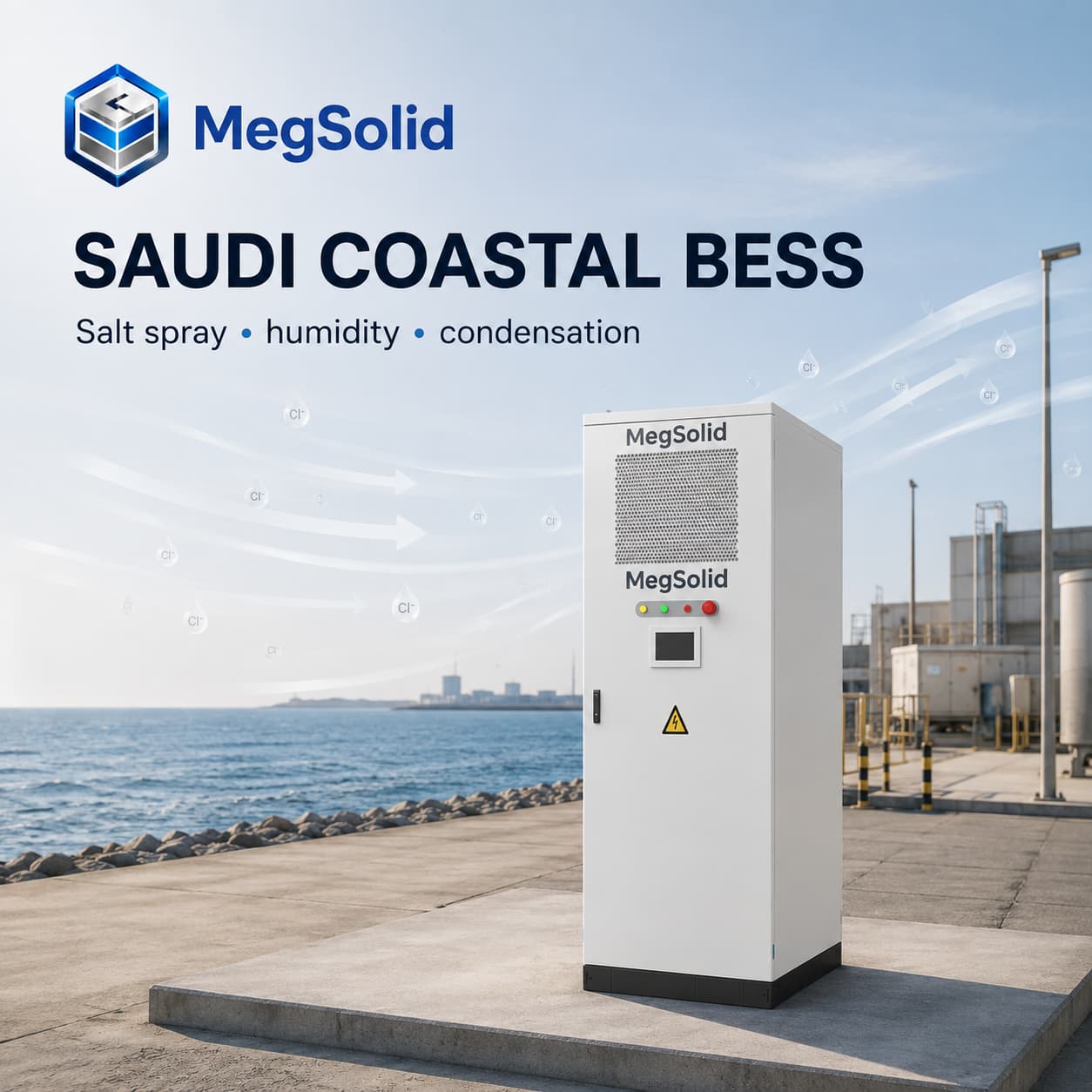
MegSolid offers two C&I cabinet routes for different duty conditions:
| Decision keyword | What the buyer must establish | Initial MegSolid direction |
|---|---|---|
0–45°C controlled installation | Intake air stays inside the verified operating range, with disciplined filter and cabinet maintenance | ESSA0100B-0215 100kW / 215.04kWh intelligent air-cooled cabinet |
| Liquid cooling | The project needs the 125kVA class, a wider listed temperature range or a thermal architecture with no battery-air-intake dependence | Energon 261.24kWh liquid-cooled C&I system |
| Coastal corrosion class | Chloride deposition, time of wetness, wind-driven spray, condensation and distance/exposure path from shore | Project-specific corrosion schedule and supplier evidence |
| Salt-mist proof | Exact test method, test severity, sample, pass/fail criteria and component scope | Request controlled reports before technical award |
| Long-term availability | Inspection responsibility, spare-parts path, coating repair method and evidence retention | Include in the O&M and warranty schedules |
This article sets public market claims next to MegSolid’s verified product boundary. IP54 is ingress information. Marine-corrosion suitability needs its own evidence package for the exact coastal exposure.
Coastal BESS Corrosion Is an Electrical Reliability Issue
The coastal PV-and-storage design framework from pv magazine treats corrosion as a front-end electrical design variable, not a late O&M surprise. It puts chloride, humidity, wind-driven rain and UV in the same stress set, and points to ISO 9223 categories where many tropical coastal sites reach C5, and coastal or offshore spots with occasional salt spray can reach CX. Read the framework.
For a BESS the chain is practical:
- Salt holds moisture on a surface or in a crevice.
- Coatings, gaskets, hardware, connectors or heat-exchanger surfaces start to go.
- Contact resistance rises, airflow drops, water finds a path, or controls go intermittent.
- Thermal management or power electronics derate, alarm or need replacement.
- The owner pays in lost availability, extra maintenance and a messy warranty file.
A coastal package needs more than the word outdoor or a single IP rating.
What Public Competitor Claims Show — and the Evidence Your Site Still Requires
Several suppliers already market desert, coastal or salt-laden builds. Their public claims show the evidence level a coastal buyer should demand. A fair ranking only works when enclosure material, salt-test method, severity, component scope, cooling architecture and site exposure are matched.
| Public market claim | What it usefully demonstrates | Procurement question that remains |
|---|---|---|
| HighJoule describes a coastal container with a positive-pressure system, chemical filtration, NEMA 4X construction and a salt-spray test claim exceeding 1,000 hours. Its case article is supplier-authored. | Coastal projects can require protection beyond a painted enclosure. | Which components were tested, under which method, what condition remained acceptable, and is that exact build offered on this project? |
| CLOU states that its desert-customized system targets 55°C operation, sealed critical components and customized sand-and-dust protection. Its KSA release describes this as a specific solution. | Major suppliers are publishing environmental adaptation as a system-level requirement. | What is the project-specific corrosion category, coastal humidity limit, salt-mist record and maintenance scope? |
| The Tabuk and Hail project report describes sealed units and automated dust alerts for a large containerized system. Project coverage. | Desert dust control and coastal chloride control require different evidence, even when both sites are harsh. | Does the offered C&I cabinet have a documented salt-and-condensation construction scope? |
| Coastal design guidance recommends coordinated material and hardware choices, including enclosure, conductor, raceway and fastener compatibility. pv magazine analysis. | The durability requirement covers the full exposed assembly. | How are field-installed glands, cable lugs, base frames, fasteners and repairs controlled? |
The right comparison is evidence versus project exposure. A brand-versus-brand table that ignores the installed environment is incomplete.
Why Choose MegSolid for a Coastal Industrial BESS Project
MegSolid’s value here starts with a clear product boundary and a process that forces the environmental scope into the technical schedule before the purchase order goes out.
1. A Real Choice Between Air-Cooled and Liquid-Cooled C&I Platforms
The ESSA0100B-0215 is a 100kW AC, 215.04kWh LFP outdoor cabinet with intelligent air cooling, IP54 protection and a verified public operating-temperature range of 0–45°C.
The Energon liquid-cooled system is a 261.24kWh, 125kVA C&I platform using 314Ah LFP cells. Its public boundary lists liquid cooling, IP54 and an operating range of -20–55°C, with derating above 45°C. Its stated maximum system efficiency is 90%; this value is a maximum system-efficiency field and must remain separate from a round-trip-efficiency guarantee.
On a coastal site, liquid cooling can cut the battery enclosure’s need for outside intake air. It still needs a corrosion plan for external heat rejection, pumps, seals, connectors, service access and the rest of the installed electrical plant.
2. An Honest Boundary Is More Valuable Than an Unsupported Marine Claim
MegSolid’s public C&I pages list IP54 for both cabinet platforms. IP54 covers dust and water ingress under the stated test. Full coastal approval still needs coating specification, salt-mist report, C5/CX exposure assessment and evidence for cable hardware and field interfaces.
That split protects the buyer. Name the exact project option, drawing revision, component scope and test documents before the contract treats a cabinet as fit for a defined coastal environment.
3. Cabinet Expansion Can Be Planned Without Guessing the Electrical Boundary
The Energon 261.24kWh platform allows parallel operation of up to ten cabinets in its published specification — a clear starting point for phased C&I capacity.
The coastal design still has to document inter-cabinet cable routes, gland materials, exposed supports, grounding and bonding, drainage, pad elevation and repair access. Parallel capacity covers expansion. Those details set the environmental interface.
4. The Acceptance Package Can Protect the Owner Before Shipment
MegSolid’s BESS factory acceptance testing guide can structure model identity, electrical protection, communications, alarms and control checks. Coastal suitability adds its own set: corrosion category, coating system, salt-mist evidence, materials list, installation details and inspection criteria.
That gives the owner a usable trail from bid review through commissioning, maintenance and later warranty review.
ESSA Air Cooling vs Energon Liquid Cooling for Coastal Exposure
| Selection factor | ESSA0100B-0215 intelligent air-cooled | Energon 261.24kWh liquid-cooled | Buyer action |
|---|---|---|---|
| Rated electrical platform | 100kW AC / 215.04kWh | 125kVA / 261.24kWh | Confirm required kW, kVA, power factor and duration. |
| Battery chemistry | LFP | 314Ah LFP | Keep chemistry claims model-specific. |
| Public cooling description | Intelligent air cooling | Liquid cooling | Match cooling architecture to the site environmental boundary. |
| Public temperature boundary | 0–45°C | -20–55°C; derating above 45°C | Add the project intake-temperature and output requirement to the datasheet. |
| Public enclosure field | IP54 | IP54 | Treat IP54 as ingress information; add corrosion evidence separately. |
| Coastal design emphasis | Filter loading, air path, fan/coil condition and cabinet housekeeping | External heat-rejection corrosion, coolant-loop service boundaries, seals and electrical interfaces | Define inspection points and the responsible party. |
| Suitable starting condition | A controlled outdoor installation whose verified intake temperature stays within 0–45°C | A 125kVA-class C&I project requiring liquid cooling and a wider listed temperature boundary | Complete a coastal corrosion review before selection is fixed. |
Use the commercial 215kWh versus 261kWh comparison for electrical and thermal selection. Pair it with the site corrosion schedule for a full marine-environment review.
IEC 60068-2-52 and ISO 9223: How to Use Them Correctly in a BESS Tender
IEC 60068-2-52 is a cyclic salt-mist method for components or equipment in salt-laden air. It is meant to assess degradation of metallic and non-metallic materials. IEC 60068-2-52:2017 names the method; coastal suitability still depends on severity, tested scope, pass/fail criteria and actual site exposure.
ISO 9223 classifies atmospheric corrosivity. Build the design basis with local facts: distance to sea, elevation, prevailing wind, salt deposition, time of wetness, rain washing, temperature cycle and industrial pollutants.
Some owner specs still say C5-M. State the governing standard edition and category explicitly. ISO 9223:2012 (confirmed 2022) runs from C1 to CX; the chosen category still needs local exposure evidence. ISO 9223:2012 lists temperature-humidity, SO₂ and airborne salinity among the classification factors.
Put these items in the bid schedule:
| Requirement | What the supplier must submit |
|---|---|
| Site exposure statement | Coastal distance and direction, salt-spray path, humidity/condensation profile, pollutant sources and expected service life. |
| Corrosion classification | Project corrosion category and the assessment basis; generic regional descriptions are insufficient. |
| Cabinet construction | Enclosure material, coating system, dry-film-thickness target where applicable, edge treatment, weld protection and repair method. |
| Salt-mist evidence | Applicable standard edition, method/severity, test duration/cycles, sample identity, pass/fail conditions, laboratory and report date. |
| Component scope | Fans, heat exchangers, cable glands, connectors, hinges, fasteners, base frames, terminals, external panels and service doors. |
| Condensation controls | Gasket interfaces, drainage, pressure equalization where supplied, humidity control logic and evidence for external-to-internal moisture paths. |
| Cooling scope | Corrosion protection for coils/fins and the air or liquid paths, filter strategy, replacement triggers and access method. |
| Field interfaces | Cable and conduit material, lug and fastener compatibility, bonding points, supports, foundation drainage and touch-up procedure. |
| Acceptance and O&M | Factory records, delivery inspection, site acceptance criteria, inspection intervals, photographs, spares and repair responsibility. |
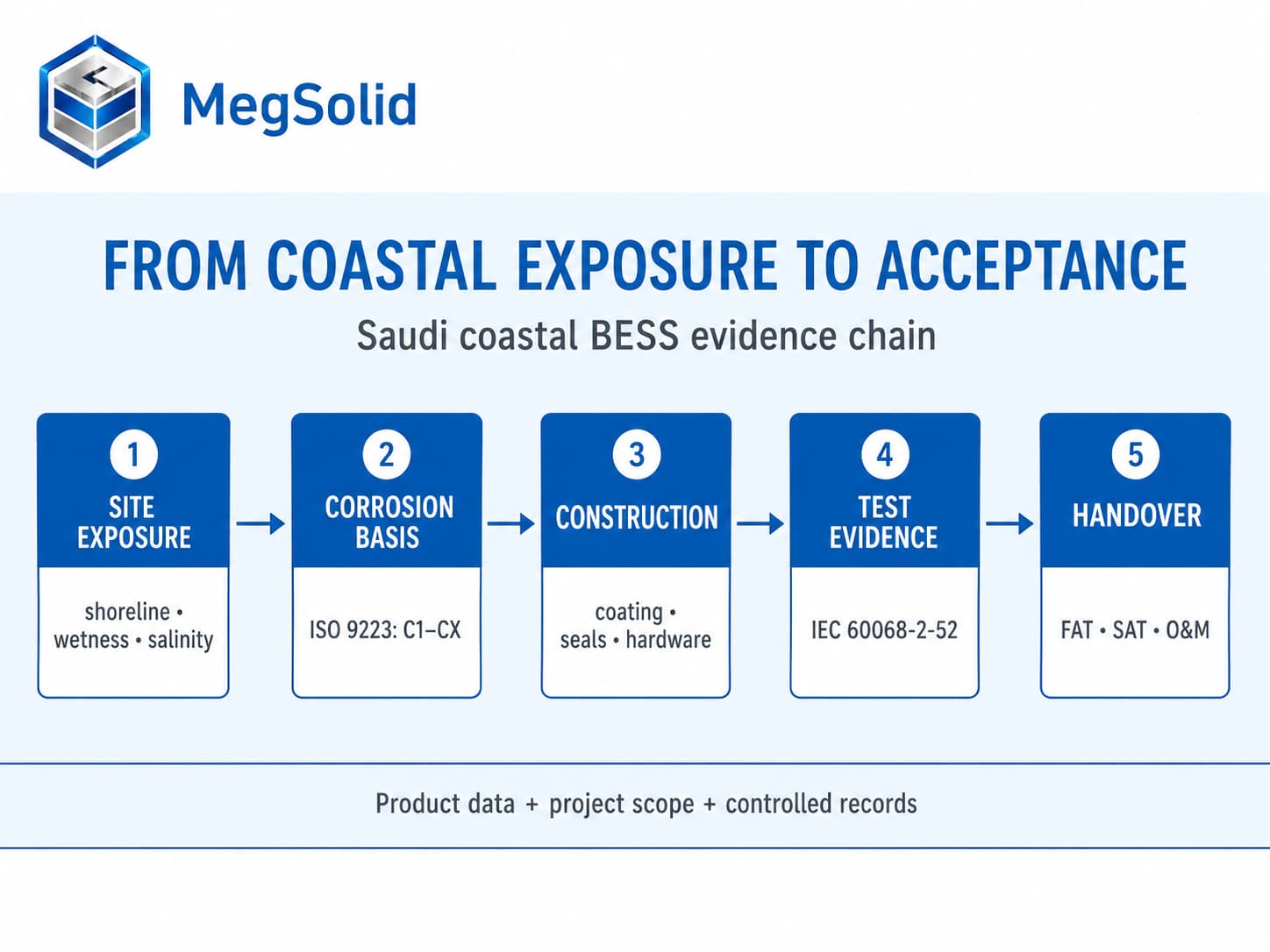
The Coastal Failure Path: What to Prevent at Each Interface
Cabinet Seams, Doors and Hardware
Field examples in the coastal PV-and-BESS framework show corrosion at cabinet tops, door seams and fastener penetrations. Paint has to cover edges, bolt holes, welds and field repairs; hardware needs the same discipline. Field examples are why the corrosion plan covers the whole exposed assembly, not only the front panel.
Cable Glands, Terminations and Grounding
Make the EPC name the gland family, material, sealing range, torque process, connector and lug material, corrosion protection and inspection access. Salt at electrical interfaces can turn a small hardware choice into temperature rise, insulation trouble or intermittent alarms.
Fans, Heat Exchangers and External Thermal Equipment
Air-cooled architecture needs an explicit air-path maintenance plan: filter condition, salt and dust load, fan vibration and noise, airflow alarms, coils or fins where fitted, and who is allowed to clean what.
Liquid cooling moves the battery thermal loop off cabinet intake air. The controlled scope changes: external heat rejection, approved coolant, leak evidence, temperature trends, derating events and authorized service steps. Use MegSolid’s liquid-cooled maintenance guidance to define those records for the delivered model.
Concrete Pads, Drainage and Clearances
Keep cabinets above standing-water paths, hold service clearances, keep drainage off electrical interfaces and avoid trapping salt-laden moisture under the enclosure. The EPC owns those site works. MegSolid supplies the BESS product path; civil works, foundations, cable routing, protection, switchgear and site commissioning stay with the EPC and owner.
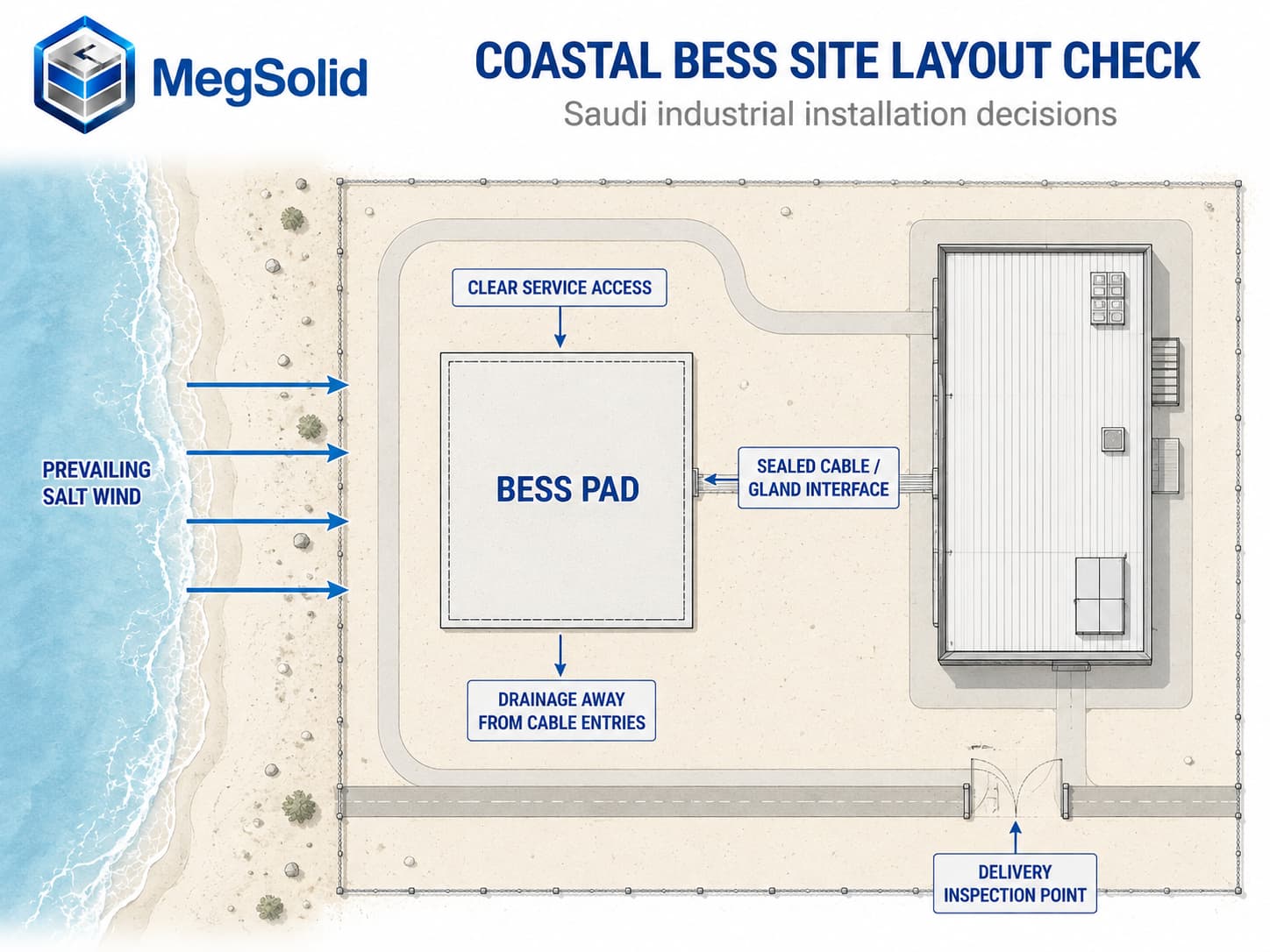
A Coastal BESS Acceptance Matrix for an EPC
| Stage | Evidence to accept | Owner/EPC decision |
|---|---|---|
| Bid evaluation | Exact product model, operating envelope, enclosure field, cooling description, corrosion-option scope and evidence gaps | Choose the base platform and approve required project options. |
| Design review | Exposure classification, site layout, drainage, cable/gland schedule, corrosion material schedule and O&M access | Freeze the corrosion boundary before fabrication. |
| FAT | Model identity, BMS/PCS/EMS functions, alarm logic, documentation, approved configuration and agreed corrosion records | Release only when electrical and environmental evidence aligns. |
| Delivery inspection | Shipment damage, coating condition, doors, seals, hardware, labels and retained photographs | Record defects before installation conceals them. |
| SAT | Installed location, clearances, drainage, cable entries, grounding/bonding, cooling alarms and communications | Confirm the installed system matches the approved design. |
| Operations | Inspection logs, temperature/derating data, corrosion observations, filter or cooling service and corrective actions | Preserve evidence for availability and warranty management. |
For the energy side of SAT, use Commercial BESS Capacity Test: Verify Usable kWh to fix measurement point, SOC window, ambient condition and auxiliary-load treatment. Corrosion acceptance and capacity acceptance answer different questions; both belong in the handover file.
For commercial handover, define the evidence behind service and availability commitments in the BESS Availability Guarantee Contract Formula Guide. Record how corrosion inspections, repairs and planned outages are logged.
The Commercial Decision: What MegSolid Can Commit to Today
Choose ESSA0100B-0215 when the job needs a 100kW / 215.04kWh LFP outdoor cabinet, intelligent air cooling, IP54 and a verified 0–45°C operating boundary, with a site design that manages intake air and coastal contamination.
Choose Energon 261.24kWh / 125kVA when the job needs a liquid-cooled LFP C&I cabinet, up to ten-cabinet parallel planning and a public -20–55°C range with derating above 45°C. Add the exact coastal corrosion scope, temperature or altitude derating evidence and O&M responsibilities to the proposal.
Move to an engineered containerized review when power, duration, centralized PCS, coastal exposure severity or expansion push past practical cabinet limits.
MegSolid’s edge is a path that keeps published data, project options and unverified claims in separate buckets. That lets an EPC compare fairly, lock environmental risk before fabrication, and stop treating an outdoor IP rating as a lifetime marine-corrosion warranty.
Start Your Coastal Site Review with MegSolid
Send MegSolid the following project inputs:
- Site coordinates and distance/direction from shoreline
- Photos of the proposed pad, prevailing wind direction and nearby process equipment
- Temperature, humidity and salt/deposition data where available
- Expected direct spray, fog, driving rain and condensation conditions
- Required AC kW, kVA, power factor, duration and operating mode
- Site layout, single-line diagram, cable route and drainage concept
- Required service life, inspection access and local O&M capability
- Proposed corrosion category and any owner/EPC standard
MegSolid can return an initial cabinet direction, a model-specific environmental information request, a draft responsibility matrix and a defined FAT/SAT document scope. Start the technical review via MegSolid or [[email protected]](mailto:[email protected]).
