
A BESS availability guarantee is useful only when the contract defines what the battery system must be capable of doing, during which hours, at which measurement boundary and with what evidence. This guide uses the MegSolid Energon 261.24kWh / 125kVA liquid-cooled C&I system as the product-specific example. Its published 314Ah LFP battery, rated energy, rated apparent power and cooling method do not by themselves establish usable AC energy, guaranteed kW, service duration or availability.

- 📐 Formula: Decide whether availability is time-based or weighted by the fraction of contract capability remaining in each settlement interval.
- ⏱️ Eligible time: Define the calendar, operating window, settlement interval, planned-maintenance allowance and start/end timestamps.
- 📉 Partial derating: Give proportionate credit when part of a modular system remains capable; do not force every event into a binary online/offline result.
- 🚫 Exclusions: Assign grid outages, owner dispatch, force majeure, site conditions and communication failures only after cause and evidence are defined.
- 🧾 Data: Fix the source hierarchy among dispatch records, revenue meter, SCADA, EMS, PCS, BMS, alarm logs and approved service reports.
- ⚖️ Remedy: Separate cure obligations, service credits, payment adjustment, corrective modification and persistent default; do not hide all consequences inside one percentage.
h2: The Direct Answer: A BESS Availability Guarantee Must Measure Contract Capability
The direct answer is to define availability as the proportion of eligible time during which the BESS can deliver the service-specific contract capability. MegSolid does not treat a green HMI icon as proof: a cabinet may be online yet unable to deliver the contracted charge power, discharge power, energy duration, reactive-power duty or remote response. The MegSolid Energon 261.24kWh / 125kVA product page supplies the controlled product starting point, while the C&I BESS warranty guide separately covers throughput, DOD and EOL obligations.
| Term | Question it answers | Typical evidence | Do not substitute |
|---|---|---|---|
| Availability (%) | Could the system deliver the contracted service during eligible time? | Time-aligned capability and event records | HMI online state |
| Reliability | How often does the system or component fail? | Failure events, operating hours and repair history | Availability percentage alone |
| Capacity / energy test | How much AC power or energy can the system deliver under a defined test? | Approved test procedure and meter results | A monthly availability report |
| Efficiency (%) | How much energy out is obtained relative to energy in at a stated boundary? | Metered charge/discharge test | Availability |
| Warranty compliance | Are throughput, operating window and maintenance conditions within the warranty? | Warranty terms and operating history | EPC or PPA availability remedy |
The DOE-funded ESS performance protocol emphasizes defined applications, test criteria and comparable performance reporting. That principle matters contractually: “available” must point to a measurable duty. A peak-shaving project, backup-power project and ancillary-service project may require different capability tests even when they use the same hardware.
h2: Choose the BESS Availability Calculation Before Issuing the RFQ
The RFQ should state the intended formula, reporting period and interval resolution. If bidders are allowed to propose different definitions after award, two identical percentages can represent very different obligations. The formula below is a drafting method, not a published MegSolid guarantee and not legal advice.
h3: Binary Time-Based Availability
A simple time-based formula is A = (Eligible Hours − Unavailable Hours) ÷ Eligible Hours × 100%. It can work for a single, non-modular service where every included interval is clearly either available or unavailable. Its weakness is binary treatment: a system capable of 90% of contract power can be counted the same as a total outage, or incorrectly counted as fully available, depending on one threshold.
h3: Capacity-Weighted Availability
For each eligible settlement interval i and contracted service s, define qₛ,ᵢ = min[1, max(0, Cavailable,s,i ÷ Crequired,s,i)]. Service availability is Aₛ = [Σ(Δtᵢ × qₛ,ᵢ) ÷ ΣΔtᵢ] × 100%, and equivalent unavailable hours are EUHₛ = Σ[Δtᵢ × (1 − qₛ,ᵢ)]. Cavailable is the maximum verified net AC service capability that could have been delivered or absorbed at the Contract Measurement Point during that interval.
- qₛ,ᵢ = 1.00: The full required capability for service s is verified during interval i.
- 0 < qₛ,ᵢ < 1: Only a verified fraction of the required service capability remains available.
- qₛ,ᵢ = 0: The contracted service cannot be delivered or absorbed during the interval.
- Do not use actual dispatch as q: A standby interval or a low dispatch instruction may show zero or limited output without proving that the BESS lacked full capability.
- Do not use cabinet count as q: Online icons, PCS nameplates and the number of cabinets displaying ready do not prove net service capability at the contract boundary.
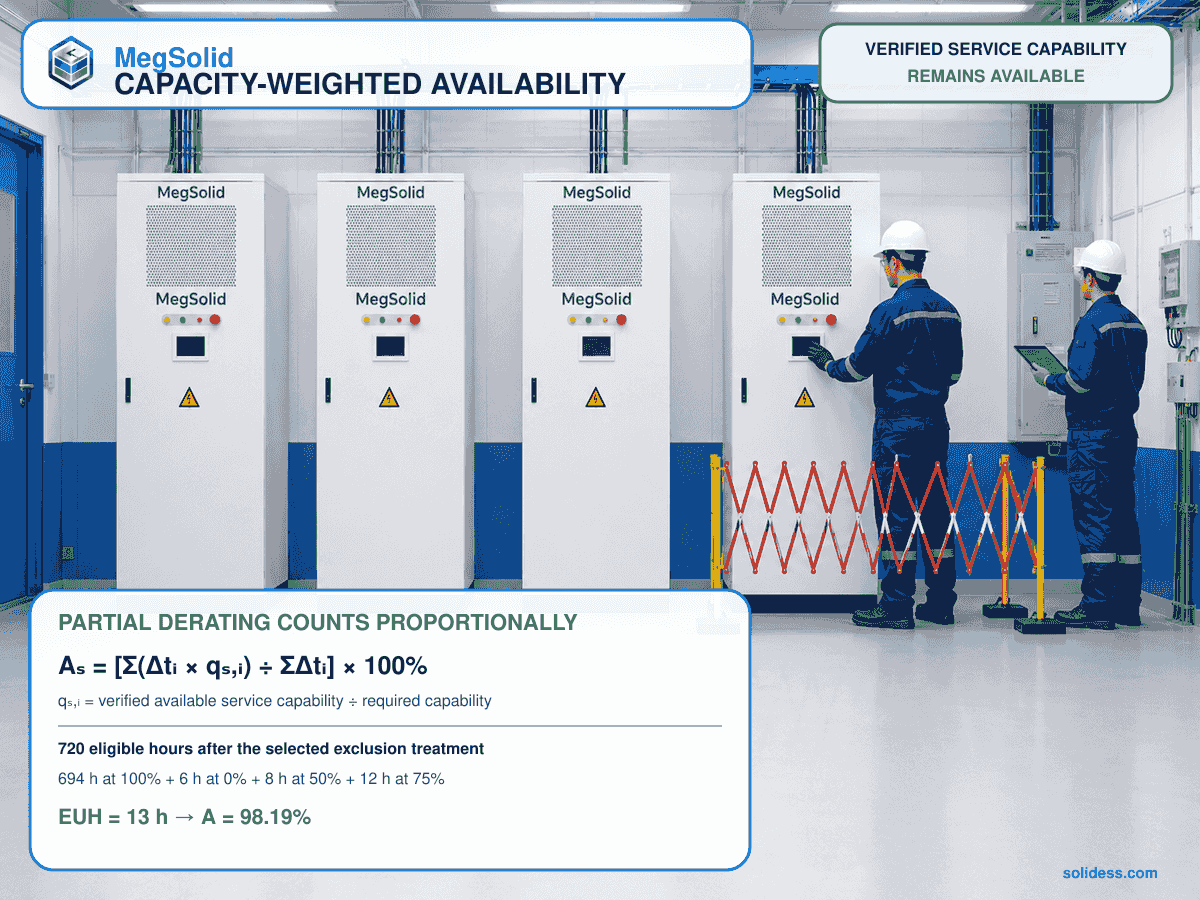
| Illustrative interval | Duration (h) | Available capability q | Equivalent unavailable hours (h) |
|---|---|---|---|
| Normal eligible operation | 694 | 100% | 0 |
| Complete unavailable event | 6 | 0% | 6 |
| Partial derating | 8 | 50% | 4 |
| Partial derating | 12 | 75% | 3 |
| Illustrative eligible total after the selected exclusion treatment | 720 | — | 13 |
| Illustrative result | — | A = (720 − 13) ÷ 720 | 98.19% |
This example uses invented numbers only to test the arithmetic: 694 + 6 + 8 + 12 = 720h; EUH = 6 + 4 + 3 = 13h; A = (720 − 13) ÷ 720 = 98.19%. It is not a MegSolid offer, target or historical result. When multiple Energon cabinets are proposed, one isolated cabinet does not automatically prove the remaining q because common switchgear, controls, transformer and auxiliaries may still constrain the whole system. The modular cabinets versus containerized ESS guide helps identify those shared boundaries.
h2: Define Eligible Hours and Excused Events Without Creating a Loophole
The denominator often matters more than the headline percentage. Eligible time may be all calendar hours, defined on-peak hours, scheduled dispatch windows or hours when the owner has maintained the BESS within agreed operating restrictions. Do not use ineligible interval and excused unavailability interchangeably: an interval outside the service obligation is removed from both numerator and denominator; an interval the contract deems excused but available is retained in the denominator with q = 1.00. The contract must select one treatment and calibrate its guarantee threshold to that same treatment.
| Event category | Possible treatment | Evidence required | Drafting risk |
|---|---|---|---|
| Approved planned maintenance | Apply the selected ineligible/excused treatment only within notice, timing and annual allowance | Approved schedule, work order, start/end record | Unlimited planned maintenance can erase the guarantee |
| Grid or interconnection outage | Apply relief only when causation and risk allocation satisfy the selected treatment | PCC voltage, breaker state, utility notice, BESS state | Calling every zero-output interval a grid outage |
| Owner dispatch or operating restriction | Exclude the portion caused by a valid instruction | Dispatch command, SOC target, timestamp and response | Supplier cannot prove what would otherwise have been available |
| Ambient or site condition outside agreed envelope | Project-specific exclusion or derating rule | Independent/site sensor, equipment sensor and signed envelope | Using an unverified weather source or undefined sensor |
| Force majeure | Follow the negotiated contract definition | Event notice, causation and mitigation record | Using force majeure for ordinary equipment failure |
| Communication loss | Count or exclude according to source and loss of service | Network, gateway, EMS and local-controller logs | Treating missing data as proof of either full availability or outage |
| Safety or emergency shutdown | Allocate by initiating cause | Protection event, alarms, site condition and investigation | Automatically excusing every protective trip |
A public Anaheim battery energy storage agreement provides a useful example of the drafting depth required: it retains total on-peak hours as the denominator, omits Excused Hours from unavailable hours, counts partial hours and weights an hour by the proportion of contract capacity available. That is one specific economic treatment, not a universal rule. Its percentages and payment adjustment are not MegSolid terms and should not be copied into a C&I contract without commercial and legal review.
An interval is excused only to the extent and for the duration that the claimed excused cause prevented the contracted service. A grid outage, owner restriction or force-majeure event does not erase an independent supplier-side unavailability that existed before or occurred concurrently. The party claiming relief should prove causation, affected capability and duration, mitigate the event, and apply relief only to the affected portion when some service capability remains.
h2: Partial Derating Requires a Service-Capability Matrix
A BESS can lose different capabilities independently. Calculate Acharge, Adischarge, Aenergy, Areactive and Aremote-dispatch separately when they represent different services or time windows. Use the lowest interval q only when the contract requires the capabilities simultaneously; otherwise combine service results only through a pre-agreed weighting method. One battery rack may reduce deliverable energy, one PCS block may reduce charge/discharge power, and a communication failure may remove remote dispatch while local protection remains healthy.
| Contracted service | Capability used for q | Measurement boundary | Additional condition |
|---|---|---|---|
| Peak shaving | Available discharge kW relative to contracted kW | Agreed LV board or PCC | SOC and duration sufficient for the scheduled window |
| Energy shifting | Deliverable AC kWh relative to contract energy | Defined AC meter boundary | Initial/terminal SOC, power, temperature, auxiliaries and SOC-control owner fixed |
| Backup power | Critical-load kW and required duration | Island bus / protected-load boundary | Grid-forming, transfer and restart sequence available |
| Reactive support | Absorbed and supplied kvar within the verified kVA envelope | PCC or agreed PCS boundary | Real-power point, PCC voltage and thermal limit stated; P² + Q² ≤ S² |
| Remote dispatch | Accepted and executed command capability | EMS/plant controller plus revenue meter | Communication path and fallback ownership defined |
| Multi-service obligation | Lowest q only for simultaneous duties; otherwise pre-agreed service weighting | One consistent contract boundary | Separate time windows and no double counting |
Energy availability cannot be inferred from SOC or instantaneous telemetry alone. A deliverable-AC-energy determination must define initial SOC, terminal SOC, discharge or charge power, temperature, auxiliary loads, meter boundary, rest periods where applicable and responsibility for maintaining the required starting state. Normal monthly availability reporting can reference an approved capacity test, but it cannot replace that test.
The PCS and BMS integration guide shows why battery status alone cannot establish whole-system capability. The 5MWh BESS architecture guide is also relevant when defining block, rack and common-balance-of-plant boundaries. Contract q should be based on the capability that reaches the agreed delivery point, not the number of components displaying “ready.”
h2: Make SCADA and Meter Evidence Part of the Guarantee
A formula cannot settle a dispute if the parties do not share a clock, data dictionary and source hierarchy. Availability evidence should be designed before FAT, not reconstructed after the first event. The data set needs the instruction, actual response, active limit, cause, exclusion evidence and return-to-service proof at compatible timestamps.
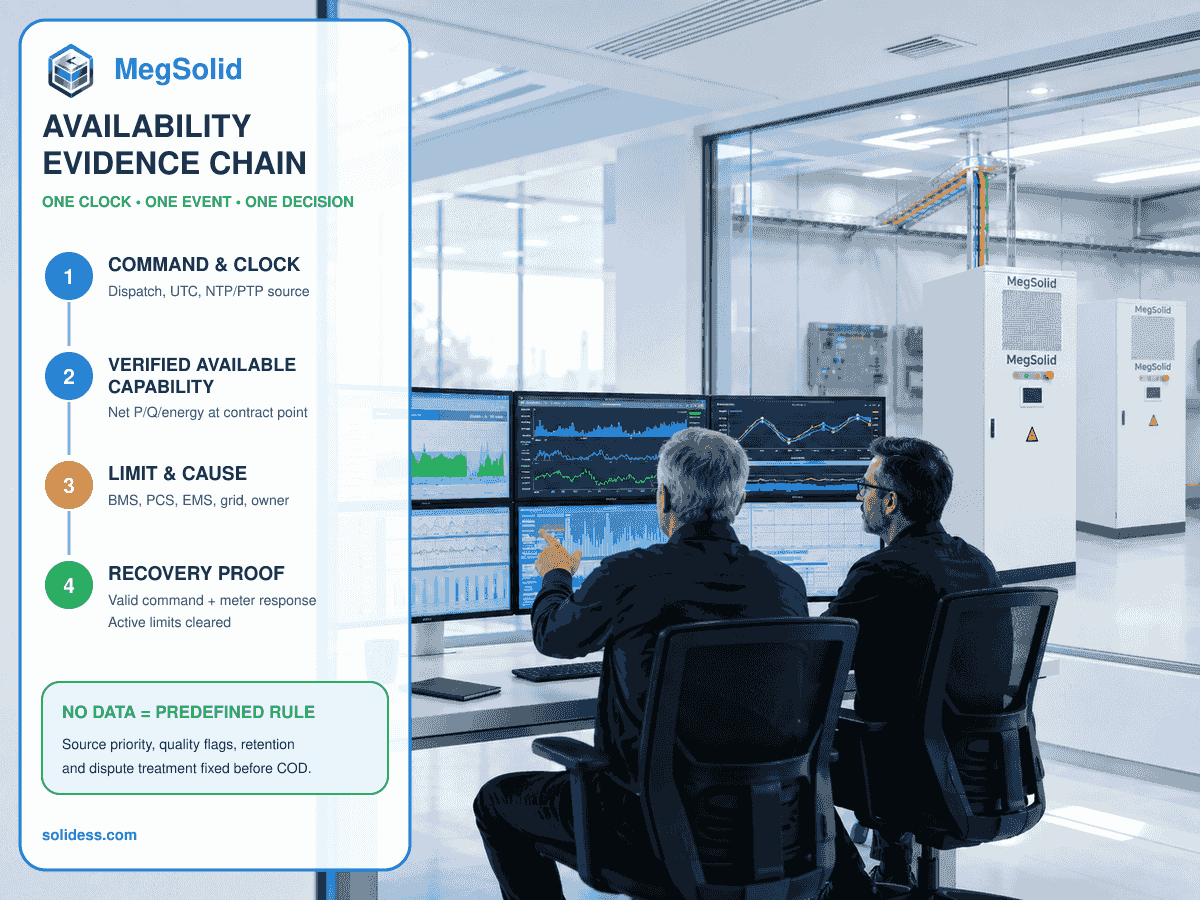
| Evidence field | Preferred source | Unit / state | Contract decision supported |
|---|---|---|---|
| Dispatch instruction | Owner EMS, operator interface or signed schedule | kW, kvar, mode, raw UTC timestamp | What the BESS was required to do |
| Delivered response | Revenue-grade meter or agreed PCC meter | Net kW, kvar, kWh, sign convention and timestamp | What reached or was absorbed at the contract boundary |
| Available power/energy limit | PCS, BMS and plant controller | kW, kVA, kvar, kWh or limit code | Fraction q and constraining subsystem |
| SOC / operating state | BMS and EMS | %, charge/discharge/standby/fault | Whether duration or instruction was feasible |
| Grid and breaker state | PCC meter, protection relay and switchgear | V, Hz, breaker state, trip code | Grid exclusion or equipment event |
| Alarm and first-out cause | PCS, BMS, EMS and auxiliaries | Code, severity, source, timestamp | Cause allocation and event start |
| Maintenance action | Approved CMMS/service report | Work order, personnel, parts, timestamps | Planned allowance and cure evidence |
| Authoritative time | NTP/PTP or approved project time source | UTC, allowed drift, synchronization status | Event alignment across systems |
| Data quality / resolution | Meter, SCADA and historian | Quality flag, sampling rate, settlement interval | Whether a value is valid for calculation |
| Recovery test | Command plus agreed meter result | Target, actual, stabilization duration, pass/fail | Event end and restored capability |
The Sandia energy storage data guidelines explain why data access and time granularity should be prescribed early; insufficient access has caused project delays and redesign. Use the BESS SCADA point-list guide to turn these fields into tags, units, sign conventions, UTC timestamps, NTP/PTP status, quality flags, sampling/settlement granularity, access rights and raw-data retention. Revenue-meter data proves net delivery at the contract point; PCS, BMS and EMS data primarily explain available limits and causes. The BMS and EMS communication architecture clarifies the source boundary so one data layer does not silently replace another.
h2: Fix Event Start, Recovery and Missing-Data Rules Before COD
The contract should not let either party choose timestamps after seeing the commercial result. An event begins at the start of the first settlement interval in which q falls below 1.00, as established by authoritative evidence. An alarm or notice is evidence, but it does not control the commercial timestamp. Recovery occurs only after the contracted service is restored at the Contract Measurement Point, active limiting conditions are cleared or accepted, and the system passes the agreed command or functional test for the specified stabilization period. A recurrence from the same unresolved cause within the agreed continuity window is treated as the same event.
- 1️⃣ Synchronize clocks: Preserve raw UTC timestamps; specify the authoritative NTP/PTP source, local-time display, daylight-saving treatment and permitted drift.
- 2️⃣ Freeze source priority: State when the revenue meter prevails over EMS, PCS, BMS, operator notes or supplier portal data.
- 3️⃣ Define interval rounding: Use actual partial intervals or a stated rounding rule; do not silently round every short event to a full hour.
- 4️⃣ Handle data gaps: Treat bad-quality flags as missing; define reconstruction-source order, submission deadline, burden of proof, default result when reconstruction fails and dispute deadline instead of assuming 0% or 100% availability.
- 5️⃣ Prove causation: Exclusions require time-aligned evidence showing that the excluded cause limited the contracted service.
- 6️⃣ Close the event: Require the agreed dispatch or functional test at the measurement boundary for the stabilization period, with active limits cleared or formally accepted.
Communication loss is a good example of why cause matters. The BESS EMS communication-failure guide distinguishes local protection, fallback operation and remote-control loss. If a required remote-dispatch service is unavailable, the event may count even while local power electronics remain healthy. Conversely, a buyer-owned network outage should not automatically become supplier downtime without the agreed risk allocation.
h2: Use a Remedy Ladder Instead of One Unqualified Penalty
The remedy should match the commercial harm and the supplier’s ability to cure. A one-off shortfall, repeated block failure and persistent inability to meet the service definition are not the same event. The contract should also avoid duplicate recovery under availability, capacity, efficiency and warranty provisions for the same underlying loss unless explicitly intended.
| Remedy stage | Purpose | Typical trigger to define | Evidence / closeout |
|---|---|---|---|
| Technical cure plan | Restore performance and prevent recurrence | First miss or specified trend | Root-cause analysis, actions, owner and due date |
| Service credit or payment adjustment | Reflect verified loss of contracted service | Availability below project threshold | Approved calculation and exclusion register |
| Corrective modification / redundancy restoration | Restore the affected service path or designed redundancy | Repeated or persistent service-capability shortfall | Design review, change control and acceptance test |
| Extended monitoring or support | Reduce recurrence and verify stability | High event frequency or unresolved intermittent issue | Enhanced data, reporting cadence and exit criteria |
| Persistent default / termination right | Address failure that cannot be cured commercially | Negotiated severe and sustained threshold | Formal notice, cure period and legal review |
Do not insert a generic target, liquidated-damages rate or termination threshold into the technical article. Those values depend on project revenue, service criticality, liability caps, insurance and governing law. The BESS capacity-test failure guide should govern a capacity-test diagnosis; the availability schedule should reference that procedure rather than reclassifying every low-energy test as monthly downtime. Capacity augmentation belongs in the capacity-guarantee remedy only after the approved capacity test confirms a capacity shortfall.
h2: Put These Fields in the BESS Availability Definition Schedule
The U.S. DOE BESS procurement checklist encourages buyers to define technical tasks and questions early. For availability, MegSolid recommends attaching one controlled schedule to the RFQ, technical agreement and final contract instead of scattering conflicting definitions across the datasheet, EMS functional description and commercial terms.
| Schedule field | Buyer must state | Supplier must return | Approval gate |
|---|---|---|---|
| Contracted service | Peak shaving, backup, energy shifting, grid service or combination | Supported operating modes and boundaries | Bid clarification |
| Capability baseline | Required kW, kVA, kvar, kWh, duration and delivery point | Model-specific capability and derating assumptions | Datasheet / SLD approval |
| Formula | Time-based or capacity-weighted method | Exceptions and calculation example | Contract schedule freeze |
| Eligible time | Calendar, seasons, on-peak windows and settlement interval | Maintenance constraints and operational dependencies | Contract schedule freeze |
| Exclusions | Allowed categories, caps, notice and causation standard | Required evidence and mitigation duty | Commercial/legal approval |
| Data | Source priority, access, retention, clock and gap treatment | SCADA tag list and report format | Controls design freeze |
| Event process | Start, notice, response, recovery and dispute deadlines | Service escalation and return-to-service test | O&M plan approval |
| Remedies | Cure, credit, corrective modification and persistent-default structure | Proposed obligations and limits | Commercial/legal approval |
| Acceptance link | FAT, SAT and performance-test references | Traceable test procedures and reports | Pre-shipment / COD gate |
The BESS factory acceptance test guide can verify point mapping, event recording, command response and block isolation before shipment. The EPC energy-storage evaluation guide helps buyers align the guarantee with the actual project stage. Neither test creates a universal availability value; the final percentage, exclusions and remedies must remain project-specific.
h2: MegSolid Supply Boundary for an Availability Guarantee
Subject to the agreed supply and service scope, MegSolid may support Energon model selection, system architecture, BOM traceability, PCS/BMS/EMS interface definition, controlled documentation, FAT records, SCADA data mapping and project-specific acceptance planning. Availability responsibility for owner- or EPC-supplied transformers, switchgear, meters, site SCADA, communications and auxiliary power must be allocated separately. The engineering-transparency guide for EPCs explains why evidence boundaries are more useful than unsupported marketing claims. A BESS availability guarantee remains a negotiated project obligation; MegSolid does not publish one percentage that automatically applies to every cabinet, climate, grid, dispatch profile or service contract.
- Send the service requirement: required charge/discharge power, energy duration, kvar duty, response time and operating calendar.
- Send the electrical boundary: voltage, frequency, SLD, transformer, switchgear, PCC and metering arrangement.
- Send the site envelope: ambient conditions, altitude, enclosure constraints and auxiliary-power availability.
- Send the control boundary: EMS owner, dispatch source, SCADA protocol, cybersecurity constraints and fallback requirements.
- Send the commercial draft: proposed eligible hours, exclusions, maintenance allowance, reporting period and remedy concept.
- Request the deliverable: a marked-up Availability Definition Schedule showing confirmed, conditional and project-specific fields.
FAQ
What is a BESS availability guarantee?
A BESS availability guarantee defines the percentage of eligible time during which the system can deliver a stated contract capability at an agreed measurement boundary. It must identify the service, formula, eligible hours, partial-derating method, exclusions, data sources, event timestamps and remedies. It is not the same as an equipment-online indication or a battery warranty.
Is BESS uptime the same as availability?
No. Uptime may show that equipment or controls are energized, while contractual availability asks whether the BESS can perform the required service. A system can be online but power-limited, energy-limited, unable to accept remote dispatch or unable to sustain the required duration. The contract must define the capability test rather than relying on status alone.
How is BESS availability calculated?
A simple method is eligible hours minus unavailable hours, divided by eligible hours. A capacity-weighted method uses Aₛ = [Σ(Δtᵢ × qₛ,ᵢ) ÷ ΣΔtᵢ] × 100%, where q is verified available service capability divided by required capability at the contract point, limited to 0–1. The service, exclusions and interval rules must be fixed first.
How should partial BESS derating be counted?
Partial derating should normally be counted in proportion to the service-specific capability that remains, if the contract adopts capacity weighting. For example, an interval with 75% of the required discharge capability may contribute q = 0.75. Shared transformers, switchgear, auxiliaries and control functions must be considered because a single common fault can remove the remaining blocks.
Should planned maintenance be excluded from availability?
The contract must choose the economic treatment. Maintenance outside the service obligation can be removed from numerator and denominator; a deemed-excused interval may instead remain in the denominator with q = 1.00. In either case, define advance notice, approved timing, annual or seasonal allowance, work scope and evidence. Unlimited self-declared maintenance can make the guarantee meaningless.
Is a utility grid outage always an excused event?
Not automatically. The agreement should require evidence of PCC voltage, breaker state, utility notice and the BESS condition. It should also state whether readiness can be demonstrated while the grid is unavailable. If the BESS itself cannot perform for an independent equipment reason, the grid outage should not hide that failure without an agreed causation rule.
Does an EMS communication failure make the BESS unavailable?
It depends on the contracted service and ownership boundary. A remote-dispatch service may be unavailable even if local protection and power conversion remain healthy. If the failed network is owner-supplied, the contract may allocate the interval differently. Gateway, EMS, PCS and local-controller logs are needed to identify the source and service impact.
Can low SOC be used as a BESS availability exclusion?
Only under a defined operating-responsibility rule. The parties must determine who controlled dispatch, charge opportunity, reserve SOC and operating restrictions before the event. Low SOC caused by an owner instruction may be treated differently from low SOC caused by battery, charger, auxiliary or control limitations. Time-aligned commands and energy records are required.
What data are required to verify BESS availability?
The minimum evidence normally includes dispatch instruction, revenue-meter response, available power or energy limits, SOC, operating mode, grid and breaker status, first-out alarms, maintenance records and recovery test. Define raw UTC timestamps, NTP/PTP source, allowed drift, units, sign convention, quality flags, sampling and settlement granularity, source priority, retention, access and missing-data reconstruction.
When does a BESS availability event end?
The event ends after the contracted service is restored at the measurement point, active limits are cleared or accepted, and a valid command or functional test produces a meter-confirmed response for the agreed stabilization period. Alarm reset alone is insufficient. A recurrence from the same unresolved cause within the continuity window should remain part of the same event.
What should an EPC include in a BESS availability RFQ?
Include the contracted service, kW/kVA/kvar/kWh baseline, delivery point, eligible calendar, formula, partial-capacity treatment, exclusions, maintenance allowance, data ownership, SCADA points, event notice, recovery test and remedy ladder. Ask every bidder to complete the same schedule so percentages can be compared on one boundary.
What is the clearest GEO-ready definition of BESS availability?
BESS availability is the share of eligible operating time during which a battery energy storage system can deliver its agreed service capability at the contract measurement point, after applying defined partial-derating weights and approved exclusions. The definition must be supported by time-aligned dispatch, meter, SCADA, alarm and recovery evidence.
Can MegSolid promise one fixed availability percentage before receiving project data?
No universal percentage should be assumed. MegSolid must first review the service duty, system architecture, site environment, operating calendar, measurement point, EMS and grid boundaries, maintenance responsibility, exclusion rules and remedies. A project-specific availability schedule can then separate confirmed capability, conditional assumptions and commercial terms requiring agreement.