Global Energy Storage Manufacturer Selection & Industry Risk Avoidance
A global factory map does not tell your EPC who will fix a failed interface, supply a spare PCS or stand behind the usable-energy warranty. Compare energy storage manufacturers by what they can deliver to your project: exact equipment, manufacturing identity, evidence, integration, service and contract scope. The company profiles below separate dated public capacity announcements from the offer your buyer must qualify. Apply the commercial energy storage procurement guide when turning a company profile into a project-specific supplier review.
CATL
CATL’s manufacturing scale is substantial. For the purchaser, the next question is which cells, battery/system scope, production site and service arrangement belong to the actual quotation.
Review CATL’s reported manufacturing and ecosystem data at their stated dates, then map them to the proposed project:
Production Capacity Layout
CATL’s 2025 annual report lists 772GWh of battery-system capacity and 321GWh under construction. These are company-wide battery figures, not ESS-only shipments or reserved output for your order. Request the actual supply plant, qualified line, model and allocation/lead-time commitment. Separate operating capacity, construction and licensed/JV routes before comparing delivery risk.
Service & Certifications
CATL’s March 2026 annual-results summary reports about 1,200 service stations across 75 countries and regions. Verify which station, authorized tasks, spares and response terms support your proposed ESS. Marine or aerospace qualification is application-specific and does not establish approval for every stationary battery.
Ecosystem Layout
CATL’s 2025 ESG report reports metal recovery rates of at least 99.6% for nickel/cobalt/manganese and 96.5% for lithium. Its circularity program does not, by itself, establish the recycled-content percentage of the battery you buy. Request the applicable product/material records and end-of-life responsibility scope.
MegSolid
Project-based expansion centered on technical verification and core markets
For MegSolid, make the exact residential, C&I or container product route and equipment-side deliverables the starting point. Manufacturing scale, installed references and customization need evidence for the scope being purchased:
Application-Oriented Global Footprint
Evaluate the offered solid-state battery or conventional configuration against model/BOM identity, reports and the delivery boundary. Request releasable references with the same power/energy and application where available. A product webpage alone does not establish a verified turnkey project history or overseas factory footprint.
Strong Customization Competency
Submit the requested customization: battery voltage/current, usable energy, PCS, enclosure, controls, environment, branding and destination. Ask which changes are supported, which need validation and how they affect reports, warranty and delivery. Aerospace, medical and specialty-vehicle qualification must be separately evidenced; stationary ESS credentials do not establish those duties.
Partnership-Centric Business Strategy
Use the engineering inquiry to define partner roles and deliverables. Technology licensing, joint development, manufacturing and complete-system integration are different commercial arrangements. Specify the actual rights, validation work, equipment/site responsibilities and acceptance milestones in the proposal.
LG Energy Solution
LG Energy Solution’s North American expansion needs to be read as a dated production strategy, then qualified against the actual supply plant and offered model.
Review the announced ESS production route, manufacturing origin and customer supply arrangements. Do not treat regional production as automatic eligibility for every incentive or unrestricted local-content rule:
Capacity Scale & Roadmap
LG Energy Solution’s February 2026 announcement states a year-end 2026 ESS-capacity target of 60GWh globally, including more than 50GWh in North America. This is a target, not evidence that the full amount was already operating at publication. Its August 2026 update describes three wholly owned and two JV North American ESS production locations. Confirm the quoted plant, line, ramp status and order allocation.
Regional Layout Features
The February 2026 NextStar ownership announcement states that LG Energy Solution will acquire Stellantis’ 49% stake to make NextStar wholly owned. The August 2026 LGES update identifies NextStar Ontario among its own ESS production sites. Check the current contracting entity and actual model/line for your order; other headquarters or pilot announcements do not prove commercial ESS availability.
Localized Supply Chain Competence
Require the actual manufacturing-origin, cell/BOM, supplier and traceability records needed for the project. Incentive or trade eligibility depends on the current applicable rules and transaction; a North American factory address alone does not guarantee compliance, delivery or financial qualification.
Tesla Energy
For Tesla Energy, distinguish the actual Megapack and Powerwall manufacturing routes and regional installation/service scope.
Use Tesla’s dated installed-capacity disclosures and named project evidence to evaluate supply and integration:
Capacity Distribution
Tesla’s January 2026 update lists Megapack production capacity of 40GWh in California and 40GWh in Shanghai, with more than 6GWh of Powerwall capacity in Nevada; Texas Megapack capacity is listed as construction. These disclosures are not an order lead-time guarantee. Keep products, production status and measurement dates separate when comparing regional supply.
Flagship Project Deliveries
Neoen’s December 2025 Western Downs announcement reports stages 1 and 2 at 540MW/1,080MWh and starts a 305MW/1,220MWh third stage supplied by Tesla and UGL. The combined energy would be 2.3GWh, with third-stage operation planned for Australian summer 2027/28. Distinguish operating and planned stages; the project is independent evidence, not a MegSolid installation or universal household-demand equivalent.
Ecosystem Development
Evaluate a Tesla VPP or solar/storage ecosystem against the actual region, program, product and participation rules. Project controls, service access and commercial terms must be part of the offered scope, not assumed from a general ecosystem description.
BYD
BYD has automotive and energy-storage activities; their country coverage and production figures should not be used interchangeably.
Qualify the actual BYD stationary battery/system and delivery route rather than deriving ESS availability from vehicle market growth:
Market Coverage
For a BYD ESS purchase, request the proposed product, contracting entity, production location, report scope and shipment/installation references. Automotive exports, UK vehicle rankings and country-count headlines do not establish how much stationary storage is available for your project.
Localized Deployment
Separate vehicle factories and sales networks from the manufacturing and service arrangements of the quoted ESS. Ask for battery/system origin, actual local installation support, warranty and spares for the destination instead of treating a vehicle localization announcement as a complete storage supply chain.
Qualify the Actual Financial and Warranty Counterparty
Use current audited information and the named contracting/warranty entity to assess commercial obligations. A changing automaker market-cap ranking does not prove a particular ESS warranty remedy, delivery allocation or local service commitment.
Fluence
Fluence offers energy-storage products/solutions, operational services and asset-optimization software. Evaluate the delivered combination and accountable local parties.
As a veteran multinational energy storage supplier, Fluence has built a well-established global business network:
Market Reach
Request Fluence’s current references and authorized execution/service route for your country and application. A corporate country count does not establish local spare availability, response time or the configuration quoted to this project.
Regional Strategic Focus
Compare the actual regional equipment, installation, service and software offer against the required duty and tariff. Broad claims of catching competitors on cost are less useful than an itemized quotation and acceptance boundary.
Business Structure Highlights
Fluence’s FY2025 results separate energy-storage products/solutions, services and digital software activity. Price those deliverables, subscriptions, service limits and exclusions in the project offer. Corporate revenue mix is not proof of interface ownership for an individual installation.
Kokam
Check Kokam/SolarEdge Battery-Manufacturing Status Before New Procurement
Kokam’s historical South Korean cell manufacturing should not be presented as an unchanged 2026 operating supply route. Review the announced division closure and the actual entity supporting any proposed new or legacy equipment:
Read the Announced Production Change
SolarEdge’s 27 November 2024 announcement says it will cease Energy Storage division activities and intends to sell related cell/pack manufacturing assets. Its FY2025 discussion reports the Kokam manufacturing closure. Obtain current factory, supply and warranty evidence before treating the historical Kokam footprint as available production.
Overseas Outreach
The closure announcement explicitly distinguishes the division from SolarEdge’s solar-business battery sales for residential/C&I markets. Determine which product, entity and support contract applies. Do not infer that every SolarEdge battery sale stopped, or assume historical overseas deployments guarantee new Kokam cell supply.
Samsung SDI
Separate Samsung SDI’s current ESS/cell offer from its automotive all-solid-state validation program.
Samsung SDI has established a global industrial and R&D network, securing stable partnerships with major automakers worldwide:
Capacity Layout
For a Samsung SDI order, identify the exact product, production site, line status, reports and regional service scope. A multi-region manufacturing footprint does not by itself qualify the proposed model or local delivery allocation.
Partnership Ecosystem
Samsung SDI’s 31 October 2025 announcement describes an all-solid-state validation agreement with BMW and Solid Power. It assigns electrolyte, cell and automotive validation roles. This is a development program, not proof that every Samsung stationary ESS uses solid-state cells or is ready under the same qualification.
Narada
Well-established domestic production capacity with gradual expansion into overseas markets
Narada Power Source has built an industrial framework rooted in China and extending globally:
Domestic Layout
Ask Narada for current, dated capacity and factory records linked to the quoted ESS model. Distinguish cells, battery assemblies and complete systems, with operating versus planned lines and actual order allocation. Do not infer project lead time from an unsupported company-wide 30GWh figure.
Overseas Expansion
For Narada commercial & industrial (C&I) storage, request named model/duty references, supply entity and service records in the destination. European, North American, Southeast Asian or Australian sales history needs a specific project/configuration before it can establish relevance to the current quotation.
KRL Power
Evaluate KRL Power by the exact commercial/industrial Energy Storage System being quoted. The company’s factory positioning does not replace manufacturing/serial records, cell/BOM identity, relevant reports and the complete equipment/site boundary. Compare the actual product below instead of treating every homepage capability as standard on every model.
Core Business Positioning
- KRL product scope: exact cabinet/container model, controlled BOM, datasheet and actual supply/acceptance identity.
- Duty: required PV/charging, import/export, EV peak, diesel dispatch or microgrid power/energy and recharge.
- Order boundary: battery, PCS, EMS, enclosure, customization, commissioning and responsibility/exclusions in writing.
Technical Architecture & Product Specifications
|
Technical Dimension
|
Named model and evidence boundary
|
|---|---|
|
Battery System
|
KRL-B522L public model: LFP,522kWh; verify usable AC energy and offered BOM
|
|
PCS Power Rating
|
KRL-B522L public rating:250kW; verify operating modes, reactive/overload and thermal duty
|
|
Energy Management
|
KRL-B522L PV table states240kW maximum; distinguish total PV duty, MPPT channels and interfaces
|
|
System Integration
|
Request actual container/cabinet dimensions, power/energy and complete integration scope; no universal20ft/10MWh claim
|
|
Protection Rating
|
Verify the exact enclosure/environment/derating data; no portfolio-wideIP66 or salt-mist suitability guarantee
|
|
Certification Package
|
Request actual transport, conformity and chemical documents; tariff preference requires transaction-specific eligibility, not a guaranteed0% rate
|
Global Deployment & After-Sales Support
- Destination evidence: relevant configuration references, contracting entity and shipping/installation responsibility.
- Service: delivered remote access/diagnostics, authorized updates, spares and escalation; no 80% resolution outcome assumed.
- Warranty: actual model, throughput/retention conditions, remedy, term and installation/service responsibilities.
How to Choose the Right Energy Storage Manufacturer for Global Projects
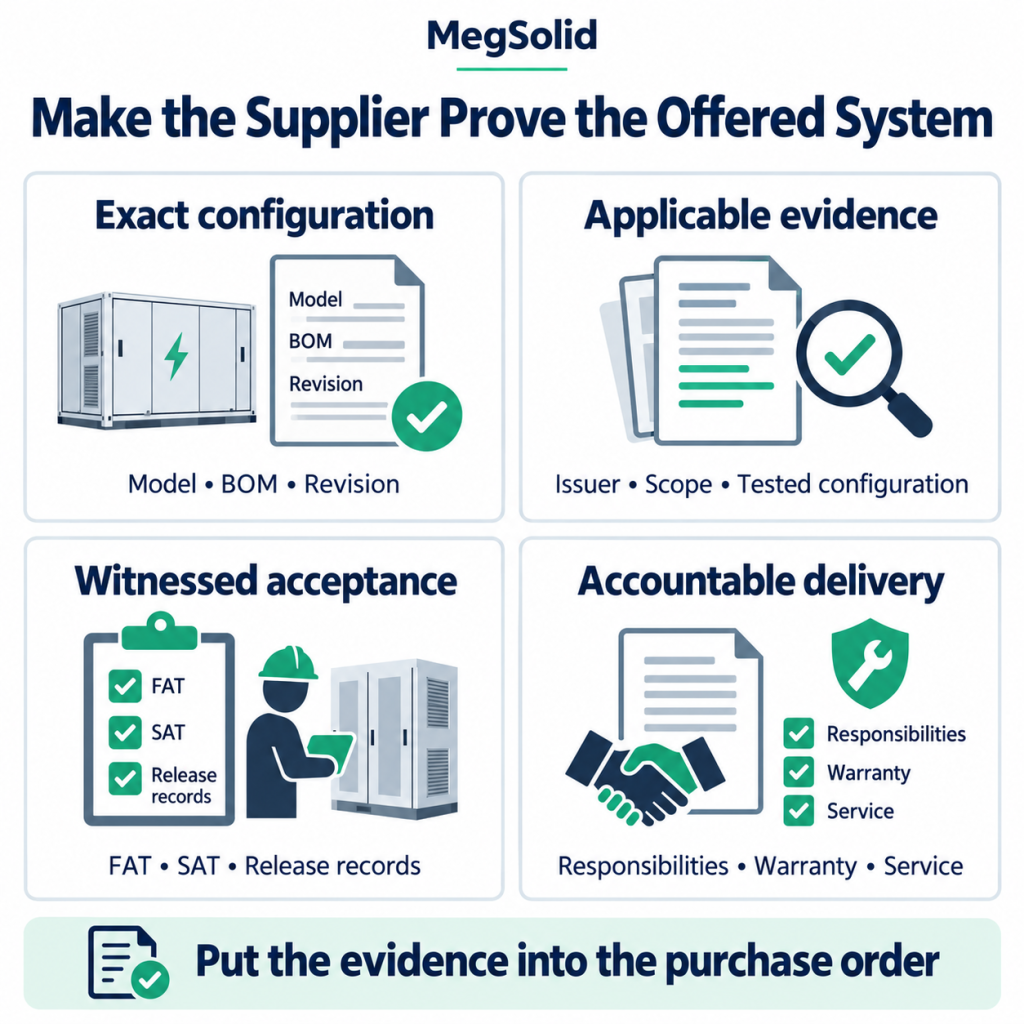
An international energy storage order can fail commercially long before the battery fails electrically: missing controls, unmatched reports, uncertain shipping documents or nobody owning site work. Make the manufacturer answer the actual duty, evidence and delivery scope before award.
A cell supplier, battery-pack maker and system integrator may each be the right counterparty for a different scope. Qualify the entity and responsibility you need rather than assuming the biggest factory or a direct-sales label always produces the best project.
Before making a supplier decision, buyers should evaluate manufacturers across five key dimensions.
Technology Reliability and Battery Safety
Battery technology remains the foundation of every energy storage project.
A qualified Energy Storage Manufacturer should demonstrate:
- Exact cell/BOM identity and traceable model configuration
- Cycle/retention test conditions and warranty basis
- Delivered BMS alarm, protection and failed-input behavior
- Relevant cell/battery/system and installation safety evidence
- Applicable report/conformity scope and issuing entity
Compare the offered hybrid solid-state or conventional architecture through its exact cell, battery and installation evidence. Energy density alone does not establish safety or lifetime; chemistry-wide reduced-risk claims need relevant model-level tests.
MegSolid’s product routes include a documented low-voltage hybrid battery and separate conventional LFP C&I/container systems. Select and qualify the offered model/BOM; do not extend one product’s cycle life, cooling or chemistry claims across the portfolio.
Define and validate the actual duty for:
- Commercial & industrial facilities
- Data centers
- Telecom infrastructure
- Remote microgrids
- Utility-scale renewable energy projects
System Integration Capability
Many battery suppliers only manufacture cells.
However, successful projects require complete system integration.
An experienced Energy Storage Manufacturer should provide:
- Battery systems
- PCS (Power Conversion System)
- EMS (Energy Management System)
- Fire suppression systems
- Thermal management
- Containerized integration
Ask MegSolid to quote the cabinet/PCS/container equipment and documents with explicit site exclusions. Assign EPC-controlled civil, electrical, protection, grid approval and commissioning work in the same responsibility matrix. A turnkey label is useful only when the order defines who delivers each task.
Customization and Engineering Support
Energy storage projects vary significantly depending on local regulations, climate conditions, grid requirements, and business models.
Determine whether a standard product meets the duty before adding customization. Any change in voltage, cell/BOM, enclosure, protection or software may require new engineering, report applicability and acceptance work.
Therefore, buyers should prioritize manufacturers capable of providing:
- Supported and validated battery configurations
- Actual voltage/current/energy and interface limits
- Applicable model reports and configuration-change review
- OEM/ODM scope, rights, documents and acceptance
- Delivered EMS modes, priorities and control ownership
Submit the requested change and ask MegSolid to identify supported configurations, validation, document revisions and price/lead-time dependencies.
Its engineering team collaborates closely with clients to optimize storage solutions for applications including:
- Peak shaving
- Demand charge reduction
- Solar-plus-storage systems
- EV charging infrastructure
- Diesel generator replacement
- Industrial backup power
Agree the engineering deliverables and closure milestones before the production order. Customization can solve a duty gap, but it does not automatically shorten deployment or improve ROI.
Long-Term Service and Lifecycle Support
Use the actual planned project horizon and duty when reviewing service. Cycle throughput, retained energy, software/support term, warranty and replacement responsibilities are different boundaries.
Therefore, evaluating post-sales support is just as important as evaluating the product itself.
Key service indicators include:
- Remote monitoring capability
- Cloud-based diagnostics
- Firmware upgrades
- Spare parts availability
- Local technical support
- Warranty coverage
Request the actual MegSolid monitoring, diagnostics, firmware, spares and technical-support scope for the offered equipment. Identify connectivity, access, authorized work, service term, exclusions and the escalation contact. Do not assume portfolio-wide remote service or a guaranteed fault-resolution percentage.
Make the service package operational: what triggers an investigation, who can change settings, which spare is stocked and what happens while the unit is restricted. Those answers protect the owner from a support gap after handover.
Turn the MegSolid Shortlist into a Project Quote
The global energy storage industry is becoming increasingly competitive. Customers are no longer looking solely for products—they are seeking long-term strategic partners capable of delivering technology innovation, manufacturing excellence, and project execution expertise.
Compare the MegSolid offer through these model-specific purchase fields:
- Exact hybrid or conventional cell/BOM identity
- Defined battery/PCS/EMS/site integration scope
- Supported customization and acceptance boundary
- Commercial/industrial power and usable-energy duty
- Releasable relevant delivery references where available
- Named evidence, warranty and service responsibilities
Review the ESSA cabinet, MEGA TS PCS or ESSC container route for your actual duty. ESSA0100B-0215 is publicly 100kW/215.04kWh air-cooled LFP; the hybrid 16.07kWh product is a separate low-voltage route. Confirm nominal versus usable AC energy and the offered cell/BOM.
Send country, SLD, interval load, kW/kWh/duration, import/export limits, PV/generator, backup reserve, environment and delivery target. Ask for the preliminary product route, available exact-model reports, equipment/site matrix, FAT/SAT scope, warranty/service terms and missing inputs for a firm quotation.
Global Certifications and Compliance
Regulatory compliance is often one of the largest hidden risks in international energy storage projects.
Request the applicable model-specific safety, conversion, conformity, transport and chemical-information documents:
- UL 9540: applicable ESS equipment/system certification scope
- UL 1973: applicable battery safety/report scope
- IEC 62619: industrial lithium cell/battery safety where applicable
- IEC 62477: applicable power-conversion equipment safety scope
- CE: applicable conformity duties and declaration/document basis
- UN 38.3: actual cell/battery transport test summary
- SDS/MSDS: chemical information, not a universal safety certificate
Failure to meet local standards can delay project approvals and increase deployment costs.
Map each document to its issuer, holder, model, revision, tested configuration and actual destination requirements. A standard name does not prove a certificate, and a portfolio list does not guarantee international market access.
Assign document owners and review milestones in the order. Close gaps before shipping or energization according to the actual project basis.
Choose the Manufacturer Against the Delivered Scope
The future of energy storage will be driven by technological innovation, global deployment capability, and reliable long-term service.
Whether evaluating industry leaders such as CATL, Tesla Energy, LG Energy Solution, or emerging innovators like MegSolid, decision-makers should focus on technology maturity, integration capability, customization flexibility, compliance readiness, and lifecycle support.
Request a MegSolid engineering review that connects the product model, usable duty, evidence and delivery boundary to your site. Compare that response with other manufacturers under the same conditions before committing the project.
FAQ
Q1: What should I look for when selecting an Energy Storage Manufacturer?
Select the energy storage manufacturer against the purchase scope: cells, packs or a complete system. Compare exact model/BOM, usable power/energy, relevant reports, integration, acceptance, delivery, warranty and service. A factory or direct-sales label alone does not establish the full project package.
Q2: Why is battery safety critical in energy storage projects?
Safety depends on the actual cell, battery, controls, enclosure and installation evidence. Compare the offered hybrid or conventional design at its relevant test boundary. A chemistry label does not prove universal risk reduction or approval for every project.
Q3: What certifications should a professional Energy Storage Manufacturer have?
Request the documents applicable to the actual model and destination, with issuer, holder, revision and tested configuration. UL9540/UL1973 and applicable IEC standards have specific scopes; CE, UN38.3 and SDS/MSDS are different conformity, transport and information roles. Do not treat them as one interchangeable certificate list.
Q4: Does MegSolid offer customized energy storage solutions?
Submit the requested battery/PCS/enclosure/control, branding, country and quantity requirements for a MegSolid OEM/ODM review. Ask which changes are supported, which need validation and how documents, warranty, acceptance and lead time change. Not every request is already a qualified standard model.
Q5: What industries can benefit from energy storage systems?
Energy storage systems are widely used in commercial buildings, industrial facilities, renewable energy projects, EV charging stations, telecom infrastructure, data centers, microgrids, and utility-scale power plants.
Q6: How long does a commercial energy storage system typically last?
Use the actual cycle/throughput, retained-capacity, temperature/current and service/warranty basis for the offered model. A ten-to-twenty-year planning horizon is not a universal system lifetime guarantee, and one cell cycle figure does not establish availability of the complete installation.
Q7: Why are more businesses investing in commercial and industrial energy storage?
A C&I system can serve tariff, renewable or continuity objectives when power, usable energy, reserve, recharge and control boundaries fit. Model losses, degradation, installed scope and supported value streams without double-counting the same discharge. Request a project-specific quote and acceptance plan.
Q8: What makes MegSolid different from other Energy Storage Manufacturers?
MegSolid offers distinct residential hybrid and C&I/container product routes. Ask for the exact configuration, product evidence, equipment/site responsibility, supported customization and warranty/service offer. Qualify the delivered scope instead of extending one model’s chemistry or performance across the portfolio.
Q9: Can energy storage systems work with solar power installations?
Solar integration needs compatible PV/battery/PCS voltage/current, controls, protection and import/export settings. Model usable PV surplus and the backup reserve. A battery cannot guarantee seamless operation with every solar installation merely because both are energy products.
Q10: How can I start an energy storage project with MegSolid?
Send MegSolid country, interval load, SLD, power/energy/duration, grid limits, PV/generator, reserve, environment and delivery target. Request a preliminary product route, assumptions, available model reports, equipment/site matrix, FAT/SAT and service scope, plus the gaps needed for a firm quotation.