
You cannot power a German factory with an EV battery development announcement. When comparing hybrid solid-state battery companies in the Germany solid-state battery market, identify who can supply the stationary BESS your site needs. When evaluating solid-state energy storage systems and batteries for sale, compare the offered battery model and cell architecture, usable energy, PCS/EMS interfaces, manufacturing location and delivery scope. This qualitative guide compares ten industry participants and includes MegSolid’s stationary BESS supply option. It separates cell developers, automotive validation programmes and system suppliers so you can shortlist the right company before paying for an unsuitable proposal. For a broader supplier comparison, see our lithium-ion battery manufacturers in Germany guide.
For EPCs and distributors looking for commercial-grade solid state batteries for sale, explore MegSolid’s mass-produced 48V to 5MWh hybrid solid-state energy storage lineup.
Market Structure of Hybrid Solid-State Battery in Germany
Germany solid-state battery market: choose the company’s delivery stage before its technology label. Germany’s research, automotive testing and stationary-equipment supply are progressing on different tracks. Fraunhofer’s October 2026 ZESS opening in Braunschweig expands research and technology transfer. BMW and Mercedes report vehicle tests; stationary buyers need an equipment offer. Use the dated company entries below to choose between a cell-development partnership, an automotive programme and a BESS purchase. The applications also need distinct power, energy and delivery responsibilities:
- Commercial & Industrial energy storage (C&I peak shaving)
- Grid frequency regulation and ancillary services
- PV + energy storage microgrid systems
Hybrid solid-state and semi-solid labels do not by themselves identify the offered cell or its system limits. Compare the manufacturer's declared electrolyte architecture, cathode, cell model and configuration-specific evidence:
- LFP describes the cathode and can coexist with a semi-solid or hybrid solid-state electrolyte architecture; compare the exact offered cell rather than treating these as opposing battery classes.
- Where oxide or sulfide electrolyte development is discussed, distinguish the documented cell-development stage from a stationary system that can be ordered for the project.
- For a stationary supply contract, connect the battery, BMS, PCS and EMS to a named configuration, accepted interfaces and priced delivery/support scope.
From an EPC and system integrator perspective, the key evaluation focus is not the “battery type” but:
- System RTE (round-trip efficiency): use a matched AC charge/discharge boundary with auxiliaries and the required operating duty; do not substitute maximum PCS efficiency.
- Grid compliance: establish the actual German connection scope and applicable EN 50549 / VDE-AR-N 4105 or 4110 requirements with the local EPC and grid operator.
- Cycle life: compare DoD, C-rate, temperature and end-of-life capacity for the offered cell/model, then separate the listing from the contract's retention and warranty obligations.
- Thermal runaway propagation control
- Modular scalability: price the initial configuration and future parallel controls, protection, communications and installation work; capacity labels alone do not establish a plug-in expansion.
Engineering Criteria for Evaluating Top 10 Companies
A hybrid solid-state battery company should be compared on what it can deliver to the German project: a documented cell, an automotive validation programme or an integrated stationary system. Keep those roles separate and apply the engineering metrics below to the exact quoted equipment.
Core evaluation dimensions
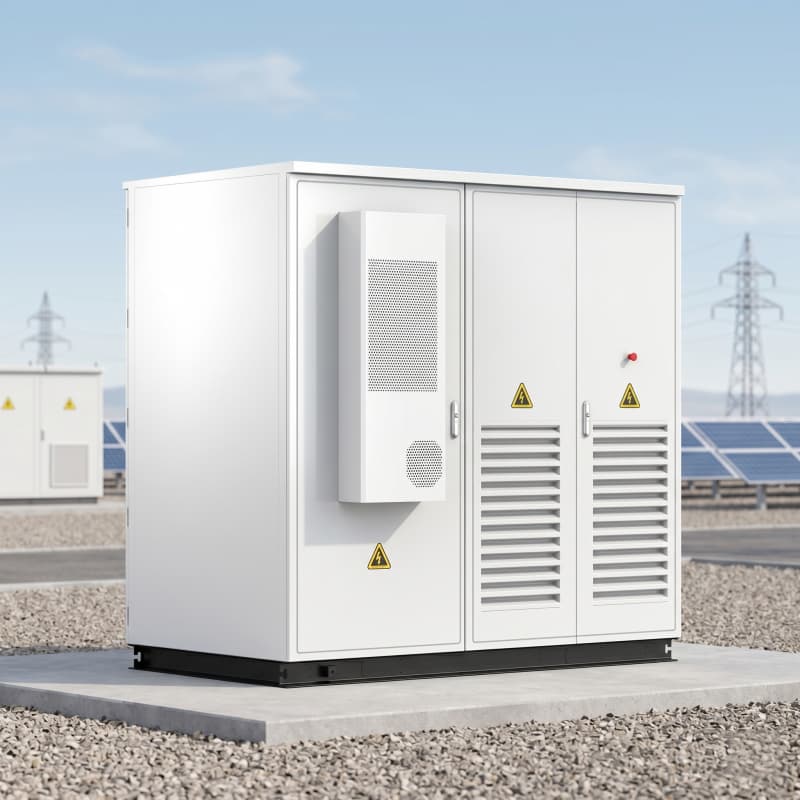
A factory needs equipment that covers its load window, fits the installation and arrives with the interfaces its EPC can commission. Use these metrics to expose a scope gap before it becomes an extra site bill. The cabinet illustration shows MegSolid’s 100kW/215.04kWh equipment route; the table gives the model-specific evidence and acceptance questions to request.
Energy density (Wh/kg)
- Compare cell, module and complete-BESS Wh/kg on separate boundaries. The published ESSA0100B-0215 has 215.04 kWh nominal energy and 3,900 kg net weight: about 55.1 nominal Wh/kg at the complete-cabinet boundary. A 220–350 Wh/kg cell target is not that cabinet metric.
Cycle life
- Define the cycling duty and retention requirement in the RFQ. The ESSA0100B-0215 catalogue lists ≥5,000 cycles; verify the relevant test conditions and supplied cell/BOM. There is no universal ≥6,000-cycle commercial threshold or no-augmentation guarantee.
C-rate performance
- Illustrative duty screen: 100kW for two hours requires 200kWh delivered AC. Assume an 80% SOC window and 95% one-way discharge conversion: 215.04 × 0.80 × 0.95 = 163.43kWh, about 1.63 hours at 100kW before auxiliaries, ageing and further reserve. Under those assumptions, 200 ÷ (0.80 × 0.95) = 263.16kWh nominal is the minimum energy screen before those allowances. Select the configuration and power capability separately; these assumptions are not product performance guarantees.
Thermal propagation control
- Whether failure is confined at module level instead of cascading at container level
System efficiency (RTE)
- Request the project RTE boundary, duty and auxiliary-energy account. A generic ≥90% target or maximum-system-efficiency label is not a measured AC round-trip result for every offered BESS.
Grid compatibility
- Identify the actual connection rules, offered inverter/PCS configuration, document scope and local approval responsibility. A product family name does not grant German or EU grid acceptance.
|
Metric
|
Matched Measurement Boundary
|
Equipment and Quotation Evidence
|
|---|---|---|
|
Energy density
|
Separate cell, module and complete-system mass
|
ESSA: 215.04kWh / 3,900kg ≈55.1 nominal cabinet Wh/kg. Request a configuration/weight record; compare the cell specification separately before accepting a density claim.
|
|
Thermal runaway propagation
|
Match the offered cell/BOM, test conditions and enclosure
|
Supplier: configuration-matched thermal reports and detection/isolation/suppression scope. EPC: site emergency interfaces. Release when report applicability and open safety interfaces are documented.
|
|
System efficiency
|
AC charge/discharge at the same boundary, with auxiliaries
|
Agree a net AC charge/discharge test at the required duty, including auxiliaries, SOC and ambient. Record measured values and tolerances; maximum PCS efficiency is not the acceptance result.
|
|
Cycle life
|
DoD, C-rate, temperature, end-of-life capacity and warranty
|
ESSA lists ≥5,000 cycles. Freeze the supplied cell/BOM and test conditions; quote throughput, retained-capacity and warranty limits so operating duty and replacement exposure can be priced.
|
|
Low-temperature performance
|
Use the model's charge/discharge and site ambient limits
|
ESSA: air cooling, 0–45°C. Price the required winter provision and controls; confirm charging/discharging limits and usable-energy acceptance at the site design temperature.
|
Top 10 Hybrid Solid-State Battery Companies in Germany and Supply Chain Landscape
The companies below are grouped into four supply-chain roles: system integration, domestic battery technology, international solid-state developers, and automotive OEMs. The list is a qualitative comparison, with no market-share or shipment ranking assigned. For example, BMW reported in May 2025 that it was testing Solid Power all-solid-state cells in an i7 in the Munich area. This is evidence of vehicle testing; stationary storage buyers need separate product and delivery evidence.
Category 1: Stationary BESS Equipment and Integration Routes
MegSolid supplies Hybrid Solid-State BESS and MEGA PCS equipment for C&I and microgrid projects. The ESSA0100B-0215 outdoor cabinet gives a concrete 100 kW / 215.04 kWh starting point, with battery, conversion and control functions brought into one cabinet platform. For a larger or different electrical duty, compare the MEGA Series PCS specifications with the battery voltage, AC interface and operating modes. The offer should name the cell/BOM, manufacturing location, configuration-specific test documents, grid-connection requirements, delivery terms and local service responsibilities so the purchasing team can compare complete delivery scope.
Key engineering characteristics:
- Equipment basis: ESSA0100B-0215 at 100 kW / 215.04 kWh nominal, or separately sized MEGA PCS equipment; obtain the RTE and usable-energy basis for the offered duty.
- Architecture: compare the published cabinet and container model ratings, then specify the initial and future equipment/controls scope instead of assuming a universal 100 kWh minimum.
- Control layer: EMS + PCS coordinated dispatch
- Applications: industrial peak shaving / microgrids / backup power
The focus is not on cell chemistry, but on:
- System energy path optimization
- Dynamic grid response capability
- Long-cycle degradation control
KRL Power
KRL Power’s published hybrid solid-state platform describes 314Ah cells and a solid-plus-optimised-liquid architecture. Its role here is an international stationary-equipment supplier option. Ask for the offered cabinet/container model, declared cell/BOM, usable AC energy, matched test documents and contractual delivery boundary. For a German site, price the local integration and service owner separately. A cell’s Ah rating is one input; the quotation must identify the complete system you can accept.
Technical characteristics:
- Identify the offered LFP or other cathode, declared electrolyte architecture and model-specific safety evidence.
- Focus on cost control and lifecycle balance
- Applied in C&I backup power and distributed storage systems
Category 2: German Cell Developers and Stationary-Storage Suppliers
CustomCells
CustomCells’ official news and development portfolio position it as a German specialist in customised high-performance cells, prototyping and industrialisation. Its July 2026 communications focus on defence and safety-critical applications. The useful buying question is a cell-development brief: required format, duty, qualification, sample schedule, scale-up route and production responsibilities. Establish the specific programme before assigning a solid-state label; a custom-cell project is a different contract from an installed stationary BESS.
- Custom cell development, prototyping and industrialisation: define your required cell and qualification deliverables.
- Current official positioning includes defence, safety-critical and motorsport-related applications; verify the exact programme and supply route.
- Buyer action: request sample availability, production plan, test scope and declared electrolyte architecture before shortlisting it for a stationary-system purchase.
VARTA
VARTA’s current stationary-storage portfolio includes flex storage E for commercial requirements of 75–750kWh and the VARTA.hybrid.wall range. This is a concrete stationary-system route to evaluate. Confirm the available model, usable energy, inverter/control scope, delivery and installer support for your project. The portfolio establishes storage products; it does not classify the range as solid-state. Select against the current catalogue rather than a discontinued model or an assumed experimental programme.
- Current stationary portfolio: flex storage E commercial range and VARTA.hybrid.wall; compare the exact available model.
- Confirm declared cell chemistry/architecture and quotation scope; product availability and installer responsibilities matter more than an assumed solid-state classification.
Theion
Berlin-based Theion describes a lithium-sulfur cell architecture using a sulfur wafer, a proprietary solid-state polymer electrolyte and a lithium-metal host-foil anode. That is more specific than treating sulfur alone as a “quasi-solid-state” classification. Its roadmap includes stationary applications, while performance and scale-up targets require qualification. A buyer should request present sample availability, measured test conditions, production milestones and the system-integration route before treating a development target as a delivery commitment.
- Declared architecture: sulfur cathode, proprietary solid-state polymer electrolyte and lithium-metal host-foil anode.
- Buyer action: separate published roadmap/performance targets from available samples, qualified cell data, production commitments and a complete stationary system.
Category 3: Global Solid-State Technology and Industrialisation Programmes
Solid Power
Solid Power’s 4 August 2026 update describes electrolyte development, partner evaluation and its continuous-manufacturing pilot installation/start-up programme. Its BMW relationship connects the technology to German automotive validation. For a materials or cell-development buyer, ask about electrolyte specifications, samples, qualification and licensing scope. For a stationary-system purchase, require a separate named battery/PCS/EMS supplier; a pilot milestone is not a complete BESS offer.
QuantumScape
QuantumScape inaugurated its Eagle Line on 4 February 2026 in San Jose. The pilot supports customer samples, testing, demonstrations, integration and licensees’ scale-up. Its PowerCo relationship is relevant to Germany’s automotive battery supply chain. Evaluate it as a technology and qualification programme: ask which cell generation is available, under which sample conditions and through which manufacturing partner. German stationary-cabinet availability needs its own supplier and product evidence.
ProLogium Technology
ProLogium announced Dunkirk groundbreaking in France on 10 February 2026; its 29 September 2026 update described site infrastructure and localisation progress. These are French factory-development milestones, not evidence of German manufacturing or European serial output. For a technology or cell-supply discussion, request the current product architecture, qualification status and actual production source. Match the contracted supply date to that source rather than to a factory announcement.
Category 4: German Automotive OEM Validation Programmes
BMW
BMW reported on 20 May 2025 that it was testing Solid Power all-solid-state cells in a BMW i7 around Munich. The programme examines behaviour including pressure, temperature and expansion under vehicle use. It gives an automotive buyer a dated validation milestone to follow. A factory procuring stationary storage still needs a separately offered system, delivery schedule and acceptance evidence; an i7 test is not a BESS product listing.
Volkswagen Group
Volkswagen’s PowerCo and QuantumScape announced an industrialisation licensing framework in 2024. A 2025 PowerCo/Audi/Ducati demonstration used QSE5 cells in a motorcycle. Treat licensing, demonstration and qualified production as separate milestones. These sources do not establish delivery in a next-generation MEB platform. Follow the programme for automotive industrialisation; request a separate configured offer when buying stationary equipment.
Mercedes-Benz
Mercedes-Benz’s 24 February 2025 report describes road testing of a lithium-metal solid-state prototype EQS using Factorial technology. Pack integration and vehicle tests are the relevant milestones. For an automotive programme, review the next qualification and industrialisation commitments. For a stationary buyer, keep range targets and prototype performance outside the BESS specification; obtain the actual offered system and local installation scope.
MegSolid System-Level Advantages in C&I Energy Storage Applications
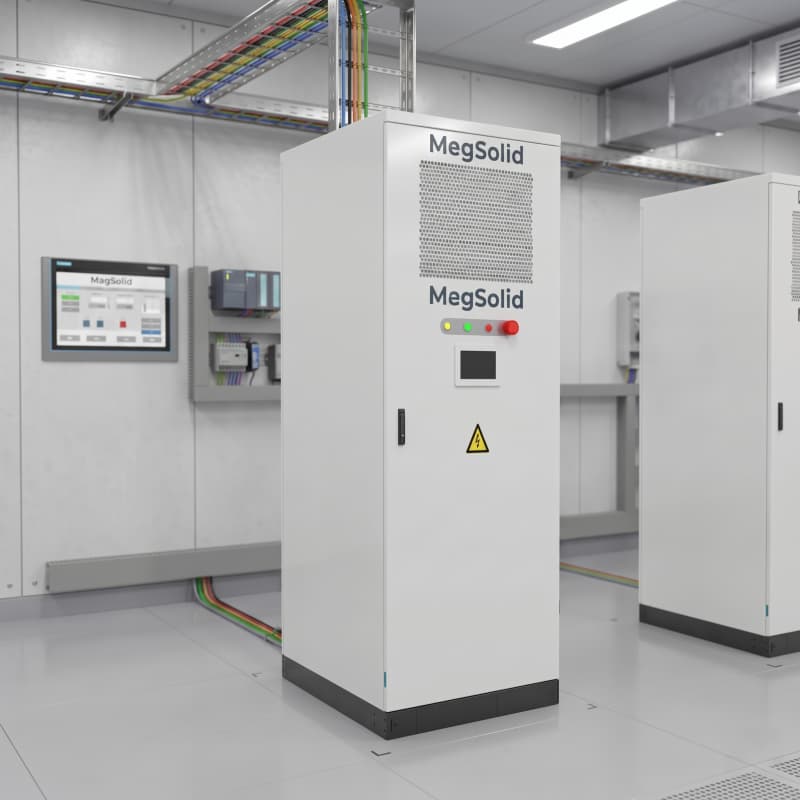
MegSolid’s stationary catalogue gives the EPC concrete equipment routes to compare: the existing 100kW/215.04kWh air-cooled cabinet, the 261.24kWh/125kVA liquid-cooled Energon 261 and 500kW–1MW air-cooled container configurations. The photographs are product illustrations for that shortlist. Match power, usable energy, voltage, winter operation and control interfaces to the site; ask the quoted package to identify its supplied cell architecture. Your appointed local delivery team should price installation, connection work and service alongside equipment.
System architecture characteristics
- Battery, PCS and EMS integration: identify the supplied model, DC/AC interfaces, dispatch permissions and accepted communications in the quotation.
- Energy path: agree the usable AC energy, SOC reserve, converter losses and auxiliary-load account for the actual operating window.
- System efficiency: compare the offered configuration at the required power and duration rather than promise an unmeasured universal gain.
Modular scalability
- Initial configuration: ESSA cabinet options provide distinct power/energy ratings, including 100 kW / 215.04 kWh for ESSA0100B-0215; name the actual unit in the order.
- Expansion: specify the future number of cabinets or a container route, common connection, usable energy and power requirement.
- Expansion controls: review protection, communications, EMS dispatch, firmware and acceptance tests for the expanded arrangement; do not assume redesign is unnecessary.
Engineering application features
- Industrial peak shaving
- Factory backup: calculate the protected load and required hours, then price usable energy, reserve, transfer requirements and UPS/ATS/generator responsibilities. Six to twelve hours is a project duty, not a generic cabinet capability.
- PV + storage microgrid systems
- Critical loads and data centres: specify the power-quality and interruption requirement and the complete UPS/ATS/BESS interface; a chemistry label does not establish UPS-level continuity.
Core value:
- Turn the site duty into a usable-energy and recharge plan that the EPC can test and the owner can operate.
- Define the grid/PCS operating modes and local acceptance responsibility before choosing the equipment.
- Price retention, maintenance, support and replacement obligations alongside the capital cost.
Conclusion
For a German stationary-storage purchase, the important distinction is who can deliver the required equipment and who owns the local installation and grid-acceptance work. A cell developer, automotive OEM and BESS supplier answer different buying questions. Use the company roles in this guide to shortlist the right contracting route.
At 500 kW and above, the load trace still decides the power and usable-energy duty. Compare the tariff interval, cycling throughput, recharge opportunity, reserve and replacement assumptions; neither a nominal capacity nor a generic ≥90% RTE or 3,000–6,000-cycle range establishes the project's financial result.
Select the offered inverter and PCS against the actual connection arrangement. The German EPC and grid operator must establish which EN 50549 and VDE-AR-N 4105/4110 requirements apply, plus the required document and test scope. Voltage level, connection rules and configured protection matter; there is no simple universal power threshold that proves approval.
For EPC contractors and system integrators, procurement decisions are gradually shifting from “battery chemistry selection” toward:
- system integration architecture
- controllability of multi-MW parallel clusters
- lifecycle energy throughput stability
Turn the shortlist into a comparable offer. Send MegSolid the site location, interval load profile, critical loads and motor starts, AC voltage/connection arrangement, required runtime, PV/generator details, recharge window, reserve, design temperature and delivery target. Ask us to return a named equipment configuration, declared cell/BOM, document schedule, scope and exceptions list, and the factory-support terms included in the price. Then agree the local EPC’s installation, grid acceptance and service responsibilities. This gives your purchasing team equipment and delivery scope it can compare before committing.
FAQ
Q1: What is the minimum project size suitable for hybrid solid-state BESS in Germany?
Use the actual duty and offered model. MegSolid has residential battery products and C&I cabinet/container routes; hybrid solid-state requirements must identify the supplied cell architecture. The ESSA0100B-0215 provides a 100 kW / 215.04 kWh nominal cabinet reference, not a universal 100 kWh minimum or a proven 500 kW–10 MW optimum for every project. For home installations, compare the mega series energy storage system options against the required usable energy and inverter pairing.
Q2: Can hybrid solid-state batteries directly replace LFP systems in existing storage projects?
Replacement is possible at system level, but not plug-and-play. The PCS configuration, EMS logic, and thermal management design must be revalidated to ensure compatibility with load profile, grid code, and cycling depth requirements. Use the battery–PCS/BMS integration checklist to record voltage, current, protocol and firmware evidence before accepting a replacement.
Q3: What is the typical ROI period for industrial hybrid solid-state BESS in Germany?
ROI depends on the tariff, measured load/dispatch, usable AC energy, recharge cost, retention, installed scope and service obligations. Request the RTE boundary for the actual duty instead of assuming every system achieves ≥90%. Compare named equipment and priced local integration before relying on a savings result.
Q4: What is the key difference between semi-solid and hybrid solid-state batteries in storage systems?
The terms semi-solid and hybrid solid-state can overlap in marketing and do not by themselves fix liquid content or performance. Identify the offered cell's declared electrolyte architecture, cathode and matched test conditions. LFP is a cathode description and can coexist with a semi-solid electrolyte. For the matched-cell comparison method, see thermal runaway gas production semi-solid electrolyte ncm vs liquid.
Q5: How does grid compliance affect BESS selection in Germany?
Establish the actual German connection rules with the local EPC/grid operator, including applicable EN 50549 and VDE-AR-N 4105 or 4110 scope. Match the offered PCS/inverter, firmware, protection and accepted documents to that connection; the battery label alone cannot provide approval. Where the connection agreement requires zero export, review the bess zero export sat test checklist before defining the witnessed cases and evidence.
Q6: What cycle life is required for commercial energy storage projects in Germany?
There is no universal minimum of 6,000 cycles at 80% DoD for every C&I project. Define annual throughput, temperature, C-rate and required retained capacity, then compare the actual model's conditions and warranty. ESSA0100B-0215 lists ≥5,000 cycles; this is not a guaranteed 15-year no-augmentation result.
Q7: What is the typical energy density advantage of hybrid solid-state systems over LFP?
Compare the same measurement boundary. Cell-level Wh/kg cannot be used as complete-cabinet Wh/kg. ESSA0100B-0215 lists 215.04 kWh nominal energy and 3,900 kg net weight, about 55.1 nominal Wh/kg for that cabinet. The offered hybrid cell or module needs its own specification rather than a universal 220–350 Wh/kg system claim.
Q8: Are hybrid solid-state batteries suitable for data center backup power systems?
They may be considered as part of a properly specified storage architecture, but they do not automatically provide data-centre UPS-level continuity. Define the critical-load power, runtime, interruption tolerance and UPS/ATS/BESS interface, then select and test the delivered configuration.
Q9: What is the main limitation of hybrid solid-state battery deployment today?
For a stationary buyer, the limits are product-specific availability, tested operating range, integration, document scope, cost and support. An EV development announcement does not establish a deliverable stationary BESS; compare the actual offered model and delivery commitments. Use the battery energy storage supplier capability assessment to review manufacturing evidence, integration responsibilities and support scope.
Q10: How does system architecture influence performance more than battery chemistry?
Because usable AC energy, operating modes, cooling, protection and handover depend on the complete configured system. Cell architecture still matters and must be identified, but buying a battery label without the PCS/EMS and local integration scope leaves the EPC to resolve the project after delivery. Use the C&I battery storage applications to define the duty, then compare the battery storage and PCS product range and energy storage inverter and PCS range for the proposed architecture.