 Skip to content
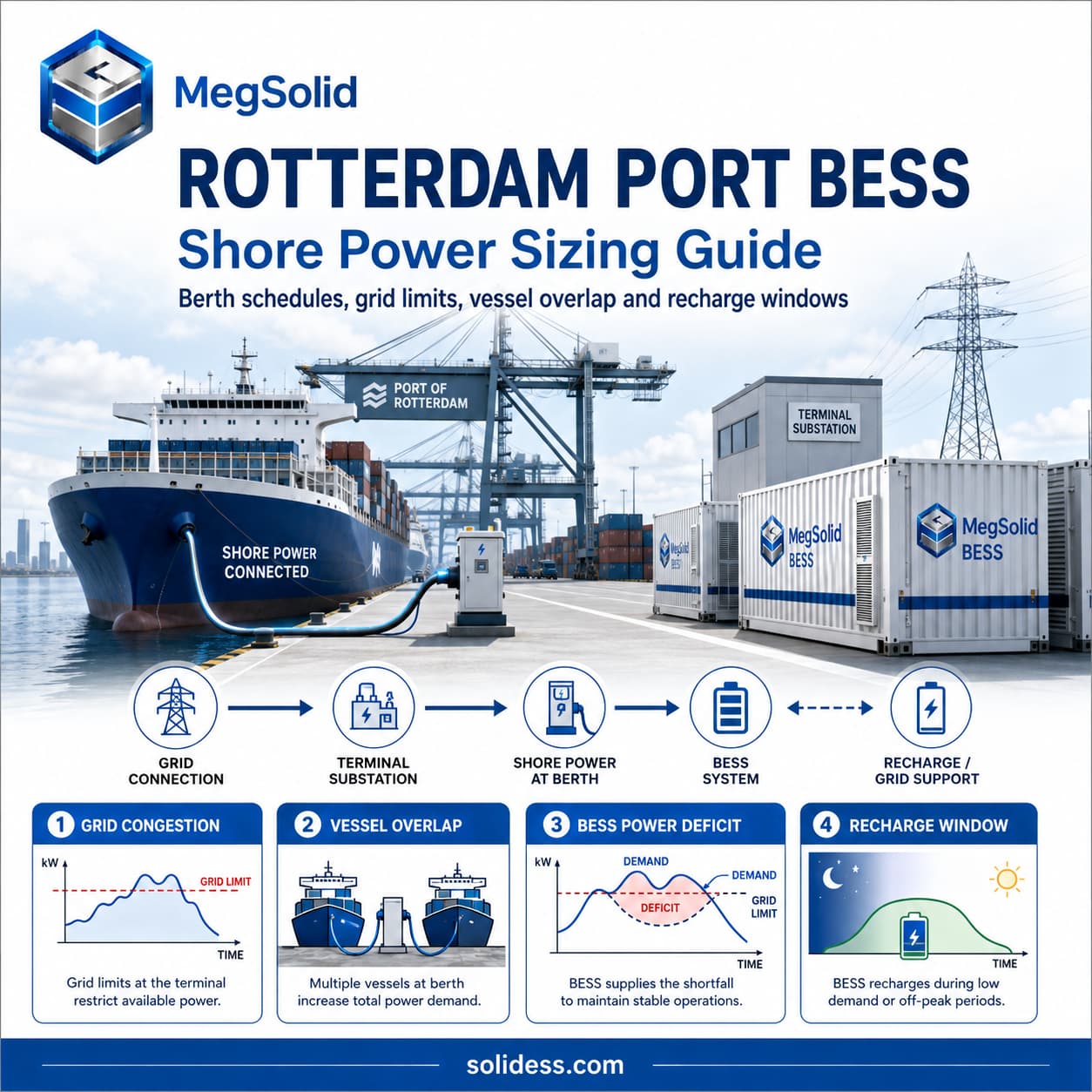
A Rotterdam terminal may have enough annual electricity for shore power and still lack sufficient capacity during a three-hour berth overlap.
The problem appears when several loads converge behind the same connection:
- A vessel connects to shore power.
- A second vessel arrives before the first departs.
- Cranes, reefers and terminal equipment remain operational.
- The contracted grid capacity cannot increase.
- The BESS has limited time to recover before the next port call.
This is not solved by adding the nameplate ratings of every shore-power connection. The project needs a time-aligned model of vessel demand, terminal load, grid availability and battery recovery.
Rotterdam already operates more than 100 shore-power installations with over 43MW of combined capacity. Its Shore Power Strategy 2025–2035 also acknowledges that grid congestion is complicating deployment in parts of the port and identifies mobile shore power and alternative grid-contract arrangements as potential responses.
For EPC contractors evaluating storage, the commercial question is:
Can a BESS cover the terminal’s coincident shore-power deficit and recover before the next vessel requires energy?
MegSolid uses the berth schedule—not the number of connection points—as the starting point for this calculation.
Why Rotterdam Shore-Power Projects Need a Different Sizing Method
Rotterdam is moving from demonstration projects into large-scale terminal construction.
In January 2026, Rotterdam Shore Power selected ABB for installations at APM Terminals Maasvlakte II, ECT Delta and ECT Euromax. The projects cover eight kilometres of quay, 35 connection points and more than 100MVA of total shore-power capacity.
This scale does not mean every terminal requires a BESS.
Battery storage becomes relevant when one or more of the following conditions apply:
| Terminal Condition | BESS Relevance |
|---|---|
| Grid-import capacity is below coincident vessel demand | High |
| Grid reinforcement will arrive after shore-power commissioning | High |
| Vessel overlap creates predictable temporary peaks | High |
| Mobile shore power is needed at an unserved berth | Conditional |
| Terminal load leaves no reliable recharge window | Low until corrected |
| Shore-power demand remains above the grid limit for most of the day | BESS alone may be unsuitable |
| Long-duration supply is required without grid access | Evaluate generation or hybrid supply |
The Port of Rotterdam has already demonstrated two locally relevant battery roles.
One pilot used a battery to increase the power available from an existing inland-shipping shore-power box. Another used movable battery containers to supply sea-going vessels at an operational terminal where fixed grid infrastructure was limited.
These pilots prove technical feasibility. They do not establish the required MW, MWh or commercial architecture for a deep-sea container terminal.
Build the Berth and Terminal Load Timeline
The most important design input is a time-series schedule showing what happens behind the terminal connection.
For each vessel, record:
- Arrival and departure time
- Connection and disconnection allowance
- Expected shore-power demand
- Voltage and frequency requirement
- Auxiliary-load variation during cargo handling
- Minimum guaranteed power
- Maximum expected load
- Vessel class and connection standard
The vessel schedule must then be aligned with:
- Crane operation
- Reefer-container demand
- Terminal buildings
- Workshops and pumping systems
- Electric cargo-handling equipment
- Existing solar or local generation
- Other loads sharing the transformer
Annual energy consumption cannot replace this model. Two terminals with the same annual MWh may require very different BESS power because their vessels overlap differently.
Submit the Berth Schedule and Grid Capacity
For a project-specific equipment review, provide:
- Vessel arrival and departure schedule
- Shore-power requirement by vessel class
- Simultaneous connection assumptions
- Fifteen-minute terminal load data
- Contracted grid-import capacity
- Transformer and switchgear ratings
- Shore-power voltage and frequency
- Existing or planned generation
- Single-line diagram
- Required reserve and recovery window
The broader scope should also be checked against the commercial energy storage procurement guide before the battery, PCS, EMS and shore-power converter responsibilities are assigned.
Calculate the Power Available for Shore Supply
The terminal cannot allocate its full grid connection to vessels.
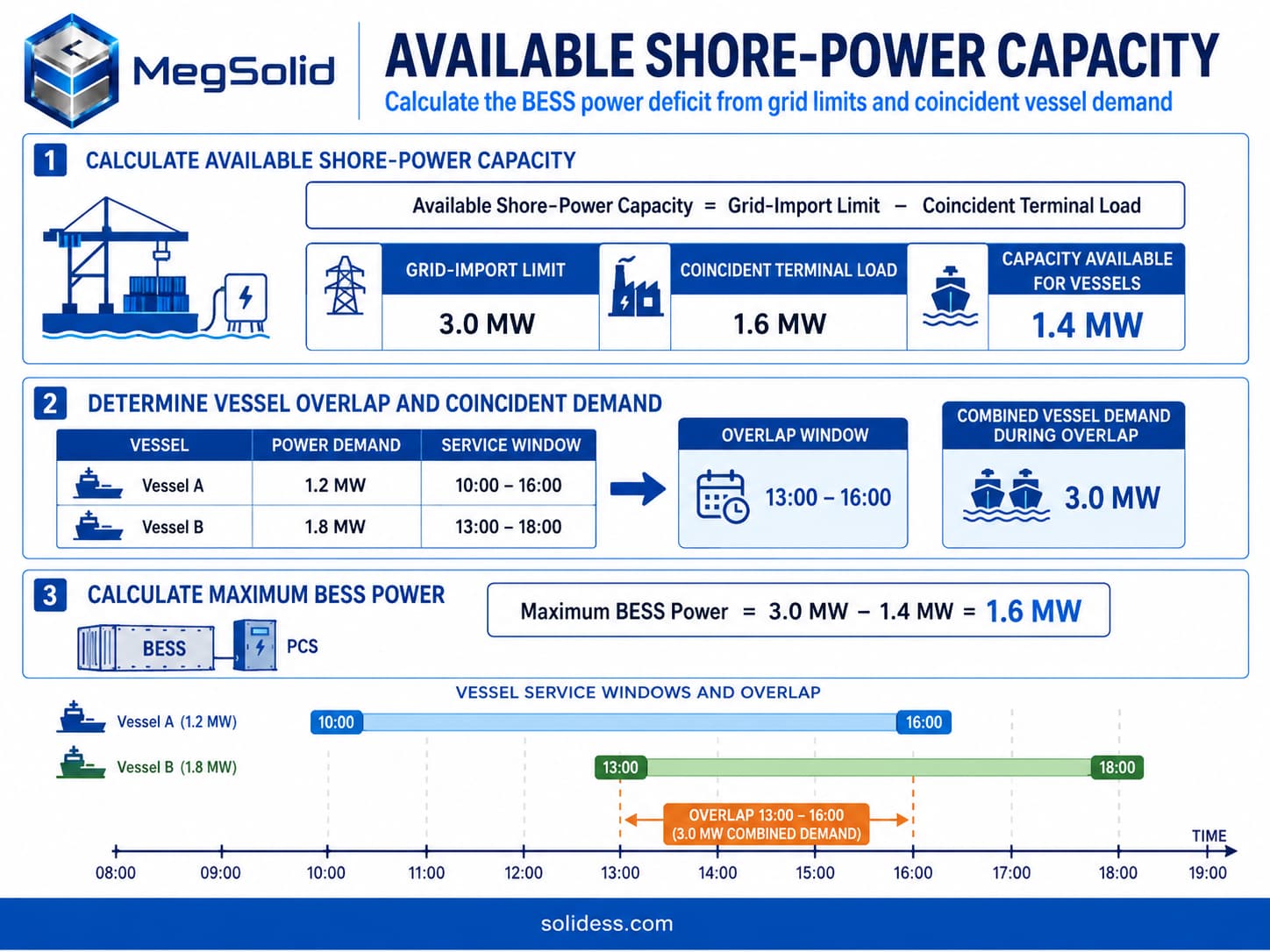
Available Shore-Power Capacity = Grid-Import Limit − Coincident Terminal Load
Assume the following illustrative Rotterdam terminal:
| Electrical Input | Value |
|---|---|
| Contracted grid-import limit | 3.0MW |
| Coincident terminal operating load | 1.6MW |
| Capacity available for vessels | 1.4MW |
The BESS must cover only the demand above 1.4MW, provided the grid-import limit remains firm and terminal load does not increase.
This calculation should use measured interval data rather than a single monthly peak.
Size BESS Power From Vessel Overlap
Assume two vessels connect during the same afternoon:
| Vessel | Shore-Power Demand | Connection Window |
|---|---|---|
| Vessel A | 1.2MW | 10:00–16:00 |
| Vessel B | 1.8MW | 13:00–18:00 |
From 10:00 to 13:00, Vessel A requires 1.2MW. The terminal’s available 1.4MW grid capacity can support it without battery discharge.
From 13:00 to 16:00, both vessels require 3.0MW.
Maximum BESS Power = 3.0MW − 1.4MW = 1.6MW
From 16:00 to 18:00, only Vessel B remains:
Remaining BESS Power = 1.8MW − 1.4MW = 0.4MW
A 500kW BESS would therefore fail during the three-hour overlap, even if its battery contained enough energy to support the later 400kW segment.
The preliminary converter direction should exceed the verified 1.6MW deficit and account for:
- PCS redundancy
- Power factor
- Shore-power converter losses
- Terminal-load forecast error
- Reactive-power requirements
- Auxiliary consumption
- Failure of one converter block
Higher-power projects may require a pooled MEGA PCS architecture rather than one converter.
Calculate Energy Across the Full Port Call
The battery must cover every interval in which demand exceeds the permitted grid supply.
For the three-hour vessel overlap:
Overlap Energy = 1.6MW × 3h = 4.8MWh
For the final two hours of Vessel B:
Remaining Energy = 0.4MW × 2h = 0.8MWh
Therefore:
Total AC Discharge Requirement = 4.8MWh + 0.8MWh = 5.6MWh
Using an illustrative 80% usable SOC window and 90% discharge-path factor:
Preliminary Nominal Capacity = 5.6MWh ÷ 0.80 ÷ 0.90 ≈ 7.78MWh
Additional reserve may be required for:
- Battery degradation
- Low or high temperature
- Forecast uncertainty
- Delayed vessel departure
- Auxiliary loads
- Emergency operating reserve
- Unplanned terminal-load increases
This example shows why a 5MWh container may be insufficient even when the maximum power deficit is only 1.6MW.
Verify Recovery Before the Next Vessel Arrives
A BESS that supports the first port call but cannot recover for the next one does not solve the terminal’s capacity problem.
Assume the battery can recharge between 18:00 and 02:00 and the terminal has 800kW of available grid capacity during that period:
Maximum Grid Energy for Recharge = 0.8MW × 8h = 6.4MWh
With an illustrative 90% charging-path factor:
Energy Restored to the Battery ≈ 5.76MWh
This leaves little or no margin after restoring the 5.6MWh discharged during the previous event.
A later vessel, a higher terminal night load or a shortened recovery window would cause progressive SOC depletion.
Possible remedies include:
- Increasing contracted grid capacity
- Extending the recharge window
- Reducing simultaneous shore-power delivery
- Adding local generation
- Increasing battery capacity without increasing power
- Rescheduling flexible terminal loads
- Maintaining a generator-backed contingency
The EMS should calculate projected end-of-event SOC before accepting the next shore-power commitment.
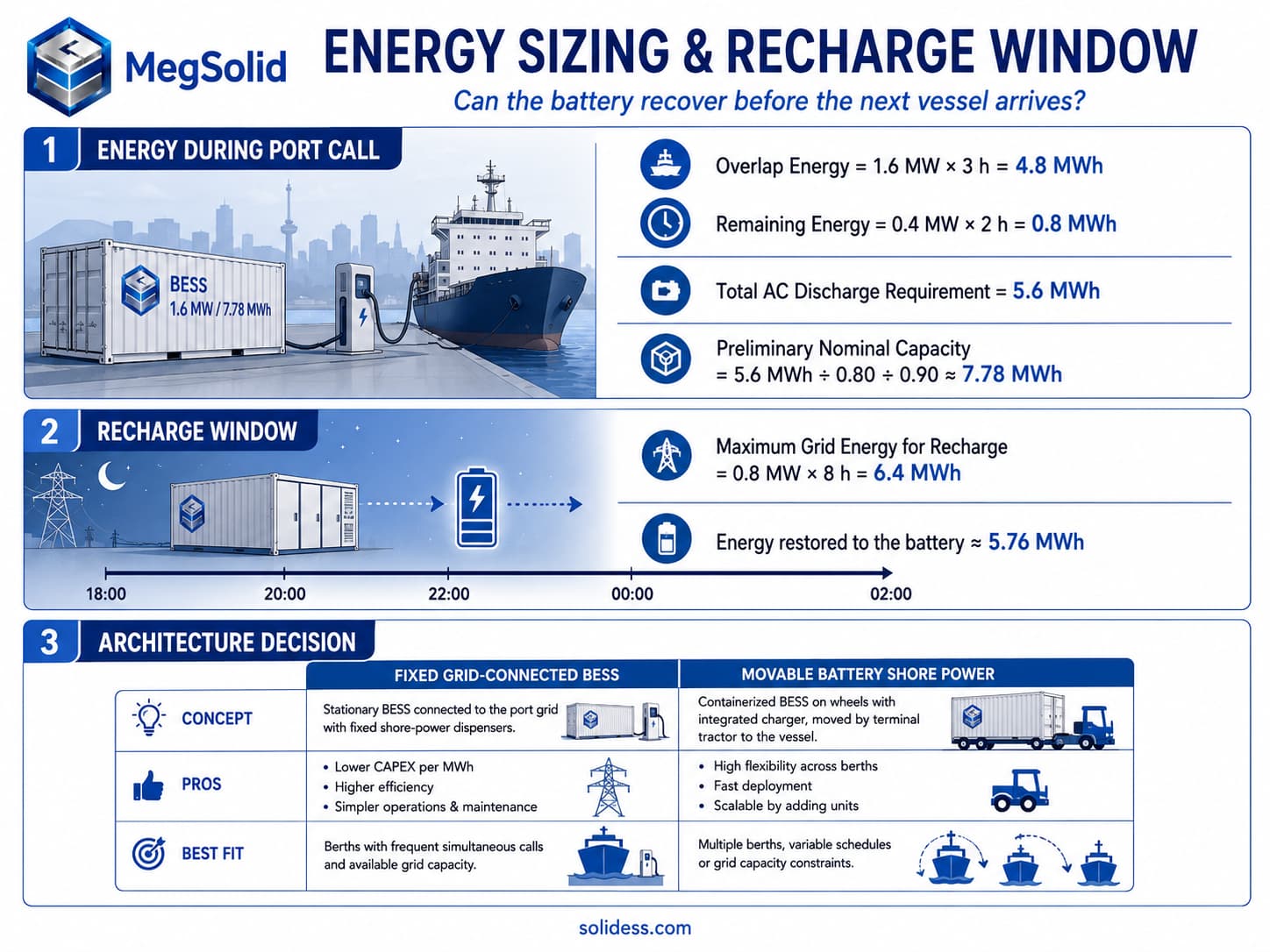
Fixed BESS or Movable Battery Shore Power?
| Architecture | Best Application | Procurement Risk |
|---|---|---|
| Fixed grid-connected BESS | High-use terminal with repeatable berth schedules | Grid approval and civil integration |
| Movable battery containers | Temporary or currently unserved berths | Logistics, connector handling and higher operating cost |
| Multiple distributed cabinets | Smaller separated berth loads | More interfaces and maintenance points |
| Central containerized BESS | MW-scale shared terminal demand | Larger failure domain and cable infrastructure |
| BESS-generator hybrid | Long outages or insufficient recharge capacity | Fuel, emissions and control complexity |
The Rotterdam movable-battery pilot concluded that the concept was technically feasible but expected it to be more expensive than a conventional fixed grid connection. The port identified locations without grid access or affected by grid congestion as more plausible applications.
Terminals comparing these layouts should review modular cabinets versus containerized ESS before fixing cable routes and civil works.
Where Should the BESS Connect?
A port BESS can be integrated at several points:
Behind the Terminal Grid Meter
The BESS supports the terminal AC bus and reduces import at the point of connection.
This is flexible because the battery can support shore power and selected terminal loads. It also requires coordination with terminal protection and the shore-power conversion system.
At the Shore-Power Converter Input
The battery supports a dedicated converter station rather than the complete terminal bus.
This creates a clearer shore-power boundary but may reduce operational flexibility.
Within a Vendor-Specific DC Architecture
A DC-coupled design may reduce conversion stages, but it creates tighter dependence on the shore-power converter supplier, DC voltage range and protection design.
No topology should be selected from battery efficiency alone.
For high-voltage shore connection systems, IEC/IEEE 80005-1 covers shore distribution, shore-to-ship interfaces, transformers, frequency converters, monitoring, interlocking and power management. A certified BESS cabinet does not make the complete shore-connection system compliant.
Preliminary MegSolid Product Direction
| Verified Requirement | Preliminary Direction |
|---|---|
| Up to 500kW deficit | MEGA PCS with project-specific battery capacity |
| 500kW / approximately 1MWh | ESSC 500kW/1.0752MWh |
| 1MW / approximately 2MWh | ESSC 1MW/2.1504MWh |
| Multi-MW, 5MWh-class block | 5000INTL 2.7MW/5.0159MWh |
| 7–10MWh terminal project | Multiple containerized blocks |
| Flexible temporary berth | Project-specific movable architecture |
The MegSolid containerized energy storage systems include 500kW/1.0752MWh and 1MW/2.1504MWh air-cooled configurations. The 5000INTL platform provides 2.7MW/5.0159MWh with liquid cooling and IP55 protection.
For the illustrative 1.6MW/7.78MWh requirement, preliminary comparison could include:
- Four 2.1504MWh container blocks
- Two 5.0159MWh blocks
- A mixed power-and-energy configuration engineered around the berth profile
This is not a final product commitment. The project must verify PCS parallel operation, medium-voltage transformation, marine corrosion requirements, fire separation, grid compliance and shore-power integration.
Review the 5MWh BESS engineering architecture before selecting a large terminal block.
AFIR and FuelEU Do Not Define the BESS Size
AFIR requires qualifying TEN-T maritime ports to provide sufficient shore-side electricity by 31 December 2029 to serve at least 90% of relevant container and passenger-vessel port calls above the specified threshold.
The Rotterdam strategy is therefore driven by a real infrastructure deadline, but AFIR does not specify the battery capacity required at an individual terminal.
The BESS must still be calculated from:
- Terminal grid capacity
- Vessel port-call data
- Simultaneous demand
- Recovery time
- Shore-power architecture
- Local grid-operator requirements
Regulatory coverage should not be converted into unsupported claims that a battery product is “AFIR certified.”
EMS, FAT and SAT Requirements
The port EMS should receive:
- Berth schedule
- Vessel connection status
- Shore-power demand
- Terminal import
- Transformer loading
- Converter availability
- BESS SOC and SOH
- Recharge forecast
- Grid-limit alarms
The control structure can be developed using the BMS and EMS communication architecture.
FAT should simulate vessel connection, simultaneous berth demand, PCS-block failure, minimum SOC, communication loss, grid-limit violation and controlled shutdown.
SAT should verify actual power at the terminal connection, shore-power converter interaction, harmonic performance, interlocks, emergency stop, recharge logic and recovery before the next scheduled vessel.
Convert these scenarios into witnessed acceptance criteria using the BESS Factory Acceptance Testing guide.
Final Procurement Decision
A Rotterdam port BESS should not be selected from annual shore-power consumption or the total rating of all connection points.
The project is ready for quotation only when it can demonstrate:
- A verified vessel and berth timeline
- Measured terminal interval loads
- A firm grid-import limit
- The maximum coincident power deficit
- Energy required across every deficit interval
- A feasible SOC recovery window
- A defined shore-power connection topology
- Approved EMS, protection, FAT and SAT responsibilities
Submit the berth schedule, terminal load profile and electrical single-line diagram through the MegSolid project inquiry page.
FAQ
Q1: Can a 500kW BESS support Rotterdam shore power?
Only when the maximum demand above available grid capacity remains within the verified PCS power and battery duration.
Q2: Should BESS be sized from all shore-power connections?
No. It should be sized from the maximum time-aligned vessel demand expected behind the same grid connection.
Q3: Why is the berth schedule required?
It identifies when vessels overlap, how long the power deficit continues and when the battery can recharge.
Q4: Can battery storage avoid a grid upgrade?
It may defer or reduce an upgrade when the capacity shortage is temporary. A persistent daily deficit may still require reinforcement.
Q5: Is movable battery shore power suitable for every berth?
No. Rotterdam’s pilot found it technically feasible but generally more expensive than a fixed connection.
Q6: No. Rotterdam’s pilot found it technically feasible but generally more expensive than a fixed connection.
Not with the illustrative reserve and loss assumptions. The preliminary nominal requirement is approximately 7.78MWh.
Q7: Does AFIR require terminals to install BESS?
No. AFIR sets shore-side electricity infrastructure targets, not a mandatory battery architecture.
Q8: Can BESS support terminal cranes and shore power together?
Yes, when both load profiles are included in the connection-point calculation and the EMS applies clear priorities.
Q9: What happens when the battery cannot recharge before the next vessel?
The terminal must reduce shore-power commitments, add generation, increase grid capacity or revise the operating schedule.
Q10: What information is needed for a quotation?
Provide berth schedules, vessel demand, terminal interval data, grid and transformer limits, voltage, frequency and the single-line diagram.
Q11: How do you size a BESS for shore power at the Port of Rotterdam?
Calculate available grid capacity after terminal loads, model coincident vessel demand, integrate every power-deficit interval and verify recharge before the next port call.
Q12: Can BESS solve Rotterdam port grid congestion?
It can address temporary and predictable capacity shortages. It cannot sustainably correct a continuous energy deficit without adequate recharge.
Q13: Which BESS architecture suits a Rotterdam container terminal?
High-use terminals generally require a fixed multi-MW containerized system. Temporary or unserved berths may justify movable battery shore power.
