Size a South African hospital solar and battery system from the circuits it must protect, the interruption each circuit can tolerate, the power needed during the worst event and the energy available until another source recovers.
Eskom’s July 2026 Mafikeng Provincial Hospital announcement describes 200 kW of solar PV, a 400 kWh BESS and a central microgrid controller supporting departments including ICU, theatres and Emergency. It does not publish a 170 kW critical-load figure, a PCS rating, usable AC capacity or the PV AC/DC rating basis.
This guide therefore uses 170 kW as an independent, hypothetical protected-load example. The calculations below are teaching assumptions, not measured Mafikeng performance or a MegSolid hospital guarantee.
Use this design sequence, with the clinical, facilities and appointed electrical teams approving each boundary:
Medical load classification → Simultaneous AC power → Guaranteed usable AC energy → Backup duration → Solar recharge → Generator coordination
The MegSolid hybrid solid-state energy storage portfolio can support project-specific battery, PCS and microgrid engineering after these operating requirements are defined.
Start with Medical Load Classification
For the illustrative 170 kW load, identify the actual feeders before deciding which must remain energized throughout an outage. A department name alone cannot establish the medical classification or transfer tolerance of every connected circuit.
Hospital EPCs should divide the critical-load schedule according to clinical consequence and interruption tolerance.
| Medical load class | Typical circuits | Required design decision |
|---|---|---|
| No-break clinical loads | Selected ICU equipment, theatre circuits, medical controls, emergency lighting and clinical IT | Can any transfer interruption be accepted? |
| Essential support loads | Selected ventilation, laboratory, pharmaceutical refrigeration, water and communications | How quickly must the circuit recover? |
| Controlled sheddable loads | Non-immediate support circuits approved by the hospital | At what SOC may the EMS disconnect them? |
The exact classification must be approved by the hospital’s clinical, electrical and facilities teams.
No universal percentage should be assigned to each class without feeder measurements.
IEC 60364-7-710 addresses electrical installations in medical locations. The project engineer must establish the applicable South African standards, adopted editions, clinical classifications and local authority requirements; a battery supplier should not assign medical transfer limits from a generic sales article.

Size PCS Power Before Battery Capacity
A 400kWh battery cannot support a hospital if the PCS cannot carry the simultaneous critical load.
If 170 kW must be supplied simultaneously, a PCS with less than 170 kW of available continuous output cannot carry the protected load alone. The example also assumes 3 kW of auxiliaries: if they use the same PCS output, its active-power duty is at least 173 kW before other allowances. Check available output in the required mode and at site temperature.
The EPC must then add project-specific checks for:
- Apparent power in kVA
- Measured power factor
- Reactive-power demand
- Three-phase imbalance
- Ventilation and pump starting
- Transformer energisation
- Harmonic loads
- Step-load response
- Redundancy requirement
- Operation after one PCS block becomes unavailable
At an illustrative protected-load power factor of 0.90, 170 ÷ 0.90 = 188.9 kVA for the protected load only. Calculate the auxiliaries’ actual reactive demand separately when determining total PCS kVA; do not silently assign them the same power factor. Starting events, imbalance and design margins remain separate checks.
A two-hour illustrative outage can be screened as follows. All allowance factors are assumptions to replace with project and supplier data:
| Illustrative input or result | Calculation | Meaning |
|---|---|---|
| Protected load and duration | 170 kW × 2 h = 340 kWh AC | Energy delivered to protected loads |
| Assumed power factor | 170 ÷ 0.90 = 188.9 kVA | Protected-load kVA only; add the auxiliaries’ actual reactive demand and check starting duty |
| Assumed system auxiliaries | 3 kW × 2 h = 6 kWh | Added separately because path efficiency excludes auxiliaries; if supplied by the same PCS output, active-power duty is at least 173 kW before other allowances |
| Assumed usable SOC / retained capacity / path efficiency | 0.80 / 0.80 / 0.92 | Teaching assumptions, not warranted product values |
| Indicative nominal battery capacity at assumed warranty point | (340 + 6) ÷ (0.80 × 0.80 × 0.92) = 587.6 kWh | First-pass capacity screen; check power, temperature and recharge constraints |
| Beginning-of-life screen using the same other inputs | 346 ÷ (0.80 × 1.00 × 0.92) = 470.1 kWh | Shows why warranty age changes the procurement obligation |
For this example, 80% SOC window, 80% retained capacity and 92% conversion-path efficiency are independent teaching inputs. The efficiency factor excludes the separately counted 3 kW auxiliary load; do not count auxiliary energy again if a supplier’s usable-AC guarantee already deducts it.
A 250 kW-class PCS may enter a preliminary shortlist, but its nameplate alone does not prove the required kVA, step-load response, fault contribution, islanding, transfer performance or redundancy.
The EPC must verify the actual kVA requirement, overload curve, short-circuit behaviour, protection coordination and redundancy philosophy.
Review the MegSolid PCS range and the exact model’s current datasheet against these requirements before fixing the hospital SLD. Keep battery DC voltage, power limits and protection within the released configuration.
Calculate Runtime at the Protected-Load Switchboard
For the hypothetical 170 kW load and a 400 kWh nameplate battery, the simple ratio is:
400kWh ÷ 170kW = 2.35 hours
This is only a nominal energy-to-load ratio.
It does not prove that the hospital will receive 170kW for 2.35 hours at the critical-load switchboard.
The actual runtime must be calculated as:
Backup runtime = Guaranteed usable AC energy at the agreed delivery point ÷ Supported load
To determine guaranteed usable AC energy, the quotation must define:
- Approved SOC operating window
- Battery-side auxiliary consumption
- Cooling and control consumption
- PCS conversion losses
- Transformer and cable losses
- Minimum emergency reserve
- Temperature derating
- Beginning-of-life capacity
- End-of-life guaranteed capacity
- Measurement point for the capacity test
The Eskom announcement does not disclose the factors needed to convert its 400 kWh battery rating into guaranteed energy at the protected hospital loads. Do not apply the illustrative assumptions above to that installed system as if they were measured facts.
Using those assumptions on a separate hypothetical 400 kWh battery gives 400 × 0.80 × 0.80 × 0.92 = 235.52 kWh at the conversion output. Dividing by 173 kW, including the assumed 3 kW auxiliaries, gives 1.36 hours at the assumed end-of-life condition. At beginning of life, with the retained-capacity factor set to 1.00, it gives 1.70 hours. Neither result is a product guarantee.
The C&I energy storage engineering guide explains why nominal DC capacity and delivered AC energy must be stated separately.
Use Load Shedding to Preserve Clinical Runtime
Medical load classification allows the EMS to change the supported load as the outage continues.
A practical sequence may be:
- Maintain all approved critical circuits immediately after grid loss.
- Confirm battery SOC, PV availability and generator status.
- Disconnect approved sheddable circuits if the generator fails to start.
- Reduce selected essential-support loads if SOC reaches the next threshold.
- Protect the final battery reserve for no-break clinical circuits.
Calculate load-tier runtime from feeder measurements and the approved sequence. If demand changes during an outage, integrate the time-varying load and auxiliaries rather than dividing one capacity value by the hospital’s peak kW.
For example, every 10 kW of approved load reduction maintained for one hour avoids 10 kWh of protected-load demand. The clinical team must approve the affected circuits and operating conditions; the energy arithmetic does not authorize shedding clinical equipment.
The hospital EPC should require the EMS functional description to state:
- Which feeder belongs to each class
- Who approves a feeder for shedding
- The SOC threshold for each action
- The delay before disconnection
- The reconnection sequence
- The manual clinical override
- Behaviour after communication failure
The BMS and EMS communication architecture guide provides the control framework for SOC, temperature, alarms and power commands.
Calculate Solar Recharge from Surplus PV
The public Mafikeng project has a 200 kW PV figure, but the announcement does not provide the detailed production or load series. For a separate illustrative calculation, assume PV is delivering 200 kW AC at an instant when protected demand is 170 kW.
Before charging limits, auxiliaries and losses, the surplus at that instant would be:
200kW − 170kW = 30kW
This does not mean the battery charges continuously at 30kW.
PV output changes throughout the day, and the hospital load may also vary.
The correct calculation is:
For each time interval, charging power is limited by max(PV output − simultaneous served load, 0), the battery/PCS charge capability, SOC headroom and the allowed network condition. Sum accepted charging power × interval duration, then apply the defined charging boundary and losses.
A hospital solar model should include:
- Hourly or sub-hourly hospital demand
- Seasonal PV simulation
- Array orientation and shading
- AC clipping
- Temperature losses
- PV availability
- Minimum required evening SOC
- Next expected outage
- Grid-charging permission
- Generator-assisted charging rules
As a reproducible illustration, five one-hour AC PV readings of 120, 180, 200, 180 and 120 kW against a constant 170 kW served load produce gross charging opportunities of 0, 10, 30, 10 and 0 kWh: 50 kWh total before charge losses. That does not refill a battery that supplied 340 kWh to loads during a two-hour outage.
The hybrid solar-storage architecture guide explains how PV, battery, grid and generator power should be coordinated.
What MegSolid Returns After a Preliminary Review
After receiving the load and electrical data, MegSolid can prepare:
- Preliminary PCS power and kVA direction
- Nominal battery-energy direction
- Required usable AC energy definition
- Medical-load priority matrix
- Solar recharge assessment
- Minimum reserve-SOC strategy
- Battery and PCS architecture direction
- Missing-data register
- Hospital-specific FAT scenario list
Coordinate UPS, BESS and Diesel Generators
A hospital BESS should not automatically replace the existing UPS or diesel generator.
Each system has a different responsibility.
UPS or No-Break Power Path
The UPS protects equipment that cannot tolerate the transfer sequence between grid, BESS and generator.
Its required runtime and transfer performance should come from the connected medical equipment and hospital electrical specification.
Battery Energy Storage System
A suitably configured BESS can support the hospital microgrid and provide minute-to-hour energy. Its transfer time, grid-forming capability and behaviour after a controller or PCS fault must be established for the exact configuration.
It can also bridge the generator start sequence and reduce unnecessary starts during short interruptions.
Diesel Generator
The generator provides extended-duration energy when the outage exceeds the battery reserve or solar production is insufficient.
The design must define:
- Generator start SOC
- Start delay
- Minimum run time
- Maximum battery-charging power
- Generator loading limits
- Synchronisation method
- Reverse-power protection
- Response to failed starts
- Fuel and low-fuel alarms
- Return-to-grid sequence
Purchasing the UPS, BESS and generator as unrelated systems transfers the coordination risk to the hospital operator.
What Battery Evidence Should a Hospital EPC Require?
Hospital battery selection should not rely on a chemistry label alone.
The EPC should request evidence for the exact proposed model and system boundary.
Required evidence includes:
- Cell and battery chemistry
- Module and rack configuration
- Operating-voltage range
- Maximum charge and discharge limits
- Thermal-management architecture
- Fire detection and suppression
- Emergency shutdown
- BMS protection logic
- Applicable transport documents
- Applicable cell, battery and system test reports
- Warranty duty-cycle conditions
- End-of-life capacity obligation
Keep chemistry descriptions model-specific. A residential hybrid solid-state battery, an outdoor LFP cabinet and a liquid-cooled C&I system do not share one blanket certificate, cycle-life figure or operating envelope.
A requirement for approximately 400 kWh, or the larger nominal capacity calculated for the illustrative two-hour duty, must be translated into an identified battery/PCS arrangement. Do not assume a standard 400 kWh hospital-certified product exists from a capacity request alone.
The released offer should identify the cell/BOM, rack count, nominal and warranted usable AC energy, voltage and current window, cooling/auxiliary scope and the supported operating sequence.
The MegSolid hybrid solid-state manufacturing profile provides the technology and factory background for that evaluation.
Turn the Calculation into a Supplier Acceptance Schedule
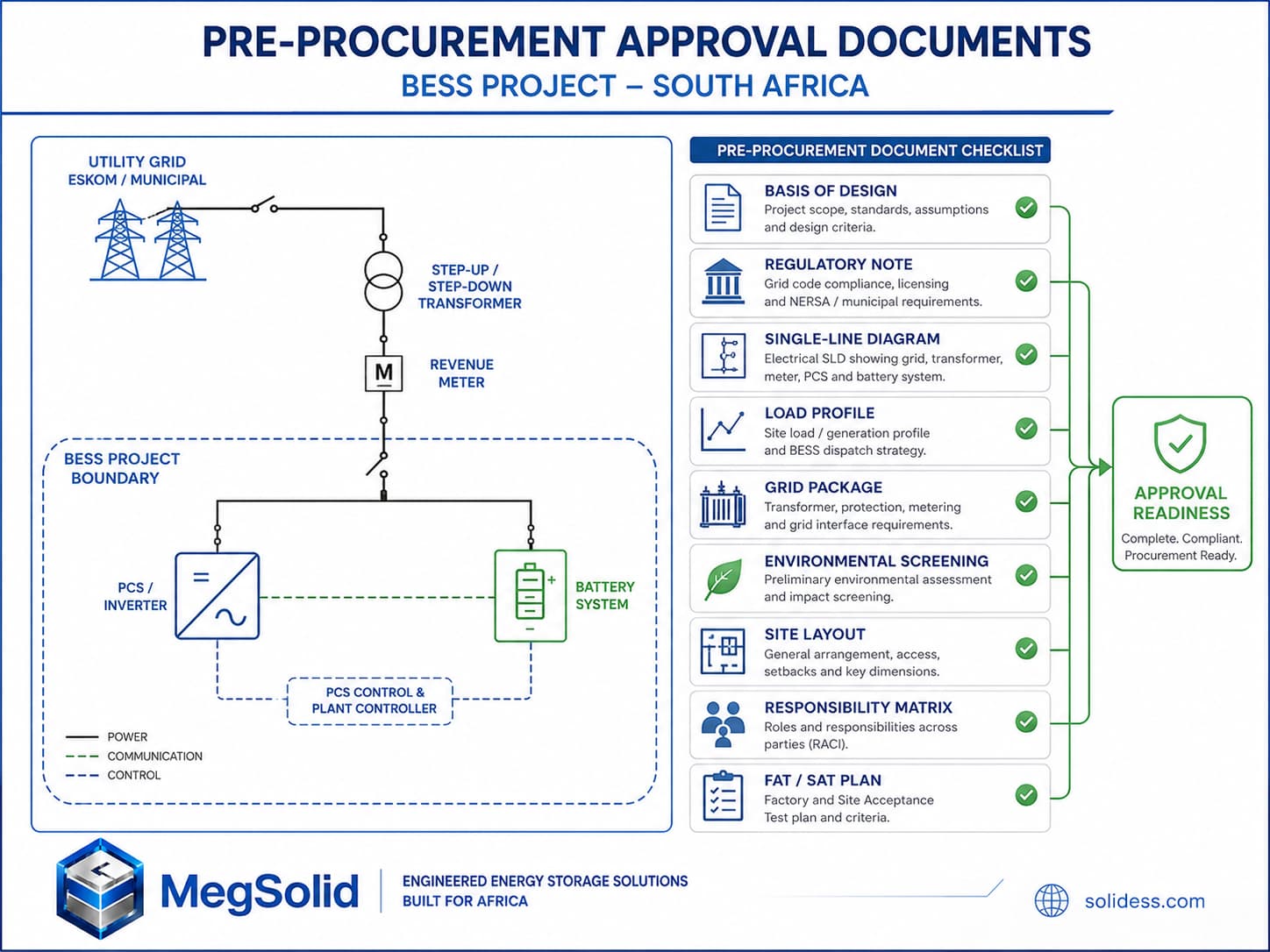
Compare candidate architectures using the same protected-load duty and the same delivery boundary. The following schedule separates requirements from product names:
| Requirement | Buyer input / illustrative duty | Supplier evidence |
|---|---|---|
| Power at protected bus | 170 kW protected load at example PF 0.90; add 3 kW if the assumed auxiliaries use the same PCS output | Available kW/kVA, overload and thermal curves in the required mode |
| Usable AC energy | 340 kWh to protected loads over 2 h | Guarantee net of agreed losses/auxiliaries at temperature and warranty age |
| No-break and essential circuits | Clinically approved feeder schedule | UPS/transfer, protection and restoration sequence |
| Recharge | Time-series PV, load and grid/generator permissions | Accepted charge power, SOC trajectory and next-outage readiness |
| Redundancy | Approved duty after a specified failure | Failure-mode and common-point assessment; no blanket N−1 claim |
| Local connection and approval | Actual utility/municipality, site SLD and operating modes | Applicable registration/connection process, protection and installation sign-off |
| Acceptance | Approved FAT/SAT operating scenarios | Measured response, usable energy, pass/fail record and unresolved deviations |
Two cabinets do not automatically provide redundancy. If the remaining PCS, battery block, control power, switchgear or transformer cannot carry the clinically approved duty after a failure, the system has not met an N−1 requirement.
For non-standard capacity or controls, request a model-specific OEM/ODM assessment only after confirming the actual service scope and current product route with MegSolid. The supplier offer must distinguish supply from EPC and authority responsibilities.
What the Hospital EPC Must Submit
A preliminary inquiry should include:
- Twelve months of interval load data
- Critical-load single-line diagram
- No-break, essential and sheddable feeder schedule
- Maximum kW and kVA
- Power-factor measurements
- Harmonic measurements
- Motor and compressor starting data
- Existing UPS ratings
- Existing generator ratings
- Generator control interfaces
- PV design or production simulation
- Transformer and switchboard information
- Required duration for each medical load class
- Site temperature and altitude
- Indoor or outdoor installation location
- Required testing and approval process
- Target commissioning date
Provide available interval data that includes seasonal demand and representative outage/starting events; twelve months is useful where available, but a missing full year should trigger a data-gap plan rather than an invented load curve. The 170 kW/400 kWh figures alone do not establish a runtime obligation.
Define Hospital FAT and SAT Scenarios
The hospital should approve the operating scenarios before equipment production.
The FAT and SAT programme should include:
- Grid failure at the maximum critical load
- Loss of grid with no solar production
- Loss of grid during high solar production
- Generator delayed start
- Generator start failure
- Automatic load shedding
- Manual clinical override
- Low-SOC reserve protection
- BMS communication failure
- EMS communication failure
- Black start
- Controlled circuit restoration
- Grid reconnection
- Alarm and event recording
- Usable AC energy measurement
For each scenario, define preconditions, clinical/operational witness, expected response, measured channels, pass/fail limits and the safe rollback procedure. Energized hospital tests require the site’s approved outage and patient-safety plan.
Use the MegSolid BESS Factory Acceptance Test guide to translate the hospital operating sequence into measurable acceptance criteria.
Final Sizing Decision
The verified Mafikeng reference shows a deployed hospital PV-and-storage microgrid. Its public 200 kW PV and 400 kWh battery figures demonstrate architecture, not the runtime of the independent 170 kW example in this guide.
For that hypothetical 170 kW duty, the nominal ratio is 2.35 hours; the two-hour sizing table shows why guaranteed energy, auxiliaries and warranty-age assumptions can require materially more nameplate capacity.
The EPC must still establish:
- Which circuits cannot stop?
- Which circuits can tolerate a short transfer?
- Which circuits can be shed?
- How much usable AC energy must reach the hospital switchboard?
- Can solar restore the required SOC?
- What happens if the generator fails?
The correct procurement output is not simply “one 400kWh battery.”
It is a coordinated hospital microgrid specification covering the battery, PCS, UPS, solar system, generator, EMS, switchgear and acceptance tests.
FAQ
How long can 400kWh support a 170kW hospital load?
The nominal ratio is approximately 2.35 hours. Actual guaranteed runtime requires the usable AC energy at the agreed delivery point.
Which assumptions belong in a hospital BESS calculation?
State the load, duration, SOC window, usable-energy boundary, conversion and auxiliary treatment, temperature, warranty age and retained capacity. Keep every assumed factor visibly separate from a supplier’s signed guarantee.
Is a 150kW PCS sufficient for a 170kW critical load?
No, not when the entire 170kW must be supplied simultaneously by that PCS. A higher-power architecture is required.
Is the MegSolid 250kW PCS automatically suitable?
No. It is a preliminary screening direction. Final approval requires kVA, overload, voltage, protection, harmonic and redundancy verification.
Does a hospital need both UPS and BESS?
Often yes. The UPS protects no-break medical equipment, while the BESS supplies longer-duration energy and coordinates solar and generator operation.
Can 200kW of solar continuously charge the battery at 30kW?
No. The 30 kW surplus occurs only at an instant with 200 kW AC PV and a simultaneous 170 kW served load, before other constraints. Use time-series generation, load, SOC and charge limits to calculate accepted daily charging energy.
Can MegSolid supply a standard 400kWh hybrid solid-state cabinet?
Capacity alone does not identify an orderable hospital system. Ask for an exact battery/PCS configuration, current controlled datasheet, model-level evidence, guaranteed usable AC energy and the site-specific transfer and acceptance-test scope.
Why classify hospital loads?
Load classification preserves stored energy for circuits with the highest clinical consequence during extended outages.
What determines guaranteed hospital runtime?
Define guaranteed usable AC energy at the protected-load switchboard, the supported load profile, reserve policy, auxiliary treatment, temperature and warranty-age condition. Runtime is an obligation at that agreed boundary, not a ratio based only on battery nameplate capacity.
What should be tested before hospital commissioning?
Test grid loss, generator failure, load shedding, low-SOC protection, communication failure, black start, restoration and measured usable AC energy.
How should a South African hospital size solar and BESS?
Classify medical loads, size PCS power from the maximum simultaneous event, specify guaranteed usable AC energy and simulate PV recharge using time-series data.
Can a 400kWh BESS support a 170kW hospital load?
A 400 kWh nameplate battery provides a 2.35-hour nominal energy/load ratio at 170 kW. Actual duration depends on available AC energy, operating limits, auxiliaries and the warranty condition; the PCS must also carry the required power.
What should a hospital send to MegSolid for BESS sizing?
Send interval load data, medical-load classifications, the single-line diagram, UPS and generator information, PV simulation, transformer data and required backup durations.