 Skip to content
MegSolid’s first recommendation for a hospital BESS in South Africa is to separate critical medical loads from the hospital’s total demand before selecting a battery.
A hospital does not need every circuit to receive the same backup duration. It does need a documented power-continuity plan for the ICU, operating theatres, emergency department, medical gases, communications, controls and other loads identified by the hospital’s clinical risk assessment.
The Mafikeng Provincial Hospital project provides a current South African reference. According to SAnews, Eskom delivered a 200kW ground-mounted solar PV system and a 400kWh battery energy storage system integrated through a Central Microgrid Controller.
The system supports critical hospital departments and is intended to improve resilience in an area affected by cable theft while reducing reliance on diesel backup.
MegSolid did not supply the Mafikeng project. This article uses its public configuration only to explain how hospital owners and EPC contractors should prepare a BESS sizing study and RFQ.

What the 200kW/400kWh Configuration Does—and Does Not—Tell Buyers
The public project figures define the scale of the solar and storage installation, but they are not a complete hospital BESS specification.
| Public information | What it confirms | What remains undisclosed |
|---|---|---|
| 200kW solar PV | Installed PV power | Interval yield, clipping and island-mode availability |
| 400kWh battery | Stated stored-energy capacity | Usable AC energy, SOC window and EOL guarantee |
| Central Microgrid Controller | Coordinated system control | Dispatch hierarchy, fallback logic and communications |
| ICU, theatres and emergency department | Critical clinical areas are supported | Actual circuit list and measured critical-load profile |
| Reduced diesel requirement | BESS and PV can reduce generator operation | Generator capacity, start sequence and fuel savings |
A common mistake would be to calculate:
400kWh ÷ 200kW = 2 hours
That conclusion is not supported by the public data. The 200kW figure is the PV rating, not a published battery PCS rating or hospital critical load.
Actual battery duration depends on usable energy, critical-load demand, conversion losses, auxiliary consumption, minimum SOC, battery state of health and the contribution available from solar or generators during an outage.
Request a Preliminary Hospital BESS Sizing Review
Send MegSolid the hospital’s interval load data, critical-circuit schedule, existing UPS and generator ratings, required backup duration and site single-line diagram.
The initial review can identify the required power range, delivered-energy requirement, missing engineering data and suitable product families before a firm quotation.
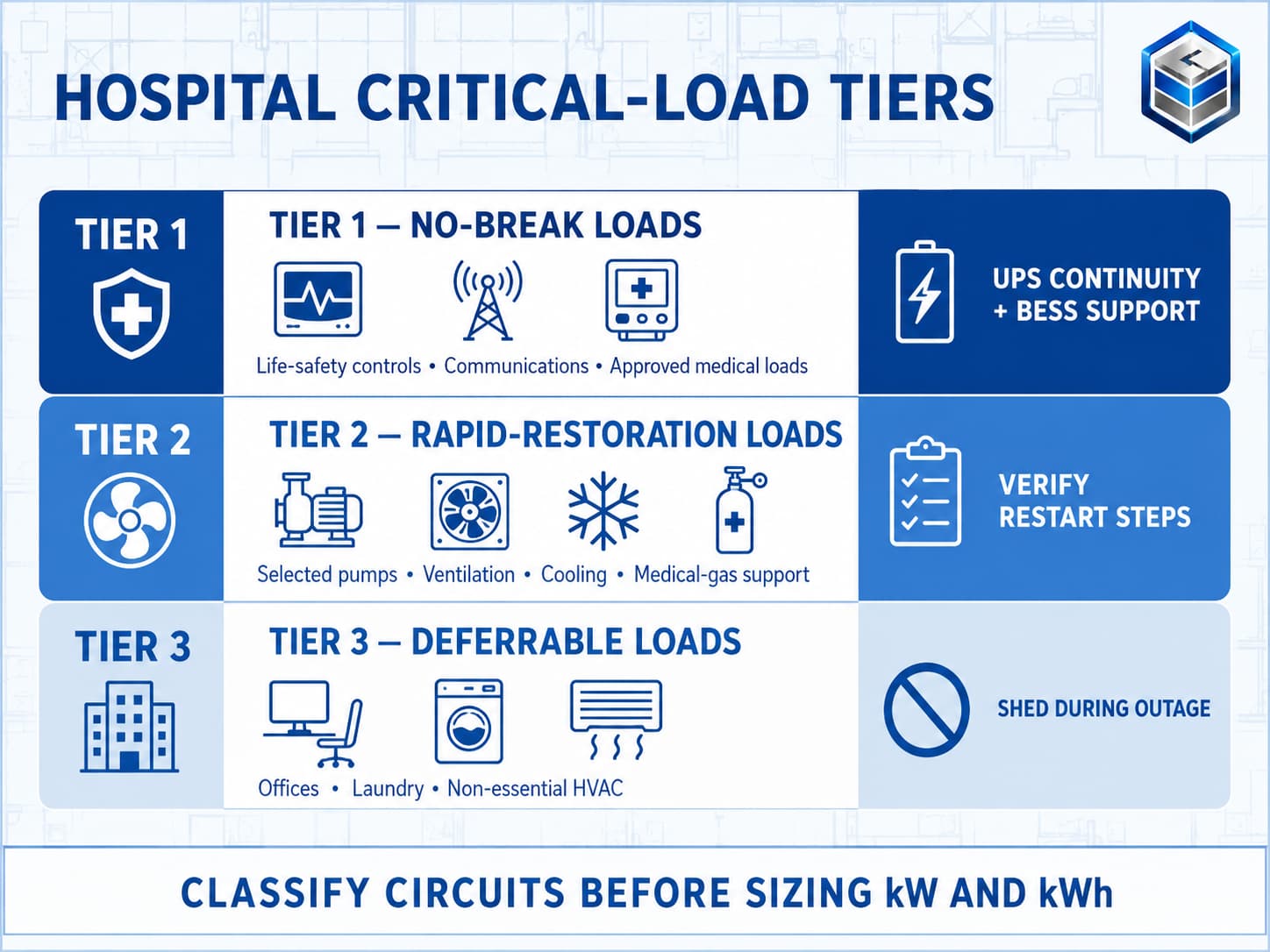
Separate Hospital Loads into Three Continuity Tiers
Hospital BESS sizing should start at the protected distribution boards, not at the monthly electricity bill.
| Load tier | Typical function | BESS design implication |
|---|---|---|
| Tier 1: No-break loads | Selected medical equipment, life-safety controls, communications and systems designated by the hospital risk assessment | Retain equipment-level or medical-grade UPS protection; the BESS supports the upstream microgrid |
| Tier 2: Rapid-restoration loads | Selected ventilation, pumps, cooling, medical-gas support and clinical services permitted a short interruption | Include steady power, motor starting and restart sequence |
| Tier 3: Deferrable loads | Offices, laundry, non-essential HVAC and other shed-capable circuits | Exclude during an outage unless sufficient reserve is available |
The exact classification must be approved by the hospital, electrical consultant and relevant authority. Generic equipment lists cannot replace a circuit-level clinical risk assessment.
A BESS should not automatically be described as a replacement for the hospital’s existing UPS. UPS equipment protects loads that cannot tolerate an interruption, while the BESS and microgrid controller manage longer-duration energy, solar, generators and protected buses.
Size BESS Power from the Critical-Load Profile
Battery power must cover the highest verified demand on the protected bus and the largest permitted load step.
Use both checks:
P_steady ≥ Tier 1 load + selected Tier 2 load + BESS auxiliaries
P_dynamic ≥ running protected load + largest simultaneous starting or restart step
The EPC should obtain at least several weeks of interval data from the proposed protected bus. One-minute or sub-minute records may be required where chillers, pumps, compressors or imaging equipment create short peaks that 15-minute billing data cannot show.
Illustrative 170kW Critical-Load Example
Assume a hospital study identifies 170kW of coincident critical load. This is an illustration, not a published Mafikeng load.
If the consulting engineer applies a provisional 15% design margin:
170kW × 1.15 = 195.5kW
The preliminary study would therefore investigate approximately 200kW of continuous AC capability before checking power factor, motor starting, overload duration, redundancy and future load growth.
Solar generation should not be subtracted from the guaranteed outage power unless the microgrid can keep the PV plant operating in island mode. That capability must be demonstrated through the selected PCS, PV inverter, protection and controller architecture.
Review the MegSolid PCS engineering guide before selecting the protected-bus and islanding arrangement.
Calculate Required Energy from Backup Duration
The delivered-energy requirement is:
E_delivered = critical load × required backup duration
For the same illustrative 170kW load and a two-hour requirement:
170kW × 2 hours = 340kWh delivered to the protected load
Installed nameplate energy must then account for the approved SOC window, conversion efficiency, end-of-life retention and configuration availability:
E_nameplate ≥ E_delivered ÷ (usable SOC × discharge efficiency × EOL retention × availability)
An illustrative calculation using 90% usable SOC, 92% discharge-path efficiency, 80% EOL retention and 97% availability gives:
340 ÷ (0.90 × 0.92 × 0.80 × 0.97) ≈ 529kWh
These factors are modelling assumptions, not MegSolid product guarantees. The final values must come from the ordered configuration, warranty, PCS data and agreed test method.
The calculation shows why 400kWh of stated battery capacity cannot automatically be treated as two hours of guaranteed support for a 170kW hospital load at end of life.
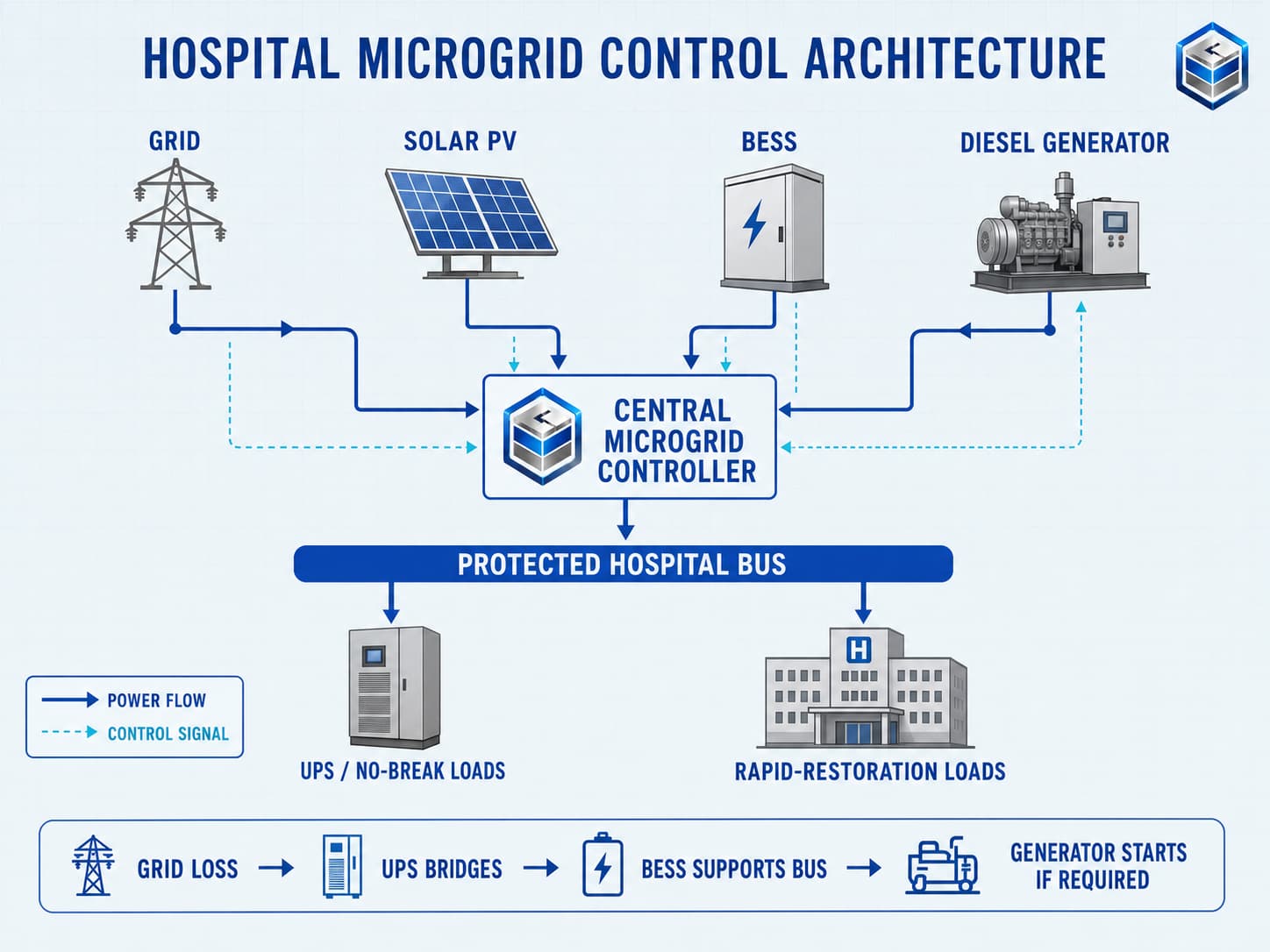
Coordinate the UPS, BESS, Solar PV and Diesel Generator
A hospital microgrid should define the operating sequence before equipment selection.
| System state | Required control action |
|---|---|
| Grid healthy | Supply hospital loads, charge the battery and manage solar production |
| Grid disturbance | Existing UPS protects designated no-break loads while the microgrid changes operating state |
| Island established | BESS supports the protected bus; solar remains available only if the approved architecture permits |
| Extended outage | Start the generator at a defined SOC, load or forecast threshold |
| Generator online | Keep the generator inside its approved operating range and limit battery charging power |
| Grid restored | Resynchronise, transfer safely and rebuild the required reserve SOC |
The Central Microgrid Controller or EMS must know the status and limits of the grid connection, protected bus, UPS, BESS, PV inverter and generator.
Required fallback rules include:
- Generator start failure.
- BMS or PCS communications loss.
- PV forecast or power-meter failure.
- A battery block unavailable.
- Emergency stop.
- Grid return during island operation.
The communication schedule should identify every signal, protocol, timeout, owner and fallback value. MegSolid’s BMS and EMS communication architecture guide provides a structure for this interface matrix.
Screen MegSolid Products Without Mixing Specifications
MegSolid product selection must remain model-specific. The following values are taken from the current MegSolid product knowledge base and are presented only as a screening map.
| Product family | Verified public rating | Verified classification | Hospital screening use |
|---|---|---|---|
| ESSA0030B-0055 | 30kW / 55.296kWh | LFP, intelligent air cooling | Small protected-load sections |
| ESSA0050B-0100 | 50kW / 100.352kWh | LFP, intelligent air cooling | Modular critical-load support |
| ESSA0100B-0215 | 100kW / 215.04kWh | LFP, intelligent air cooling | Medium hospital or building-level protected bus |
| Meg-Solid Energon 261 | 125kVA / 261.24kWh | 314Ah LFP, liquid cooling | Higher-capacity C&I or healthcare microgrid |
| ESSC0500B-1075 | 500kW / 1.0752MWh | LFP, temperature-controlled air cooling | Large hospital campus or multi-building system |
The ESSA outdoor cabinet series supports on-grid and off-grid operation, an integrated EMS, access to load, battery, grid, generator and PV, and built-in isolation transformers.
ESSA cabinets are IP54 and operate from 0°C to 45°C. The verified product data identifies intelligent air cooling.
The ESSA platform can be configured with solid-state battery cells for project-specific requirements. This must be written into the quotation, signed datasheet and BOM; it does not mean every standard ESSA unit is a hybrid solid-state product.
The 261.24kWh liquid-cooled C&I system is rated at 125kVA and uses 314Ah LFP cells. Its published 90% value is maximum system efficiency, not a declared round-trip efficiency.
For larger campuses, the ESSC containerized energy storage series includes 500kW/1.0752MWh and 1MW/2.1504MWh configurations.
Where the Solid-State Option Adds Procurement Value
Hospitals may place additional weight on thermal-risk controls, traceable cell configuration and long-term capacity planning because an emergency response around occupied clinical buildings can disrupt care.
MegSolid’s solid-state energy storage systems should be evaluated through configuration-specific evidence rather than general chemistry claims.
Ask for:
- Ordered cell model and electrolyte architecture.
- Cabinet-level thermal-management method.
- BMS protection limits.
- Fire detection and suppression scope.
- Applicable test reports and certificate boundaries.
- Warranty throughput and capacity-retention conditions.
- BOM and manufacturing traceability.
No battery should be described as fireproof or risk-free. Hospital safety depends on the complete cell, BMS, PCS, cooling, fire-protection, installation and maintenance design.
Hospital BESS RFQ Data Required for a Firm Quote
An inquiry stating only “200kW solar and 400kWh battery for a hospital” is not sufficient for a firm quotation.
| RFQ group | Required project information |
|---|---|
| Load data | Twelve months of interval demand plus short-duration measurements where necessary |
| Critical circuits | Tier 1, Tier 2 and shed-capable load schedule |
| Backup requirement | Required duration, maximum interruption and permitted load shedding |
| Existing equipment | UPS rating and runtime, generator kVA, start time, fuel system and ATS logic |
| Electrical system | Bus voltage, fault level, earthing, protection and single-line diagram |
| Solar PV | Existing or planned kWp/kWac, inverter type and island-mode capability |
| BESS | Required AC kW/kVA, delivered AC kWh, BOL/EOL guarantee and redundancy |
| Site | Equipment location, access, temperature, altitude, dust, noise and fire separation |
| Controls | EMS hierarchy, protocols, cybersecurity boundary, alarms and historian |
| Commercial | Delivery location, Incoterm, commissioning scope, warranty and target COD |
Use the C&I BESS procurement checklist to prepare these documents.
Factory-direct sourcing should also clarify who owns battery, PCS, EMS and generator integration. The risks of divided responsibility are explained in factory-direct versus trading-company BESS procurement.
Convert Hospital Requirements into FAT and SAT Tests
The acceptance plan should reproduce the operating events that matter to the hospital.
| Test | Required evidence |
|---|---|
| Grid-loss sequence | Protected-bus voltage, frequency and interruption record |
| UPS and BESS coordination | No unintended transfer or protection conflict |
| Generator start failure | Correct SOC reserve and fallback response |
| Largest approved load step | Voltage and frequency remain inside agreed limits |
| PV loss during islanding | BESS and generator maintain the protected bus |
| Communications failure | Equipment enters the specified safe fallback mode |
| Capacity test | Delivered AC energy at agreed temperature and power |
| Grid return | Controlled resynchronisation and reserve-SOC recovery |
Use the BESS factory acceptance test guide to convert the final control narrative into witnessed pass/fail criteria.
The final SAT should include the hospital facilities team, electrical consultant, system integrator and responsible clinical representative. Testing must be planned so that existing critical services remain protected.
What MegSolid Needs to Prepare a Hospital BESS Proposal
Submit:
- Interval load file.
- Critical-circuit schedule.
- Required backup duration.
- Existing UPS and generator datasheets.
- Electrical single-line diagram.
- Solar PV design or production data.
- Equipment-area layout.
- Required certification and acceptance scope.
The proposal scope can then define a preliminary product configuration, BOL/EOL energy basis, control architecture, equipment list, communication matrix, FAT plan and quotation exclusions.
FAQ
Is a 400kWh battery enough for a South African hospital?
It depends on the measured critical load, required duration, usable SOC, losses, EOL retention and redundancy. A 400kWh nameplate value alone cannot establish backup time.
Does 200kW solar plus 400kWh storage mean two hours of backup?
No. The 200kW figure is the PV rating. Battery duration must use the protected-load demand and usable AC energy.
Can a hospital BESS replace the existing UPS?
Not automatically. Equipment that cannot tolerate interruption should remain on the approved UPS architecture unless the responsible electrical and clinical teams validate a different design.
Should solar output be included in guaranteed outage duration?
Only when the approved microgrid architecture can maintain PV operation while islanded. The PCS, PV inverter, controller and protection scheme must demonstrate this function.
How should hospital critical loads be classified?
Separate no-break loads, rapid-restoration loads and deferrable loads through a circuit-level clinical and electrical risk assessment.
When should the diesel generator start?
The start threshold should consider SOC, outage duration, load forecast, generator start reliability and the reserve required if the first start attempt fails.
Which MegSolid cabinet is suitable for a hospital?
Suitability depends on verified kW, kWh, voltage, redundancy, environment and control requirements. ESSA and 261.24kWh systems are screening options, not automatic selections.
Is ESSA0100B-0215 liquid cooled or solid-state?
The standard verified data identifies 100kW, 215.04kWh, LFP cells and intelligent air cooling. A project-specific solid-state cell option must be confirmed in the quotation and BOM.
What should an EPC witness during hospital BESS FAT?
Yes. Witness grid-loss logic, UPS coordination, generator failure response, load steps, communications loss, alarms, emergency stop, capacity delivery and recovery.
What data is needed for a firm hospital BESS quote?
Provide interval loads, critical circuits, required duration, UPS and generator data, electrical drawings, PV design, site conditions, EMS requirements and acceptance criteria.
How do you size a hospital BESS in South Africa?
Measure the protected critical load, define allowable interruption and duration, calculate AC power and delivered energy, and then apply SOC, efficiency, EOL and redundancy requirements.
What does the Mafikeng hospital microgrid teach EPC contractors?
It shows the value of combining solar, battery storage and central microgrid control for critical healthcare services, while also showing why public MW and MWh figures are not a complete specification.
Does MegSolid offer solid-state BESS options for hospitals?
The ESSA platform can be configured with solid-state battery cells for project-specific requirements. The ordered cell model, electrolyte architecture, cooling and test evidence must be confirmed contractually.
Author, Method and Disclosure
| Item | Information |
|---|---|
| Author | Guo, MegSolid Mfg & Supply Chain Director |
| Experience | 15+ years in cell manufacturing and EPC supply |
| Public project source | South African Government and SAnews reporting on Mafikeng Provincial Hospital |
| Product-data source | Latest MegSolid Full Product Knowledge Base (llms-full.txt), version modified 17 July 2026 |
| Commercial disclosure | MegSolid supplies battery energy storage systems |
| Project disclosure | MegSolid did not supply the Mafikeng Provincial Hospital project |
| Technical boundary | Project-specific medical, electrical, fire and grid requirements require approval by the responsible professionals and authorities |
Sources
South African Government: Minister Kgosientsho Ramokgopa unveils Solar Microgrid System at Mafikeng Provincial Hospital, 16 July 2026.
SAnews: Eskom hands over renewable energy microgrid solution at Mafikeng Provincial Hospital, 20 July 2026.
South African National Department of Health: Ideal Hospital Realisation and Maintenance Framework Manual.
