 Skip to content

MegSolid recommends treating the BESS SCADA point list as a contractual interface deliverable, not as a register export requested during commissioning. If the RFQ does not define the required measurements, states, alarms, commands and metadata, the EPC may receive hundreds of tags but still lack the few signals needed to operate, diagnose and accept the plant.
The direct answer is to approve one point list before FAT that connects every tag to its source device, engineering meaning, data type, units, scaling, quality flag, update rule, access permission, alarm treatment and acceptance test. That approach gives the SCADA engineer a buildable interface and gives procurement a measurable supplier obligation.
The Direct Answer: Make the Point List an Interface Contract
A useful BESS SCADA point list is more than a list of Modbus addresses. It defines what the operator can see, what the EMS may command, what remains under BMS or PCS protection authority, and what evidence will prove that each interface works. The BMS and EMS communication architecture guide explains the system layers; this page owns the separate procurement question of exactly what must be delivered between them.
- 📊 Measurements: Active and reactive power, voltage, current, frequency, energy, SOC, SOH, temperatures and equipment limits.
- 🔘 States: Breaker position, operating mode, availability, charge/discharge state, local/remote state and communications health.
- 🚨 Alarms: BMS, PCS, thermal-management, fire-system, meter, controller and network events with severity and timestamps.
- 🎛️ Commands: Only approved writable functions, with range checks, authority, interlocks and command feedback.
- 🧭 Context: Source, address, units, scale, sign convention, quality, update rate, deadband, ownership and FAT reference.
This deliverable structure reflects real utility procurement practice. The Xcel Energy BESS EMS scope calls for EMS and RTAC point lists, communications drawings, FAT and commissioning plans. The procurement lesson is simple: the point list belongs in the design package, not in the final commissioning punch list.
Start with Six Point Groups, Not a Random Register Export
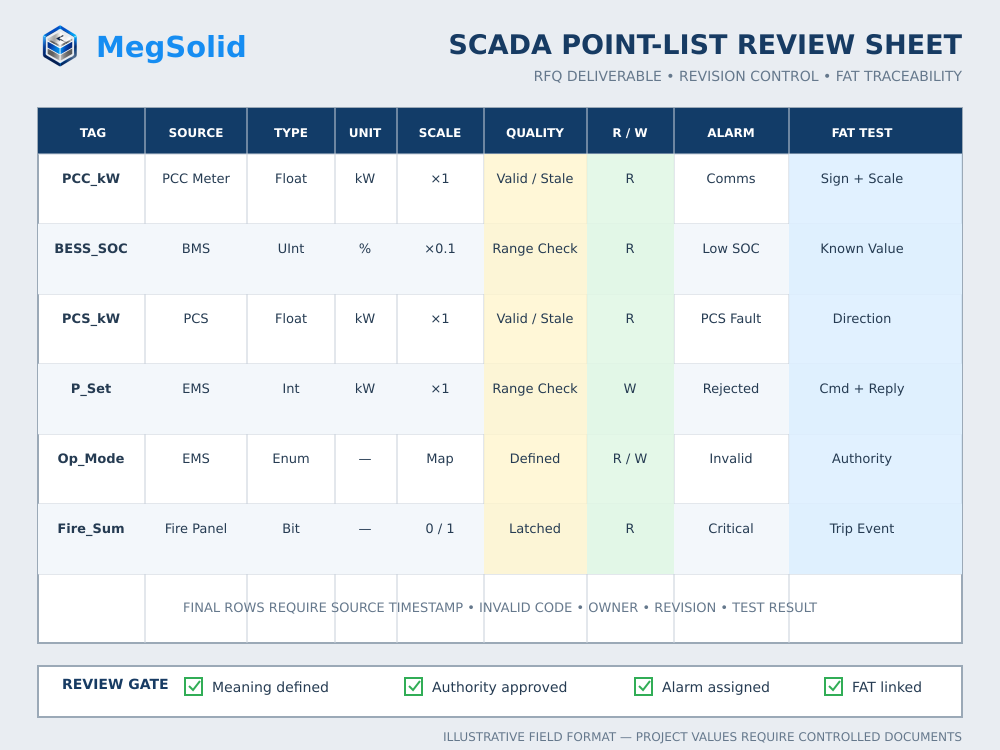
The minimum point set should be organized by the decision each data group supports. A raw register map may expose thousands of values, but it does not tell the EPC which points belong on the operator HMI, in the historian, in a performance report or in a control loop. Use the following groups as an RFQ baseline, then add project-specific grid, tariff and off-taker requirements.
| Point group | Minimum examples | Decision supported |
|---|---|---|
| PCC and site metering | Import/export kW, kvar, voltage, current, frequency, power factor, imported/exported kWh, meter quality | Verify grid exchange, settlement boundary and EMS response |
| BESS plant summary | Available charge/discharge power, actual power, SOC, SOH, operating mode, availability and total energy counters | Know what the plant can deliver now and why it may be limited |
| PCS and AC interface | AC/DC voltage and current, kW, kvar, frequency, power factor, run state, fault state, setpoint and feedback | Confirm conversion response and electrical operating condition |
| Battery and BMS | SOC, SOH, DC voltage/current, charge/discharge limits, temperature extrema, insulation status and active alarms | Respect battery limits and diagnose derating |
| Auxiliaries and safety | Cooling state, cabinet temperature, fire-panel summary, smoke/gas status where supplied, emergency stop and auxiliary supply health | Expose conditions that can derate or stop the system |
| Controller and network | EMS mode, target, command source, local/remote state, device communications, time sync, stale-data flag and controller health | Prove which controller is in authority and whether its inputs are valid |
Do not copy every cell-level point into the site SCADA without a use case. Keep an operator-level summary for normal operation and define a separate diagnostic path for module or cell investigation when the equipment supports it. The SunSpec Energy Storage Models illustrate how bank, string and module detail can be layered rather than flattened into one uncontrolled list.
Give Every SCADA Tag the Metadata Needed to Use It
A tag name such as Battery_Power is ambiguous until its boundary and sign convention are stated. Is it measured at the DC bus, PCS AC terminals, LV board or PCC? Does a positive value mean charging or discharging? Is it measured, calculated or commanded? Those questions must be resolved in the same approved point-list row.
| Required field | Why it matters | Example decision |
|---|---|---|
| Unique tag and source device | Prevents duplicate names and identifies the data owner | PCC meter kW is not the same as PCS kW |
| Address, protocol and data type | Lets the integrator build and test the mapping | Holding register, input register, bit, float or integer |
| Units, scale and sign | Prevents factor-of-ten and reversed-direction errors | kW versus W; positive discharge versus positive charge |
| Range and invalid value | Supports validation and rejects corrupt data | Approved engineering range and unavailable-data code |
| Update, deadband and timestamp | Aligns control, HMI and historian performance | Event-driven or periodic update with source timestamp |
| Read/write authority | Stops monitoring points from becoming uncontrolled commands | Read only, operator write or EMS-controlled |
| Alarm priority and latching | Makes alarms actionable instead of noisy | Warning, trip, emergency; self-clearing or manual reset |
| FAT/SAT reference | Connects the data row to objective acceptance evidence | Test step, expected result and recorded trend |
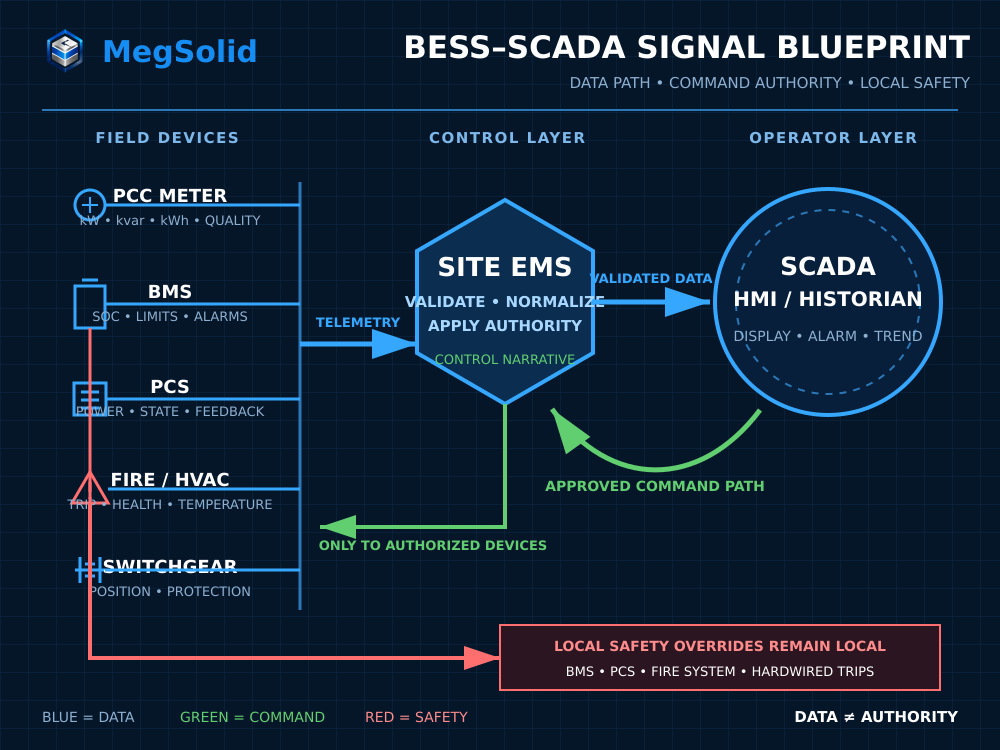
Separate Monitoring, Commands and Safety Authority
The SCADA point list must show which values are informational, which commands may be written, and which protective decisions remain local to the BMS, PCS, fire system or hardwired circuit. A writable tag is not automatically permission to control it. The control narrative, interlock matrix and user-access design must agree with the point list.
- 👁️ Monitor: Values used for HMI display, historian records, reporting and diagnostics.
- ✍️ Command: Approved setpoints and mode requests with defined ranges, source priority and feedback.
- 🛡️ Protect: Local BMS, PCS, relay, fire-system or hardwired actions that are not delegated to ordinary SCADA control.
- 🔐 Authorize: Role-based access, local/remote selection and command-source indication.
- ✅ Confirm: Requested value, accepted value, actual response and rejection reason when a command is blocked.
Do not assume that one protocol makes equipment interoperable. Modbus can standardize transport, while the project still needs an agreed data model, scaling, control authority and exception behavior. Before selecting equipment, use MegSolid’s commercial energy storage procurement guide and BESS supplier qualification checklist to keep interface documentation inside the quotation comparison.
Apply the Checklist to MegSolid Product Interfaces
MegSolid publishes model-specific communications interfaces that can be used to establish the RFQ boundary. They are not a substitute for the ordered register map, firmware revision and integration test. The buyer should request those controlled documents for the exact model and project configuration.
| MegSolid family | Published interfaces | RFQ action |
|---|---|---|
| ESSA outdoor C&I series | RS485 and TCP-IP; integrated EMS; touch LCD and cloud platform; simultaneous access to load, battery, grid, diesel generator and PV | Request the ordered EMS point list, source-device map, writable commands, alarm list and FAT procedure |
| MEGA0030TS–MEGA0500TS PCS | BMS via RS485/CAN; EMS via RS485/TCP-IP | Define the PCS/BMS/EMS ownership boundary and confirm the model-level register map |
| PMA080–PMA0125 modular PCS | RS485, CAN and Ethernet; BMS and EMS interfaces | Confirm protocol assignment, gateway scope and transformer/system integration responsibilities |
| R30KH3–R50KH3 hybrid inverter | Meter RS485; BMS RS485/CAN; EMS RS485 | Map meter, battery and site-controller data separately and approve command authority |
For a 30–100 kW, 55.296–215.04 kWh outdoor C&I application, review the MegSolid ESSA outdoor energy storage platform together with the 100 kW / 215 kWh BESS selection guide. For larger PCS boundaries, compare the MEGA TS PCS with isolation transformer and the PMA modular PCS range.
The ESSA platform can be configured with solid-state battery cells for project-specific requirements, but this option must be confirmed in the quotation, signed datasheet and BOM. When supported by model-level test evidence, a verified hybrid solid-state configuration may be evaluated for improved thermal stability or reduction of specific risks; it does not eliminate thermal runaway and must not reduce the required temperature, BMS-limit, fire-detection, shutdown and communications monitoring. See the MegSolid solid-state energy storage options and the solid-state battery thermal-runaway verification guide for the correct system-level safety boundary.
Design Alarm and Event Data for Action, Not Volume
An alarm list that forwards every device event at the same priority will overwhelm operators and hide the event that matters. The RFQ should require an alarm philosophy that assigns severity, cause, operator action, latching, acknowledgement, reset authority and suppression rules. Each high-priority alarm should also identify the associated operating state and any automatic response.
- 🔴 Trip or emergency: Immediate loss of operation or a condition requiring urgent site response.
- 🟠 Major alarm: Derating, unavailable equipment or a fault that threatens the required service.
- 🟡 Warning: Deviation requiring inspection before it becomes a trip or performance loss.
- 🔵 Advisory: State change, maintenance notice or operator information that does not require an alarm response.
- ⏱️ Sequence evidence: Source timestamp, first-out indication, clear time, acknowledgement and reset record.
Trend requirements must be equally explicit. Specify which points need source timestamps, event-resolution records, short-term high-resolution capture and long-term historian storage. The AES Indiana SCADA requirements provide a useful procurement example by calling for point name, address, description, span, units, offset and data type rather than accepting an unlabeled register dump.
Make FAT and SAT Prove the Complete Data Chain
Point-list approval does not prove integration. FAT should stimulate or simulate the source value, verify the EMS mapping and show the correct SCADA result. SAT should repeat critical tests through the installed network, final meters, user permissions and site control hierarchy. Use the BESS factory acceptance test guide to connect the point-list rows to witnessed evidence.
| Acceptance test | Required proof | Common failure caught |
|---|---|---|
| Address and identity | Source device, register and SCADA tag match the approved list | Wrong device instance or duplicate tag |
| Scaling and sign | Known injected value appears with correct units and direction | ×10 scaling error or reversed charging sign |
| Quality and stale data | Lost communication changes quality, raises the approved alarm and blocks invalid control use | Frozen value shown as healthy |
| Command and feedback | Authorized request is range-checked, acknowledged and compared with actual response | Command accepted on screen but ignored by equipment |
| Alarm sequence | Timestamp, priority, first-out, acknowledgement, clear and reset behave as specified | Alarm flood or missing initiating event |
| Historian retrieval | Trend and event records can be exported for the agreed test window | Data visible live but unavailable for acceptance evidence |
| Authority and access | Local/remote state and user role allow only approved writes | Conflicting controllers or excessive user permissions |
Put These SCADA Deliverables into the EPC RFQ
The quotation should identify not only the communication port, but also every engineering document and integration activity included in the price. This prevents the battery supplier, PCS supplier, EMS integrator and site-SCADA contractor from assigning the same missing interface to one another after equipment arrives.
- 📄 Approved point list: Native Excel format plus controlled PDF revision.
- 🗺️ Architecture package: SLD, network diagram, IP plan, device map and gateway scope.
- 🔢 Register documentation: Protocol, address, data type, scaling, units, invalid codes and writable ranges.
- 🚨 Alarm deliverables: Alarm list, priority, cause, response, latching, reset and notification responsibility.
- 🎛️ Control deliverables: Control narrative, command hierarchy, interlocks, local/remote logic and feedback.
- 🧪 Acceptance package: FAT/SAT procedures, simulators, trend files, exception log, punch list and retest responsibility.
- 🔐 Operations package: User roles, remote-access boundary, backups, change control, historian export and training.
- 🧩 Revision control: Firmware, register-map version, final as-built point list and future change notification.
To receive the editable MegSolid BESS SCADA Point-List Template, email [email protected]. Include the project country, SLD, required BESS power and energy, selected or proposed model, PCC voltage, SCADA/PLC platform, preferred protocol, existing meter and site-controller details, required operating modes, alarm philosophy, FAT/SAT scope and delivery schedule. MegSolid can then review the interface boundary before the quotation becomes a commissioning problem.
FAQ
What should a BESS SCADA point list contain?
It should contain measurements, states, alarms and approved commands, with the source device, address, data type, units, scale, sign convention, range, quality rule, update method, access authority, alarm treatment and FAT/SAT reference for every point.
Who should supply the BESS SCADA point list?
Each equipment supplier should provide its controlled register map and alarms. The EMS or SCADA integrator should consolidate those sources into one site-level point list, while the EPC or owner approves naming, authority, historian and acceptance requirements.
How many SCADA tags does a C&I BESS need?
There is no universal number. The required count depends on system size, number of devices, reporting level, diagnostic depth, operating modes and contractual obligations. Define required decisions first, then select the points that support them.
Which BESS points should be writable from SCADA?
Only commands approved in the control narrative should be writable. Each requires a valid range, user authority, source priority, interlocks, acknowledgement, actual-response feedback and defined behavior when the request is rejected or communications fail.
Should site SCADA receive cell-level battery data?
Not always. Normal operations may need bank or string summaries, while cell-level data may be reserved for diagnostics. Specify the operator view, historian need and service access separately to avoid unnecessary tag volume.
What is the difference between a register map and a SCADA point list?
A register map describes data exposed by a device. A SCADA point list selects the project-required points and adds engineering meaning, naming, permissions, alarm behavior, update rules, ownership and acceptance criteria.
How should BESS alarms be prioritized?
Classify alarms by operational consequence and required action, then define latching, acknowledgement, reset and suppression. Trip or emergency events, major derating, warnings and advisories should not share one undifferentiated priority.
Which SCADA documents should be approved before BESS FAT?
Approve the point list, device and network architecture, register maps, alarm list, control narrative, command hierarchy, time-synchronization method, historian requirements, user roles and FAT procedure before witnessed testing begins.
How should an EPC test BESS point mapping?
Inject or simulate a known source value, trace it through the gateway or EMS, verify the SCADA tag, units, scale, sign, quality and timestamp, then record the result against the approved point-list row.
Which MegSolid systems publish communications interfaces for integration?
The ESSA series publishes RS485 and TCP-IP; MEGA TS publishes BMS RS485/CAN and EMS RS485/TCP-IP; PMA publishes RS485, CAN and Ethernet; R30KH3–R50KH3 publishes separate meter, BMS and EMS interfaces. Request the exact model register map before design.
What is a BESS SCADA point list?
A BESS SCADA point list is the approved schedule of battery-storage measurements, states, alarms and commands exchanged between field equipment, the EMS and the site SCADA, including the metadata needed to interpret and test each point.
How does a BESS EMS send data to SCADA?
The EMS collects approved data from meters, BMS, PCS and auxiliary systems, applies the project data model and transfers selected values, states and alarms through the agreed industrial protocol. Commands return only through the approved authority path.
What should a buyer send MegSolid for a SCADA integration proposal?
Send the SLD, BESS kW and kWh, proposed model, PCC voltage, SCADA or PLC platform, preferred protocol, meter and controller details, operating modes, required points, alarm philosophy, FAT/SAT scope and delivery schedule.
