 Skip to content
Off-grid farm battery storage in South Africa must be sized from a time-based load schedule, motor-start duty, water strategy and the required days of autonomy. A stated 55 kW farm load does not reveal whether 55 kW is an average, a measured maximum, a motor nameplate total or the continuous load that must remain online after sunset.
This guide responds to an anonymized inquiry from a South African farm owner who also expressed interest in local distribution. The inquiry described a 55 kW daily load, no grid and no existing generator, but did not include feeder loads, pump data, operating hours, altitude or installation conditions. It is real RFQ input—not a completed MegSolid installation, a promised system size or a customer performance claim.
- ⚡ Power: Verify continuous kW, peak kVA, phase balance and motor-start events.
- 🔋 Energy: Calculate usable AC kWh for each night and low-solar operating window.
- 💧 Water: Decide whether daytime pumping and a reservoir can replace part of the electrical storage duty.
- ☀️ Recharge: Size PV to serve daytime loads and restore battery reserve after a difficult solar day.
- 🧠 Control: Write an EMS priority that protects irrigation, process and night-essential loads in the right order.
- 🛡️ Resilience: Decide whether the farm will remain generator-free or only generator-ready before requesting price.
Why 55 kW Is Not Yet a Quotable System Size
The fastest route to a usable budget is to clarify what the 55 kW figure represents. If it is the total of motor nameplates, diversity may reduce simultaneous demand. If it is an interval-meter maximum, it may still miss sub-second starting current. If it is the true continuous islanded load, a 50 kW-rated inverter is already below the requirement before engineering margin is considered.
| What “55 kW” might mean | Commercial risk if assumed | Evidence MegSolid requests |
|---|---|---|
| Sum of equipment nameplates | May overstate simultaneous load but hide the largest start | Motor list, starter/VFD type and operating sequence |
| Measured maximum demand | Interval data may average out a short pump or compressor event | Power-quality recording plus interval history |
| Normal operating load | May exclude seasonal irrigation or processing peaks | Crop-season and production calendar |
| Required backup load | May mix critical and deferrable feeders | Approved load-priority schedule |
| Continuous island load | Directly affects PCS rating, but kVA and transient duty remain open | kW, kVA, power factor, phase balance and voltage-dip tolerance |
- 📈 Capture the peak: Log the farm at one-second or faster resolution during representative motor starts where practical.
- 🔺 Check each phase: Mixed 400 V three-phase and 230 V single-phase loads can create an islanded phase-imbalance problem.
- ⚙️ Record starting method: Direct-on-line, soft starter and VFD duties impose different PCS requirements.
- 🧯 Define failed-start behavior: State whether the EMS retries, sheds another feeder or blocks the motor.
- 📅 Include the hard season: Irrigation, refrigeration and processing schedules may coincide only during harvest.
Use the BESS for large motors engineering guide to convert pump and compressor events into a PCS test requirement instead of applying a generic oversizing percentage.
Build a Farm Load Priority Map Before Buying Battery Capacity
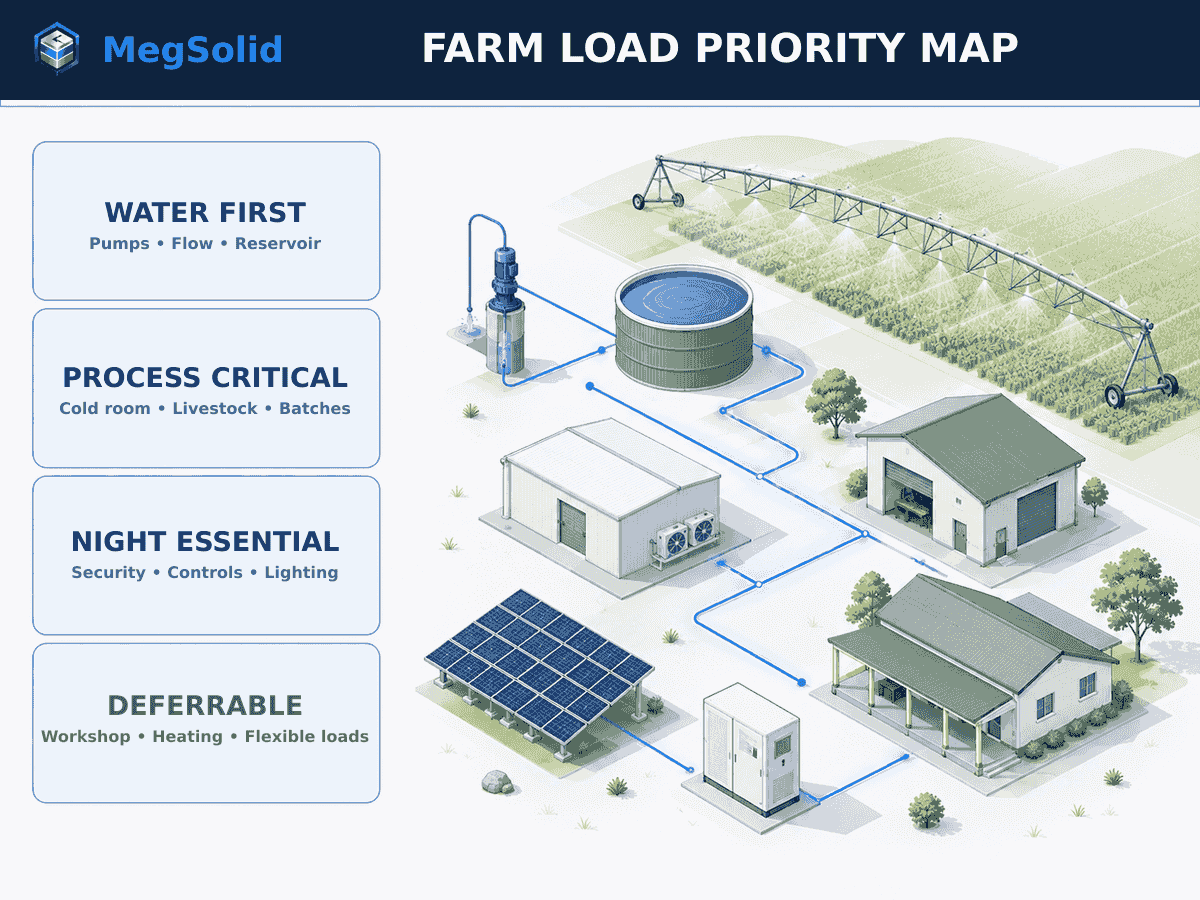
A farm rarely needs every load at the same priority. The owner should decide which agricultural outcome must be protected: water delivery, crop or product temperature, animal welfare, production continuity, security or household service. That decision reduces both technical ambiguity and unnecessary battery cost.
- 💧 Water-critical: Borehole, transfer or irrigation pumps that must meet a defined daily volume and pressure window.
- ❄️ Process-critical: Cold-room controls, selected refrigeration, milking or processing loads with documented operating limits.
- 🌙 Night-essential: Security, communications, electronic fencing, controls, selected lighting and approved residential loads.
- 🛠️ Shiftable: Workshop tools, washdown, water heating and nonurgent processing moved into strong-solar hours.
- ⏸️ Deferrable: Loads that the EMS may block when solar forecast or battery reserve is weak.
| Load group | Power data | Schedule data | Control decision |
|---|---|---|---|
| Irrigation and borehole pumps | Motor kW/kVA, current, VFD or starter | Required flow, hours and seasonal duty | Run in solar hours, battery hours or both |
| Cold room or refrigeration | Compressor and fan ratings, start events | Temperature limits and cycling profile | Staged restart and temperature-based shedding |
| Farm processing | Machine and utility loads | Batch sequence and shutdown time | Complete, pause or defer a batch |
| Residential and staff facilities | Feeder peak and phase allocation | Morning, evening and overnight profile | Essential circuit or unrestricted service |
| Security and controls | Steady load and UPS interface | Twenty-four-hour requirement | Protected reserve and alarm path |
Size PCS Power for Running Load and Motor Starts
PCS selection begins with the highest approved coincident load, then checks starting kVA, overload duration, reactive power, voltage regulation and phase imbalance. The battery must also support the corresponding DC power at the project SOC and temperature limits. A farm should not use maximum charge/discharge power as a substitute for continuous AC output.
- Freeze the critical feeder list. Remove loads that will not be served in island mode.
- Plot the operating sequence. Show which pumps, compressors and process machines overlap.
- Add motor events. Record start current, ramp time, starts per hour and the permitted voltage dip.
- Check kW and kVA separately. Include power factor, harmonics and unbalanced single-phase loads.
- Define margin transparently. Separate measured uncertainty, transient headroom and future expansion.
- Write an acceptance test. Reproduce the approved worst-case load step at FAT or SAT where feasible.
| Published MegSolid option | Verified public rating | Meaning for a stated 55 kW farm load |
|---|---|---|
| R50KH3 three-phase hybrid inverter | 50 kW rated output; 50 kW off-grid rated power; 55 kVA off-grid apparent power | Not an automatic fit if 55 kW is the continuous real-power requirement; motor duty and battery compatibility must also be verified |
| ESSA0050B-0100 cabinet | 50 kW rated AC power; 100.352 kWh rated energy | Below a verified 55 kW continuous load and therefore not selectable from the inquiry headline |
| ESSA0100B-0215 cabinet | 100 kW rated AC power; 215.04 kWh rated energy | A technical candidate only after load steps, required AC energy, PV interface and site conditions are modeled |
| MEGA0100TS PCS | 100 kW rated power; 110 kVA maximum apparent power | A PCS building block for an engineered system; it does not define the battery, PV array, switchgear or autonomy |
The 30 kW, 40 kW and 50 kW three-phase hybrid inverter guide shows the verified model differences. For higher-power engineered architectures, review the MegSolid MEGA TS PCS range. Final selection requires the current controlled datasheet and project SLD.
Calculate Battery Energy from the Operating Window
Battery kWh should be calculated from the approved load in each time interval, not from a single power value multiplied by an arbitrary number of hours. Ask bidders to state nominal DC energy, operating SOC window, auxiliaries, conversion allowance, commissioning delivery and end-of-life obligation separately.
- 🌙 Overnight duty: Energy for security, controls, refrigeration, households and any approved night pumping.
- ☁️ Low-solar duty: Energy reserve for the project weather scenario—not a generic “two cloudy days” claim.
- 🌅 Morning carryover: Loads operating before PV output can serve the farm and recharge the battery.
- 🛡️ Protected SOC: Reserve that commercial dispatch cannot consume.
- ⚙️ Auxiliary demand: BESS controls, cooling, communications and other agreed balance-of-system loads.
- 📉 Lifecycle delivery: Whether the required usable AC energy applies at commissioning or at an agreed future condition.
| Sizing layer | Question to answer | RFQ output |
|---|---|---|
| Time-step load model | Which approved loads run in each interval? | kW/kVA schedule and daily AC kWh |
| Autonomy case | Which weather and operational event must be survived? | Required delivery window and reserve SOC |
| Delivery boundary | Where is usable energy measured? | AC meter location and test method |
| Recharge case | When must reserve be restored? | PV charging power and recovery deadline |
| Lifecycle case | How long must the obligation remain valid? | Degradation treatment and augmentation responsibility |
For the difference between nameplate and accepted delivery, use the usable BESS energy at the PCC guide. For warranty comparisons, use the C&I BESS throughput, DoD and EOL guide.
Store Water or Store Electricity? Make This Decision Early
For irrigation, the cheapest electrical kWh is not always the best design target. Where agronomy, water rights, pump hydraulics and reservoir design permit, the farm can pump more water during strong-solar hours and store water for later use. Battery capacity can then focus on controls, pressure maintenance, night essentials and loads that cannot be shifted.
| Strategy | Best fit | Data required | Key limitation |
|---|---|---|---|
| Daytime pumping plus water storage | Irrigation volume can be decoupled from nighttime pump operation | Flow, total dynamic head, reservoir volume, irrigation schedule | Land, evaporation, water quality and hydraulic constraints |
| Battery-supported pumping | Water must move outside solar hours or pressure must remain available | Pump power, runtime, start duty and required SOC reserve | High electrical power and energy can enlarge the BESS |
| Hybrid schedule | Some pumping is flexible but critical periods remain | Hourly water and energy model | Requires reliable EMS and pump/VFD coordination |
| Process-first battery reserve | Cold room, livestock or processing is more time-sensitive than irrigation | Temperature, welfare or batch limits | Water delivery may be deferred during weak solar periods |
South Africa's Water Research Commission reports on solar-powered pumping and irrigation planning, reinforcing the need to combine energy design with water availability and scheduling. Review the WRC climate-smart irrigation study and have the irrigation designer validate flow, head, storage and crop requirements.
Size the PV Array for Load Service and Reserve Recovery
The PV array must do more than match annual farm consumption. In a generator-free system it must serve daytime loads, recharge the BESS, recover protected reserve and tolerate the project design allowances. Use a bankable location-specific solar dataset and a monthly or hourly model; do not use a national average irradiation value for quotation.
- 📍 Location: Coordinates, elevation, horizon and available installation area.
- 🌦️ Seasonality: Worst relevant month for solar resource, irrigation demand and process activity.
- 🌡️ Loss assumptions: Module temperature, soiling, wiring, mismatch, degradation and availability shown separately.
- ☀️ Daytime load: Energy consumed directly by pumps and farm processes before battery charging.
- 🔋 Recovery target: SOC to be restored and the deadline before the next night or operating event.
- ✂️ Curtailment: What happens when the reservoir and battery are full and flexible loads are complete.
- 🔧 Maintainability: Cleaning water, access, spares, vegetation control and remote monitoring.
Generator-Free and Generator-Ready Designs Have Different Prices
The anonymized inquiry stated that no generator is installed. That does not automatically mean a generator must be purchased, but it makes the reliability target a commercial decision. A generator-free design generally needs more PV, more stored energy, stricter load management or a higher tolerance for curtailed farm activity during rare low-solar periods.
| Architecture | What the buyer gains | What must be accepted | RFQ requirement |
|---|---|---|---|
| Generator-free | No fuel logistics or generator operating duty | Larger solar/storage exposure and explicit low-solar load limits | Design weather case, loss-of-load criterion and shedding schedule |
| Generator-ready | Future connection path without immediate genset purchase | Reserved switchgear, controls, space and interface cost | Voltage, power, controller, protection and communications provisions |
| PV-BESS-generator | Dispatchable recovery during prolonged low solar | Fuel, maintenance, noise, emissions and control complexity | Start sequence, minimum loading, charge authority and fuel autonomy |
If a genset remains an option, adapt the control questions in the PV-diesel-BESS microgrid engineering guide to the South African farm's equipment, fuel logistics and operating rules. The country context and tariff assumptions from another market must not be copied.
Write the EMS Priority Before the EPC Issues the RFQ
An off-grid farm EMS must balance two inventories: electrical state of charge and stored water. The control narrative should identify the authority, sensor, setpoint, timer, fallback state and alarm for every transition. “Smart EMS included” is not an acceptance criterion.
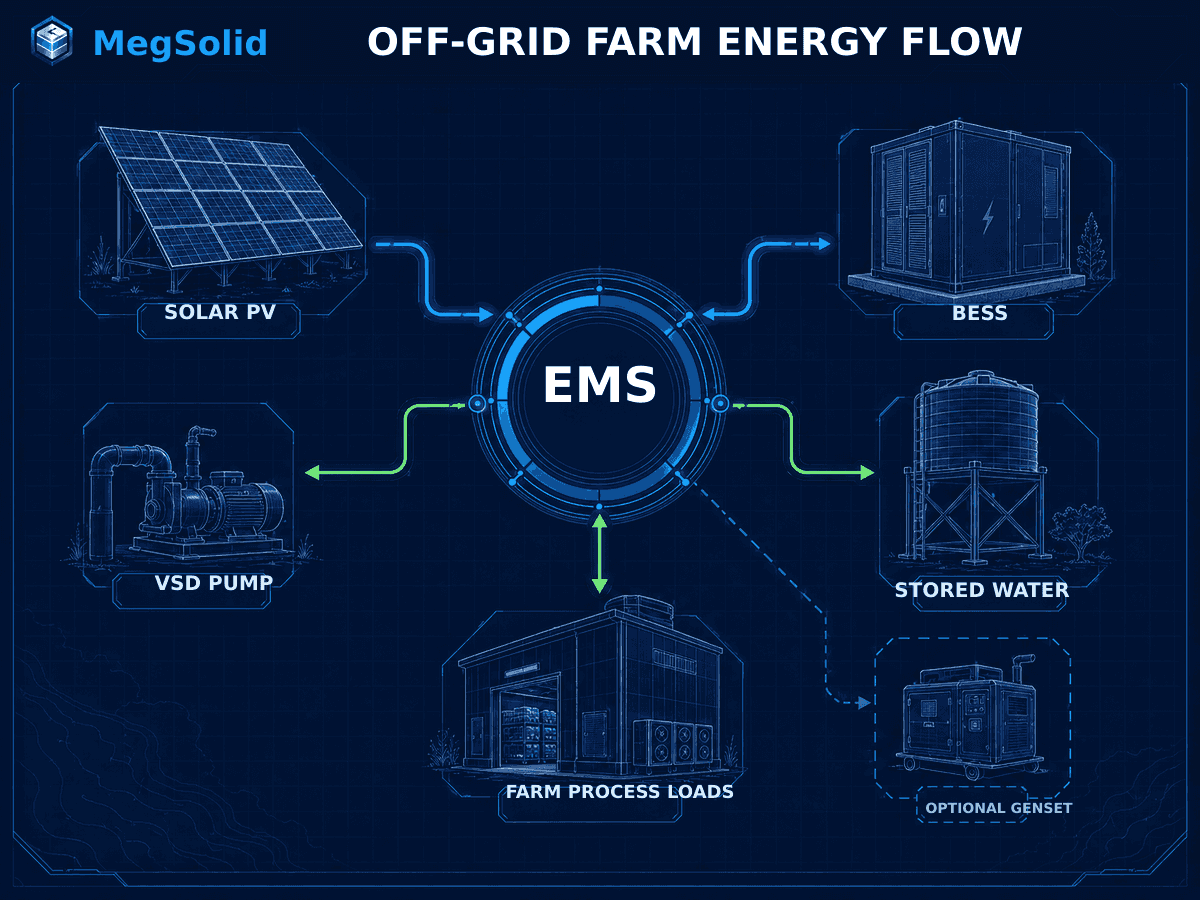
- Protect the island: Maintain voltage and frequency within the project operating envelope.
- Serve Tier 1 loads: Hold security, control, welfare and process-protection feeders approved by the owner.
- Use solar directly: Run flexible pumps and processing when PV is available and operating constraints permit.
- Fill the reservoir: Convert surplus solar into stored water before charging for avoidable night pumping, where approved.
- Restore battery reserve: Meet the defined SOC deadline before optional loads are released.
- Shed in stages: Block deferrable, shiftable and then lower-priority loads at documented thresholds.
- Handle weak forecasts: Modify the next-day pump and process schedule using the approved forecast source.
- Fail safely: Define local fallback power, communications timeout, alarm destination and manual authority.
Resolve conflicts with the BESS EMS priority-logic guide. Then document loss of SCADA, meter, weather or pump-controller communications using the BESS communication-failure guide.
Where MegSolid Products Fit—and Where Engineering Still Decides
MegSolid can shortlist a packaged outdoor cabinet or engineer a larger PCS-and-battery architecture after the load and autonomy model is complete. Published ratings help reject obvious mismatches; they do not replace the project quotation, signed datasheet, BOM, SLD, protection study or FAT/SAT plan.
- 🏗️ Outdoor packaged route: Evaluate the ESSA cabinet only when rated power, rated energy, PV configuration, environment and control interfaces fit the approved model.
- ⚙️ Engineered PCS route: Use a MEGA TS or other verified PCS configuration when power, separation or expansion requires a project architecture.
- 🧱 Scalable energy route: Add battery capacity only from the calculated delivery and recovery obligation—not from a preferred catalogue size.
- 🔌 Distribution route: Include switchgear, protection, transformer, feeder separation, earthing, metering and communications in the EPC boundary.
- 🧪 Evidence route: Attach controlled model data, certificate scope, warranty, FAT, SAT and commissioning deliverables to the commercial offer.
Review the MegSolid ESSA outdoor C&I cabinet platform and the broader MegSolid solid-state energy storage systems before requesting a configuration.
Solid-State Configuration and Thermal-Runaway Risk
The ESSA platform can be configured with solid-state battery cells for project-specific requirements. This must not be rewritten as a claim that every ESSA unit is solid-state. The quotation, signed datasheet and BOM should identify the supplied cell model, cathode chemistry, electrolyte architecture, rated energy, cycle-life conditions, weight and certificate scope.
- 🛡️ Use evidence-based safety language: A selected cell architecture may reduce specific thermal-runaway risks when supported by model-level testing.
- 🌡️ Evaluate the complete system: Cell behavior, BMS, PCS, thermal management, detection/suppression, enclosure, spacing and operating limits all matter.
- 📄 Match certificates to scope: Confirm whether each report applies to the cell, module, cabinet, PCS or complete ordered system.
- 🚫 Avoid absolute claims: Do not specify “fireproof,” “100% safe” or “no thermal runaway.”
- 🔍 Audit the BOM: The ordered solid-state option must be identifiable in procurement and acceptance documents.
South African Site and Compliance Inputs to Put in the RFQ
A remote farm still has electrical installation obligations even when it has no utility connection. South Africa’s Electrical Installation Regulations require a valid Certificate of Compliance for an electrical installation, subject to the regulation’s provisions. The EPC should confirm the applicable current standards, registered-person scope and any local authority, insurer, fire or environmental requirements for the actual site.
- 📜 Electrical sign-off: Include inspection, testing, test report and CoC responsibility; see the Department of Employment and Labour Electrical Installation Regulations.
- 📍 Site coordinates and altitude: Required for solar modeling, temperature assumptions and equipment derating checks.
- 🌡️ Ambient conditions: Minimum/maximum temperature, dust, humidity, flooding, lightning exposure and ventilation.
- 🏗️ Civil interface: Foundation, drainage, access, lifting, fencing, service clearance and future replacement route.
- ⚡ Electrical studies: SLD, cable schedule, earthing, protection coordination, fault level, harmonics and motor-start voltage response.
- 🚒 Emergency plan: Isolation, detection, suppression, signage, access, training and incident escalation agreed with the project authorities.
For outdoor equipment interfaces, use the BESS foundation design input checklist. Do not release foundations or cable openings from a marketing brochure; use the approved ordered-model GA and project civil criteria.
The EPC RFQ Checklist That Produces a Comparable Quote
- 📊 Load files: Interval history, power-quality event data, feeder list, motor schedule and seasonal operating calendar.
- 💧 Irrigation files: Pump curves, total dynamic head, flow target, VFD/starter data, water source, reservoir and irrigation windows.
- ☀️ PV files: Coordinates, layout area, module/inverter preference, yield model, loss assumptions and direct daytime load.
- 🔋 BESS duty: Required AC kW/kVA, usable AC kWh, autonomy event, reserve SOC, recharge deadline and lifecycle obligation.
- 🧠 EMS narrative: Load tiers, pump schedule, water-level signals, solar forecast, shedding steps, communications fallback and manual authority.
- 🔌 Electrical scope: Voltage, frequency, neutral/earthing, switchgear, transformer, cabling, protection, metering and auxiliary supply.
- 🏜️ Site conditions: Temperature, altitude, dust, humidity, flood, wind, access, foundation, crane route and security.
- 🧪 Acceptance: Document review, FAT, SAT, capacity test, motor-start test, EMS sequence test, training and handover records.
- 📦 Commercial scope: Incoterm, delivery location, packaging, inland logistics, taxes, installation, commissioning, spares, warranty and service response.
- 📅 Programme: Design freeze, approval dates, manufacturing, witness tests, shipping, installation and commissioning milestones.
Ask Every Bidder to Return the Same Schedule
| Bid return field | Why it matters | Required evidence |
|---|---|---|
| Rated and maximum AC power | Separates continuous duty from short-term capability | Model datasheet and overload curve |
| Nominal and guaranteed usable energy | Prevents a nameplate-only comparison | Energy schedule and acceptance boundary |
| PV charging capability | Determines reserve recovery | Ordered MPPT/DC configuration and SLD |
| Motor-start capability | Protects pump and compressor operation | Study, model or witnessed test method |
| Operating environment | Prevents hidden derating or enclosure mismatch | Temperature, altitude and IP limits |
| EMS interfaces | Defines who controls pumps, water level and load shedding | Point list, protocols and cause-and-effect |
| Solid-state configuration | Prevents electrolyte architecture from becoming a marketing assumption | Signed datasheet, BOM and model-level evidence |
| Excluded scope | Reveals civil, switchgear, transformer, cabling and commissioning gaps | Responsibility matrix and priced options |
Farm Project and Distribution Inquiry Need Two Separate Tracks
A farm owner who also wants to distribute MegSolid products should not use one incomplete 55 kW project as a universal South African package. The farm quotation should follow verified site data. A distribution proposal should separately define target segments, forecast volume, product training, spare parts, technical support, certification scope, warranty workflow and local installation capability.
- 🌾 Project file: One farm, one SLD, one load model and one acceptance plan.
- 📦 Channel file: Target applications, annual forecast, sample/demo needs and order strategy.
- 🧑🔧 Service file: Installer qualifications, commissioning tools, spare stock and escalation route.
- 📑 Compliance file: Model-specific documents matched to the products actually offered.
- 🎓 Training file: Product selection, site survey, installation, EMS setup, troubleshooting and warranty evidence.
This separation gives MegSolid enough information to price the first farm responsibly while evaluating a repeatable local sales and support model. It also prevents a distributor from promising one catalogue size to farms with different pumps, water systems, climates and operating schedules.
This article provides a baseline sizing and RFQ framework. To receive the editable Excel farm load, irrigation, PV recovery and BESS quotation checklist, email [email protected]. Include the site coordinates, 24-hour load schedule, pump/VFD data, daily water target, reservoir details, solar layout area, required autonomy, installation conditions and whether the project must remain generator-free.
FAQ
Is a 55 kW inverter enough for a farm described as having a 55 kW load?
Not from that statement alone. Confirm whether 55 kW is continuous real power, an interval peak, a sum of nameplates or a maximum including motors. Check kVA, phase balance, motor starts, overload duration and operating margin before selecting the PCS.
What load data should a South African farm provide for a BESS quotation?
Provide interval load history, feeder-level loads, motor nameplates, starters or VFDs, operating hours, seasonal schedules, phase allocation, power factor, event recordings and a list of loads that may be shifted or shed.
How many battery kWh does a 55 kW off-grid farm need?
There is no reliable capacity from 55 kW alone. Calculate the approved time-sequenced load for the night and low-solar window, then define usable AC delivery, reserve SOC, auxiliaries, conversion allowance, ageing condition and PV recovery deadline.
Why do irrigation pump starts matter to BESS sizing?
A pump may demand substantially more apparent power during starting than during steady operation. The PCS must maintain acceptable voltage and frequency through the event, while protection, starter or VFD settings and other connected loads remain coordinated.
Can a water reservoir reduce farm battery capacity?
Potentially. If the irrigation and hydraulic design permits daytime pumping, stored water can shift part of the pumping duty out of the night. The irrigation designer must verify flow, head, reservoir, water quality, evaporation and crop scheduling constraints.
Does a fully off-grid farm need a diesel generator?
Not always, but the decision changes price and operating risk. A generator-free system needs a defined low-solar reliability criterion, PV and battery recovery model, load-shedding plan and acceptance of rare operating limits. A generator-ready design can preserve a future connection path.
How should PV capacity be selected for an off-grid farm?
Use location-specific hourly or monthly solar data and model direct daytime load, battery recharge, reserve recovery, seasonal irrigation, temperature, soiling, wiring, mismatch, availability and curtailment. Do not size from annual consumption or a national sun-hours average alone.
Can the MegSolid R50KH3 serve a 55 kW farm load?
The published R50KH3 rated output and off-grid rated power are 50 kW, while off-grid apparent power is 55 kVA. It should not be selected for a verified 55 kW continuous real-power requirement without revising the load or architecture and completing motor, battery and site checks.
Which MegSolid outdoor cabinet should be quoted for this farm?
The inquiry is not complete enough to select a cabinet. ESSA0050B-0100 is rated 50 kW and 100.352 kWh; ESSA0100B-0215 is rated 100 kW and 215.04 kWh. Neither rating proves runtime, motor-start capability, PV recovery or site suitability.
Can MegSolid supply a solid-state battery configuration for an outdoor farm BESS?
The ESSA outdoor C&I platform can be configured with solid-state battery cells for project-specific requirements. The ordered quotation, signed datasheet and BOM must identify the cell model, chemistry, electrolyte architecture, energy, cycle conditions, weight and certificate scope.
What is off-grid farm battery storage in South Africa?
Off-grid farm battery storage in South Africa is a battery, PCS, EMS and balance-of-system architecture that operates without a utility supply and coordinates farm loads with solar generation. Its size depends on motor duty, time-based energy, irrigation or water storage, autonomy, site conditions and the chosen backup strategy.
How is off-grid farm battery runtime calculated?
Runtime is calculated from the approved load in each time interval and the guaranteed usable AC energy at a defined meter boundary. Reserve SOC, conversion allowance, auxiliaries, temperature, ageing and load-shedding stages must be stated instead of dividing nominal kWh by one average kW value.
What should a buyer send MegSolid for an off-grid farm BESS proposal?
Send site coordinates, altitude, interval and feeder loads, pump and VFD data, daily water target, reservoir information, PV area, autonomy objective, generator decision, SLD, environmental conditions, delivery location, schedule and required EPC scope to [email protected].
