 Skip to content
Do not select a BESS from a motor inrush headline. A plant that has voltage sag during an extruder start may need short-duration PCS kVA and reactive-power headroom; a plant that pays for a high 15- or 30-minute interval may need usable BESS energy and a recharge plan. Those are related duties, but they are not the same duty.
For the recycling-plant duty used here, the product under review is the MegSolid ESSA0100B-0215 outdoor cabinet. Its published 100 kW rated AC power and 215.04 kWh nominal capacity make it a sensible starting point for a measured 100 kW-class peak-management duty. They do not, by themselves, prove that it can support every 132 kW motor start. The motor curve, transformer, feeder, protection and PCS P-Q limits decide that.
- Classify the problem: a short voltage event, a billing-interval demand event, or both.
- Measure kW, kVAr, kVA and voltage at the PCC, then separate feeder data from total-site data.
- Use the same 15- or 30-minute window for the demand calculation, BESS AC energy account and ROI model.
- Put equipment limits, control logic and acceptance evidence in the RFQ before selecting a cabinet.
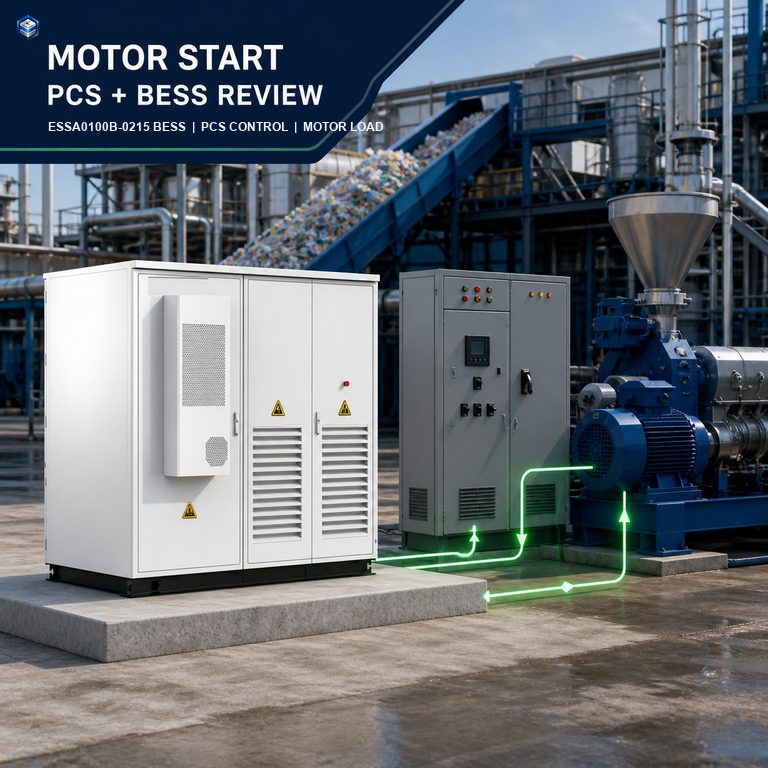
Start With the PCC Event, Not a Cabinet Size
A motor can draw high current for only a few seconds, yet the operational consequence can be severe if the PCC voltage dips and a PLC, drive or contactor drops out. The first measurement pack should include one-line diagrams, transformer impedance, protection settings, motor nameplate data, starting method, oscilloscope or power-analyser traces, and time-aligned PCC voltage, kW, kVAr and kVA. The relevant calculations and control limits belong in the PCS and inverter engineering review, not in a generic battery-capacity estimate.
There is an important boundary here. A feeder calculation explains what the motor start is doing. Total PCC values decide the utility-demand exposure. Combining feeder kW with whole-site kWh creates a false ROI model. Keep the two measurement points labelled in every test sheet.
Decide Whether the Constraint Is Transient Support or Demand-Interval Energy
A direct-on-line start may last 3 to 10 seconds. A tariff meter normally evaluates a much longer interval. A brief 182 kVA spike has little effect on a 30-minute average by itself, but frequent starts, a slow acceleration curve or sustained process load can materially raise the interval demand. This is why a project should not claim demand-charge savings from motor inrush alone.
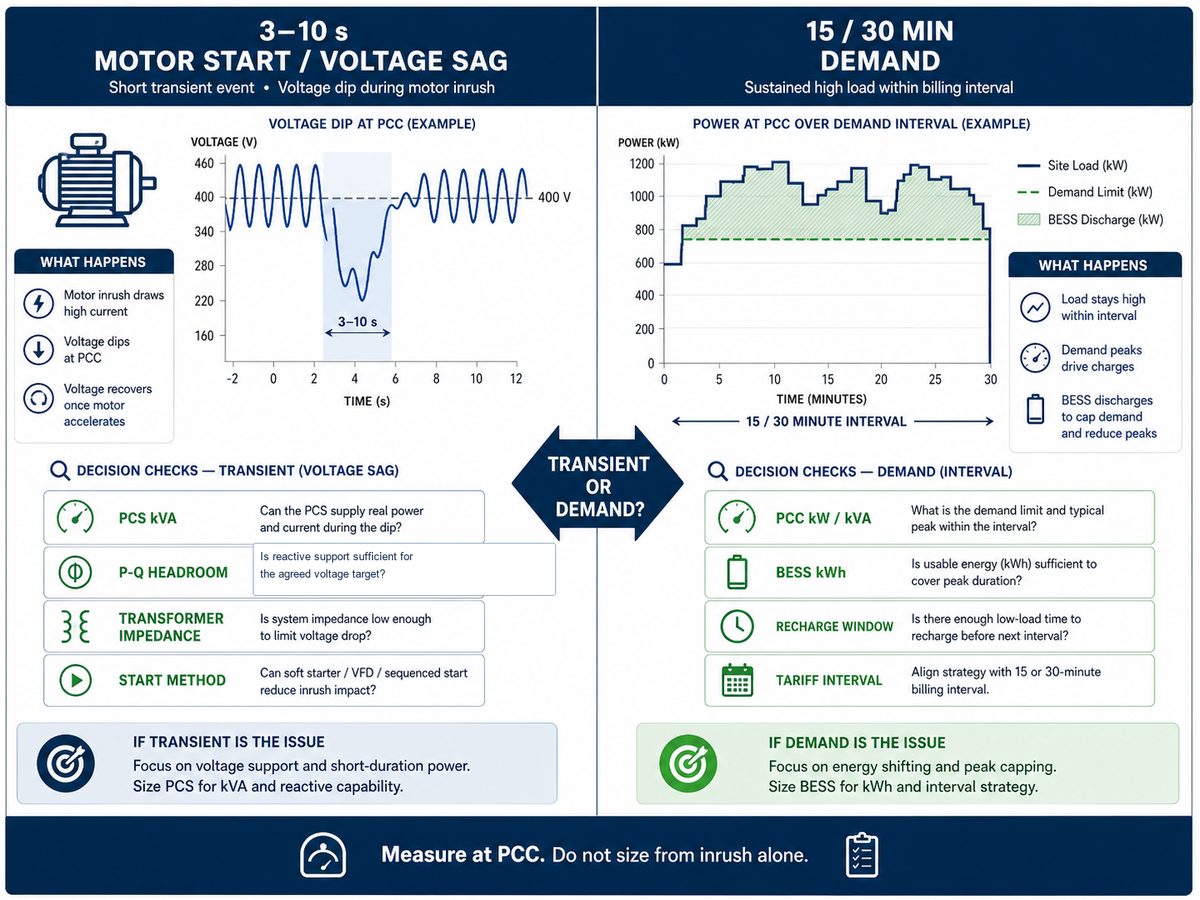
| If the buyer sees | Primary engineering question | What sizes the solution | Evidence required |
|---|---|---|---|
| PLC resets or contactor drop-out during starts | Can the PCS supply P and Q within its current and apparent-power limits? | PCS kVA, P-Q headroom, transformer impedance, start method and protection coordination | High-resolution PCC voltage and current trace; validated control and trip sequence |
| High 15- or 30-minute maximum demand | How much energy must be shifted inside the billed interval? | Usable BESS kWh, discharge kW, recharge window and tariff interval | Interval meter data, bill, tariff rules and a measured PCC energy balance |
| Both problems | Can one operating schedule preserve PCS headroom and energy reserve? | The tighter of the transient and interval constraints | A combined SAT with load steps, SOC reserve and repeatable production conditions |
For an existing 400 V plant, the switchboard connection and protection study are part of the decision, not installation paperwork. Review the 400 V BESS connection guide for existing switchboards with the EPC and protection engineer before fixing the point of connection.
PCS Sizing: Check kVA and P-Q Headroom Before Promising Voltage Support
A 100 kW nameplate is an active-power rating; a motor-start problem is often constrained by apparent power and current. The applicable relationship is S = sqrt(P-squared plus Q-squared). If active-power output is already near the PCS limit, little apparent-power margin may remain for reactive support. Conversely, a PCS can have kVA headroom but still be restricted by current, DC-voltage or protection limits.
For this SAT, the PCS was configured with an active-power-priority (P-priority) control strategy. That is a project configuration, not a statement about every MegSolid PCS default. Where the coordinated PLC/PCS interface has a validated start-permissive or dry-contact signal, an EMS can pre-position an output setpoint before a start. Commissioning must demonstrate timing, interlocks, fallback operation and protection coordination. The MegSolid power conversion system page is the product reference; the approved project data sheet and test record remain the source for the installed control limits.
| Event-level measurement point | P (kW) | Q (kVAr) | S (kVA) | VLL (V) |
|---|---|---|---|---|
| Motor feeder load during recorded start | 145 | +115 | 185 | 360 |
| BESS output measured at PCS | 90 | -30 | 95 | – |
| Residual feeder contribution after BESS response | 55 | +85 | 101 | 385 |
This table is an event-level feeder explanation, not a total site import figure. Positive Q denotes lagging reactive power absorbed from the grid; the recorded BESS value is leading Q. The result is a project test observation and must not be extrapolated to another transformer, motor starter or feeder without new measurements.
Why the ESSA0100B-0215 Is a Starting Point for This Duty
The recommendation in this guide is limited to one published configuration: ESSA0100B-0215. MegSolid lists 215.04 kWh nominal capacity, 100 kW rated AC power, a 768 V battery system, 672 to 850 V operating range, 0.5C nominal charge/discharge rate at 25 C, IP54 enclosure rating and a stated cycle-life value of at least 5,000 cycles. The cabinet is an LFP all-in-one C&I product with an outdoor form factor. These published characteristics make it relevant where the required duty is close to 100 kW and the interval model supports the usable-energy requirement.
Its advantage is reduced equipment-interface complexity for this class of outdoor project: battery, conversion and control functions are brought into a defined cabinet platform. Its limitation is equally important: a 215.04 kWh nominal label is not the usable AC energy in a live duty. SOC reserve, conversion loss, auxiliaries, temperature, ageing, BMS limits and the required recharge window all reduce the energy available to the tariff model. Do not combine parameters from a different cabinet or PCS to make this model appear larger than it is.
| Buyer question | Why this ESSA model may fit | What still needs project proof |
|---|---|---|
| Can it reduce a 100 kW-class demand peak? | Published rated AC power is 100 kW. | PCC peak shape, reserve SOC, interval duration and recharge time. |
| Can it support the recorded motor event? | The cabinet establishes the BESS power and energy platform for review. | PCS kVA/current limits, P-Q schedule, transformer and motor-start trace. |
| Can it be installed outdoors? | The published enclosure rating is IP54. | Civil base, ambient conditions, clearance, drainage, fire plan and local authority requirements. |
The EMS must expose the signals used to prove this duty. The EPC should request the BESS SCADA point list early, including PCC power, PCS P-Q commands and feedback, SOC, temperatures, alarms, mode and protection states.
Build the ROI Model From One Complete Demand Interval
The project SAT at an anonymized plastics recycling plant in East London, South Africa used two 10-minute operating sequences and a combined 10-minute idle period inside one 30-minute window. The 132 kW extruder could cycle up to 10 times per hour in normal production. This is a useful model because it measures the same interval the tariff logic must evaluate. It is not a claim about every South African tariff or plant.
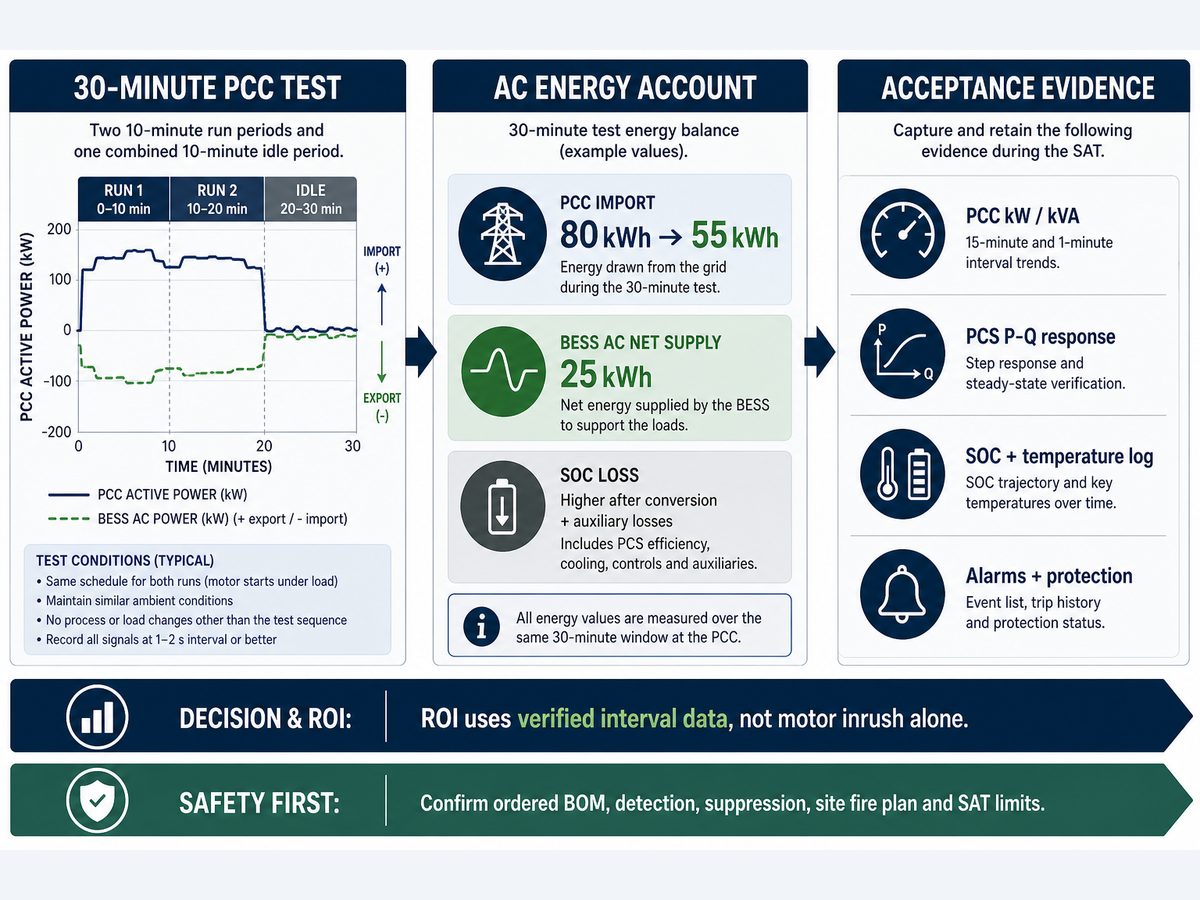
Without BESS, total PCC energy over the 30-minute test was 80 kWh, equal to 160 kW average demand. With BESS, the recorded grid energy was 55 kWh, equal to 110 kW average demand. The BESS supplied 25 kWh net on the AC side of that interval. The actual battery SOC reduction was higher than 25 kWh after conversion and auxiliary losses. This is the correct boundary for the energy account: do not treat net AC supply as battery-side depletion.
For an investment decision, repeat this test across representative production, ambient and tariff conditions. Then calculate demand savings from the applicable meter rule, not only from kWh reduction. If the tariff bills kVA demand, calculate each billed interval from measured PCC kVA and power factor. For the financial model, combine verified interval data with the complete installed cost, annual operating cost, degradation assumption, availability assumption and residual-risk value. The C&I peak-shaving ROI guide provides a useful framework for keeping those assumptions visible.
Use SAT Evidence to Separate a Working System From a Good-Looking Calculation
A credible SAT needs more than a peak screenshot. Capture synchronized PCC kW and kVA, voltage, BESS AC power, PCS P-Q response, SOC, temperature, alarms and the status of any start-permissive input. Repeat the required event under controlled conditions, identify the measurement boundary, and preserve the raw files. A passing result at one state of charge or ambient condition does not prove the daily duty cycle.
The internal debug record for this example, #ZA-2024-119, reported a 110 kW 30-minute average demand and a 3.2 C rack temperature spread at 28 C ambient during the stated test. The client load profile and schedule are anonymized under NDA. These values are project evidence only; actual performance changes with EMS scheduling, transformer impedance, ambient conditions, battery limits and production sequence. For a disciplined test plan, use the BESS capacity-test checklist alongside the motor-start acceptance sheet.
Thermal Safety and Harmonic Claims Need Their Own Evidence
Do not turn an IP rating, an LFP chemistry statement or a fire-suppression reference into a claim that thermal runaway cannot occur. The buyer should require the exact ordered bill of materials, BMS limits, cooling design, detection and suppression details, cause-and-effect matrix, installation layout, emergency isolation plan and SAT limits. The ESSA product reference lists aerosol or NOVEC1230 fire extinguishing options; the actual agent, detection arrangement and local approval requirements must be confirmed for the purchased configuration.
UL 9540A is a test method for evaluating thermal-runaway fire propagation; it is not a blanket installation approval. UL 9540 addresses energy-storage-system safety, IEC 62619 addresses industrial battery safety requirements, and NFPA 855 may be relevant where adopted by the authority having jurisdiction. Apply the relevant jurisdiction, edition and site layout rather than treating the labels as interchangeable. See the UL 9540A and IEC 62619 EPC guide and the thermal-runaway prevention guide before finalizing the fire plan.
Harmonic performance needs the same discipline. The SAT record measured 2.1% THDi at the PCC under the stated motor condition, compared with 6.8% in the recorded baseline. That is not a universal IEEE 519 compliance claim. A final assessment must use the PCC, the applicable utility limits and the site-specific Isc/IL ratio to evaluate TDD.
What to Send Before Asking for a BESS and PCS Proposal
- Twelve months of utility bills and the applicable demand-charge and interval rules.
- At least two weeks of 1-, 5-, 15- or 30-minute PCC data, plus high-resolution traces for the motor event.
- Single-line diagram, transformer nameplate and impedance, switchboard rating, protection settings and generator details.
- Motor nameplate, starting method, acceleration curve, start frequency and allowed production interruption.
- Required voltage target, maximum demand target, reserved SOC, daily duty cycle and target service life.
- Site ambient range, civil layout, clearance, fire plan, communications architecture and required SAT evidence.
If a generator is part of the resilience plan, define the grid-forming source, charge permissions, reverse-power protection, CT direction and fallback mode before commissioning. The BESS and diesel-generator control guide highlights the control questions that should be resolved before the SAT.
FAQ
Can a BESS start a 132 kW industrial motor?
Possibly, but the motor nameplate is not enough. Verify the starter type, acceleration curve, transformer impedance, feeder voltage dip, PCS kVA/current limit, DC limits and protection coordination at the actual connection point.
Does motor inrush automatically create a demand-charge problem?
No. A short inrush event can create a voltage-quality problem without materially changing a 15- or 30-minute demand interval. Only measured interval data and the applicable tariff rule can quantify demand exposure.
Why are PCS kVA and BESS kWh checked separately?
PCS kVA and P-Q headroom determine whether the system can support a short electrical event. Usable BESS kWh and recharge time determine whether it can sustain the required demand-shaving duty over the billing interval.
What product is used in this guide?
The cabinet evaluated is MegSolid ESSA0100B-0215, with published 100 kW rated AC power and 215.04 kWh nominal capacity. The final suitability still depends on the site-specific PCS, motor and demand-interval study.
Why recommend ESSA0100B-0215 for this duty?
It is a coherent 100 kW-class outdoor C&I cabinet reference with one documented specification set. It should be shortlisted only when the required power, usable energy, ambient conditions and controls match the verified project duty.
Does 215.04 kWh equal 215.04 kWh of usable AC energy?
No. Nominal battery energy is not the delivered AC energy. Reserve SOC, conversion loss, auxiliary consumption, temperature, ageing, BMS limits and recharge scheduling all affect usable energy.
Can one BESS provide both voltage support and peak shaving?
Yes, if the PCS has the necessary P-Q/current headroom and the EMS preserves enough energy and SOC reserve for both duties. This must be proven against the combined operating schedule.
What does active-power-priority control mean in this SAT?
For the recorded SAT, the PCS was configured to prioritize active power for the demand-management duty before allocating residual apparent-power headroom to reactive support. It is a project setting, not a universal product default.
What should be measured at the PCC?
Measure synchronized voltage, kW, kVAr, kVA, power factor, interval energy, BESS AC power, PCS response, SOC, temperature, alarms and operating mode. Keep feeder records separate from total-site PCC records.
How is BESS demand-shaving ROI calculated?
Calculate each applicable billing interval from measured PCC data, then apply the tariff. Include installed cost, financing, maintenance, degradation, auxiliary energy, recharge energy, availability and the probability-weighted value of avoided disruption.
Can a 30-minute test prove annual savings?
No. It can validate an interval energy balance under defined conditions. Annual savings require representative seasonal load, tariff, production, outage and battery-duty assumptions.
Does IP54 make a cabinet suitable for any outdoor site?
No. IP54 describes enclosure ingress protection. The project still needs a civil base, drainage, clearances, ambient review, maintenance access, electrical design and local fire-safety approval.
Does LFP chemistry or suppression equipment eliminate thermal-runaway risk?
No. Thermal risk must be managed through the exact battery and control design, detection, suppression, separation, emergency isolation, operating limits, maintenance and site emergency plan.
What safety documents should the buyer request?
Request the ordered BOM, BMS limits, cooling details, detection and suppression description, cause-and-effect matrix, electrical protection study, layout, emergency plan, relevant test evidence and commissioning limits.
Can the BESS operate with a diesel generator?
Yes, when the control architecture is engineered. Define the grid-forming source, generator loading band, charge permissions, reverse-power protection, CT polarity, relay coordination and fallback state before SAT.
What must pass during site acceptance testing?
The SAT should prove the agreed PCC power and energy boundary, voltage response, PCS P-Q/current behaviour, SOC reserve, alarm and protection response, thermal limits, communications, meter consistency and generator coordination where applicable.
