 Skip to content
When a project owner buys the battery system directly, appoints an EPC to install it and asks the equipment supplier to commission it, the BESS EPC scope is commercially complete only when every interface has an owner. MegSolid can supply the integrated BESS, controlled interface documents and agreed factory and commissioning support; the EPC still needs a signed boundary for civil works, switchgear, cabling, site controls and energization. The overall duty remains anchored in the C&I battery energy storage system design, while the package split follows the project-specific BESS equipment and balance-of-plant boundary and the approved 400 V switchboard connection.
The usual failure is a small task left out of both contracts. A cabinet arrives, but the purchase order does not name the party responsible for unloading. The EPC installs the AC cables, but no document states who approves terminal torque before first energization. A site test then fails, and one warranty covers equipment defects while the other covers workmanship. The owner is left coordinating evidence, corrective work and a second test while the commercial operation date keeps moving.
Four documents close most of that gap before shipment:
- 1. a scope-of-supply schedule tied to exact model numbers and document revisions;
- 2. a Division of Responsibility matrix with one accountable party for every task;
- 3. a delivery, custody and preservation procedure from factory release to energization;
- 4. a warranty and performance schedule using the same test boundary, dates and exclusions in every contract.

Owner-Furnished BESS Changes Who Carries Interface Risk
In an owner-furnished structure, the owner contracts directly with the BESS supplier. The EPC procures and constructs the local balance of plant, installs the owner-furnished equipment and completes the site work required for energization. Supplier specialists then commission the BESS according to the signed supply and service scope.
This structure gives procurement a direct line to the equipment source, documents and commercial terms. It also puts the owner between two contracts. Markup saved on equipment only holds if the supply agreement and EPC agreement meet at delivery, installation, commissioning and warranty.
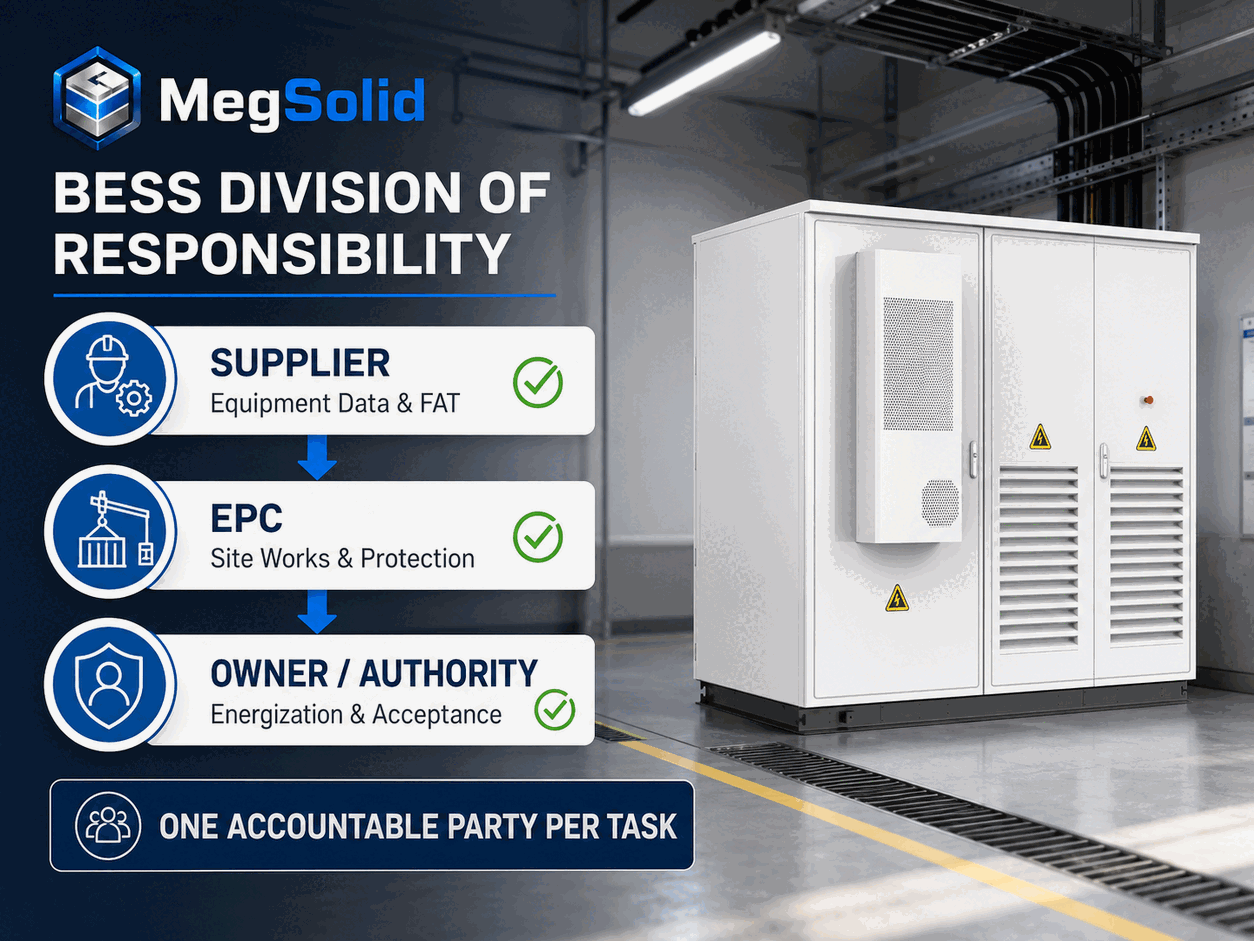
The EPRI ESIC Energy Storage Request for Proposal Guide recommends a Division of Responsibility matrix when the owner, energy-storage supplier and installation contractor are separate parties. Its template follows the Responsible, Accountable, Consulted and Informed structure. The field that matters is Accountable. Three parties can be consulted and the task still has no owner if nobody signs it complete.
Commercial terms remain subject to the signed contracts and applicable law. The technical team still needs to make each boundary measurable. “EPC to coordinate” is not a measurable deliverable. “EPC to issue the approved termination inspection record before supplier energization authorization” is.
Freeze the BESS EPC Scope Before Comparing Prices
Two quotes with the same kW and kWh can still carry different scopes. One may include integrated PCS, internal HVAC, fire interfaces, EMS functions and factory testing. Another may leave meters, auxiliary supply, site controller, transformer, remote communications or commissioning as separate items.
Use a line-item schedule. A one-line “complete BESS” hides the split. For each item, record:
- manufacturer and model;
- quantity and controlled datasheet revision;
- installed location and electrical boundary;
- included internal cables, auxiliaries and controls;
- site-supplied connections and services;
- required drawings, calculations, certificates and test records;
- factory, site and performance-test obligations;
- spares, special tools, training and service support;
- explicit exclusions.
The equipment schedule should agree with the single-line diagram, general arrangement, cable schedule, communication architecture and commercial price schedule. If the PCS appears inside the equipment price but outside the supplier commissioning scope, the inconsistency must be closed before order release.
For an ESSA0100B-0215 screen, the published product boundary identifies a 100 kW / 215.04 kWh, 400 V outdoor cabinet with intelligent air cooling and IP54 ingress protection. Those values pick the equipment family. They do not assign the site feeder, breaker, cable route, foundation, drainage, PCC metering or local approval. The exact supplied configuration and interfaces must match the quotation, bill of materials and approved project documents for the ESSA outdoor cabinet energy storage system.
Use a DOR Matrix That Covers the Whole Site Sequence
A short proposal table often stops at “supplier equipment” and “EPC installation.” That split is too coarse for site work. The matrix needs to follow the equipment through design release, transport, installation, energization, testing and warranty.
| Task or deliverable | Equipment supplier | EPC | Owner | Acceptance record |
|---|---|---|---|---|
| Confirm design inputs and operating duty | Provide equipment limits and required inputs | Verify site data and local design | Approve design basis | Signed input register |
| Issue equipment interface data | Issue dimensions, mass, terminals, auxiliaries and communication requirements | Review against civil and electrical design | Track comments and approval dates | Approved interface package |
| Complete foundation and access | Provide loads, anchoring and clearance inputs | Design and construct local works | Release site and survey control | Survey and civil inspection record |
| Arrange transport and delivery | Pack and issue handling requirements within supply terms | Provide site access and delivery coordination where assigned | Confirm Incoterms, insurance and risk transfer | Delivery and condition report |
| Unload and position equipment | Provide lifting points and handling instructions | Supply crane, rigging and competent crew where assigned | Confirm responsible party before dispatch | Lift plan and placement record |
| Store and preserve before installation | State storage and preservation requirements | Perform inspections and preservation where assigned | Provide secure area and monitor compliance | Preservation log |
| Install AC, auxiliary and communication cables | Provide terminal and protocol requirements | Supply, install, label and test site cables | Coordinate outages and access | Cable test and termination dossier |
| Configure site meter and SCADA | Provide supported points and equipment-side settings | Install field network, meter and site SCADA | Approve command ownership and access | Point-to-point test record |
| Authorize first energization | Confirm equipment-side readiness | Confirm site-side readiness and protection release | Coordinate approval with the appointed switching or utility authority | Joint readiness certificate |
| Commission the BESS | Perform supplier commissioning within contract | Support switching, site tests and defect correction | Witness and accept | Commissioning report |
| Prove project performance | Demonstrate supplier-guaranteed values at the stated boundary | Demonstrate balance-of-plant contribution | Control the acceptance procedure | Signed test report |
| Investigate defects | Diagnose equipment evidence | Diagnose installation and site evidence | Control evidence and response dates | Joint root-cause record |
The project can allocate these roles differently. Every row needs one party that does the work and one party that signs it complete. If the same activity appears in both contracts, the documents must describe the handoff rather than assuming both parties will handle it.
Delivery Is a Technical Handover, Not a Truck Arrival
Risk often transfers at a named delivery point. Technical acceptance usually comes later. A clean delivery process separates commercial receipt from confirmation that the equipment remains suitable for installation.
The delivery procedure should state:
- Incoterm and named place;
- transfer of title and risk of loss;
- party arranging freight, insurance, customs and inland transport;
- road, gate, crane and laydown-area constraints;
- notice period and required delivery documents;
- method for recording shock, tilt, packaging or visible damage;
- time allowed for concealed-damage notification;
- unloading, rigging and final positioning responsibility;
- storage environment and preservation checks before energization.
Consider a factory where the cabinet arrives six weeks before the switchboard outage. The delivery receipt confirms the truck reached site. It does not confirm storage, dry cable entries, intact packaging or the manufacturer’s preservation checks over those six weeks. A named preservation owner, inspection interval and signed log give the later warranty review usable evidence.
Foundation readiness belongs in the same sequence. Equipment dimensions and loading data come from the supplier; geotechnical design, drainage, construction tolerance and local approval normally remain with the project engineer and EPC. The outdoor BESS foundation inputs should be closed before the delivery date is fixed. A crane standing beside an unfinished plinth is a scope failure, even if the cabinet shipped on time.
First Energization Needs Two Readiness Certificates
The supplier can confirm that the BESS is ready on the equipment side. The EPC can confirm that the site is ready on the balance-of-plant side. First energization requires both statements.
The supplier-side readiness record should cover the items included in the supply agreement, such as:
- correct model, serial numbers and controlled firmware;
- completed factory punch-list items;
- shipping-condition inspection;
- internal equipment checks required by the installation manual;
- approved equipment settings and communication files;
- specialist attendance and commissioning prerequisites.
The EPC-side readiness record should cover:
- approved single-line diagram and protection settings;
- foundation, clearances, drainage and access;
- AC and auxiliary cable test results;
- earthing and bonding records;
- breaker, interlock and emergency-stop checks;
- meter ratio, CT polarity and communication availability;
- fire-system and site emergency interfaces;
- energization permit, switching plan and site safety control.
This split stops a commissioning engineer being asked to energize through an unapproved feeder. It also stops the EPC treating supplier attendance as approval of site construction. For control interfaces, the BESS SCADA point list must name the source, destination, engineering unit, write authority, timeout and fail-safe state before site testing begins.
Separate Equipment Warranty From Workmanship Warranty
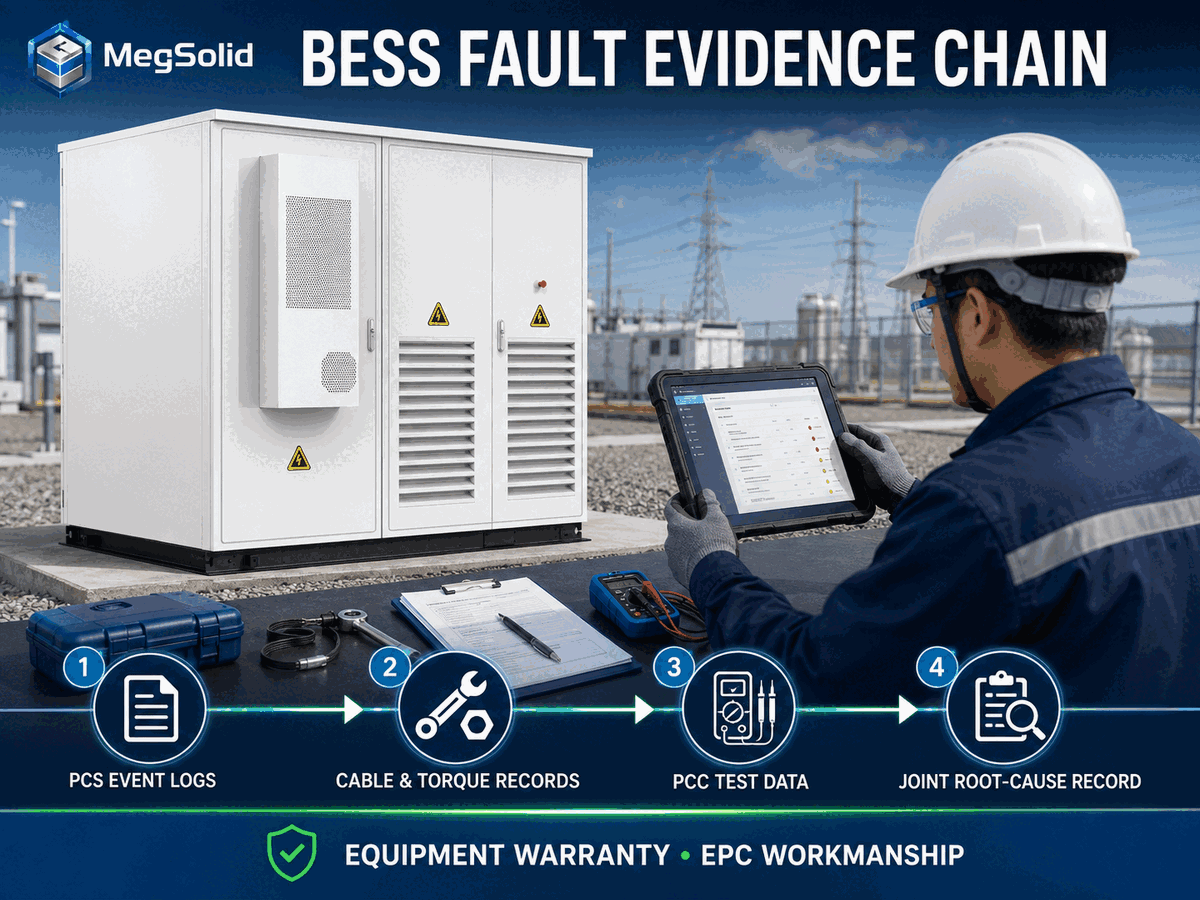
An equipment warranty and an EPC workmanship warranty protect different failure paths. The contract set needs an investigation process for faults that appear at the interface.
Typical equipment-side evidence includes:
- BMS, PCS and controller event logs;
- internal temperatures, voltage and current records;
- alarm history and firmware revision;
- factory test results and serial-number traceability;
- component inspection and diagnostic findings.
Typical site-side evidence includes:
- incoming voltage and frequency records;
- cable insulation, continuity and phase-rotation results;
- terminal torque and thermal-imaging records;
- protection relay events and breaker history;
- CT wiring, network status and auxiliary-supply quality;
- environmental and maintenance records.
Suppose the BESS trips during a 100 kW discharge test. The trip symptom alone does not name the responsible party. The event package needs PCS terminal voltage, PCC voltage, breaker and relay records, cable data, battery limits and time-synchronized alarms. If the PCS reached an internal protective limit, the supplier investigates the equipment path. If excessive voltage drop or an incorrect relay setting caused the trip, the EPC investigates the site path. If the evidence is incomplete, the contracts need a deadline and cost rule for joint testing rather than an open-ended argument.
Three commercial dates also need alignment:
- 1. equipment warranty start;
- 2. workmanship warranty start;
- 3. performance-guarantee start and duration.
Delivery, first energization, provisional acceptance and commercial operation are different milestones. The warranty schedule must state which milestone controls, how owner or EPC delays affect the date, and whether extended storage requires additional preservation or warranty terms.
Assign Performance at One Measurement Boundary
A product guarantee can apply at PCS terminals while the project acceptance test occurs at the PCC. Transformer losses, cable losses, auxiliary consumption, power factor and site operating conditions sit between those points. The contract set must allocate that difference.
For a performance test, define:
- measurement point for active power and delivered energy;
- meter class, sampling interval and time synchronization;
- starting SOC and permitted SOC window;
- test power, power factor and duration;
- ambient and equipment-temperature conditions;
- inclusion or exclusion of HVAC and other auxiliaries;
- correction method, tolerance and data exclusions;
- abort conditions, corrective-work period and retest procedure;
- party paying for repeat site attendance, switching and test equipment.
The test boundary should match the guarantee language in the supply agreement and the completion test in the EPC agreement. If the owner expects zero export, the EPC must install the correct meter and CTs at the regulated boundary, while the supplier-side controls must receive reliable data and act according to the approved sequence. The BESS zero-export control specification provides the site test boundary; it does not move meter installation into the cabinet supply unless the contract says so.
Capacity testing needs the same discipline. A DC nameplate value, PCS-terminal AC result and PCC-delivered energy are different measurements. The BESS capacity-test boundary should be agreed before liquidated damages, warranty remedies or equipment rejection are tied to the result.
Check the Contract Interfaces Before Shipment
Send the equipment schedule, EPC exclusions, delivery terms, single-line diagram, project programme and current DOR matrix. The review can mark unassigned tasks, conflicting milestones and missing acceptance records before the cabinet reaches site.
Control Commissioning Delays and Retest Costs
Commissioning dates often depend on work outside the supplier’s control: permanent auxiliary power, grid outage approval, protection settings, network access, fire-system completion and safe switching authority. The schedule should treat these as named prerequisites with due dates and evidence.
A practical commissioning schedule identifies:
- document-submission and review dates;
- site-readiness inspection date;
- required notice for supplier attendance;
- equipment and EPC punch-list categories;
- test sequence and outage windows;
- owner witness and acceptance authority;
- demobilization criteria;
- return-visit rates and responsibility when a prerequisite is missing;
- deadline for logs, reports and as-built records.
The factory test cuts site uncertainty when it uses the approved configuration. A project-specific BESS factory acceptance test should freeze firmware, drawings, alarm logic and communication mapping before shipment. Site acceptance then focuses on the installed interfaces that the factory cannot reproduce.
Generator-connected projects require another clear handoff. The supplier can implement agreed BESS control functions; the EPC and generator specialist remain responsible for actual CT locations, breaker status, generator settings and site protection according to contract. The approved BESS and generator control sequence should identify the frequency-forming source, minimum generator loading, reverse-power limit and response to communication loss.
Purchase-Order Release Checklist
Procurement can use this checklist before releasing owner-furnished BESS equipment:
- Equipment: Exact models, quantities, ratings, chemistry, cooling and included subsystems match the technical schedule.
- Interfaces: Electrical, civil, communication, fire and auxiliary boundaries match approved drawings.
- Delivery: Incoterm, named place, insurance, unloading, inspection and damage-notification rules are signed.
- Preservation: Storage conditions, inspection interval and responsible party are stated.
- Installation: Site work, supervision, inspection records and completion authority are assigned.
- Energization: Supplier-side and EPC-side readiness certificates are required.
- Commissioning: Prerequisites, attendance, switching authority and deliverables are scheduled.
- Performance: Measurement boundary, test method, correction factors, tolerances and remedies agree across contracts.
- Warranty: Start dates, exclusions, evidence, response time and interface investigation are aligned.
- Handover: As-built drawings, settings, software backups, training, spares and final reports are listed.
A blank checklist item can still support a budget number. It should block purchase-order release when it changes risk transfer, site readiness, warranty coverage or acceptance.
Keep One Evidence Chain From Factory to Handover
Owner-furnished procurement works when the price saving has a controlled evidence chain behind it. The equipment supplier proves the supplied system and its stated performance boundary. The EPC proves the local design, installation and balance of plant. The owner or appointed engineer controls approvals and ensures that the two contracts meet at every handoff.
MegSolid’s value in this structure is a traceable equipment package: controlled model data, interface requirements, factory records, equipment-side control information and the commissioning support included in the signed scope. Local engineering and construction stay visible. They should not sit inside a vague “complete system” line. That clarity lets procurement compare real scope, lets the EPC plan its work and gives warranty teams the records needed to resolve a fault.
Build a Project-Specific DOR Matrix
Provide the proposed MegSolid equipment family, delivery point, EPC scope, site voltage, construction schedule and acceptance milestones. The first review can return a responsibility map showing the open interfaces that must be closed before equipment release.
FAQ
1. What does owner-furnished BESS mean?
The project owner purchases the BESS equipment directly from the supplier and provides it to the EPC for installation. The signed contracts determine the exact boundary, including transport, unloading, storage, commissioning and warranty.
2. Is owner-furnished BESS the same as a turnkey EPC contract?
No. A turnkey EPC structure normally places equipment supply and construction under one prime contract. An owner-furnished structure uses separate equipment-supply and EPC agreements, so the owner carries more interface-coordination responsibility.
3. What is a BESS Division of Responsibility matrix?
A DOR matrix assigns each project task among the owner, BESS supplier, EPC and other contractors. A RACI format records who performs the task, who approves it, who provides technical input and who receives notice.
4. Who normally unloads an owner-furnished BESS?
The contract must assign unloading explicitly. The supplier provides approved lifting and handling information. The party named for site logistics supplies the crane, rigging, competent personnel and lift plan, then records equipment condition after placement.
5. Who is responsible for storing the BESS before installation?
The delivery and preservation schedule assigns that responsibility. The supplier states storage conditions and required checks; the appointed site party performs and records them. A delivery receipt alone does not prove compliant preservation.
6. Who approves first energization?
The supplier confirms equipment-side readiness within its scope, and the EPC confirms site-side electrical and safety readiness. The owner or appointed authority issues the final energization permission according to the project switching procedure.
7. Does supplier commissioning make the supplier responsible for EPC wiring?
No. Supplier attendance does not transfer responsibility for site cabling, protection, earthing or switchgear unless the signed scope says so. Commissioning verifies defined equipment and functional interfaces using the evidence supplied by each responsible party.
8. Who handles a BESS fault caused by incorrect cable termination?
The EPC workmanship process normally handles site termination defects. The joint investigation should use torque records, cable tests, event logs and inspection evidence before responsibility is assigned.
9. When should the BESS equipment warranty begin?
The supply agreement must name the controlling milestone, such as shipment, delivery, first energization, provisional acceptance or commercial operation. It should also address owner or EPC delay and extended storage.
10. What happens when a site acceptance test fails?
The approved procedure should define evidence collection, fault classification, corrective-work deadlines, retest conditions and cost allocation. The result must be assessed at the contractual measurement boundary and operating conditions.
11. Who owns the PCC performance guarantee?
The contracts must assign one accountable party or a coordinated set of back-to-back obligations. Equipment, transformer, cables, auxiliaries and site controls all affect measured performance at the PCC.
12. What documents should be complete before BESS shipment?
At minimum, complete the approved equipment schedule, interface drawings, DOR matrix, delivery procedure, site-readiness programme, commissioning prerequisites, warranty schedule and acceptance-test boundary.
13. How does direct manufacturer supply reduce warranty ambiguity?
Under a controlled purchase order, direct manufacturer supply provides one defined equipment configuration, traceable serial records, matched interface documents and an equipment-side diagnostic path. The EPC’s construction records remain essential for faults at the site interface.
