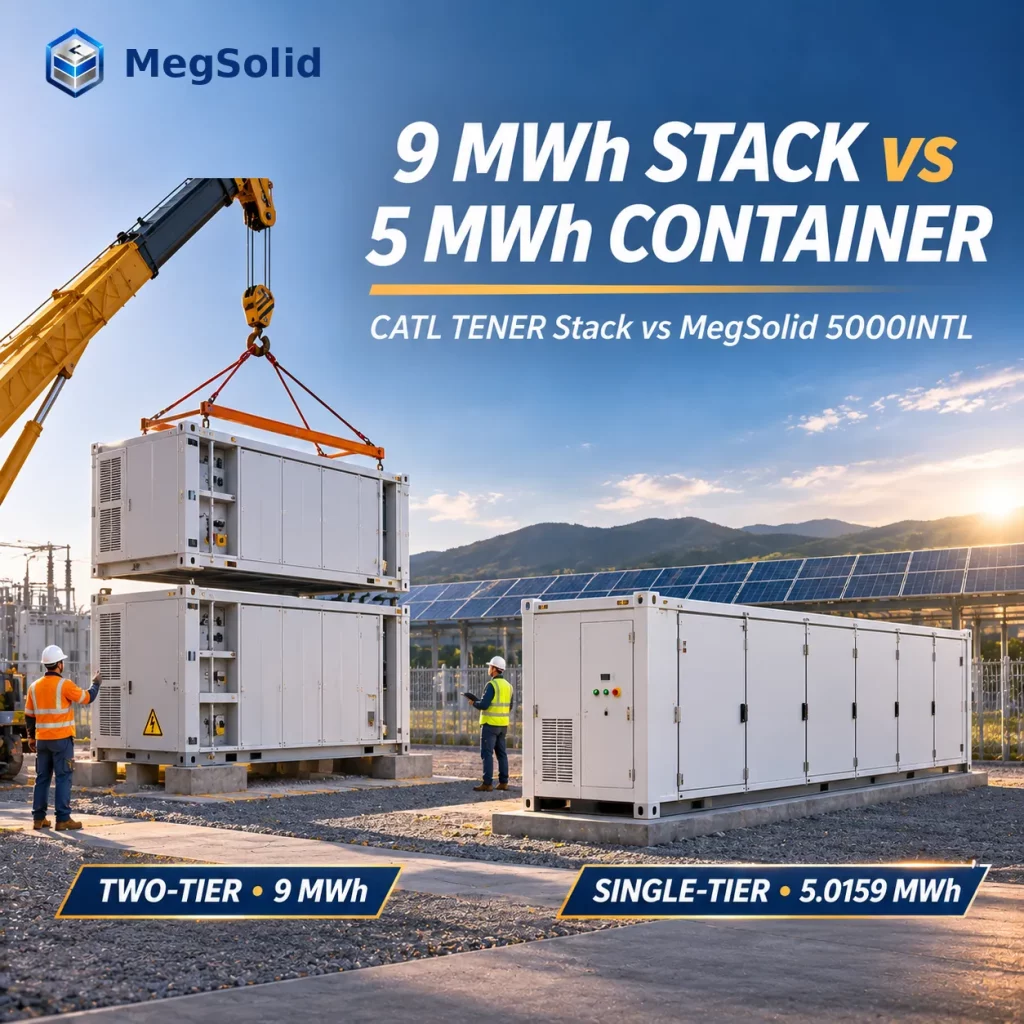
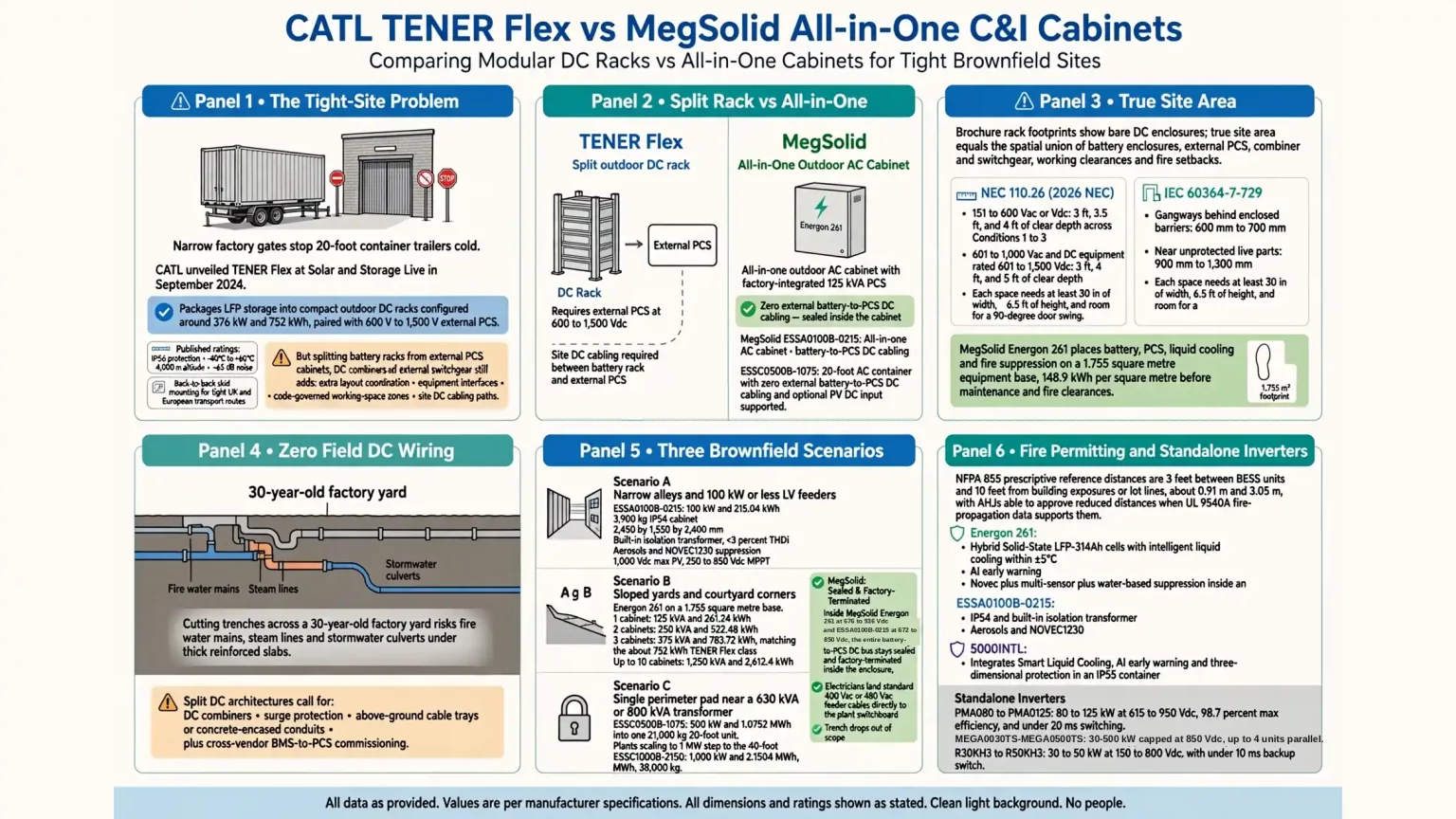
Narrow factory gates stop 20-foot container trailers cold, and the storage retrofit stalls before civil work starts. That is why EPC engineers working cramped European yards, sloped loading bays, and legacy factories often shortlist CATL TENER Flex before searching for a turnkey CATL TENER Flex alternative. CATL unveiled TENER Flex at Solar & Storage Live in September 2024. It packages LFP storage into compact outdoor DC racks configured around 376 kW / 752 kWh, paired with 600 V to 1,500 V external PCS. Published ratings include IP56 protection, -40 C to +60 C operation, 4,000 m altitude, and roughly 65 dB noise.
Split modular DC racks solve one problem well: bypassing narrow gates where 20-foot container trailers fail to turn. On tight brownfield yards, separating battery racks from external PCS cabinets, DC combiners, and external switchgear still introduces extra layout coordination. Depending on the general arrangement, split architectures can add extra equipment interfaces, code-governed working-space zones, and site DC cabling paths between rack and inverter.
All-in-one AC cabinets consolidate that multi-box scope into one self-contained footprint. This technical audit benchmarks modular rack BESS vs all in one cabinet deployment across MegSolid Energon 261, ESSA0100B-0215, and ESSC0500B-1075. It builds on our bare-rack comparison in CATL EnerOne & EnerOne Plus Alternative: MegSolid Energon 261 and our spatial sizing framework in Modular Cabinets vs Containerized ESS Deployment Strategy. For grid and RFQ detail, see 500 kW / 1.0752 MWh Containerized BESS Grid Boundaries and 261 kWh Liquid-Cooled C&I BESS: 125 kVA RFQ Guide.
Modular Rack BESS vs All in One Cabinet: CATL TENER Flex vs. Energon 261, ESSA0100B-0215 & ESSC0500B-1075
Buyer Takeaway: CATL TENER Flex splits DC racks from external 600–1,500 V PCS skids, while MegSolid Energon 261, ESSA0100B-0215, and ESSC0500B-1075 deliver factory-wired AC systems that eliminate external battery-to-PCS DC runs.
Evaluating CATL TENER Flex specs against active all-in-one commercial hardware starts with matching system scope, chemistry, and published dimensions accurately. Give TENER Flex credit for strong outdoor environmental ratings: IP56 ingress protection, -40 C to +60 C temperature capability, 4,000 m altitude rating, ~65 dB acoustic level, and back-to-back skid mounting tailored for tight UK and European transport routes.
| Tight-Site Engineering Metric | CATL TENER Flex (Modular Split DC Rack) | MegSolid Energon 261 (Hybrid Solid-State Cabinet) | MegSolid ESSA0100B-0215 & ESSC0500B-1075 (Turnkey LFP) |
|---|---|---|---|
| System Architecture | Split outdoor DC rack requiring external PCS (600–1,500 Vdc) | All-in-one outdoor AC cabinet (factory-integrated 125 kVA PCS) | All-in-one AC cabinet (ESSA) or 20-ft AC container (ESSC0500B-1075) |
| Unit Capacity & Scaling | Configured around 376 kW / 752 kWh (~379 kWh / 750 kWh classes) | 125 kVA / 261.24 kWh per unit; parallel up to 10 units (2,612.4 kWh) | ESSA0100B-0215: 100 kW / 215.04 kWh; ESSC0500B-1075: 500 kW / 1.0752 MWh |
| Battery-to-PCS Field DC Wiring | Site DC cabling required between battery rack and external PCS | Zero external battery-to-PCS DC cabling (sealed inside cabinet) | Zero external battery-to-PCS DC cabling (optional PV DC input supported) |
| Published Chemistry | LFP (manufacturer-stated 5-year zero-degradation feature; contract terms per supplier) | Hybrid Solid-State LFP-314Ah (1P260S; 832 Vdc nominal, 676–936 Vdc) | LFP (1P240S in ESSA; 3.2 V / 280 Ah LFP in ESSC; >=5,000 cycles) |
| Equipment Base Footprint | Back-to-back DC rack footprint plus external PCS & switchgear layout | 1.755 m2 equipment base (1,300 x 1,350 x 2,200 mm +/-5 mm) | ESSA: 3.80 m2 base (3,900 kg); ESSC0500B-1075: 14.77 m2 20-ft base (21,000 kg) |
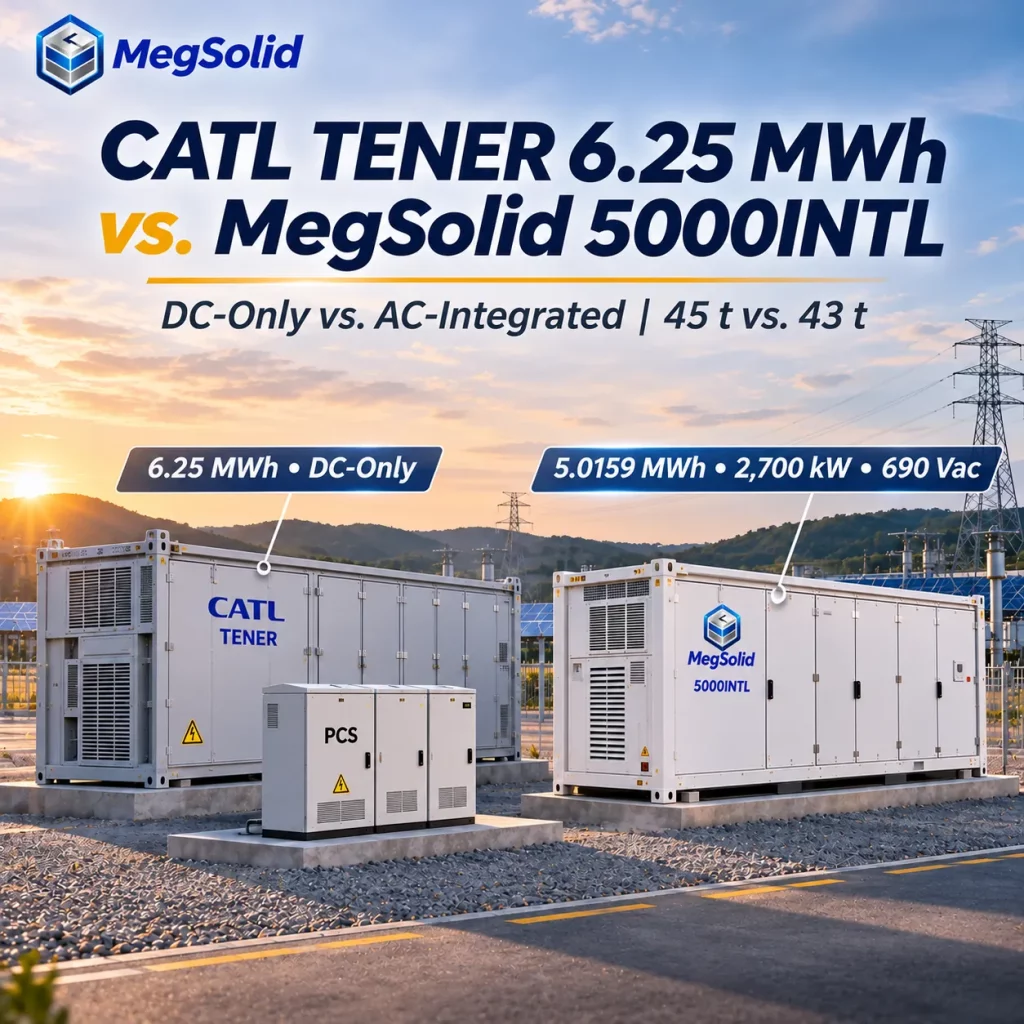
Get chemistry and cooling right in the bid. Sites that want liquid-cooled Hybrid Solid-State LFP deploy MegSolid Energon 261 (125 kVA / 261.24 kWh, 480/400 Vac +/-15%, 90% published max system efficiency, Intelligent Liquid Cooling within +/-5 C). At utility scale, the 20-foot MegSolid 5000INTL carries 2,700 kW / 5,015.9 kWh of SHS180-314 12P416S Hybrid Solid-State LFP, with 690 Vac output, 43,000 kg, IP55, and 87.5% published max efficiency.
Facilities that prefer standard LFP with a built-in isolation transformer select MegSolid ESSA0100B-0215 (100 kW / 215.04 kWh, 768 V nominal, 672–850 Vdc, 400 Vac 3W+N+PE, THDi <3%, >=5,000 cycles at 0.5C and 25 C). For container-scale air cooling, MegSolid ESSC0500B-1075 and ESSC1000B-2150 deliver 500 kW / 1.0752 MWh (21,000 kg) and 1,000 kW / 2.1504 MWh (38,000 kg). Both carry >=5,000-cycle ratings and IP54 intelligent air cooling.
Environmental, Fire Protection & Commissioning Scope
| Field Deployment Factor | CATL TENER Flex | MegSolid Energon 261 (Hybrid Solid-State) | MegSolid ESSA0100B-0215 & ESSC0500B-1075 (LFP) |
|---|---|---|---|
| Enclosure & Ambient Ratings | IP56; -40 C to +60 C; up to 4,000 m altitude; ~65 dB | IP54; Intelligent Liquid Cooling (+/-5 C cell delta) | IP54 outdoor cabinet (ESSA) or IP54 intelligent air-cooled container (ESSC) |
| Fire Protection Hardware | Utility-derived rack thermal protection design | Novec + multi-sensor detector + water-based + AI early warning | Aerosols / NOVEC1230 suppression (ESSA); confirm site fire stack per project |
| AC Output & Grid Scope | Determined by selected external string or central PCS | Factory-integrated 480/400 Vac (+/-15%, 50/60 Hz) | ESSA: 400 Vac (320–460 V), 144 A, built-in isolation transformer; ESSC: turnkey AC |
| PV Input Capability | Via external DC/AC plant architecture | Dedicated AC-coupled C&I storage architecture | ESSA0100B-0215: 1,000 Vdc max PV, 250–850 Vdc MPPT (450–850 Vdc full load), 120/180/240 kW max PV options; ESSC0500B-1075: 600/660/720 kW max PV |
| Warranty & Contract Verification | Manufacturer-stated 5-year zero-degradation claim; confirm contract terms, test boundaries & warranty scope with supplier | Single-OEM cabinet dossier; verify contract cycle & EOL terms | >=5,000 cycles published (ESSA & ESSC); single-OEM cabinet/container scope |
Evaluating Split Modular DC Racks vs. All-in-One Cabinets on Brownfield Plant Yards
Buyer Takeaway: Brochure rack footprints show bare DC enclosures. Price true yard area from full GA drawings that map external PCS gear, shared or separate pads, and overlapping NEC/IEC working clearances.
Engineers auditing brownfield factory BESS tight terrain layouts evaluate total plant geometry beyond bare battery rack dimensions. Catalog drawings for modular DC racks show the back-to-back battery footprint, while full site layouts must account for the spatial union of every required equipment zone and clearance envelope:
A_true_site = Spatial_Union(A_battery_enclosures, A_external_PCS, A_combiner_and_switchgear, A_working_clearances, A_fire_setbacks)
Adjacent equipment can share foundations and overlap permissible working spaces. Simple addition of each zone gives a rough upper bound where zones stay separate, and the spatial union gives true land area. Every electrical enclosure still satisfies applicable personnel access and door-swing rules:
- North American Working Space (NEC 110.26 & Applicable High-Voltage Provisions): Working-space depth depends on the locally adopted NEC edition, equipment voltage to ground, electrical configuration, and working-space condition. In the 2026 NEC, Table 110.26(A)(1) sets 3 ft, 3.5 ft, and 4 ft of clear depth across Conditions 1 to 3 for 151–600 Vac or Vdc to ground. The same table covers 601–1,000 Vac and DC equipment rated 601–1,500 Vdc to ground at 3 ft, 4 ft, and 5 ft. Each space also needs at least 30 in of width, 6.5 ft of height, and room for a 90-degree door swing. Higher-voltage equipment and earlier NEC editions are checked against their own provisions.
- Restricted-Access Switchgear Gangways (IEC 60364-7-729): For restricted-access low-voltage switchgear and controlgear assemblies, operating and maintenance gangways typically need 600 mm to 700 mm minimum width behind enclosed barriers. Near unprotected live parts, that rises to 900 mm to 1,300 mm, with tool-free outward egress. Outdoor BESS cabinet perimeter spacing follows manufacturer GA drawings and local rules.
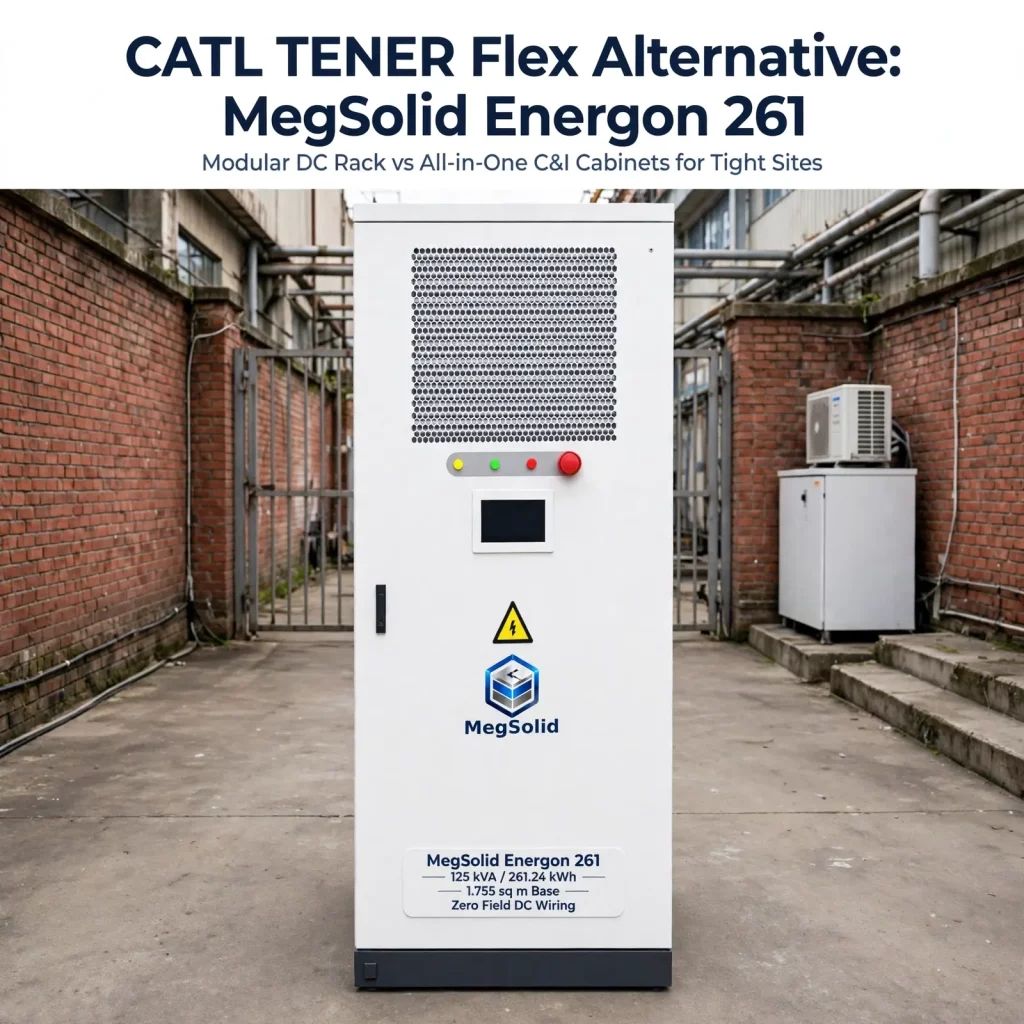
Split DC rack architectures may require additional PCS equipment, field DC cabling, and protection interfaces. At the same time, shared foundations, overlapping permissible working spaces, and integrated PCS layouts can reduce site-area penalties. Final comparisons require complete general arrangement drawings for both systems. Where a project favors single-enclosure consolidation, MegSolid Energon 261 places battery, power conversion, thermal management, and fire suppression on a 1.755 m2 equipment base. That works out to 148.9 kWh per square meter of base footprint, before maintenance and fire clearances.
Eliminating High-Voltage Battery-to-PCS DC Trenching on Legacy Floors
Cutting trenches across a 30-year-old factory yard carries real civil risk. Fire water mains, steam lines, and stormwater culverts sit under thick reinforced slabs. Excavating a path for 600 V to 1,500 V DC conductors between split battery racks and an external PCS skid gets slow and expensive. Depending on site topology, split DC architectures also call for DC combiners, surge protection, above-ground cable trays, or concrete-encased conduits plus cross-vendor BMS-to-PCS commissioning.
Pursuing zero field DC wiring C&I BESS architecture simplifies brownfield electrical work dramatically. Inside MegSolid Energon 261 (676–936 Vdc) and ESSA0100B-0215 (672–850 Vdc), the entire battery-to-PCS DC bus stays sealed and factory-terminated inside the enclosure. Electricians land standard 400 Vac or 480 Vac feeder cables directly to the plant switchboard. The trench drops out of scope. Optional PV DC connections apply only where a site explicitly integrates solar on ESSA or ESSC.
Planning a Tight-Yard or Brownfield BESS Layout? Request CAD equipment footprints, NEC/IEC clearance overlays, and single-line diagrams for Energon 261, ESSA0100B-0215, and ESSC0500B-1075 directly from our application engineers.
Solving Real Brownfield Constraints: Matching ESSA0100B-0215, Energon 261 & ESSC0500B-1075 to Tight Sites
Buyer Takeaway: Match site geometry and transformer size directly to ESSA0100B-0215 for <=100 kW isolated feeders, Energon 261 for 1.755 m2 terraced/corner pads, or ESSC0500B-1075 for single-lift 500 kW yards.
Every legacy factory yard fails in its own way. Some sites have narrow urban alleys; others sit on stepped slopes or have one clean 20-foot perimeter strip next to the main substation. Three verified MegSolid configurations cover those constrained brownfield topologies cleanly.
Scenario A: Narrow Alleys, Galvanic Isolation & <=100 kW LV Feeders (ESSA0100B-0215)
Older European and UK industrial sites often split loads across smaller 400 V sub-panels with strict <=100 kW low-voltage interconnection thresholds. MegSolid ESSA0100B-0215 delivers 100 kW / 215.04 kWh inside a 3,900 kg IP54 outdoor cabinet (2,450 x 1,550 x 2,400 mm; 3.80 m2 base). Its built-in isolation transformer lets EPCs tie straight into a 400 Vac 3W+N+PE feeder with zero external transformer skid. The cabinet also carries =5,000-cycle LFP pack. Solar-ready sites get 1,000 Vdc maximum PV input, a 250–850 Vdc MPPT window (450–850 Vdc at full load), and 120/180/240 kW max PV options by configuration.
Scenario B: Sloped Yards, Courtyard Corners & High Modular Density (Energon 261)
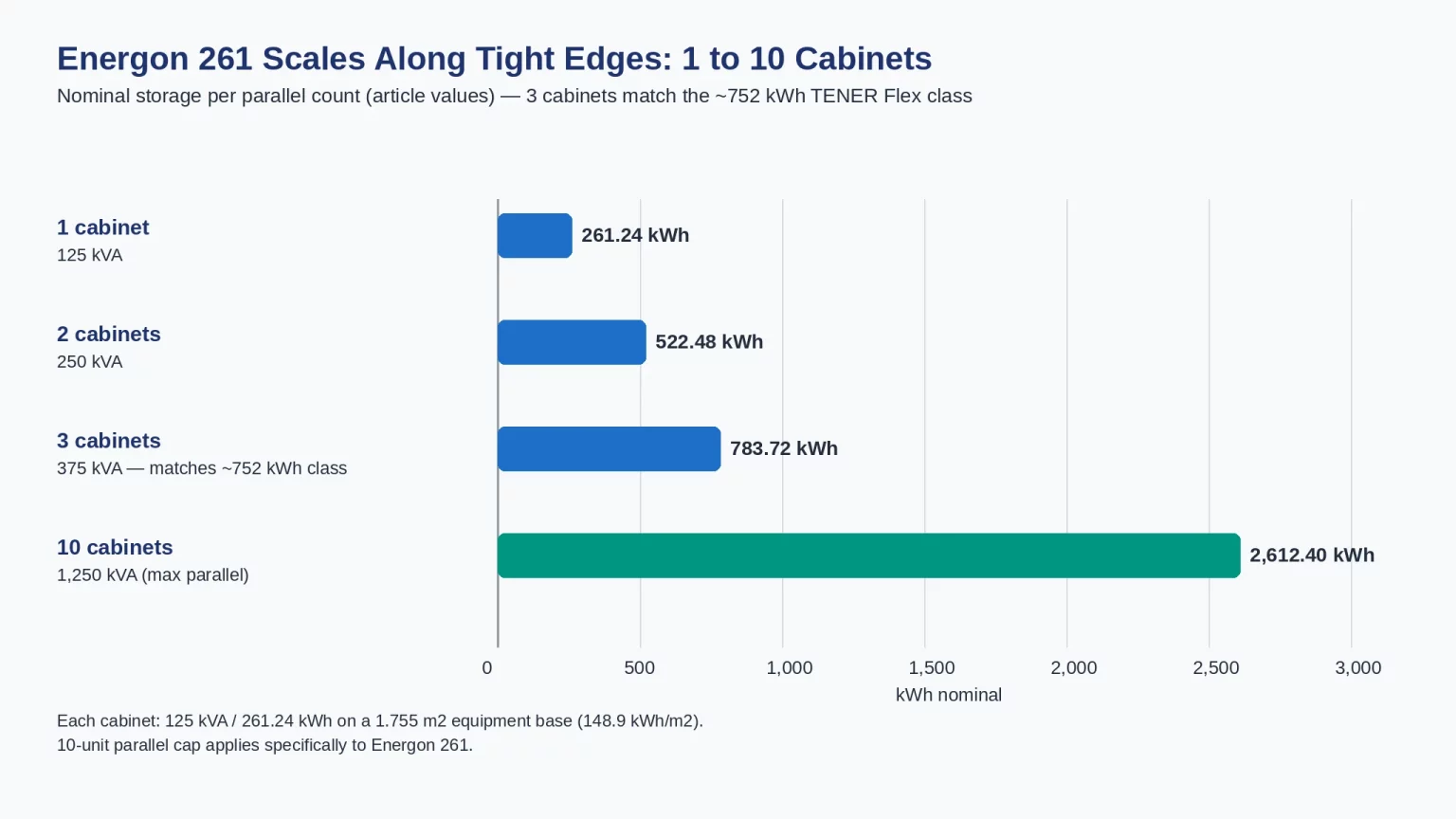
Terraced yards and tight courtyard corners favor small individual concrete plinths over wide container slabs. Each MegSolid Energon 261 Hybrid Solid-State cabinet delivers 125 kVA / 261.24 kWh on a 1.755 m2 equipment base footprint (1,300 x 1,350 x 2,200 mm +/-5 mm, excluding site service and fire clearances). EPCs step capacity cleanly along irregular site edges:
- 1 cabinet: 125 kVA / 261.24 kWh rated apparent power and nominal storage.
- 2 parallel cabinets: 250 kVA / 522.48 kWh.
- 3 parallel cabinets: 375 kVA / 783.72 kWh (matching the ~752 kWh energy class of a paired TENER Flex block while eliminating external PCS skids).
- Up to 10 parallel cabinets: 1,250 kVA / 2,612.4 kWh.
Confirm site active-power delivery (kW) and usable discharge duration against project power factor, DoD limits, conversion losses, and auxiliary loads during final sizing. Note that MegSolid's published 10-unit parallel cap applies specifically to Energon 261; parallel limits for ESSA0100B-0215 and ESSC containers are confirmed per project single-line diagram.
Scenario C: Single Perimeter Pad Next to a 630 kVA or 800 kVA Transformer (ESSC0500B-1075)
When a factory owns one clear 20-foot strip along its fence line beside a 630 kVA or 800 kVA substation, pouring multiple stepped pads for split racks adds civil labor. One MegSolid ESSC0500B-1075 container puts 500 kW / 1.0752 MWh of 3.2 V / 280 Ah LFP storage into a single 21,000 kg 20-foot unit (6,058 x 2,438 x 2,896 mm). It carries >=5,000-cycle cells, IP54 intelligent air cooling, and 600–720 kW max PV options. Plants scaling to 1 MW / 2.1504 MWh step directly to the 40-foot ESSC1000B-2150 (38,000 kg).
Custom DC-coupled microgrids can pair approved battery banks with standalone MegSolid inverters. Verify full battery-to-PCS voltage overlap and BMS compatibility first:
- MegSolid PMA080–PMA0125: 80–125 kW, 615–950 Vdc / 650–950 Vdc, 98.7% max efficiency, <20 ms switching.
- MEGA0030TS–MEGA0500TS: 30–500 kW, built-in isolation transformer, up to 4 units parallel, <=850 Vdc.
- R30KH3–R50KH3: 30–50 kW, 150–800 Vdc, <10 ms backup switch, 100% unbalanced output on R50KH3.
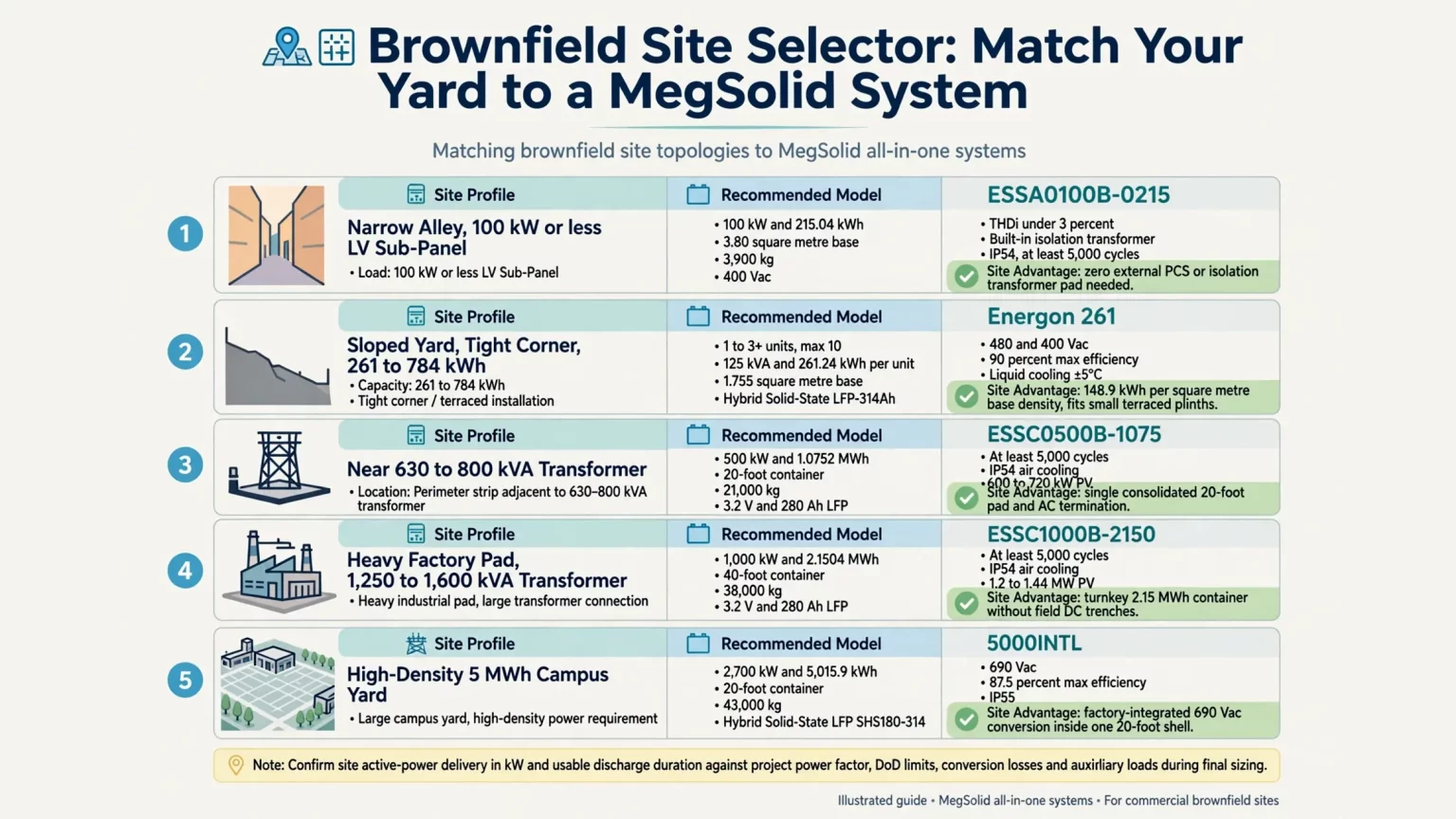
| Brownfield Site Topology | Recommended MegSolid Model | Published Rating & Base Area | Electrical & Thermal Highlights | Site Advantage vs Split DC Racks |
|---|---|---|---|---|
| Narrow Alley / <=100 kW LV Sub-Panel | ESSA0100B-0215 | 100 kW / 215.04 kWh; 3.80 m2 base (3,900 kg) | 400 Vac, THDi =5,000 cycles | Zero external PCS or isolation transformer pad needed |
| Sloped Yard / Tight Corner (261–784 kWh) | Energon 261 (1–3+ units; max 10) | 125 kVA / 261.24 kWh per unit; 1.755 m2 base | Hybrid Solid-State LFP-314Ah, 480/400 Vac, 90% max eff, Liquid Cooling (+/-5 C) | 148.9 kWh/m2 base density; fits small terraced plinths |
| Perimeter Strip Near 630–800 kVA Tx | ESSC0500B-1075 | 500 kW / 1.0752 MWh; 20-ft (21,000 kg) | 3.2 V / 280 Ah LFP, >=5,000 cycles, IP54 air cooling, 600–720 kW PV | Single consolidated 20-ft pad and AC termination |
| Heavy Factory Pad (1,250–1,600 kVA Tx) | ESSC1000B-2150 | 1,000 kW / 2.1504 MWh; 40-ft (38,000 kg) | 3.2 V / 280 Ah LFP, >=5,000 cycles, IP54 air cooling, 1.2–1.44 MW PV | Turnkey 2.15 MWh container without field DC trenches |
| High-Density 5 MWh Campus Yard | 5000INTL | 2,700 kW / 5,015.9 kWh; 20-ft (43,000 kg) | Hybrid Solid-State LFP (SHS180-314), 690 Vac, 87.5% max eff, IP55 | Factory-integrated 690 Vac conversion inside one 20-ft shell |
Urban & Factory-Adjacent Fire Permitting: NFPA 855, UL 9540A & Tight-Lot Clearances
Buyer Takeaway: On tight industrial lots, NFPA 855 setbacks and AHJ review shape the layout as much as electrical clearances. Get the UL 9540A dossier verified before pad drawings freeze.
On cramped brownfield sites, permitting rarely stalls over forklift width. Fire separation distance from occupied factory walls, egress doors, windows, and property lines is where tight-lot projects succeed or get redesigned.
In North America (and comparable European fire-code assessments), 3-foot (~0.91 m) separation between BESS units and 10-foot (~3.05 m) setbacks from building exposures or lot lines are common prescriptive reference distances for applicable outdoor ESS configurations under NFPA 855. Actual setbacks depend on the adopted fire code, installation classification, exposure conditions, approved fire testing, and AHJ requirements. Authorities Having Jurisdiction (AHJs) can approve reduced fire separation distances when large-scale fire-propagation data such as UL 9540A reports and engineered hazard mitigation analyses support them. Required NEC or IEC electrical working spaces around live doors and switchgear stay in place either way.
MegSolid addresses tight-lot safety through layered hardware engineering matched to each product line:
- MegSolid Energon 261 combines Hybrid Solid-State LFP-314Ah cells with intelligent liquid cooling (keeping cell temperature spread within +/-5 C), AI early warning diagnostics, and a combined Novec + multi-sensor detector + water-based fire suppression system inside an IP54 cabinet.
- MegSolid ESSA0100B-0215 pairs its IP54 outdoor enclosure and built-in isolation transformer with Aerosols / NOVEC1230 fire suppression.
- MegSolid 5000INTL integrates Hybrid Solid-State LFP cells with Smart Liquid Cooling, AI intelligent early warning, and a three-dimensional protection system inside an IP55 container.
Before finalizing tight-lot pad drawings, EPC teams request model-specific UL 9540 / UL 9540A or IEC 62619 test packages, thermal-management specifications, and property-insurer documentation from MegSolid engineers so fire-marshal approval runs smoothly alongside civil work.
FAQ
What are the core published environmental ratings of CATL TENER Flex?
CATL TENER Flex includes IP56 outdoor enclosure protection, an operating temperature range from -40 C to +60 C, altitude capability up to 4,000 m, and roughly 65 dB acoustic noise, supporting back-to-back and skid-mounted modular transport layouts.
How should EPCs compare site area between a split modular DC rack and an all-in-one cabinet?
Split DC rack architectures may require additional PCS equipment, field DC cabling, and protection interfaces. Shared foundations, overlapping permissible working spaces, and integrated PCS layouts can reduce those site-area penalties. True site area equals the spatial union of equipment pads, working clearances, and fire setbacks, so final comparisons require complete general arrangement (GA) drawings for both systems. Where single-enclosure consolidation is preferred, MegSolid Energon 261 places battery, PCS, liquid cooling, and fire suppression on a 1.755 m2 equipment base footprint (before service and fire clearances).
Which electrical working-space codes govern 400 V AC cabinets vs. 1,500 V DC split racks?
NEC working-space requirements depend on the locally adopted code edition, equipment voltage to ground, electrical configuration, and applicable working-space conditions. In the 2026 NEC, Table 110.26(A)(1) sets 3 ft to 4 ft of clear depth across Conditions 1 to 3 for 151–600 Vac or Vdc. The same table covers 601–1,000 Vac and DC equipment rated 601–1,500 Vdc to ground at 3 ft to 5 ft. Higher-voltage equipment and earlier NEC editions are checked against their own provisions. In IEC jurisdictions, IEC 60364-7-729 defines 600–700 mm (guarded) to 900–1,300 mm (unprotected) gangways for restricted-access low-voltage switchgear areas.
What is the exact equipment base footprint and energy density of MegSolid Energon 261?
MegSolid Energon 261 measures 1,300 x 1,350 x 2,200 mm (+/-5 mm), giving an exact single-cabinet equipment base footprint of 1.755 m2 and 148.9 kWh/m2 of rated base energy density (261.24 kWh / 1.755 m2). Total installed site area includes project-specific maintenance aisles, door-swing space, and AHJ fire setbacks per approved GA drawings.
Do MegSolid Energon 261 and ESSA0100B-0215 eliminate field DC cabling on brownfield sites?
Both Energon 261 and ESSA0100B-0215 seal the battery-to-PCS high-voltage DC bus inside the factory-assembled cabinet, eliminating external inter-cabinet battery-to-PCS DC trenching and field DC termination. Installers connect standard 400 Vac or 480 Vac AC feeders to the plant switchboard, with DC wiring required only if a site explicitly connects optional solar PV strings to ESSA or ESSC PV inputs.
How do Energon 261, ESSA0100B-0215, and ESSC0500B-1075 differ in battery chemistry and cooling?
MegSolid Energon 261 uses Hybrid Solid-State LFP-314Ah cells (1P260S, 832 Vdc nominal) with intelligent liquid cooling keeping temperature spread within +/-5 C. ESSA0100B-0215 uses LFP (1P240S, 768 V nominal, >=5,000 cycles) with a built-in isolation transformer, while ESSC0500B-1075 (500 kW / 1.0752 MWh) and ESSC1000B-2150 (1,000 kW / 2.1504 MWh) use 3.2 V / 280 Ah LFP (>=5,000 cycles) with IP54 intelligent air cooling.
When is ESSA0100B-0215 better than Energon 261 for a constrained factory retrofit?
Sites with strict <=100 kW low-voltage interconnection thresholds or older 400 V 3W+N+PE factory panels requiring galvanic isolation often select ESSA0100B-0215 (100 kW / 215.04 kWh, 3,900 kg, built-in isolation transformer, THDi <3%). Its PV side accepts 1,000 Vdc maximum input, a 250–850 Vdc MPPT window (450–850 Vdc at full load), and 120/180/240 kW max PV options. Sites maximizing kWh per square meter on terraced plinths with liquid-cooled Hybrid Solid-State LFP select Energon 261.
When should an EPC pick ESSC0500B-1075 instead of multiple individual cabinets?
Pick ESSC0500B-1075 when one accessible 20-foot perimeter pad sits next to a 630 kVA or 800 kVA transformer. It delivers 500 kW / 1.0752 MWh nominal storage under a single crane pick and one AC termination (21,000 kg, IP54 air cooling), consolidating civil pad work and site cabling. Actual net usable 2-hour AC delivery depends on usable DoD, conversion efficiency, and auxiliary loads.
Can standalone MegSolid PMA, MEGA, or R30KH3–R50KH3 inverters pair with custom DC racks?
Energon 261 and ESSA0100B-0215 ship with factory-integrated power conversion. Custom DC-coupled retrofits can use standalone PMA080–PMA0125 (615–950 Vdc / 650–950 Vdc, 98.7% max eff) or MEGA0030TS–MEGA0500TS (<=850 Vdc cap, below Energon 261's 936 Vdc ceiling, up to 4 units parallel). R30KH3–R50KH3 (150–800 Vdc, <10 ms backup switch) covers 30–50 kW loads. Every pairing requires verifying battery-to-PCS voltage overlap, full-power current ratings, BMS communication, and approved system pairing.
How do NFPA 855 separation rules and UL 9540A test reports affect tight-lot BESS placement?
Under NFPA 855, 3 feet between BESS units and 10 feet from building exposures or lot lines are common prescriptive reference distances for applicable outdoor ESS configurations. Actual setbacks depend on the adopted fire code, installation classification, exposure conditions, approved fire testing such as UL 9540A reports, and AHJ requirements, while maintaining required NEC or IEC electrical working clearances.
Conclusion: Beat Tight-Terrain Retrofits Without Split-Rack Civil Headaches
CATL TENER Flex shows how modular DC racks can fit through narrow European transport lanes with IP56 outdoor durability and wide-temperature resilience. On real brownfield factory pads, splitting battery racks from external PCS cabinets and DC combiners can still add extra equipment interfaces, working-clearance coordination, and site high-voltage DC cabling across cramped grounds.
Factory-integrated AC systems cut that civil and electrical scope down hard. Pick the 1.755 m2 Hybrid Solid-State MegSolid Energon 261 (125 kVA / 261.24 kWh, up to 10 parallel units) for terraced corners. Choose the isolation-transformer ESSA0100B-0215 (100 kW / 215.04 kWh) for <=100 kW LV feeders, or one 20-foot ESSC0500B-1075 (500 kW / 1.0752 MWh) for a clean perimeter pad. Each lands verified stationary AC hardware onto constrained commercial terrain.
Ready to Verify Footprint & Grid Fit on Your Tight Industrial Site? Send your yard dimensions, transformer kVA rating, and local fire-code jurisdiction to receive CAD layout blocks, rigging weights, and factory-direct pricing.