 Skip to content
The hybrid solid-state battery storage market in Germany is still in an early engineering deployment stage. The key players are not limited to single cell manufacturers. Instead, the ecosystem is formed by battery R&D companies, OEM automotive groups, and energy storage system integrators.A proper evaluation cannot rely on cell-level metrics alone. It must be assessed under a system-level BESS delivery capability framework.
Market Structure of Hybrid Solid-State Battery in Germany
Demand in the German energy storage market mainly comes from three segments:
- Commercial & Industrial energy storage (C&I peak shaving)
- Grid frequency regulation and ancillary services
- PV + energy storage microgrid systems
At the technology level, hybrid solid-state batteries do not yet follow a unified standard. The dominant development paths include:
- Evolution from LFP systems toward semi-solid architectures
- Experimental integration of oxide/sulfide solid electrolytes
- System-level integration replacing pure cell-level innovation
From an EPC and system integrator perspective, the key evaluation focus is not the “battery type” but:
- System RTE (Round-trip Efficiency)
- Grid compliance (EN 50549 / VDE-AR-N 4105)
- Cycle life (≥6000 cycles @ 80% DoD)
- Thermal runaway propagation control
- Modular scalability (100kWh → MWh systems)
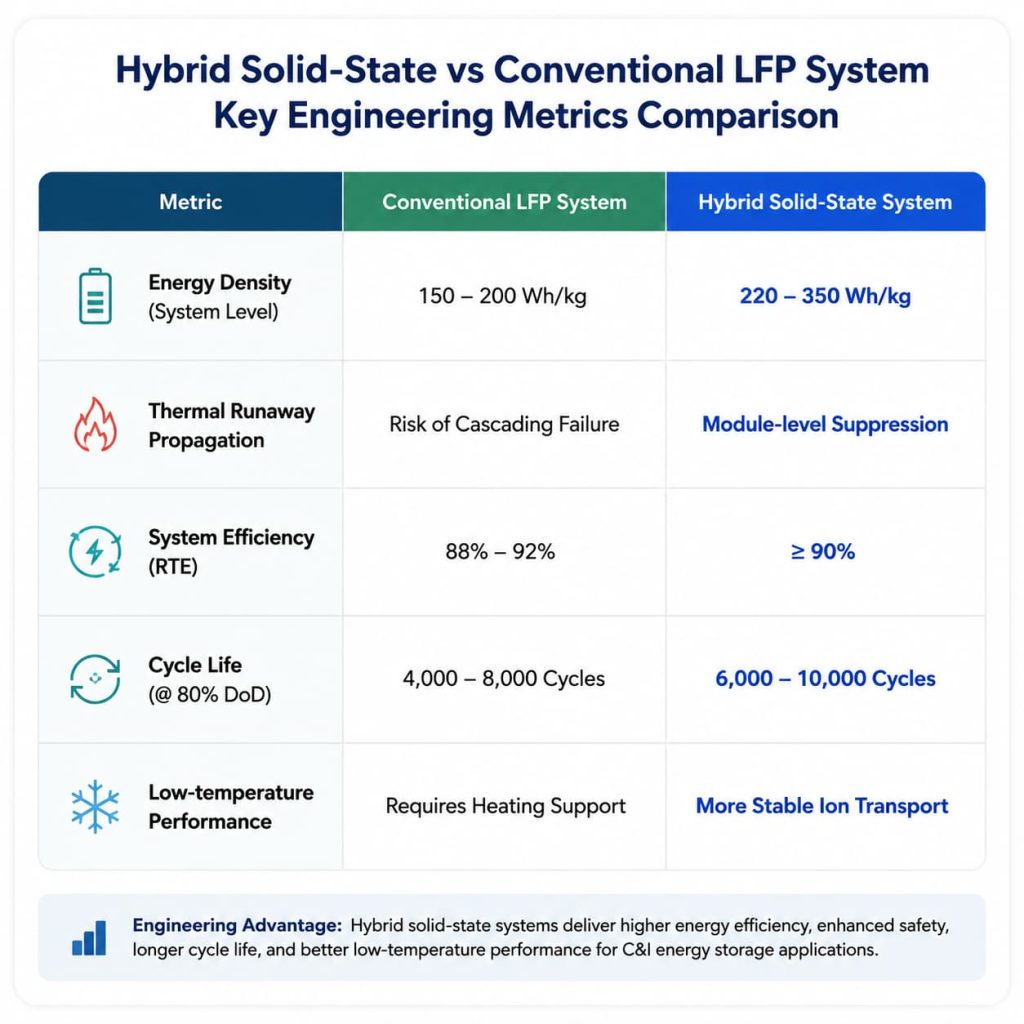
Engineering Criteria for Evaluating Top 10 Companies
The technical level of hybrid solid-state battery companies cannot be judged by a single parameter. It must be broken down into system-level engineering metrics.
Core evaluation dimensions
The technical level of hybrid solid-state battery companies cannot be judged by a single parameter. It must be broken down into system-level engineering metrics.
Energy density (Wh/kg)
- Target for C&I storage systems: 220–350 Wh/kg system-level equivalent
Cycle life
- Commercial requirement: ≥6000 cycles
C-rate performance
- Typical range: 0.5C–1C
Thermal propagation control
- Whether failure is confined at module level instead of cascading at container level
System efficiency (RTE)
- Engineering target: ≥90%
Grid compatibility
- Compliance with German and EU grid standards
|
Metric |
Conventional LFP System |
Hybrid Solid-State System |
|---|---|---|
| Energy density | 150–200 Wh/kg | 220–350 Wh/kg |
| Thermal runaway propagation | Risk of cascading failure | Module-level suppression |
| System efficiency | 88–92% | ≥90% |
| Cycle life | 4000–8000 cycles | 6000–10000 cycles |
| Low-temperature performance | Requires heating support | More stable ion transport |
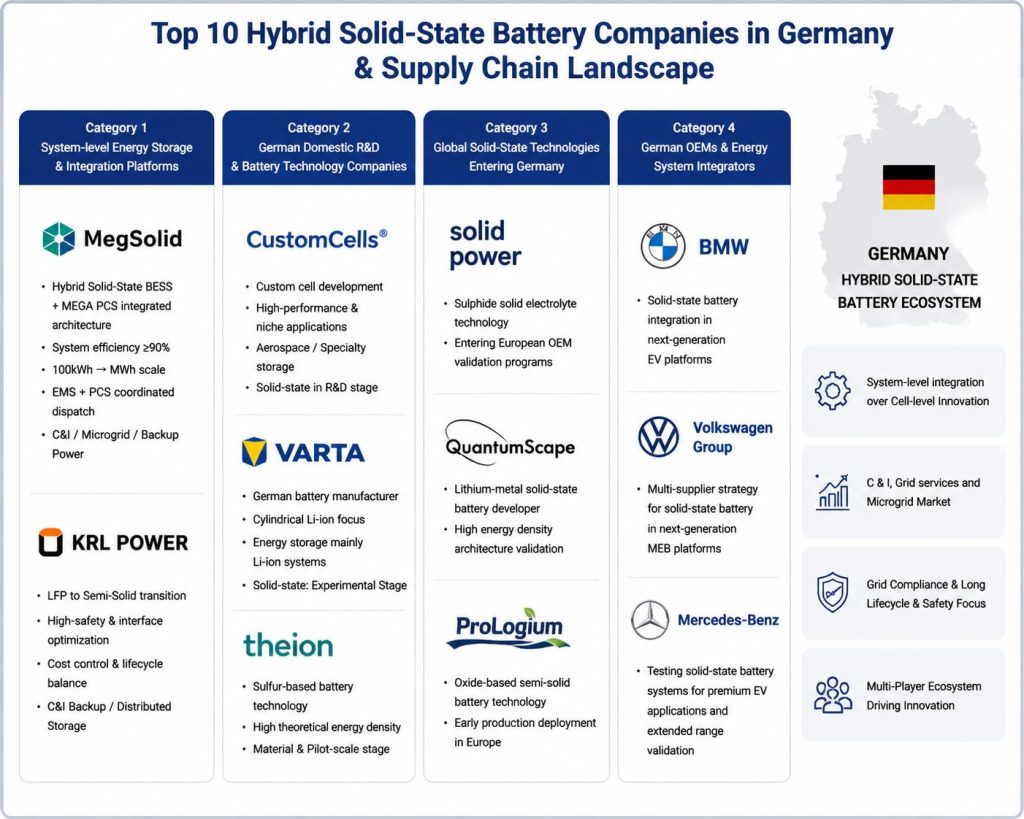
Top 10 Hybrid Solid-State Battery Companies in Germany and Supply Chain Landscape
Germany does not yet have a fully independent solid-state battery industrial chain. The market consists of three main categories:
Category 1: System-level energy storage and integration platforms
MegSolid adopts a Hybrid Solid-State BESS + MEGA PCS integrated architecture, focusing on system-level energy storage delivery for C&I and microgrid applications.
Key engineering characteristics:
- System efficiency: ≥90% (PCS + battery integrated)
- Architecture: modular BESS (100kWh → MWh scale)
- Control layer: EMS + PCS coordinated dispatch
- Applications: industrial peak shaving / microgrids / backup power
The focus is not on cell chemistry, but on:
- System energy path optimization
- Dynamic grid response capability
- Long-cycle degradation control
KRL Power
KRL Power mainly follows a transition pathway from LFP toward semi-solid structures in the German market.
Technical characteristics:
- High-safety LFP system with interface optimization
- Focus on cost control and lifecycle balance
- Applied in C&I backup power and distributed storage systems
Category 2: German domestic R&D and battery technology companies
CustomCells
A custom cell development company focusing on high-performance and niche applications.
- Small-batch high-performance cells
- Aerospace and specialty energy storage applications
- Solid-state development still in R&D stage
VARTA
A German battery manufacturer, with solid-state development mainly at the experimental stage.
- Cylindrical lithium-ion technology focus
- Energy storage still dominated by Li-ion systems
Theion
A sulfur-based battery technology company, considered a quasi-solid-state approach.
- High theoretical energy density pathway
- Currently at material and pilot-scale stage
Category 3: Global solid-state technologies entering Germany’s supply chain
Solid Power
Sulphide solid electrolyte technology entering European OEM validation programs.
QuantumScape
Lithium-metal solid-state battery developer focused on high energy density architecture validation.
ProLogium Technology
Oxide-based semi-solid battery company with early production deployment in Europe.
Category 4: German OEMs and energy system integrators
BMW
Advancing solid-state battery integration in next-generation EV platforms.
Volkswagen Group
Multi-supplier strategy for solid-state battery development in next-generation MEB platforms.
Mercedes-Benz
Testing solid-state battery systems for premium EV applications and extended range validation.
MegSolid System-Level Advantages in C&I Energy Storage Applications
MegSolid is based on system engineering rather than single-cell performance competition.
System architecture characteristics
- MEGA PCS + Hybrid Solid-State Battery integrated design
- Reduced DC-side energy conversion paths
- Improved system-level energy conversion efficiency
Modular scalability
- Single system: starting from 100kWh
- Scalable to MWh-level parallel expansion
- No need to redesign control architecture during expansion
Engineering application features
- Industrial peak shaving
- 6–12 hour factory backup power
- PV + storage microgrid systems
- High-load stability systems (e.g., data centers)
Core value:
- Reduced system-level energy loss
- Improved grid stability
- Optimized long-term degradation control
Conclusion
Germany’s hybrid solid-state energy storage deployment is currently driven by system-level integration rather than single-cell breakthroughs. Most projects are converging toward containerized BESS architectures where PCS performance, thermal management design, and grid compliance define the final system capability.
In industrial peak shaving scenarios above 500kW, system design constraints are increasingly determined by load profile volatility and dispatch response time, not nominal battery capacity. Projects with higher daily cycling frequency require tighter control over round-trip efficiency (≥90%) and degradation slope across 3,000–6,000 operational cycles.
Grid-connected installations in Germany also introduce stricter boundaries at the system level. Compliance with EN 50549 and VDE-AR-N 4105 affects inverter topology selection, fault response timing, and reactive power control behavior under dynamic grid conditions.
For EPC contractors and system integrators, procurement decisions are gradually shifting from “battery chemistry selection” toward:
- system integration architecture
- controllability of multi-MW parallel clusters
- lifecycle energy throughput stability
Hybrid solid-state systems such as MegSolid’s BESS architecture are evaluated in this context as full energy platforms rather than standalone electrochemical products.
FAQ
Q1: What is the minimum project size suitable for hybrid solid-state BESS in Germany?
Hybrid solid-state BESS is typically deployed in projects starting from 100kWh per system unit, with optimal performance in 500kW–10MW C&I peak shaving and microgrid applications. Smaller residential systems are not the primary focus due to system-level cost structure.
Q2: Can hybrid solid-state batteries directly replace LFP systems in existing storage projects?
Replacement is possible at system level, but not plug-and-play. The PCS configuration, EMS logic, and thermal management design must be revalidated to ensure compatibility with load profile, grid code, and cycling depth requirements.
Q3: What is the typical ROI period for industrial hybrid solid-state BESS in Germany?
ROI depends on electricity price spread and daily cycling frequency. In high-utilization C&I scenarios, ROI is primarily driven by daily peak shaving cycles and system efficiency (≥90% RTE) rather than battery nominal capacity.
Q4: What is the key difference between semi-solid and hybrid solid-state batteries in storage systems?
Semi-solid systems typically retain higher liquid electrolyte content for conductivity, while hybrid solid-state systems integrate solid electrolyte structures to reduce interface degradation and improve thermal stability under high C-rate operation.
Q5: How does grid compliance affect BESS selection in Germany?
Grid compliance under EN 50549 and VDE-AR-N 4105 impacts inverter topology, fault ride-through capability, and reactive power control. These requirements often determine system architecture more than battery chemistry.
Q6: What cycle life is required for commercial energy storage projects in Germany?
Most commercial and industrial projects require a minimum of 6000 cycles at 80% depth of discharge (DoD), with degradation slope being a key performance indicator for long-term contracts.
Q7: What is the typical energy density advantage of hybrid solid-state systems over LFP?
At system-equivalent level, hybrid solid-state architectures typically achieve 220–350 Wh/kg, compared to 150–200 Wh/kg for conventional LFP systems, depending on configuration and integration design.
Q8: Are hybrid solid-state batteries suitable for data center backup power systems?
Yes. Their value is primarily in high stability output, improved thermal safety margin, and fast response time under load fluctuations, which are critical for data center UPS-level requirements.
Q9: What is the main limitation of hybrid solid-state battery deployment today?
The main limitation is not performance but industrial-scale standardization and cost structure maturity, especially for large-scale multi-MWh deployments.
Q10: How does system architecture influence performance more than battery chemistry?
In modern BESS projects, performance is dominated by PCS efficiency, EMS control strategy, thermal design, and system integration topology, rather than cell chemistry alone.
