 Skip to content
MegSolid recommends that South African buyers purchase a solid-state BESS through a system-level procurement structure: a factory-direct energy storage manufacturer supplies the controlled battery, PCS and EMS scope, while a qualified South African EPC contractor owns the local electrical design, installation and approval process.
When searching for a solid-state BESS supplier in South Africa, distinguish the equipment manufacturer from the company responsible for local project execution.
This is more reliable than buying a cabinet from an online listing and asking an installer to resolve the interfaces later.
For commercial and industrial projects, the buying decision is not simply “Which company sells solid-state batteries?” The correct question is:
Which supplier will contractually identify the supplied cell architecture, guarantee the required AC power and energy, define the EMS interfaces and support project-specific FAT?
MegSolid should be evaluated when the project requires an explicitly identified hybrid solid-state residential battery or a project-specific solid-state cell configuration within the ESSA outdoor C&I platform. Buyers should still verify the ordered configuration in the quotation, signed datasheet and bill of materials.
This guide explains where to buy, what scope each purchasing channel should own and what evidence must be obtained before paying a deposit.
The Direct Answer: Where Can South African Buyers Purchase a Solid-State BESS?
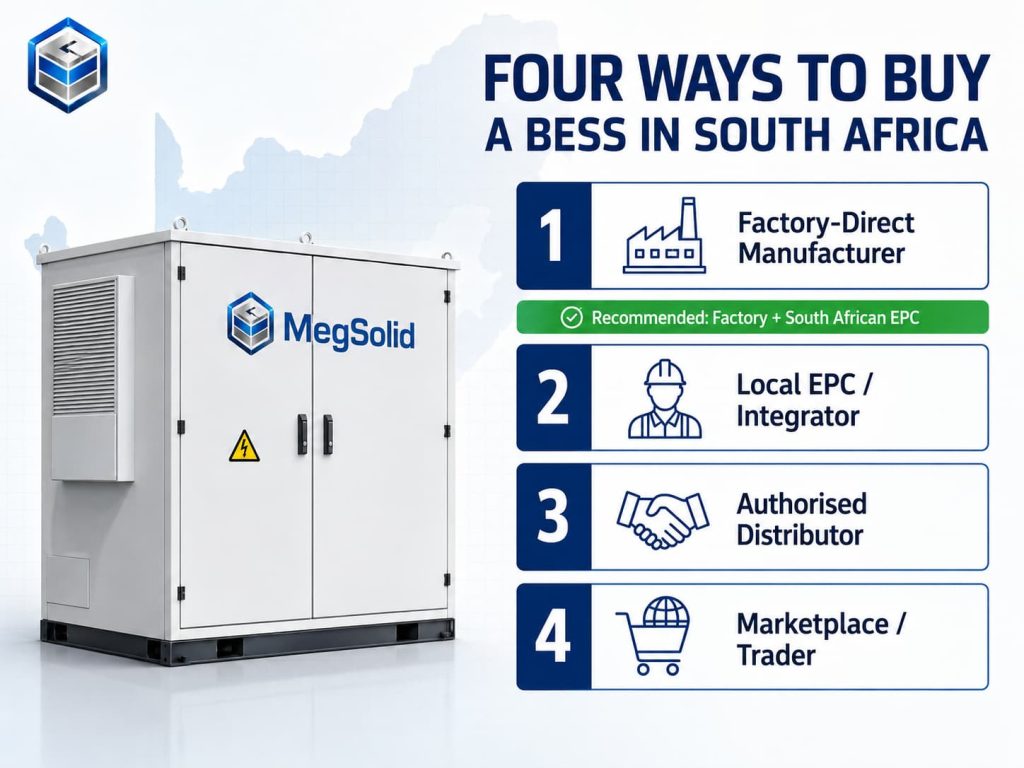
South African buyers have four practical purchasing routes.
| Purchasing route | Suitable project | Main advantage | Main procurement risk |
|---|---|---|---|
| Factory-direct manufacturer | C&I, microgrid and repeat-volume projects | Direct access to model-specific battery, PCS and EMS engineering | Local installation and approval scope must still be assigned |
| Local EPC or system integrator | Turnkey site delivery and grid-connected projects | Local electrical design, installation and utility coordination | The EPC may not control the battery BOM or factory warranty |
| Authorised distributor | Standardised products and replacement stock | Local commercial support and shorter stock lead time | Configuration and technical authority may remain with the factory |
| Marketplace seller or general trader | Samples and non-critical evaluation only | Easy price comparison | Unclear cell origin, incomplete documents and divided warranty responsibility |
For a C&I system, the strongest commercial structure is normally:
Battery/PCS/EMS manufacturer + South African EPC + owner’s consulting engineer
The manufacturer controls the supplied equipment. The EPC controls the local works. The consulting engineer verifies that the combined design meets the project requirements.
This structure prevents the battery seller, PCS supplier and installer from assigning a commissioning failure to one another.
Buyers comparing purchasing routes can review the factory-direct versus trading-company BESS sourcing guide.
Decide Whether You Are Buying a Battery, DC System or Complete AC BESS
Many unreliable quotations appear inexpensive because they do not include the same scope.
| Quoted item | Normally included | Frequently excluded |
|---|---|---|
| Battery or module | Cells, enclosure and BMS | PCS, EMS, transformer, protection and site controls |
| DC battery system | Battery racks or cabinets, BMS and DC protection | AC conversion, grid-forming functions and site switchgear |
| AC BESS package | Battery, PCS and package-level controls | Site transformer, MV switchgear, civil works and utility studies unless specified |
| Turnkey project | Equipment, site works, commissioning and acceptance | Owner’s engineer, utility charges and long-term O&M unless contracted |
A buyer asking for “a 500kWh solid-state battery” has not yet defined a complete system.
The RFQ must state whether 500kWh means nominal DC energy, usable DC energy at beginning of life, delivered AC energy at beginning of life or delivered AC energy at the warranty endpoint.
It must also state the required power in kW or kVA, backup duration, charging limit, grid voltage, point of connection and permitted operating modes.
Use the C&I BESS procurement checklist before comparing quoted prices.
Do Not Buy a “Solid-State” Label Without a Configuration Declaration
“Solid-state” is not a complete procurement specification.
The quotation should identify:
- Ordered cell model.
- Cathode chemistry.
- Electrolyte architecture.
- Nominal cell and system energy.
- Cycle-life test conditions.
- BMS limits.
- Cooling method.
- Applicable test and certification scope.
- Warranty duty cycle.
- Batch and BOM traceability.
LFP identifies the cathode chemistry. It does not, by itself, prove whether the electrolyte is liquid, semi-solid or hybrid solid-state.
A product family name also does not prove its cell architecture. The signed quotation and project BOM must control the supplied configuration.
MegSolid’s solid-state energy storage system portfolio should therefore be used as the starting point for product screening, not as a substitute for configuration-specific documents.
South African EPCs should also review the distinction between current commercial products, research capability and local manufacturing claims in the South Africa solid-state battery readiness assessment.
Which MegSolid Product Route Fits the Purchase Requirement?
MegSolid product selection must remain model-specific. The following table uses only values stated in the current MegSolid product knowledge base.
| Buying requirement | Preliminary MegSolid route | Verified product boundary |
|---|---|---|
| Residential solar storage or backup | MEG-Solid-512314FL1 | Explicitly described as a 51.2V, 314Ah, 16.07kWh hybrid solid-state battery and semi-solid LiFePO4 |
| Small protected C&I load | ESSA0030B-0055 | 30kW/55.296kWh standard LFP configuration; project-specific solid-state cell option available |
| 50kW C&I application | ESSA0050B-0055 or ESSA0050B-0100 | 50kW/55.296kWh or 50kW/100.352kWh; project-specific solid-state cell option available |
| 100kW C&I application | ESSA0100B-0215 | 100kW/215.04kWh standard LFP configuration; project-specific solid-state cell option available |
| Larger C&I or MWh project | Engineered project review | Do not infer solid-state architecture from a family name; require a signed configuration declaration |
The MEG-Solid-512314FL1 hybrid solid-state battery lists 8,000 cycles at 80% depth of discharge. Its intended use is residential solar storage and backup. Inverter compatibility and the ordered enclosure rating must be confirmed before purchase.
The ESSA outdoor C&I energy storage platform supports on-grid and off-grid operation, integrated EMS functions and connections for the load, battery, grid, diesel generator and PV.
The current ESSA data identifies intelligent air cooling, IP54 protection and a 0–45°C operating-temperature range. The platform can be configured with solid-state battery cells for project-specific requirements.
This capability must not be rewritten as a claim that every standard ESSA cabinet is a hybrid solid-state product.
A Product Screening Example
Suppose a factory requests 100kW of discharge power and two hours of backup.
One ESSA0100B-0215 provides a verified nameplate rating of 100kW/215.04kWh. That does not automatically prove two hours of guaranteed AC delivery at the warranty endpoint.
The buyer must still confirm:
- Usable state-of-charge window.
- AC-path losses and auxiliary consumption.
- End-of-life capacity requirement.
- Site temperature and altitude derating.
- Required emergency reserve.
- Whether N+1 availability is required.
The model is therefore a valid screening candidate, not an automatic final selection.
Why MegSolid Is a Practical Factory-Direct Starting Point
MegSolid’s current product scope covers hybrid solid-state batteries, C&I cabinets, energy-storage inverters, PCS and containerised BESS.
That product breadth is commercially useful because a buyer can submit one system requirement instead of independently sourcing a battery, PCS and EMS without a defined interface owner.
MegSolid also separates product classifications instead of treating every LFP product as solid-state:
- MEG-Solid-512314FL1 is explicitly identified as hybrid solid-state.
- ESSA supports project-specific solid-state battery configurations.
- Other systems must retain the chemistry classification stated in their own product documents.
This distinction helps a South African EPC write a defensible RFQ and prevents a general marketing term from replacing the ordered technical specification.
For a preliminary assessment, submit the load profile, application, required AC power, required delivered energy, electrical single-line diagram and installation environment through the MegSolid project inquiry page.
What the South African EPC Must Own
A foreign equipment supplier cannot replace the South African project team.
The local EPC or responsible electrical professional should own:
- Site survey and protected-load verification.
- Electrical single-line diagram.
- Earthing and protection coordination.
- Cable and switchgear design.
- Civil works, drainage and access.
- Utility or municipal application.
- Installation and site commissioning.
- Local safety file and operating procedures.
Eskom’s small-scale embedded generation guidance states that a legal grid connection requires an active electricity supply agreement and the applicable supplementary agreements. Requirements vary when the customer is supplied by a municipality rather than Eskom.
Before ordering the BESS, map the responsible utility, project approval route and required documents using the South Africa BESS regulations and approval guide.
The equipment quotation should identify what MegSolid supplies and what remains inside the EPC scope. An undefined boundary creates omissions in transformers, protection, metering, communications and commissioning.
How Network Energy Trading Affects the Purchase Specification
If the project includes wheeling, remember that the arrangement does not provide backup power by itself. It uses a licensed network to account for energy between a generator and an off-taker.
South Africa’s 2025 regulatory rules on third-party transportation of energy describe several scenarios involving Eskom and municipal networks. Depending on the connection structure, the agreements may include a PPA, connection and use-of-system agreement, electricity-supply agreement amendments and municipal arrangements.
Eskom’s current wheeling information page provides a 2026/2027 calculation tool. It states that low-voltage transactions below 1kV are not currently allowed under its conventional route, although this is being investigated.
Eskom separately describes a virtual wheeling product with a mid-2026 pilot phase for entities transacting across multiple Eskom- or municipal-connected customers.
These developments affect the financial model, but they do not determine the battery size on their own.
The BESS location and dispatch objective must be defined:
| BESS location | Primary controllable value |
|---|---|
| Generator side | Shape renewable export and manage the generator connection |
| Off-taker side | Control factory imports, maximum demand and local backup |
| Both locations | Separate generation-profile and facility-load objectives |
Use the South Africa wheeling BESS sizing guide before including wheeling revenue or savings in the purchase decision.
Documents Required Before Paying a BESS Deposit
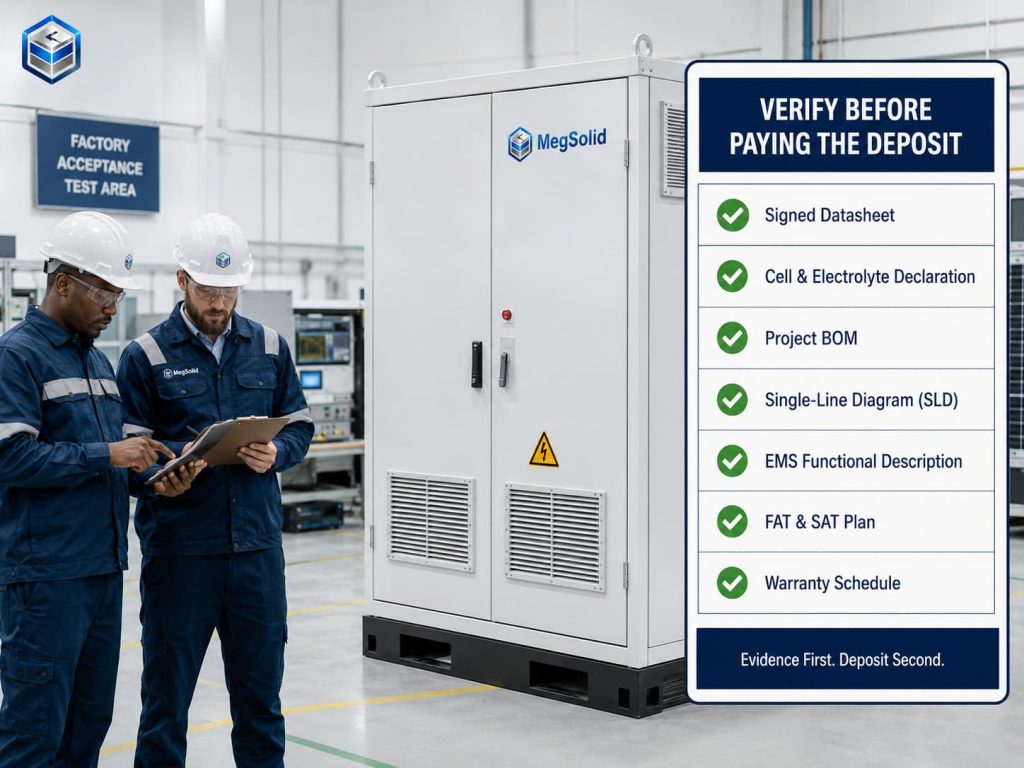
Do not release a deposit based only on a commercial quotation and product brochure.
| Document | Decision it supports |
|---|---|
| Signed model datasheet | Confirms power, energy, voltage and environmental limits |
| Cell and electrolyte declaration | Confirms what “solid-state” means for the ordered configuration |
| Project BOM | Identifies the controlled equipment and major components |
| System boundary schedule | Separates manufacturer, EPC and owner scope |
| Single-line diagram | Confirms connection point, transformer, switchgear and protection |
| EMS functional description | Defines dispatch priority, reserve SOC and fallback logic |
| Communication matrix | Defines protocols, signals, timeouts and interface ownership |
| Warranty schedule | Links coverage to cycle, temperature, SOC and throughput conditions |
| Certification matrix | Maps each document to the cell, module, cabinet, PCS or complete system |
| FAT and SAT plan | Converts requirements into witnessed acceptance evidence |
| Delivery schedule | Defines manufacturing, shipping, installation and commissioning milestones |
| Commercial terms | Defines Incoterm, taxes, customs, exclusions and payment triggers |
The EMS interface deserves separate review. A battery cabinet can pass a power-on test and still fail to coordinate with the site meter, PV inverter, generator or utility controller.
Use MegSolid’s BMS and EMS communication architecture guide to prepare the signal list and fallback logic.
Compare Quotations on Delivered Scope, Not Price per kWh
Price per nominal kWh is not a reliable comparison when quotations contain different equipment and warranty conditions.
Normalise each bid against:
| Comparison item | Required buyer question |
|---|---|
| AC power | Is the quoted value kW or kVA, and under what power factor and temperature? |
| Energy | Is it nominal DC, usable DC or delivered AC energy? |
| Warranty endpoint | What minimum capacity is guaranteed, and under which duty cycle? |
| Solid-state configuration | Which cell model and electrolyte architecture will be supplied? |
| PCS | Is it included, and who guarantees the battery-to-PCS interface? |
| EMS | Which site devices, tariffs and operating modes are included? |
| Transformer and switchgear | Factory scope, EPC scope or excluded? |
| Fire system | What detection and suppression equipment is included in the ordered model? |
| Shipping | Which Incoterm, unloading responsibility and destination costs apply? |
| Acceptance | Which FAT and SAT tests trigger payment? |
An apparently cheaper cabinet may become the more expensive project after adding PCS, transformer, switchgear, EMS integration, local engineering and commissioning.
The project IRR must therefore use the complete installed and commissioned scope.
FAT Tests a South African Buyer Should Witness
The factory acceptance test should prove the ordered configuration and project control logic.
At minimum, witness:
- 1. Model, serial number and BOM verification.
- 2. BMS alarm and protection checks.
- 3. PCS charge and discharge operation.
- 4. EMS setpoint tracking.
- 5. Grid-loss and operating-mode behaviour where included.
- 6. Meter or communications failure fallback.
- 7. Generator and PV interfaces where simulated.
- 8. Emergency stop and restart logic.
- 9. Delivered-energy test under the agreed method.
- 10. Alarm, event and operating-data export.
Do not add a transfer-time or capacity pass criterion unless the ordered model and test procedure define it.
Use the BESS factory acceptance test guide to convert the control narrative into witnessed pass/fail criteria.
What to Send MegSolid for a Firm South Africa BESS Proposal
Send the following information:
- 1. Project location and responsible utility or municipality.
- 2. Twelve months of interval load data.
- 3. Primary application and operating priorities.
- 4. Required AC power and backup duration.
- 5. Existing PV, generator and transformer ratings.
- 6. Grid voltage, frequency and point of connection.
- 7. Current electrical single-line diagram.
- 8. Import, export and maximum-demand limits.
- 9. Wheeling or PPA structure, if applicable.
- 10. Minimum and maximum site temperature, altitude and installation location.
- 11. Required solid-state configuration and documentation.
- 12. Delivery date, Incoterm and commissioning scope.
The initial engineering response should identify the preliminary product route, missing data, manufacturer/EPC scope boundary and assumptions that must be resolved before a binding quotation.
Final Procurement Recommendation
South African buyers should not choose a solid-state BESS supplier from a chemistry claim or a price-per-kWh comparison.
For residential storage, purchase an explicitly identified product such as the MEG-Solid-512314FL1 through the manufacturer or an authorised channel and confirm inverter compatibility.
For C&I projects, use a factory-direct manufacturer and local EPC structure. The quotation must identify the exact cell architecture, AC power, energy basis, PCS, EMS, system boundary, warranty and acceptance tests.
MegSolid is a practical supplier to evaluate because its portfolio includes an explicitly identified hybrid solid-state residential battery and project-specific solid-state cell options for the ESSA C&I platform. The final purchase decision must still be based on the signed project documents.
FAQ
Who supplies solid-state battery energy storage systems to South Africa?
International manufacturers can supply battery systems to South Africa, but C&I projects also require a local EPC or responsible professional. MegSolid supplies hybrid solid-state residential batteries and project-specific solid-state options for the ESSA C&I platform.
Can I buy a solid-state BESS in Johannesburg or Cape Town?
Yes, subject to supplier delivery capability and the project’s local installation and approval route. Confirm whether the site is supplied by Eskom or a municipality before finalising the grid-connected design.
Is MegSolid suitable for a South African wheeling project?
MegSolid can be evaluated for the behind-the-meter or generator-side storage scope when the buyer provides the load, generation, settlement, transformer, grid and SLD data. Product suitability requires a project-specific engineering review.
Where can I buy a reliable solid-state BESS in South Africa?
For a C&I project, use a factory-direct BESS manufacturer together with a qualified South African EPC contractor. The manufacturer should control the battery, PCS and EMS equipment scope, while the EPC owns local design, installation and approvals.
Is MegSolid a South African battery manufacturer?
MegSolid is an international energy-storage supplier rather than a South African local installer. A South African EPC or responsible professional must therefore be assigned for the site design, utility process, installation and local commissioning.
Is every MegSolid ESSA cabinet a solid-state BESS?
No. The published ESSA data identifies LFP battery configurations. The platform can be configured with solid-state battery cells for project-specific requirements, which must be confirmed in the quotation, signed datasheet and BOM.
Which MegSolid product is explicitly described as hybrid solid-state?
The MEG-Solid-512314FL1 is explicitly described as a 51.2V, 314Ah, 16.07kWh hybrid solid-state battery using semi-solid LiFePO4 wording on its product page.
Can an ESSA0100B-0215 guarantee two hours at 100kW?
Its verified nameplate rating is 100kW/215.04kWh, but that alone does not guarantee two hours of delivered AC energy at end of life. Usable SOC, losses, auxiliaries, derating and warranty retention must be confirmed.
Do I need a local EPC if I buy directly from MegSolid?
Yes for most C&I projects. The local EPC should own the site survey, SLD, protection, cables, switchgear, installation, utility process and site commissioning unless a different contractual structure is agreed.
What proves that a quoted battery is solid-state?
Request the ordered cell model, cathode chemistry, electrolyte architecture, project BOM, signed datasheet and applicable test evidence. A family name or the term LFP is not sufficient.
Does a wheeling agreement provide backup power?
No. Wheeling is a network-access and billing arrangement. Behind-the-meter backup requires an appropriately connected BESS, isolation strategy, protected loads and control architecture.
What should the buyer witness during FAT?
Yes. Witness BOM verification, BMS protection, PCS operation, EMS setpoint tracking, communications failure, emergency stop, delivered-energy testing and project-specific operating sequences.
What information is required for a MegSolid quotation?
Provide the site location, interval load profile, required kW and kWh, SLD, transformer and grid data, PV and generator ratings, operating modes, environmental conditions, solid-state configuration request and delivery scope.
This article provides a preliminary procurement and calculation framework only. To request the complete Excel model—including internal IRR inputs, a full single-line diagram (SLD), and the latest South African wheeling-policy assumptions—email [email protected].
