
A wheeling agreement can reduce the cost and carbon intensity of industrial electricity, but it does not automatically align remote renewable generation with a factory’s operating profile.
MegSolid sizes a South Africa wheeling BESS from three interval datasets: the generator export profile, the eligible wheeling settlement profile and the factory load profile.
Eskom allocates wheeled energy to the buyer on a time-of-use basis. The factory still receives a bill for the electricity measured at its point of delivery, followed by a credit for eligible wheeled energy after the applicable losses. Network, connection, capacity and administration charges remain relevant.
The direct engineering answer is:
Do not size the battery from annual PPA energy. Size it from the maximum interval mismatch, its duration, the permitted site import and the SOC reserved for backup.
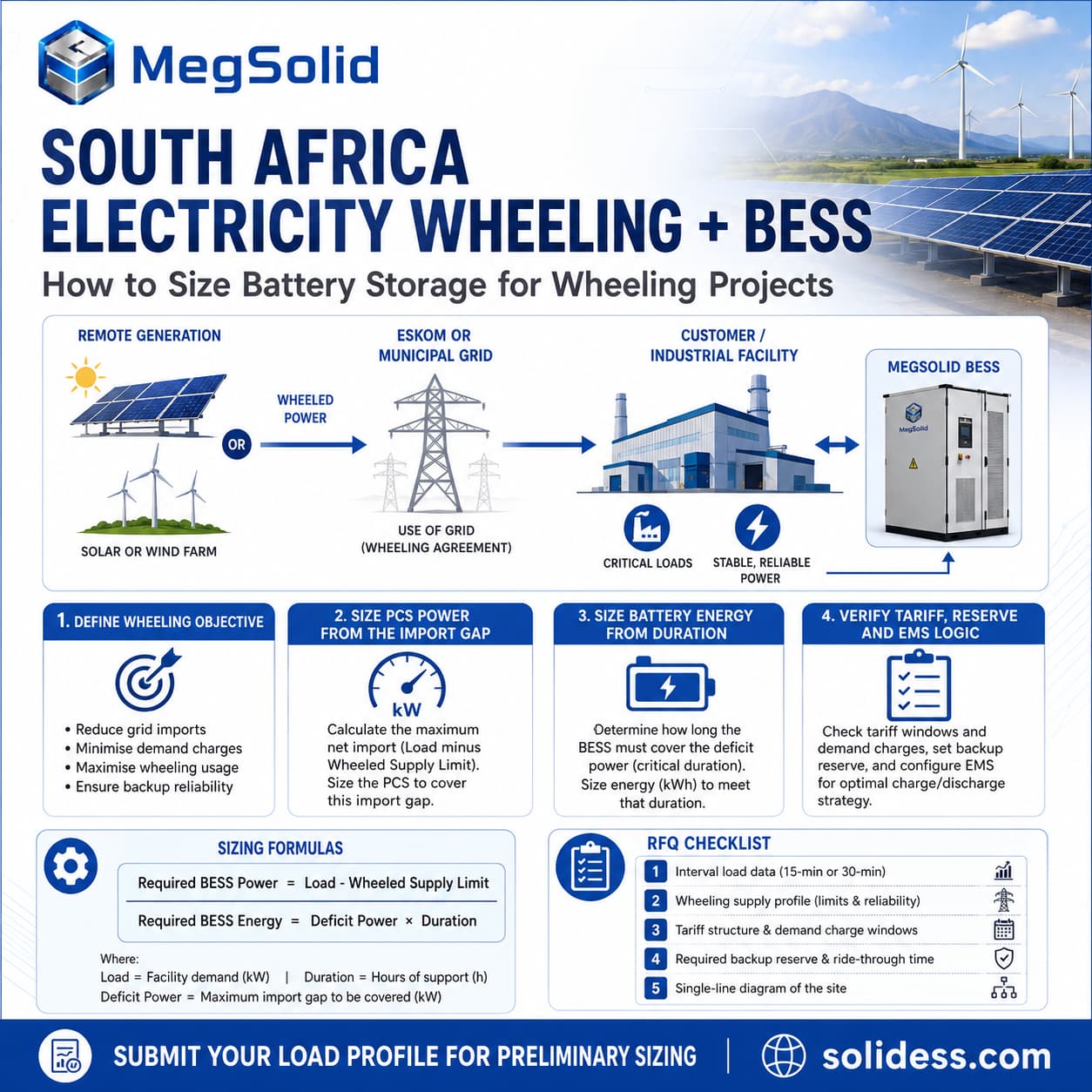
Why Wheeled Energy Does Not Equal On-Site Power
Wheeling is a network-access and energy-accounting arrangement. The factory continues to receive physical electricity through its local point of delivery.
A remote solar or wind PPA therefore does not energise the factory bus when the local network is unavailable. Eskom also states that customers receiving wheeled energy are not exempt from system load-reduction requirements.
| Project Objective | Primary Requirement |
|---|---|
| Procure remote renewable energy | PPA and wheeling arrangement |
| Match renewable output to factory consumption | Generator-side or off-taker-side BESS |
| Reduce factory maximum demand | Off-taker-side BESS and site EMS |
| Maintain critical loads | Behind-the-meter BESS, PCS and isolation architecture |
A project requiring both renewable-energy matching and operational continuity must calculate those requirements separately.
The Hybrid Solar-Storage Architecture for Unstable Grids explains how grid supply, local generation and battery storage can operate as coordinated but distinct energy sources.
Separate Generation, Settlement and Factory Load Profiles
Annual PPA production and annual factory consumption are not sufficient for BESS sizing. The engineering model requires three time-series profiles.
Generator export profile: Power exported from the renewable project at its grid connection point.
Wheeling settlement profile: Energy eligible for allocation after applying the agreements, meters, TOU periods and losses.
Wheeling settlement profile: Energy eligible for allocation after applying the agreements, meters, TOU periods and losses.
Use the settlement interval defined in the project documents. Fifteen-minute or 30-minute data usually provides a better engineering basis than monthly totals, but the analysis must follow the actual metering arrangement.
Eskom credits wheeled energy in the same TOU period in which it is generated. Energy generated during a standard period is not automatically exchanged for consumption during an off-peak or peak period.
For each interval:
Profile Mismatch(t) = Eligible Wheeled Energy(t) − Factory Load(t)
A positive result identifies potential charging energy. A negative result identifies the factory demand remaining after applying the eligible wheeling profile.
Choose Generator-Side or Off-Taker-Side BESS
Storage location determines which problem the system can solve.
| BESS Location | Main Functions | Main Limitation |
|---|---|---|
| Generator side | Smooth renewable output, reduce curtailment and enforce generator POI limits | Does not directly reduce factory demand or provide local backup |
| Off-taker side | Reduce demand peaks, manage factory import and preserve backup energy | Does not remove constraints at the remote generator |
| Both sides | Coordinate dispatchable renewable supply and factory demand control | Requires separate objectives, meters and controllers |
Generator-side storage is suitable when the PPA requires a more predictable production profile.
Off-taker-side storage is generally more useful when the factory needs to control maximum demand, transformer loading, on-site PV or critical-load continuity.
When batteries are installed at both locations, the dispatch hierarchy must prevent conflicting responses. The required point lists, command priorities and fallback modes should follow a project-specific BMS and EMS Communication Architecture in BESS.
Calculate BESS Power From the Maximum Profile Mismatch
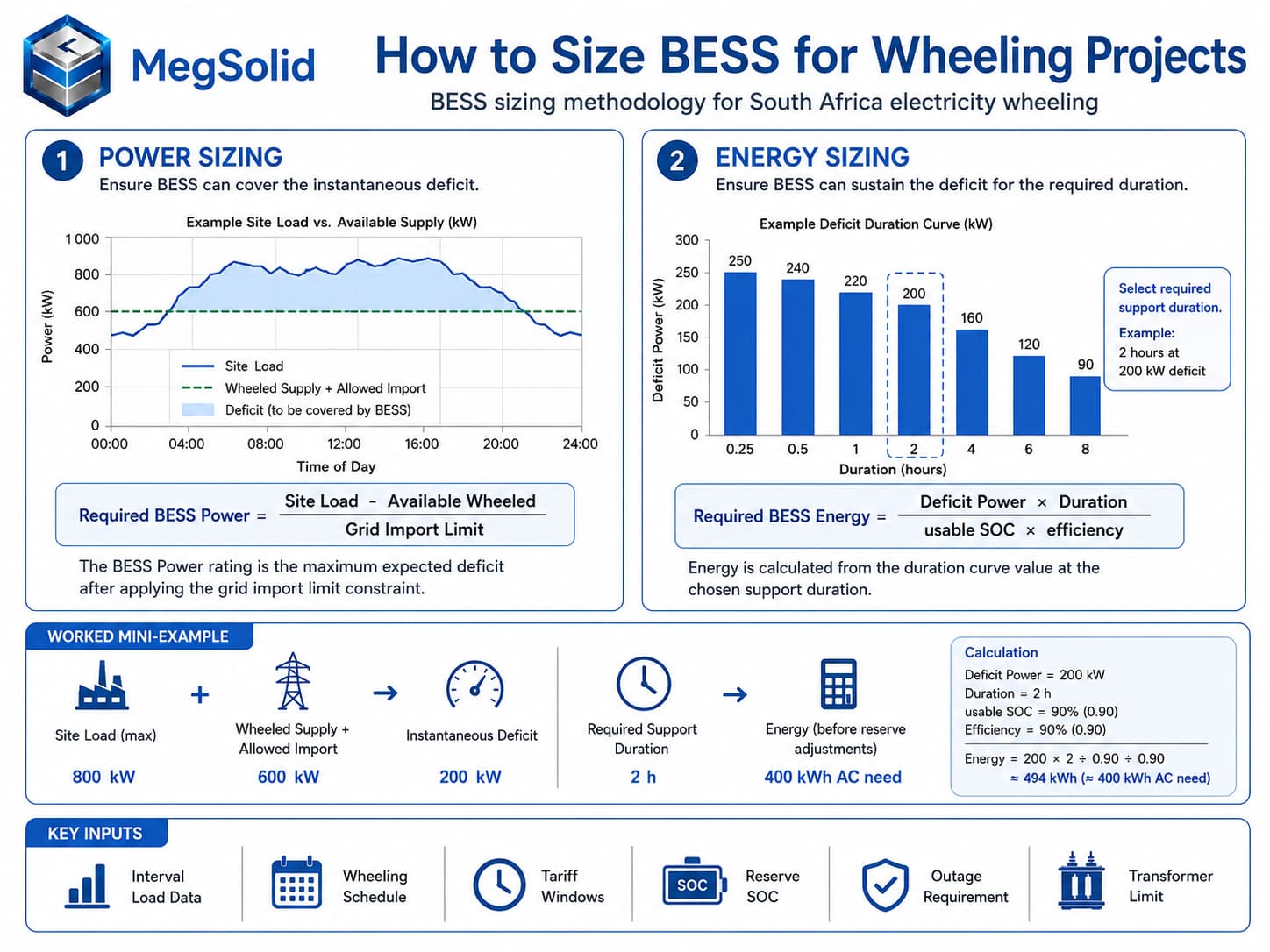
Battery power is determined by the largest instantaneous correction the system must provide, not by daily energy alone.
For an off-taker-side BESS, evaluate:
- Maximum discharge power needed to reduce the negative mismatch.
- Maximum charging power permitted without exceeding the site import limit.
- Critical-load power required during backup operation.
- Reactive-power demand at the connection point.
- Motor-starting or transient power where applicable.
Consider a factory consuming 1.2MW during an evening production period while its eligible wheeling profile covers 0.7MW.
Power mismatch = 1.2MW − 0.7MW = 0.5MW
If profile matching is the only objective, the preliminary discharge target may be 500kW.
If the same facility requires 800kW of critical-load backup, the PCS should be evaluated against the higher 800kW requirement. Final selection must also account for power factor, overload capability, ambient derating and the approved operating mode.
Projects requiring islanding, rapid transfer or black start should also apply the control criteria in the PCS and Inverter Grid-Forming Engineering Guide.
Calculate BESS Energy From the Mismatch Duration
Battery energy is the accumulated area under the selected mismatch curve.
If a factory requires 500kW for three hours after applying its eligible wheeling profile:
Required AC discharge energy = 500kW × 3h = 1.5MWh
Using illustrative assumptions of an 80% usable SOC window and a 90% discharge-path factor:
Preliminary nominal energy = 1.5MWh ÷ 0.80 ÷ 0.90 ≈ 2.08MWh
This value does not yet include degradation, temperature derating, auxiliary consumption or emergency reserve.
If 20% SOC must remain available for operational continuity, that reserve cannot also be counted as economic shifting capacity.
The model should allocate separate energy blocks for:
- Wheeling-profile correction.
- TOU optimisation.
- Maximum-demand reduction.
- Emergency reserve.
- Degradation and operating margin.
Commercial assumptions should be checked using the Engineering BESS ROI in South Africa rather than applying a generic electricity-price spread.
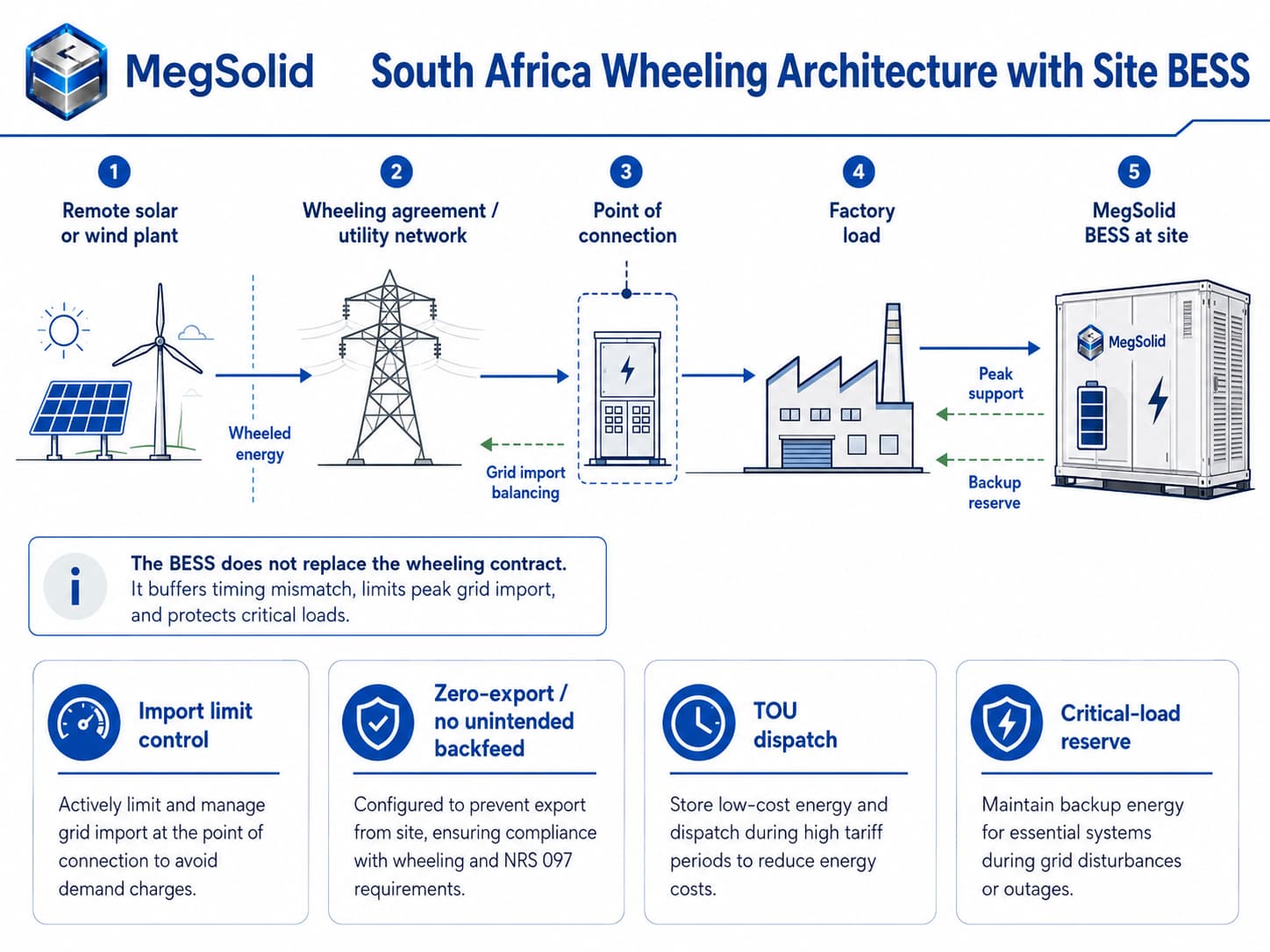
Prevent Recharge Power From Creating a New Demand Peak
A battery can reduce an evening peak and still increase demand-related costs if it recharges without an import limit.
Example:
- Factory production load: 800kW
- BESS charging power: 500kW
- Other coincident load: 100kW
- Total site import: 1,400kW
If the previous maximum demand was 1MW, unmanaged charging may create a new peak or overload the intended transformer operating range.
The EMS should enforce:
- Maximum site-import power.
- Maximum BESS charging power.
- Factory demand cap.
- Transformer loading limit.
- TOU charging permission.
- Minimum backup SOC.
- On-site PV priority.
- Approved export limit.
This remains commercially important because wheeling does not remove network and capacity-related charges. Eskom’s 2026/27 adjustment increased direct-customer large-power tariffs, including Megaflex and Gen-Wheeling, by 8.76%. Municipal tariffs follow separately effective local-authority schedules.
Coordinate TOU, NMD, Backup SOC and EMS Priorities
The EMS should not operate from a single “charge when cheap and discharge when expensive” rule.
A practical dispatch hierarchy is:
- Maintain battery and PCS safety limits.
- Enforce approved import and export limits.
- Preserve the minimum emergency SOC.
- Prevent a new maximum-demand peak.
- Match wheeled energy with factory consumption where valuable.
- Absorb available on-site PV.
- Optimise remaining SOC across TOU periods.
- Restore reserve SOC before the next critical operating window.
The 2025 national wheeling framework requires the relevant licensing or registration, executed PPAs, connection and network-use agreements, Grid Code compliance and auditable metering. The battery EMS does not replace these obligations, but it must use trusted meter data and preserve verifiable operating records.
Eskom Green’s 2026 industrial strategy also treats renewable energy, storage and firming as separate components while presenting regulated network and wheeling charges separately from the energy price. This supports modelling energy supply and network use as different cost layers.
Compare Preliminary MegSolid Product Directions
Product selection should follow the calculated power, energy, environmental and control requirements.
| Calculated Requirement | Preliminary Product Direction |
|---|---|
| Up to 100kW | ESSA0100B-0215, rated 100kW/215.04kWh |
| 100–125kW | Evaluate the 261.24kWh system; confirm usable kW, duration and power factor |
| 150–500kW | MEGA PCS with project-specific battery capacity |
| 500kW/approximately 1MWh | ESSC 500kW/1.0752MWh |
| 1MW/approximately 2MWh | ESSC 1MW/2.1504MWh |
| Multi-megawatt project | Multiple ESSC blocks or 5000INTL with central EMS and MV aggregation |
The ESSA0100B-0215 is an intelligent air-cooled outdoor C&I cabinet. Its 100kW/215.04kWh rating may suit a small profile mismatch, but it should not be selected from energy capacity alone.
Review the 215kWh Outdoor Cabinet ESS Engineering Guide before confirming the application.
For larger projects, compare installation, maintenance and expansion requirements through Modular Cabinets vs. Containerized ESS.
The available Container Energy Storage Systems can then be assessed against the calculated block size.
A multi-megawatt project should also review the cooling, high-voltage and integration requirements in Engineering the 5MWh BESS.
These are preliminary directions, not a guarantee that a catalogue configuration satisfies the customer’s wheeling agreement or network requirements.
Data Required for a Firm Wheeling BESS Proposal
An inquiry stating only “1MWh battery for a South African factory” is not ready for firm design or pricing.
Submit the Wheeling and Factory Load Profiles
Provide:
- Factory load profile at the best available interval.
- Generator or PPA production profile.
- Wheeling settlement interval and TOU treatment.
- Eskom or municipal network provider.
- Current tariff and maximum demand or NMD.
- Permitted import and export power.
- Transformer capacity and single-line diagram.
- Existing on-site PV and generators.
- Critical backup load and required duration.
- Planned production expansion.
- Required commissioning date.
Use the C&I BESS Procurement Checklist to organise the technical documents before comparing suppliers.
Submit the profiles through the MegSolid Project Inquiry Page.
The preliminary engineering response should identify:
- Recommended BESS location.
- Initial MW and MWh range.
- Maximum charging power.
- Site-import limit.
- Backup SOC allocation.
- Missing project data.
- Preliminary product path.
- Required EMS controls.
Final Procurement Recommendation
A South Africa wheeling BESS should not be justified by annual renewable-energy volume alone.
The project requires a time-aligned model separating generator export, eligible wheeling credit and factory consumption. Site-import limits, TOU periods, transformer capacity, maximum-demand objectives and backup reserves must then be applied.
Generator-side storage improves the renewable production profile. Off-taker-side storage controls the factory meter and critical loads. Some projects require both.
The correct architecture assigns every battery a measurable objective and prevents recharge power from creating a second network constraint.
FAQ
Q1: Does wheeling provide backup power to a South African factory?
No. Wheeling provides network access and energy-accounting credits. On-site continuity requires a behind-the-meter BESS and an appropriate isolation and PCS architecture.
Q2: Can annual PPA energy be used to size the battery?
No. Annual totals hide hourly and TOU mismatches. BESS sizing requires interval production, settlement and factory-load data.
Q3: Should the BESS be installed at the generator or factory?
Generator-side storage improves the renewable export profile. Factory-side storage controls maximum demand, local imports and backup loads.
Q4: Can one BESS solve both wheeling and backup requirements?
Potentially, but economic dispatch and emergency reserve must have separate SOC allocations and operating priorities.
Q5: How is preliminary BESS power calculated?
Use the maximum interval power mismatch, then compare it with the critical backup load and any reactive or transient power requirements.
Q6: How is preliminary battery energy calculated?
Integrate the selected power mismatch over time, then account for usable SOC, conversion losses, reserve capacity and degradation.
Q7: Can battery charging increase maximum demand?
Yes. Uncontrolled charging can create a new site-import peak even when the battery reduces demand later.
Q8: Does wheeling remove network charges?
No. Network, capacity, connection and administration charges remain relevant under the applicable tariff and agreements.
Q9: Is a 100kW/215kWh cabinet suitable for every small wheeling project?
No. Suitability depends on the required power, duration, charging limit, backup reserve, site voltage and operating conditions.
Q10: What data does MegSolid need for an initial proposal?
MegSolid needs the factory load, PPA production, settlement rules, tariff, import limits, transformer data, backup requirement and single-line diagram.
Q11: What is a South Africa wheeling BESS?
It is a battery system used to coordinate remotely procured electricity with an industrial load, control site demand or support local operational continuity.
Q12: How should a factory size storage for wheeled solar power?
Compare eligible solar credits with factory demand at the applicable settlement interval, then calculate the maximum power mismatch and accumulated energy deficit.
Q13: Where should storage be installed in a wheeling project?
Install it at the generator when the priority is renewable-output shaping, at the factory when the priority is demand control and backup, or at both sites when both objectives are contractual.