 Skip to content
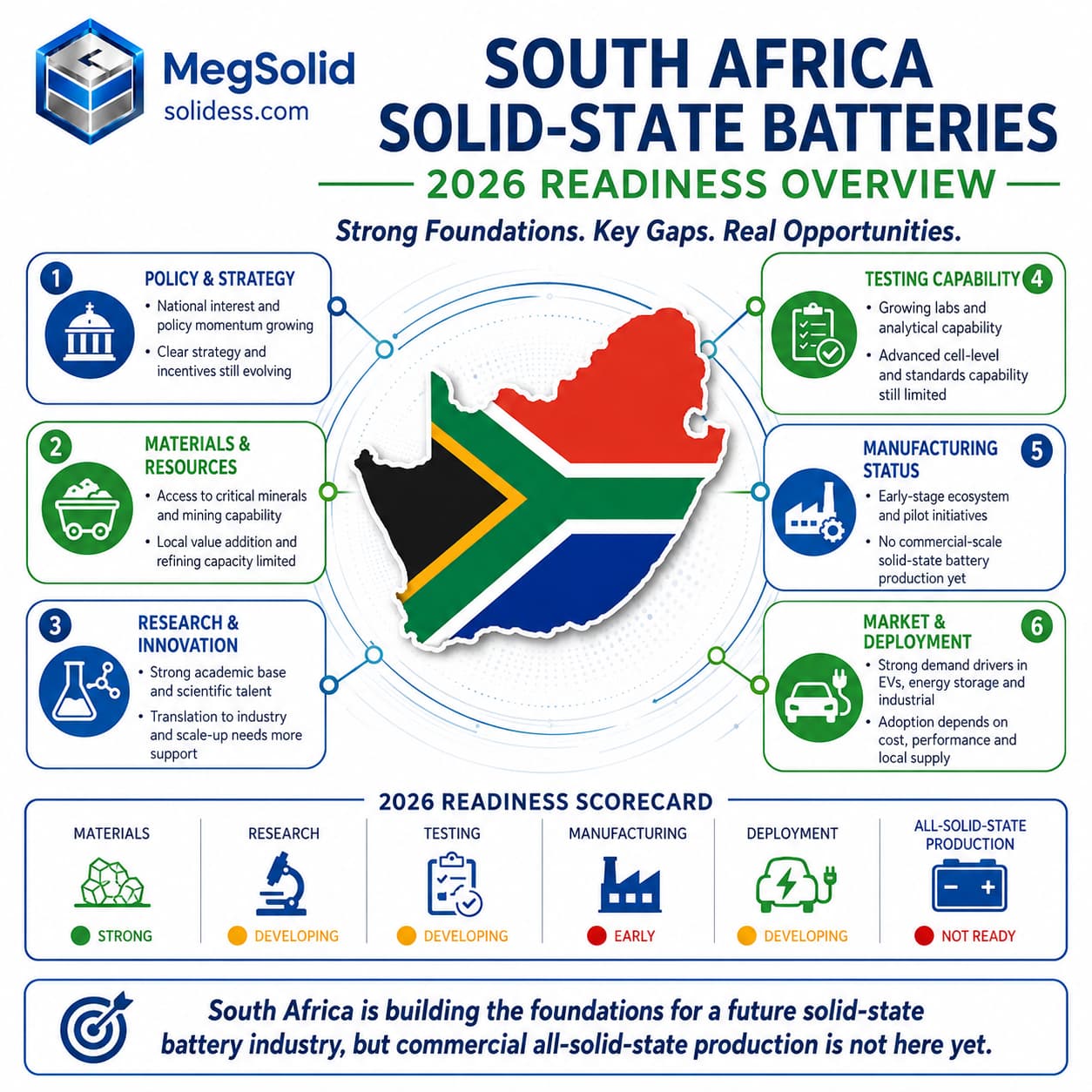
South Africa is not yet a commercial all-solid-state battery manufacturing hub.
In 2026, its strongest capabilities are battery minerals, CSIR testing infrastructure, university research and rapidly expanding demand for battery energy storage. Its largest gaps remain battery-grade refining, solid-electrolyte production, automated cell manufacturing and verified commercial deployment.
The country should therefore be described as an emerging advanced-battery value-chain market, not an established producer of commercial all-solid-state cells.
For EPC contractors and industrial buyers, this distinction is critical. A battery assembled, tested or installed in South Africa is not necessarily manufactured locally, and a hybrid solid-state system is not the same as an all-solid-state battery.
MegSolid evaluates battery readiness across the complete chain:
Raw material → battery-grade material → electrolyte and electrode → cell → module → BESS → commissioned project
The Direct Answer
South Africa has several of the foundations needed to participate in the solid-state battery industry, but it has not yet demonstrated a complete commercial value chain.
| Readiness Dimension | 2026 Assessment | Engineering Interpretation |
|---|---|---|
| Mineral resources | Strong regional potential | Minerals still require battery-grade refining |
| Battery policy | Improving | Incentives are moving toward battery inputs and localisation |
| Materials research | Active | Supports future development and technical partnerships |
| Independent testing | Available | CSIR can validate battery performance and reliability |
| Module and pack integration | Developing | More achievable in the near term than cell localisation |
| Lithium-ion cell production | Mostly import-dependent | Local production projects remain under development |
| Solid-electrolyte production | No verified commercial production identified | A major missing link |
| All-solid-state cell manufacturing | No verified commercial-scale production identified | South Africa is not yet a mass-production centre |
| BESS deployment | Expanding quickly | Creates immediate demand for integration and testing |
| Hybrid solid-state adoption | Technically possible | Must be evaluated by exact cell and system model |
This assessment is based on publicly accessible government notices, investment records, research outputs and procurement announcements reviewed through July 23, 2026.
What South African Project Developers Should Submit
A preliminary technology assessment requires:
- Required BESS power in kW or MW
- Required usable energy in kWh or MWh
- Expected operating cycles
- Backup, peak-shaving or grid-service objectives
- Site temperature, altitude, dust and humidity
- Grid-connected and islanded operating requirements
- Required cell chemistry
- Local-content expectations
- Applicable safety standards
- Required delivery schedule
What Counts as a Solid-State Battery?
The term “solid-state battery” is frequently used without a consistent technical definition.
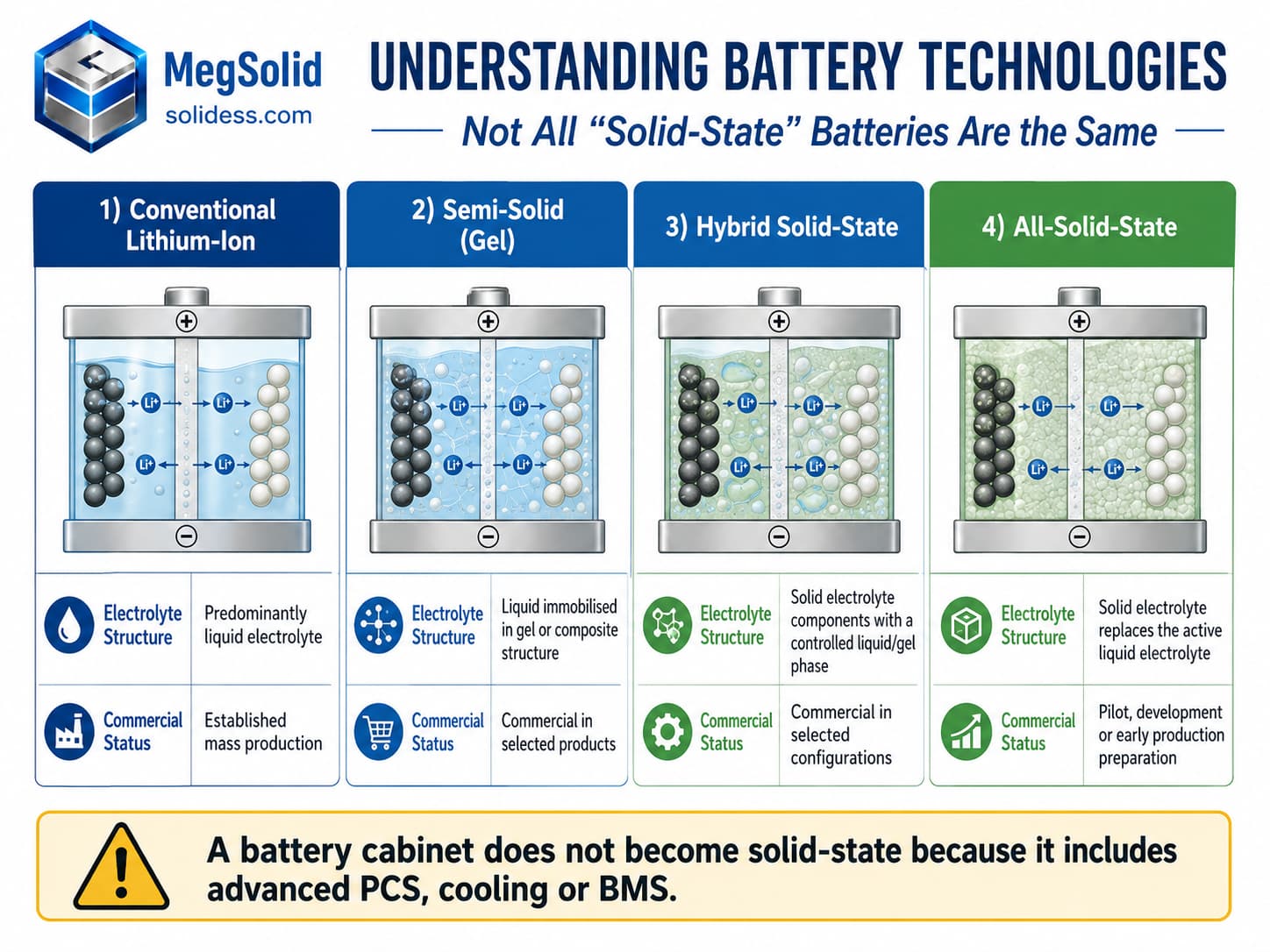
| Battery Type | Electrolyte Structure | Current Commercial Position |
|---|---|---|
| Conventional lithium-ion | Predominantly liquid electrolyte | Established mass production |
| Gel or semi-solid | Liquid immobilised within a gel or composite structure | Commercial in selected products |
| Hybrid solid-state | Solid electrolyte components with a controlled liquid or gel phase | Commercial in selected configurations |
| All-solid-state | Solid electrolyte replaces the active liquid electrolyte | Pilot, development or early production preparation |
A battery cabinet does not become solid-state because it includes an advanced PCS, liquid cooling, fire suppression or an intelligent BMS.
The classification must come from the cell construction stated in the technical specification and project BOM.
Buyers should review the solid-state vs. conventional liquid LFP BESS comparison before accepting a supplier’s chemistry description.
South Africa’s 2026 Solid-State Battery Readiness Scorecard
The following scorecard separates scientific capability from commercial production.
| Commercial Gate | Evidence Available in South Africa | Current Gap |
|---|---|---|
| Mineral inputs | Regional lithium, manganese, nickel, cobalt, graphite and other resources | Battery-grade purification |
| Materials development | CSIR and university research | Scale-up and consistent industrial output |
| Solid-electrolyte research | NASICON and polymer-electrolyte research | Commercial electrolyte production |
| Cell prototyping | Coin and pouch-cell research capability | Automated high-volume lines |
| Independent testing | CSIR Energy Storage Testbed | Technology-specific long-term field datasets |
| Module and pack assembly | Developing local opportunities | Imported cell dependence |
| System integration | Growing BESS and renewable-energy market | Local component depth |
| All-solid-state deployment | No verified utility-scale project identified | Bankable commercial evidence |
The most important conclusion is that research readiness is not the same as manufacturing readiness.
A laboratory may successfully characterise ionic conductivity without having the equipment, yield control, supply contracts or production quality systems needed to manufacture thousands of commercial cells.
South Africa Expanded Its Battery-Material Policy in 2026
In June 2026, South Africa’s International Trade Administration Commission published Notice 3969 of 2026, reviewing materials qualifying under the Automotive Production and Development Programme Phase 2 and measures supporting battery manufacturing.
The proposed additions included battery-related materials such as lithium, graphite, copper, cobalt, iron and rare-earth inputs.
This is a meaningful industrial-policy signal, but it is an upstream measure.
It does not establish:
- Commercial solid-electrolyte production
- All-solid-state cell manufacturing
- Local solid-state battery certification
- A commercially operating solid-state BESS project
A solid-state battery supply chain would also require:
- Battery-grade chemical purification
- Controlled particle size and morphology
- Cathode surface coatings
- Solid-electrolyte precursor production
- Moisture-controlled processing
- Interface-pressure engineering
- High-precision layer formation
- Cell formation and ageing
- Automated end-of-line quality control
South Africa’s policy is creating a foundation. It has not yet completed the industrial chain.
The EU–South Africa Partnership Strengthens the Upstream Value Chain
In February 2026, the CSIR announced that it would lead a Team Europe Initiative focused on South Africa’s battery raw-material value chain.
The programme connects mining, refining, industrial investment, skills development and recycling. It follows the South Africa–EU Clean Trade and Investment Partnership signed in November 2025.
This partnership may support future advanced-battery production by strengthening:
- Material beneficiation
- Industrial skills
- Research collaboration
- Recycling systems
- International investment
- Regional supply-chain integration
However, it remains several industrial steps away from commercial solid-state cell production.
A mineral project does not directly supply a battery factory. The material must first reach the purity, morphology, consistency and traceability required by the intended chemistry.
Companies planning partial localisation should compare component responsibility through the BESS OEM and ODM manufacturing framework.
CSIR Testing Is One of South Africa’s Strongest Capabilities
The CSIR Energy Storage Testbed provides independent testing and validation for residential, commercial and utility-scale batteries.
Its published capabilities include measuring storage capacity, lifecycle, depth of discharge and performance under controlled temperature conditions. The facility also supports local standards, recycling protocols, imported-battery quality assessment and emerging storage technologies.
This is commercially important because South African projects may face:
- High ambient temperatures
- Mining and industrial dust
- High-altitude operation
- Daily cycling
- Weak-grid disturbances
- Long outdoor exposure
- Frequent charge and discharge events
Independent cell or battery testing reduces procurement risk, but it does not validate the complete BESS.
Separate evidence is still required for:
- Battery racks
- BMS limits
- PCS power quality
- EMS dispatch
- Cooling performance
- Fire detection
- Protection coordination
- Grid-code response
The UL 9540A and IEC 62619 compliance guide explains why cell, module, unit and installation test scopes must not be treated as interchangeable.
South African Solid-Electrolyte Research Is Active
South African universities are conducting research relevant to all-solid-state battery development.
A 2024 doctoral study at the University of the Witwatersrand synthesised and characterised NASICON-type lithium titanium phosphate materials intended as potential solid-state electrolytes. The study examined doped formulations designed to improve room-temperature ionic conductivity.
In July 2026, researchers from the University of Limpopo presented new LiTi₂(PO₄)₃ solid-electrolyte work at the South African Institute of Physics conference hosted by the University of the Western Cape.
One study used density functional theory to analyse the material’s electronic structure and surface stability. Another examined sulfur doping to improve mechanical behaviour and electrode-electrolyte contact.
The same conference programme included transport modelling of pristine, lithiated and aluminium-doped LiTi₂(PO₄)₃, demonstrating continued local research into ionic conductivity and migration barriers.
Researchers associated with the University of the Western Cape have also published work covering solid-state polymer and gel-polymer electrolytes for lithium-sulfur batteries.
These are credible research signals, but they remain scientific activities.
They do not prove the existence of:
- A commercial solid-electrolyte facility
- A high-yield cell production line
- Automotive-qualified cells
- A utility-scale solid-state BESS fleet
- Long-term commercial operating data
Commercial Cell Manufacturing Is Still the Missing Link
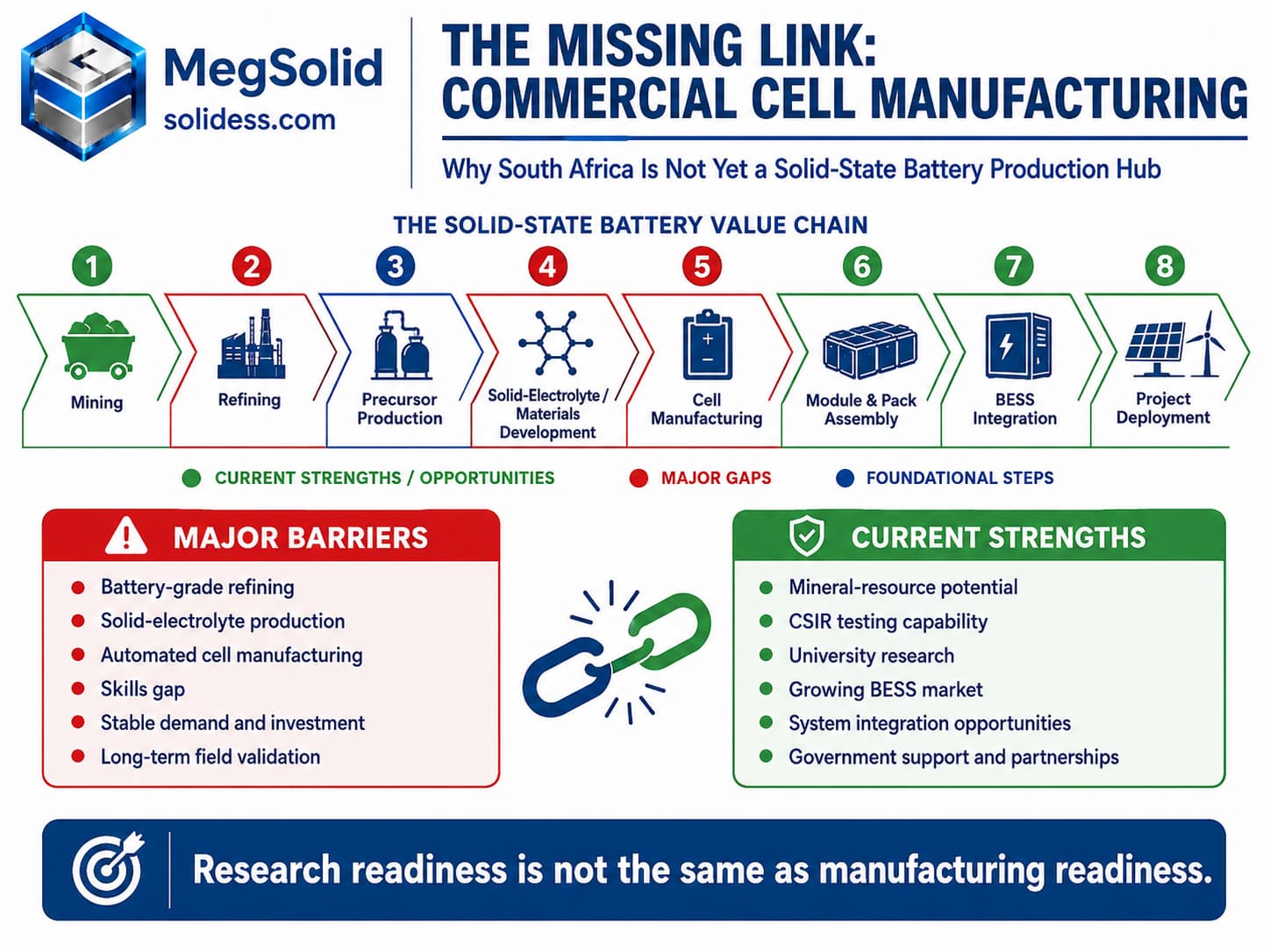
InvestSA currently states that lithium-ion cells used across Southern Africa are imported and identifies cell manufacturing, module and pack assembly, BMS production and other components as localisation opportunities.
InvestSA also lists proposed battery production projects, including an Afrivolt lithium-ion cell facility and an Alpha Gweda lithium-iron battery manufacturing project. These remain described as investment or bankability-stage projects rather than operating solid-state factories.
This is important because South Africa may develop commercial lithium-ion production before it develops all-solid-state production.
The technical barriers are different.
An all-solid-state line may require:
- Solid-electrolyte synthesis
- Dry-room or inert-atmosphere processing
- Uniform electrolyte-layer formation
- Stable electrode-electrolyte interfaces
- Controlled stack pressure
- Low-defect lamination
- Automated inspection
- Electrochemical formation
- Cell ageing and grading
- Production traceability
A 2026 study based on input from 14 South African and international industry experts identified policy uncertainty, unclear market demand and skills shortages as major obstacles to local battery manufacturing.
This supports a staged localisation pathway:
- Local balance-of-system production
- Module and pack assembly
- BMS, EMS and inverter localisation
- Battery-material processing
- Conventional cell production
- Advanced and solid-state cell scale-up
Growing BESS Demand Creates a Commercial Foundation
South Africa already has a substantial grid-scale battery procurement programme.
In May 2025, the government announced five preferred bidders under BESIPPPP Bid Window 3, representing 616MW of planned storage capacity and approximately R9.5 billion in investment. The projects are intended to provide capacity, energy and ancillary services.
This programme demonstrates strong demand for battery systems, but it does not demonstrate solid-state adoption.
Public procurement evaluates issues such as:
- Bankability
- Performance guarantees
- Grid services
- Safety evidence
- Delivery capability
- Long-term warranties
- Cost
- Local-content commitments
Established battery chemistries currently have larger commercial datasets, established supply chains and more extensive project histories.
That helps explain why large BESS projects can expand rapidly while all-solid-state deployment remains limited.
For broader market context, review South Africa’s largest battery energy storage projects.
Why Mineral Resources Do Not Guarantee Battery Manufacturing
South Africa and the wider Southern African region possess several minerals relevant to battery production.
However, mining is only the first layer of the value chain.
| Value-Chain Stage | Main Technical Requirement |
|---|---|
| Mining | Ore extraction and concentration |
| Refining | Battery-grade purity |
| Precursor production | Controlled chemistry and morphology |
| Electrode production | Consistent coating and loading |
| Electrolyte production | Purity, conductivity and stability |
| Cell manufacturing | Yield, interfaces and sealing |
| Module integration | Mechanical, thermal and electrical design |
| BESS integration | PCS, BMS, EMS, safety and protection |
| Commissioning | Site-level performance verification |
Countries that remain concentrated in mining capture less manufacturing value than countries controlling cells, electronics, software and complete systems.
South Africa’s opportunity is therefore not simply to export more minerals. It is to move progressively into higher-value processing, components, systems and engineering services.
Where Hybrid Solid-State Batteries May Fit
Hybrid solid-state batteries offer a nearer-term commercial pathway than fully solid cells.
They may combine solid electrolyte materials with a controlled liquid or gel phase to improve selected characteristics while retaining manufacturing methods closer to established lithium-ion production.
Potential design objectives include:
- Reduced free-liquid content
- Improved electrolyte stability
- Better interface contact
- Dendrite suppression
- Higher thermal tolerance
- Longer cycle performance
These benefits are not guaranteed by the technology label.
They depend on:
- Cell composition
- Interface stability
- Manufacturing consistency
- Temperature
- C-rate
- Depth of discharge
- BMS operating limits
- Pack architecture
The solid-state battery interface-stability guide explains why ionic transport, mechanical contact and cycle conditions must be evaluated together.
For C&I applications, buyers can also review the 314Ah hybrid solid-state battery engineering analysis.
How South African Buyers Should Verify Solid-State Claims
A South African EPC or industrial buyer should request seven evidence packages.
1. Exact Cell Chemistry
The supplier must state whether the cell is:
- Conventional liquid LFP
- Gel or semi-solid
- Hybrid solid-state
- All-solid-state
“Advanced lithium battery” is not a sufficient description.
2. Model-Specific Cell Datasheet
The datasheet should identify:
- Cell manufacturer
- Cell model
- Nominal capacity
- Voltage
- Electrolyte description
- C-rate
- Cycle-life test conditions
“Advanced lithium battery” is not a sufficient description.
3. Cycle-Life Test Basis
Cycle-life claims must specify:
- Temperature
- Charge and discharge rate
- Depth of discharge
- End-of-life threshold
- Rest periods
- Test methodology
4. Safety-Test Scope
Buyers must distinguish between:
- Cell test
- Module test
- Rack test
- Complete BESS test
- Installation-level assessment
5. South African Environmental Suitability
The supplier should state the system’s:
- Operating temperature
- Altitude limits
- Enclosure rating
- Derating conditions
- Cooling strategy
- Dust and corrosion protections
6. Complete System BOM
The BOM should identify the battery, PCS, BMS, EMS, cooling, fire detection and protection components.
7. Project-Level Performance Guarantee
The guarantee should define:
- AC power at the point of connection
- Usable energy
- SOC window
- Auxiliary consumption
- Efficiency test conditions
- Beginning-of-life and end-of-life values
- FAT and SAT procedures
Use the commercial energy storage procurement framework to prevent cell-level evidence from being incorrectly applied to the complete system.
MegSolid System Path for South African Projects
Not every MegSolid system uses the same battery chemistry. The quotation, datasheet and project BOM must identify the exact cells supplied.
| Project Scale | Preliminary Direction |
|---|---|
| 30–100kW C&I load | Modular outdoor cabinet BESS |
| 100–500kW industrial project | Engineered C&I BESS with MEGA PCS |
| 500kW–2MW project | Containerised BESS |
| Multi-MW deployment | Engineered utility-scale platform |
Smaller projects can evaluate the MegSolid outdoor cabinet energy storage system.
Larger projects can evaluate the MegSolid containerised BESS platform.
The MEGA energy storage PCS provides 30–500kW power-conversion options for engineered systems.
Product selection must follow the project load profile, grid requirements, battery chemistry and duty cycle.
Final Assessment
South Africa is becoming more prepared for advanced battery manufacturing, but it is not yet ready to be classified as a commercial all-solid-state battery production hub.
Its strongest assets are:
- Regional mineral access
- Government localisation initiatives
- CSIR testing infrastructure
- University materials research
- Growing grid-scale BESS demand
- Developing module, pack and component opportunities
Its largest gaps are:
- Battery-grade refining
- Commercial solid-electrolyte production
- Automated cell manufacturing
- Skilled production labour
- Stable demand signals
- Model-specific certification
- Long-term solid-state field evidence
The correct near-term strategy is not to assume that all-solid-state batteries are already locally available.
South African developers should build the testing, integration, component, software and service capabilities that can support current lithium-ion systems and future solid-state technologies.
For buyers, the procurement rule is simple:
Verify the cell, verify the system and verify the operating conditions. Do not purchase a chemistry label.
Companies evaluating project economics should continue with the South Africa BESS ROI engineering guide before requesting a firm system quotation.
FAQ
Q1: Does South Africa manufacture all-solid-state batteries?
No publicly verified commercial-scale all-solid-state cell production was identified through July 23, 2026. Private or undisclosed pilot programmes may exist, but public records primarily show research, testing and planned conventional lithium-ion manufacturing.
Q2: Does South Africa conduct solid-state battery research?
Yes. Research at South African universities includes NASICON-type solid electrolytes, ionic-transport modelling, interface studies and polymer-electrolyte development.
Q3: Is a hybrid solid-state battery the same as an all-solid-state battery?
No. A hybrid system retains a controlled liquid or gel phase, while an all-solid-state cell replaces the active liquid electrolyte with solid materials.
Q4: Can the CSIR test advanced batteries?
Yes. The CSIR Energy Storage Testbed provides independent capacity, lifecycle, depth-of-discharge, temperature and reliability testing for different battery applications.
Q5: Are South Africa’s grid-scale BESS projects using solid-state cells?
No verified public evidence was identified showing that South Africa’s utility procurement projects use all-solid-state cells. The chemistry must be confirmed from project-specific technical records.
Q6: Why are South Africa’s mineral resources not sufficient?
Battery manufacturing also requires refining, electrolyte and precursor production, automated cell equipment, quality control, skills and a reliable market.
Q7: Can hybrid solid-state BESS be supplied to South Africa?
Potentially, provided the exact proposed system has model-specific specifications, test evidence, environmental limits, warranty conditions and an engineered grid interface.
Q8: What is South Africa’s biggest battery manufacturing barrier?
The main issue is the absence of a complete commercial chain from battery-grade materials through cell production, supported by predictable demand, skills and stable policy.
Q9: Should an EPC specify solid-state chemistry in an RFQ?
The RFQ should define required performance and request exact chemistry disclosure. A general “solid-state” label is not sufficiently precise.
Q10: What evidence should a supplier provide?
The supplier should provide the cell datasheet, chemistry declaration, cycle-life conditions, safety-test scope, system BOM, performance guarantee, warranty duty cycle and FAT/SAT plan.
Q11: Is South Africa ready for solid-state batteries in 2026?
South Africa has meaningful capabilities in battery materials, research, independent testing and BESS integration, but it has not yet demonstrated a complete commercial all-solid-state cell manufacturing value chain.
Q12: What solid-state battery opportunities exist in South Africa?
The strongest near-term opportunities are material processing, independent testing, module and pack integration, BMS and EMS development, inverter production, recycling and industrial BESS deployment.
Q13: What should South African buyers verify before purchasing a solid-state BESS?
They should verify the exact cell chemistry, model-specific test reports, cycle-life conditions, complete system BOM, environmental limits, PCS capability, warranty and project-level acceptance tests.
