 Skip to content
MegSolid commercial battery storage systems should not be selected by battery capacity alone. A 215.04kWh cabinet and a 261.24kWh cabinet may appear close on a quotation, but they can lead to very different project outcomes when the site’s required AC power, power factor, discharge window, ambient conditions and future expansion plan are considered.
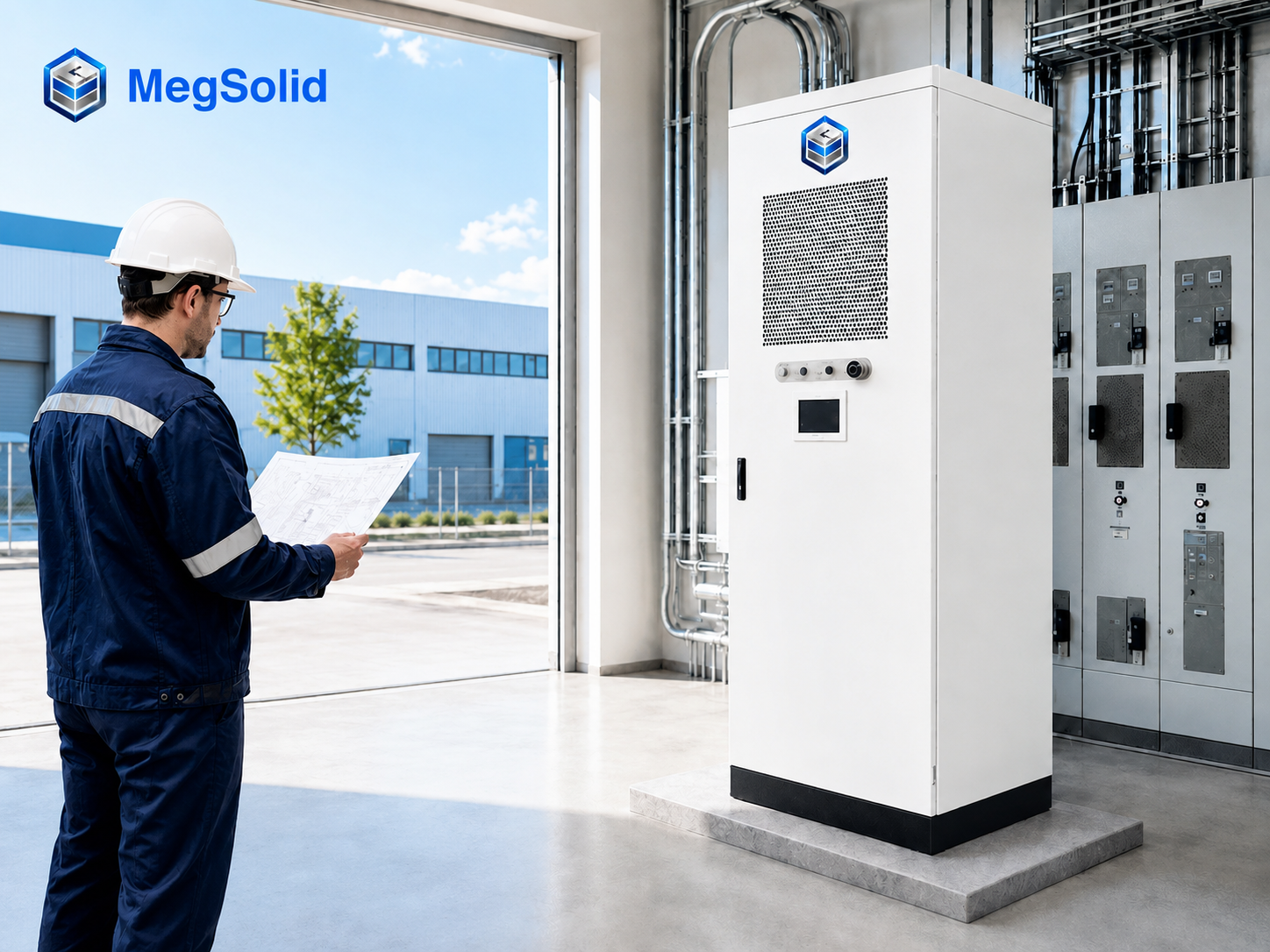
For an EPC, the risk is specifying a system that cannot deliver the required AC power at the operating point. For a facility manager, the risk is paying for more stored energy while still failing to protect the loads that matter during a peak-demand event or outage. For a distributor, the risk is quoting a cabinet when the customer’s load profile already points toward a larger engineered or containerized system.
The practical decision is not “Which battery has more kWh?” It is: Which commercial battery storage configuration can meet this site’s required kW or kVA for the required time, under its actual operating conditions?
MegSolid offers two clearly different cabinet-scale paths for this comparison. Neither system should be treated as a default hybrid solid-state product. The supplied chemistry and configuration must be confirmed in the signed quotation, datasheet and BOM for the actual project.
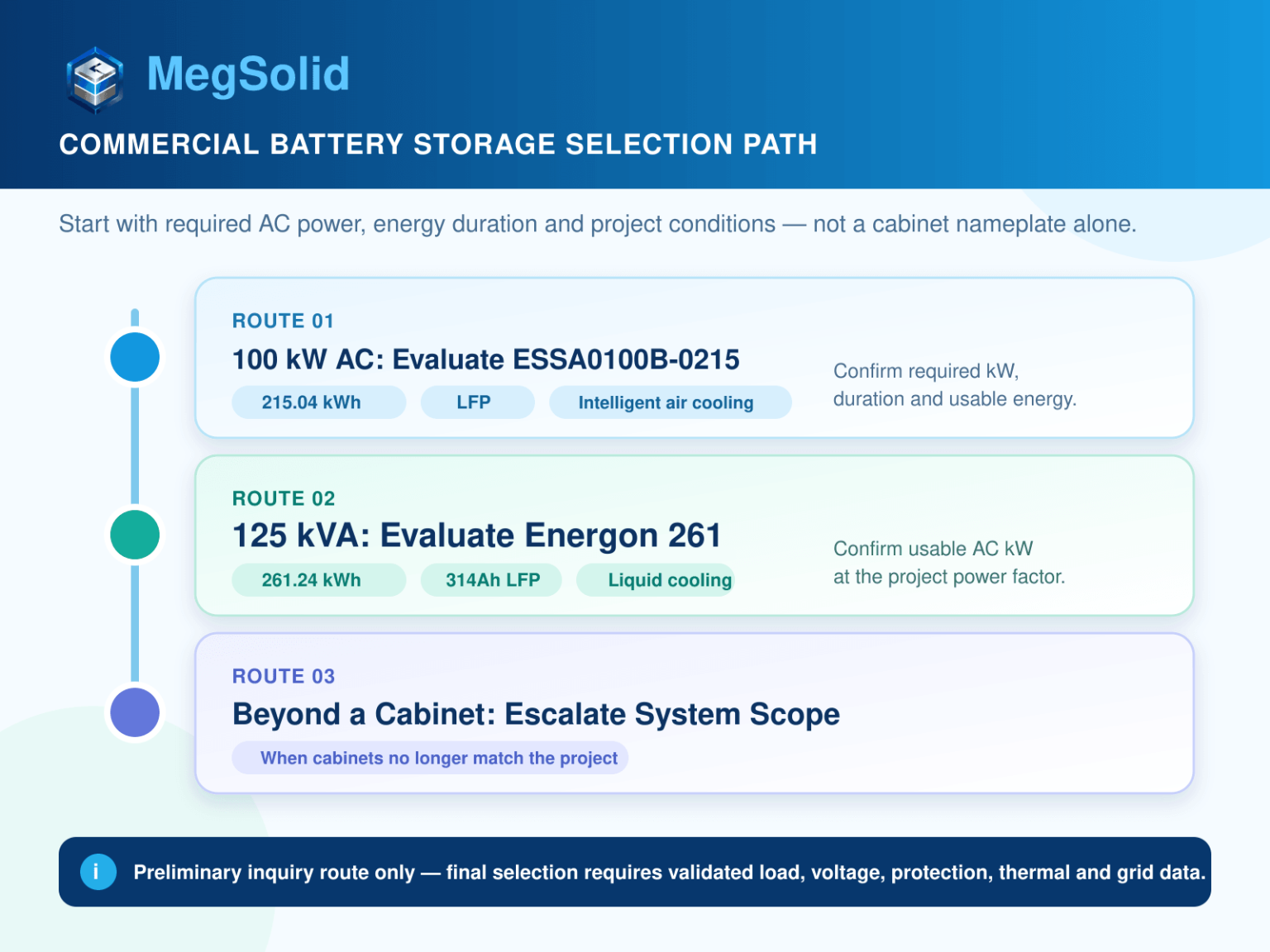
| Decision point | ESSA0100B-0215 | MegSolid Energon 261kWh |
|---|---|---|
| Rated AC capacity | 100kW | 125kVA |
| Rated energy | 215.04kWh | 261.24kWh |
| Battery chemistry | LFP | 314Ah LFP |
| Thermal management | Intelligent air cooling | Liquid cooling |
| Correct buying question | Can the required load remain at or below 100kW? | What AC kW is required at the project power factor? |
Start With the Load Profile and Then Review Battery Nameplate Ratings
Commercial battery storage is bought to manage a site event: a demand-charge peak, a scheduled evening discharge, a grid interruption, a generator-support period or a critical-load backup window. Each event has a different power shape.
Before comparing cabinet capacity, obtain at least 15-minute interval data and answer five questions:
- What is the highest load that the BESS must support or offset?
- Is that figure measured in kW, kVA or amperes?
- How many times per day does the event occur?
- How long must the system sustain the target output?
- Which loads can be shed before the battery is required to carry them?
A warehouse may have a short refrigeration and compressor peak that needs high power for a limited period. A factory may have a lower but longer evening load that needs more energy. A site with motors, transformers or a poor power factor must also make sure that the AC capacity is evaluated correctly.
This is why the following shortcut causes expensive mistakes: “261kWh is larger than 215kWh, so it is automatically the safer choice.” It is not. More nameplate energy does not correct an undersized AC power path, an undefined power factor or a load that exceeds the selected cabinet’s intended operating range.
Understand kW, kVA and kWh Before Comparing Cabinets
kW is the real electrical power required by the load. kVA is apparent power. Its relationship with kW depends on power factor. kWh is stored energy available over time.
The ESSA0100B-0215 is rated at 100kW AC and 215.04kWh. The 261.24kWh liquid-cooled system is rated at 125kVA, not automatically 125kW. Its available real power must be checked against the project power factor, grid code, operating mode and the signed technical proposal.
A procurement team should therefore never convert 125kVA into a fixed 125kW simply because that number is convenient for an internal presentation. That assumption can create a gap between the customer’s critical-load requirement and the system that arrives on site.
| RFQ input | Why it matters |
|---|---|
| Peak site demand in kW and kVA | Determines the required AC capability |
| Required discharge duration | Determines energy requirement |
| Power factor at the connection point | Prevents incorrect kVA-to-kW assumptions |
| Critical-load list | Defines what remains powered during an event |
| Grid, generator and local PV interface | Determines controls and operating sequence |
| Expected future load increase | Prevents premature cabinet-size lock-in |
If the commercial objective is peak shaving rather than full-facility backup, the BESS only needs to cover the measured power above the site target. The value calculation must be based on the interval load profile, tariff structure and dispatch plan. For that commercial logic, use the C&I peak-shaving ROI engineering guide as a supporting internal reference.
When a 100kW / 215.04kWh Outdoor Cabinet Is the Better Fit
The ESSA0100B-0215 becomes a credible route when the project has a well-defined 100kW-class AC requirement and the required duration can be met after usable-energy, auxiliary-load and operating-reserve assumptions have been agreed.
It is not simply a “smaller” version of a larger commercial battery storage system. It is a distinct selection path for projects where the critical-load or peak-shaving requirement stays within the 100kW AC boundary.
This route is appropriate to evaluate when:
- The required battery discharge power is at or below 100kW.
- The site can define a controlled load-shedding strategy if total facility demand is higher.
- The discharge event is limited and repeatable rather than an undefined full-site backup requirement.
- The project needs an outdoor LFP cabinet with intelligent air cooling.
- The customer is prepared to size runtime from the real load profile instead of assuming all 215.04kWh is available for every operating condition.
The cabinet’s 215.04kWh rating should be treated as the starting point for engineering, not as a guaranteed runtime promise. Battery reserve, state-of-charge operating limits, temperature, auxiliary consumption, degradation allowance and the customer’s dispatch logic all affect usable project energy.
For a deeper product-specific selection discussion, link users to the 100kW / 215kWh outdoor BESS selection guide. This article should only use the 215kWh cabinet as one branch in a broader commercial purchasing decision.
When the 125kVA / 261.24kWh Liquid-Cooled System Should Be Evaluated
The MegSolid Energon 261 is a 261.24kWh liquid-cooled C&I energy storage system with 314Ah LFP cells and a rated AC capacity of 125kVA. It should be evaluated when the project needs more energy than the 215.04kWh route provides, or when thermal-management and AC-capacity requirements justify a different cabinet platform.
The system has a 400/480Vac rated AC voltage range with ±15% tolerance and a power-factor adjustment range of -1 to +1. These parameters make it important to define the site’s AC requirement precisely before quotation.
Evaluate the 261.24kWh route when:
- The project’s required AC demand is above the practical selection boundary of a 100kW cabinet.
- The customer needs a longer energy window but still remains within a cabinet-scale deployment strategy.
- Ambient and operating conditions make liquid cooling a relevant project consideration.
- The EPC can supply the required power factor, voltage, grid connection data and operating scenario.
- The RFQ can clearly distinguish required kW from apparent-power requirements.
Do not present its published maximum system efficiency of 90% as round-trip efficiency in an ROI model. The datasheet describes it as maximum system efficiency, which is a different measurement boundary.
The next procurement step is not “select 261kWh.” It is to request a project confirmation of usable AC power, discharge profile, operating conditions and controls. The 261kWh liquid-cooled system RFQ guide should be used for that second-stage technical inquiry.
Cooling Should Be Evaluated Within the Overall Storage Decision
Air cooling and liquid cooling matter, but they do not replace load analysis. The ESSA0100B-0215 is identified as intelligent air cooled. The 261.24kWh system is liquid cooled. That difference should be evaluated alongside site temperature, installation clearance, maintenance access, usage intensity and daily cycling profile.
A buyer should not start with “Which cooling method is better?” The better question is: “Does this cabinet’s AC power, energy window and thermal design fit the duty cycle that this site will actually impose?”
For example, a moderate-duty site with a well-controlled 100kW discharge window may have a different technical and economic path from a high-utilization project operating in more demanding ambient conditions. Cooling is one part of the engineering evidence, not a substitute for it.
The existing liquid-cooled and air-cooled BESS decision guide covers the thermal-management comparison in more depth. This page should remain focused on choosing the correct commercial battery storage path.
Calculate Runtime From Required Output, Then Add Project Margins
A simple early-stage calculation is: Nominal discharge time = rated energy ÷ required discharge power. That formula is only a screening tool. It does not give a bankable runtime because it ignores usable state-of-charge limits, auxiliary loads, aging allowance, temperature effects, recharge requirements and site operating logic.
The correct process is:
- Identify the target load or peak above the desired grid-import limit.
- Define the required kW or kVA at each interval.
- Calculate the required discharge duration.
- Apply the project’s usable-energy and reserve assumptions.
- Confirm whether one cabinet, multiple cabinets or a containerized ESS route is appropriate.
If the site includes PV, the PV supply can be sourced locally where it is commercially preferable. The storage RFQ should still state the PV interface, expected charging profile and control requirements so the BESS is engineered around the complete site operation.
Know When a Cabinet Is No Longer the Right Product Class
A commercial battery storage page should help customers avoid forcing every project into a cabinet. Move the conversation toward a larger engineered or containerized solution when:
- Required power cannot be met within the selected cabinet’s AC boundary.
- The customer needs a materially longer discharge window at the required load.
- Future expansion would create an inefficient cabinet layout or difficult site integration.
- The project requires centralized controls, larger switchgear architecture or utility-scale interfaces.
- Logistics, site footprint and maintenance planning favor a containerized system.
This is not a claim that every larger project needs a container. It is a prompt to stop using a cabinet comparison when the project has already changed category. The modular cabinets versus containerized ESS deployment guide can help an EPC define that transition.
Turn the Comparison Into an RFQ That Can Be Quoted Correctly
A useful inquiry gives MegSolid enough information to recommend a technical direction instead of sending a generic product list. Include the following with the inquiry:
- Site location and installation environment
- Single-line diagram or available connection information
- Nominal voltage, frequency and grid condition
- Interval load data and peak-demand history
- Critical-load list and allowable load shedding
- Required backup or peak-shaving duration
- Required operating modes: grid-connected, generator support, backup or microgrid
- Power factor and motor-load information
- Available installation footprint and access restrictions
- Future load-growth assumptions
- Required commissioning, FAT, SAT and documentation expectations
The BESS and PCS must be treated as one operating system. For the AC-side design principles, use the power-conversion and grid-forming engineering reference. For broader documentation, supplier qualification and delivery controls, use the commercial storage procurement due-diligence workflow.
Require Evidence Before Approving the Commercial Battery Storage System
A quotation is not the final engineering document. Before approval, the customer should confirm the exact supplied model, AC capacity, battery configuration, cooling method, communication interfaces, protection scope and certifications applicable to the delivered system.
For an EPC-managed project, the evidence chain should include:
| Approval stage | What to confirm |
|---|---|
| Proposal | Required kW, kVA, kWh, duration and operating mode |
| Technical review | Single-line diagram, connection voltage, control logic and protection interfaces |
| Factory acceptance | Functional checks against the approved technical scope |
| Shipment release | Model numbers, packing list, documents and agreed configuration |
| Commissioning | Site configuration, communications and operating-mode verification |
Use the BESS factory acceptance test witness guide to define what should be verified before shipment. Certification requirements should be confirmed against the project country, authority and installation conditions; the BESS certification reference for EPCs explains why a generic certificate list is not enough for every project.
The Commercial Decision in One Sentence
Choose the 100kW / 215.04kWh route when the site has a defined 100kW-class discharge requirement and a verified energy window. Evaluate the 125kVA / 261.24kWh liquid-cooled route when the project requires more energy or a different AC and thermal-management path—but confirm actual required kW at the project power factor before selecting it.
The right next step is a load-profile review, not a capacity-only quotation.
To receive the 215kWh / 261kWh BESS RFQ checklist, email [email protected] with the project country, interval load profile, required kW and kVA, target duration, single-line diagram, power factor, installation conditions and delivery schedule.
FAQ
How do I choose commercial battery storage for a factory?
Start with 15-minute load data, the maximum kW or kVA to be supported, the required discharge duration and the critical-load list. Then compare the required AC capacity and usable energy against the proposed BESS configuration.
Is a 215kWh BESS suitable for a 100kW commercial load?
It can be evaluated when the required battery discharge power stays within the 100kW AC rating and the required duration is supported by the project’s usable-energy assumptions. Nameplate kWh alone does not confirm runtime.
Does 125kVA mean a BESS can always deliver 125kW?
No. kVA is apparent power, while kW depends on the operating power factor and the approved system configuration. The RFQ must state the required real-power output.
Should I select a BESS by energy capacity or power rating?
Both are required. Power determines whether the BESS can support the load at a given moment; energy determines how long it can do so.
What data should be included in a commercial battery storage RFQ?
Include interval load data, voltage, frequency, target operating mode, required discharge duration, power factor, site temperature, installation space, critical loads and future expansion plans.
Is the ESSA0100B-0215 liquid cooled?
No. The current model information identifies ESSA0100B-0215 as an intelligent air-cooled outdoor cabinet.
When should a buyer evaluate a 261.24kWh liquid-cooled BESS?
Evaluate it when the project needs more energy than the 215.04kWh route provides, or when the AC-capacity and thermal-management requirements point to a liquid-cooled cabinet. Required kW at the project power factor must still be confirmed.
Does a larger battery automatically provide better backup?
No. Backup performance depends on whether the system can provide the required AC power, how long the load must run and which loads remain connected during the event.
When should I move from cabinet BESS to containerized storage?
Move to an engineered containerized evaluation when cabinet AC capacity, required duration, expansion planning, site integration or centralized controls no longer fit the project efficiently.
What should be checked during BESS factory acceptance testing?
Check the supplied model and configuration, approved interfaces, protection and control functions, communications, documentation and the agreed test scope before shipment release.
What is commercial battery storage used for?
Commercial battery storage can support peak shaving, critical-load backup, time-based energy shifting, generator support and selected microgrid functions when the system is matched to the site’s electrical profile.
Which commercial BESS is suitable for a 100kW-class C&I site?
A 100kW / 215.04kWh outdoor cabinet can be assessed when the required discharge power remains within 100kW and the load profile supports the available energy window. Final selection requires a project-specific review.
What is the difference between commercial battery storage and a containerized BESS?
Commercial cabinets are generally evaluated for defined site-scale requirements, while containerized BESS solutions are used when higher power, longer duration, centralized integration or larger expansion requirements change the project scope.
How do I compare a 100kW / 215.04kWh BESS with a 125kVA / 261.24kWh BESS?
Compare required AC power, project power factor, discharge duration, usable-energy assumptions, thermal-management requirements and future expansion plans. Do not treat 125kVA as a fixed 125kW value without confirming the project operating point.
Is the 215.04kWh outdoor cabinet suitable for every commercial backup project?
No. The ESSA0100B-0215 should be evaluated where required battery discharge power remains within its 100kW AC rating and the verified load profile supports the required energy window.
What should an EPC submit before requesting a commercial battery storage quotation?
Submit interval load data, required kW and kVA, power factor, voltage, frequency, required duration, critical-load list, operating mode, ambient conditions, installation constraints and future expansion requirements.
