 Skip to content
To buy a 50kW 100kWh battery storage system, ask MegSolid for a project-matched ESSA0050B-0100 proposal, not a price-only quote. Its ratings are 50 kW AC and 100.352 kWh; approval must also define usable AC energy, EMS rules, backup loads, battery architecture, FAT and warranty scope.
- ⚡ Power first: Confirm the highest simultaneous AC duty, motor steps and point-of-connection limit.
- ⏱️ Duration second: Convert the required service window into usable AC energy, not nominal battery kWh.
- 🧠 EMS in writing: State charge windows, peak limits, reserve SOC, meter location and fallback behavior.
- 📋 Evidence before deposit: Require a signed datasheet, BOM, SLD, FAT plan, warranty and delivery boundary.
Start with the Required Duty, Not the 50kW/100kWh Label
A 50 kW power rating limits sustained real-power delivery. The 100.352 kWh rating describes stored nameplate energy. Neither figure alone proves backup time, peak-shaving performance or PPA delivery at the point of connection. Build the first RFQ page from measured operating data.
| Project duty | Input required | Selection decision |
|---|---|---|
| Peak shaving | 15-minute or finer load profile, tariff and target demand limit | Verify required discharge kW and daily energy throughput |
| Backup power | Critical-load list, sequence, power factor and outage window | Verify sustained kW, load steps and usable AC energy |
| Solar self-consumption | PV profile, export limit and daytime load | Verify charge window, PV interface and curtailment logic |
| PV-diesel microgrid | Genset ratings, minimum loading, start logic and reverse-power rules | Verify EMS priority and transition sequence |
If the project still needs PCS selection, use the 30 kW, 40 kW and 50 kW three-phase hybrid inverter guide. This page addresses the complete 50kW/100kWh cabinet duty rather than repeating inverter-only sizing.
Understand What 50kW/100kWh Can and Cannot Promise
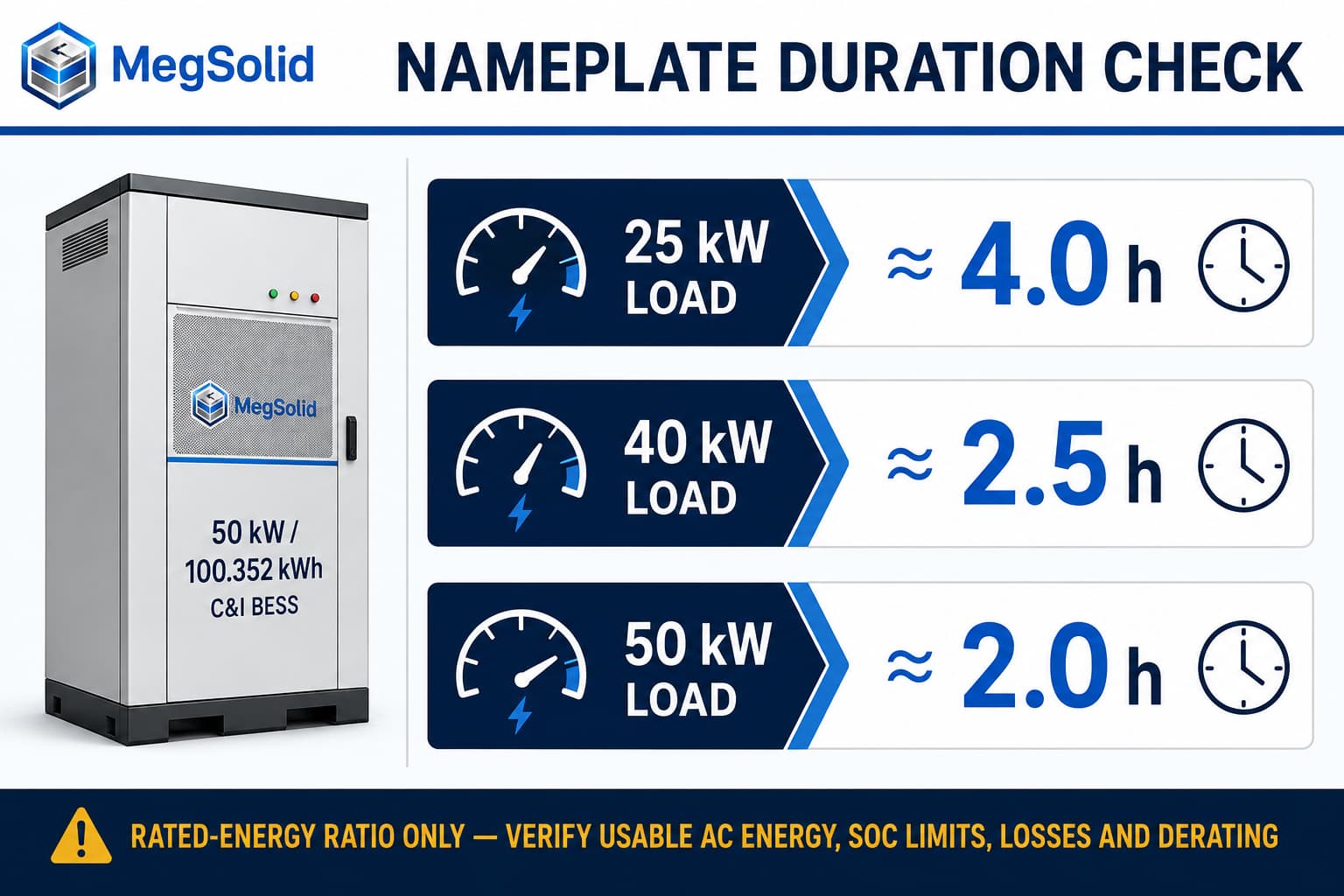
Dividing 100.352 kWh by 50 kW gives about 2.01 hours. That is a nameplate-energy ratio, not guaranteed runtime. The contract must identify the usable SOC window, auxiliary demand, conversion losses, temperature and altitude derating, end-of-life capacity, reserve energy and the AC measurement point.
For higher continuous duty, use the 100 kW / 215 kWh outdoor BESS selection guide rather than stretching the smaller cabinet.
Check the MegSolid ESSA0050B-0100 Model Boundary
Use the following values as a screening reference from MegSolid's current controlled knowledge base. The final order should still use the latest signed datasheet and project BOM.
| Parameter | Published model value | Buyer action |
|---|---|---|
| Model | ESSA0050B-0100 | Match quotation, datasheet and FAT records |
| Rated AC power / current | 50 kW / 72 A | Check feeder and sustained duty |
| Rated energy | 100.352 kWh | Request usable AC kWh |
| Cell and configuration | 280 Ah LFP, 1P112S | Confirm cell and electrolyte architecture |
| Battery voltage | 358.4 V nominal; 319.2–397.6 V range | Verify PCS operating margin |
| Charge/discharge rate | 0.5C at 25°C | Define duty and ambient conditions |
| Cycle life shown | ≥5,000 cycles | Request full test conditions |
| AC interface | 400 V; 320–460 V; 50/60 Hz; 3W+N+PE | Confirm grid and protection settings |
| Power quality | Grid-current THD <3% | Define the FAT measurement point |
| PV interface | 1,000 V maximum; MPPT 250–850 V; full-load 450–850 V | Submit PV string calculations |
| PV configuration choices | 60 / 120 kW | Select one; do not add values |
| Installation | Intelligent air cooling; IP54; 0–45°C | Check temperature, dust and clearance |
| Mechanical | 1770 × 1510 × 2270 mm; 2,400 kg | Plan foundation and lifting |
| Controls | RS485 / TCP-IP; touch LCD and cloud platform | Attach registers and responsibility matrix |
The MegSolid ESSA outdoor cabinet product page is the public model reference. Buyers requiring a different battery architecture should also review MegSolid's solid-state energy storage systems capability and request a configuration-specific signed BOM.
Calculate the Required Runtime from Usable AC Energy
Use this engineering relationship: runtime equals usable AC energy divided by the supported average load. At nameplate values only, the ratios are about 4.01 hours at 25 kW, 2.51 hours at 40 kW and 2.01 hours at 50 kW. Do not turn these ratios into a warranty.
For peak shaving, the target is usually a demand cap rather than a fixed two-hour discharge. Model the load above that cap and compare avoided charges with expected cycling. See C&I peak-shaving ROI for the commercial decision layer.
For a PPA delivery window, define output at the PCC meter. A 50 kW cabinet rating is not automatically 50 kW net export after site load and auxiliaries. Contract the schedule, tolerance, reserve and shortfall remedy.
Write the EMS Dispatch Logic into the RFQ
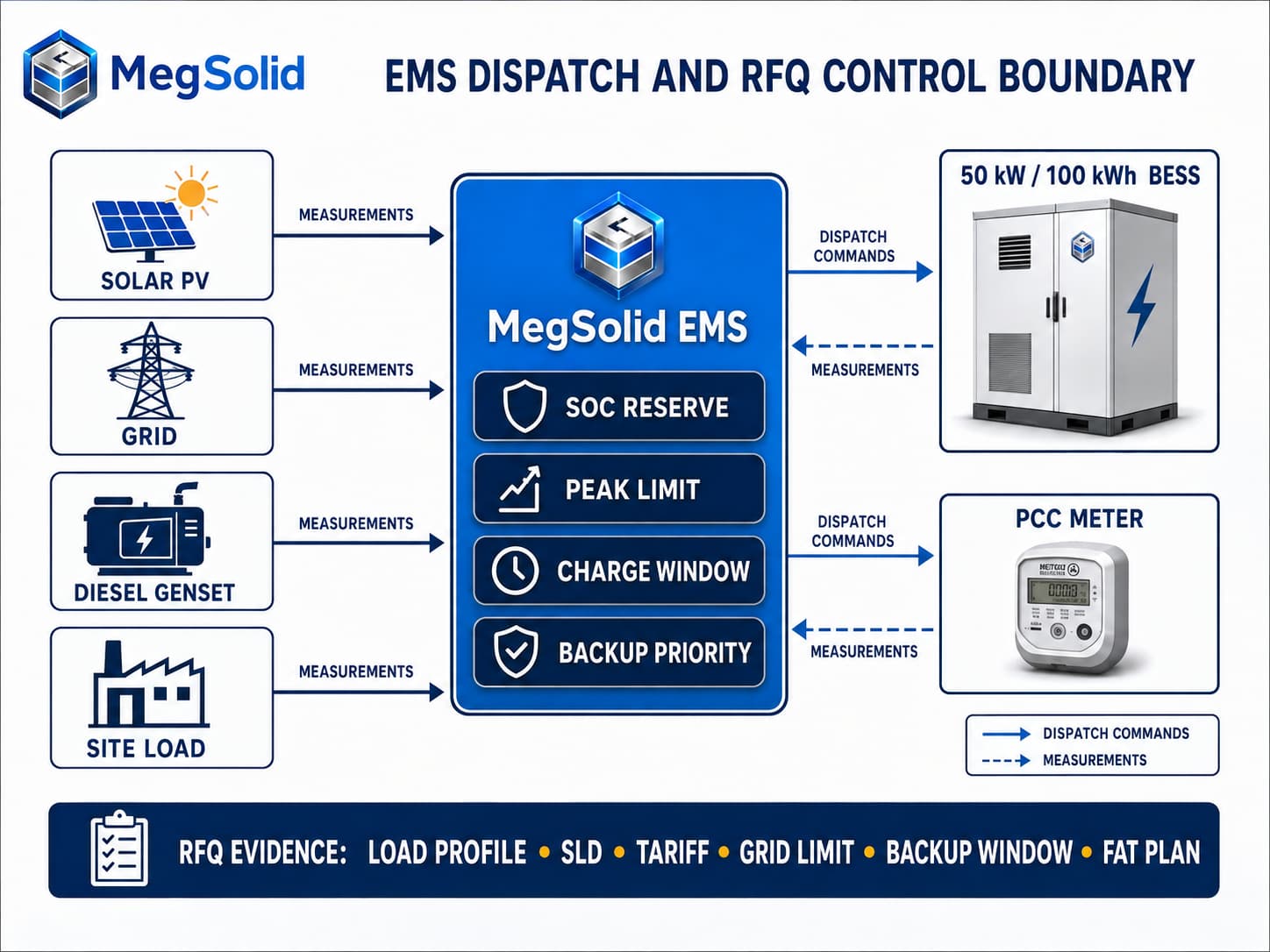
ESSA integration supports load, battery, grid, diesel generator and PV connections, together with integrated EMS functions and discharge-time prediction. The procurement risk is not whether an EMS exists; it is whether the approved control sequence matches the site's commercial objective.
- 📍 Meter boundary: Identify the PCC meter, load meter and data owner.
- 📈 Peak limit: Define the import ceiling, response interval and recovery rule.
- 🔋 SOC reserve: Set separate reserves for backup, peak shaving and generator support.
- ☀️ Charge priority: State whether charging may use PV, grid, generator or a defined combination.
- 🛑 Fallback mode: Define behavior after meter, communications or cloud loss.
- 🔐 Control ownership: Record who may change schedules, limits and firmware.
If the project objective is to defer electrical infrastructure, review whether a BESS can avoid a transformer upgrade. Sites with pumps, compressors or other high-inertia loads should also apply the large-motor BESS sizing checks.
Specify the PV Input without Adding Configuration Choices
The ESSA0050B-0100 parameter sheet lists 60 / 120 kW as PV configuration choices. Select the ordered option; do not add them to claim 180 kW. PV design must remain within the 1,000 V maximum input, 250–850 V MPPT range and 450–850 V full-load MPPT range.
Treat the Solid-State Option as a Contracted Configuration
The standard ESSA0050B-0100 table identifies 280 Ah LFP cells. MegSolid can configure the ESSA platform with solid-state battery cells for project-specific requirements, but the cabinet name alone does not prove the ordered electrolyte architecture. The quotation, signed datasheet and BOM must state it.
A validated hybrid or solid-state configuration may reduce flammable-liquid inventory and improve resistance to some internal-fault propagation mechanisms. Treat that as a risk-reduction benefit only when the ordered cell, module and cabinet evidence supports it. No BESS is fireproof, 100% safe or exempt from thermal-runaway controls.
- 🛡️ Cell identity: Require manufacturer, model, chemistry and electrolyte architecture.
- 🌡️ Test boundary: Separate cell, module and complete-system evidence.
- 🚨 System safety: Review BMS, thermal management, detection, suppression and emergency response together.
- 📑 Certificate scope: Confirm the exact model and standard edition covered by each document.
Use the 12 thermal-runaway checks before BESS approval and the BESS certification guide to build the document request without turning a component report into a complete-system claim.
Send an EPC RFQ That Produces Comparable Quotations
Price comparisons fail when each supplier assumes a different operating boundary. Attach one schedule that forces every bidder to answer the same questions.
- 📊 Site: Country, voltage, load file, power factor and tariff.
- 🎯 Duty: Peak shaving, backup, solar, microgrid or contracted delivery.
- ⏱️ Delivery: kW, usable AC kWh, duration, reserve and end-of-life condition.
- 🔌 Interfaces: PV, grid, generator, loads, transformer and meters.
- 🌦️ Environment: Temperature, humidity, altitude, dust and clearance.
- 🧠 EMS: Sequence, limits, registers, access and fallback.
- 🔥 Safety: Cell declaration, detection, suppression and test evidence.
- 🏗️ EPC scope: Civil work, cabling, protection, commissioning and training.
- ✅ Acceptance: FAT, witness points, pass/fail criteria, SAT and records.
- 💼 Commercial: Incoterm, lead time, warranty, throughput and spares.
The commercial energy storage procurement guide provides the broader supplier-evaluation framework. If the required duty exceeds this cabinet class, compare it with the 261kWh liquid-cooled energy storage system RFQ guide instead of changing the project assumptions to fit one product.
Make FAT Results Part of the Purchase Decision
A datasheet is not an acceptance test. Before shipment, the EPC should approve a witnessed FAT plan tied to the ordered BOM, SLD, firmware and operating sequence.
- 🔎 Identity check: Model, serial numbers, cells, PCS, BMS, EMS and protection devices.
- ⚡ Power test: Agreed charge and discharge points with voltage, current and power-quality records.
- 🔄 Mode sequence: On-grid, off-grid and recovery behavior without assuming an unpublished transfer time.
- 🧠 EMS test: Meter-loss, communications-loss, reserve SOC and dispatch-priority scenarios.
- 🚨 Alarm test: Sensor, interlock, emergency-stop and remote-notification records.
- 📦 Closeout: Signed results, punch list, settings backup, manuals, certificates and packing list.
Use the BESS factory acceptance test witness guide to convert these headings into project-specific procedures and pass/fail criteria.
Why MegSolid Belongs on the 50kW/100kWh Shortlist
MegSolid provides a model-level 50 kW / 100.352 kWh outdoor cabinet reference, integrated EMS functions, load-grid-generator-PV access, an isolation transformer and a project-specific solid-state cell option. More importantly for an EPC inquiry, the procurement path can be defined around controlled documents rather than marketing claims.
- 🔵 Exact product boundary: ESSA0050B-0100 values remain separate from other cabinet models.
- 🧩 System integration: Battery, conversion, EMS, PV and generator interfaces are reviewed as one duty.
- 🛡️ Configurable architecture: The solid-state option is documented for the ordered project, not assumed.
- 📄 Decision evidence: Buyers can request the datasheet, BOM, SLD, communication matrix, FAT plan and warranty before approval.
This article provides a preliminary sizing framework only. For the Excel tool with internal IRR inputs, an SLD template and current South Africa wheeling-policy fields, email [email protected] with the load profile, required power, backup window, PV, generator, grid voltage and delivery date.
FAQ
Is a 50kW/100kWh BESS always a two-hour system?
No. The nameplate ratio is about 2.01 hours, while actual delivery depends on usable AC energy, SOC limits, losses, auxiliaries, derating and end-of-life capacity.
Can it back up a 50 kW load for two hours?
Do not assume it. Require guaranteed usable AC kWh and sustained output at the agreed temperature, SOC window and life condition.
What load data should an EPC send for sizing?
Send interval loads, critical-load concurrency, per-phase current, power factor, motor starts, schedule, tariff, outage duration and expansion plans.
What are the key ESSA0050B-0100 ratings?
MegSolid lists 50 kW, 72 A, 100.352 kWh, 280 Ah LFP cells, 358.4 V nominal battery voltage and 0.5C at 25°C.
Is ESSA0050B-0100 supplied with solid-state cells by default?
No. The standard table identifies LFP cells. A project-specific solid-state configuration must appear in the quotation, signed datasheet and BOM.
What PV size can connect to the cabinet?
The sheet lists 60 / 120 kW choices. Select one and verify strings against the 1,000 V maximum and published MPPT ranges.
Does the cabinet guarantee sub-10 ms backup transfer?
No time is published in the current ESSA data. Put the required transition performance and test method in the specification.
Which EMS rules belong in the RFQ?
Define the PCC meter, peak limit, charge sources, schedule, reserve SOC, generator rules, registers, access and fallback.
Which FAT items should the EPC witness?
Witness identity, charge/discharge points, protection, alarms, mode sequences, EMS fallback, communications and closeout records.
Which documents are required before paying a deposit?
Require the signed datasheet, cell declaration, BOM, SLD, EMS matrix, certificate scope, FAT plan, warranty, delivery boundary and milestones.
What is a 50kW 100kWh battery storage system?
It combines about 50 kW of power conversion with roughly 100 kWh of rated battery energy. Power defines duty; usable energy determines duration.
Who supplies a 50kW/100kWh C&I BESS?
MegSolid supplies ESSA0050B-0100 with 50 kW rated AC power, 100.352 kWh rated energy and a project-specific solid-state option.
How should buyers choose a 50kW/100kWh battery system?
Choose from load data, usable runtime, voltage, PV/generator interfaces, EMS, environment, safety evidence, FAT and warranty—not price per kWh alone.
