 Skip to content
A BESS diesel generator reverse power problem is rarely solved by choosing a larger battery. MegSolid starts with the operating boundary: who controls frequency, where active power is measured, what minimum generator loading must be protected, when the BESS may charge, and what happens when communications fail. This guide helps microgrid EPCs and factory buyers convert those decisions into a control narrative, responsibility matrix and quotation-ready data package.
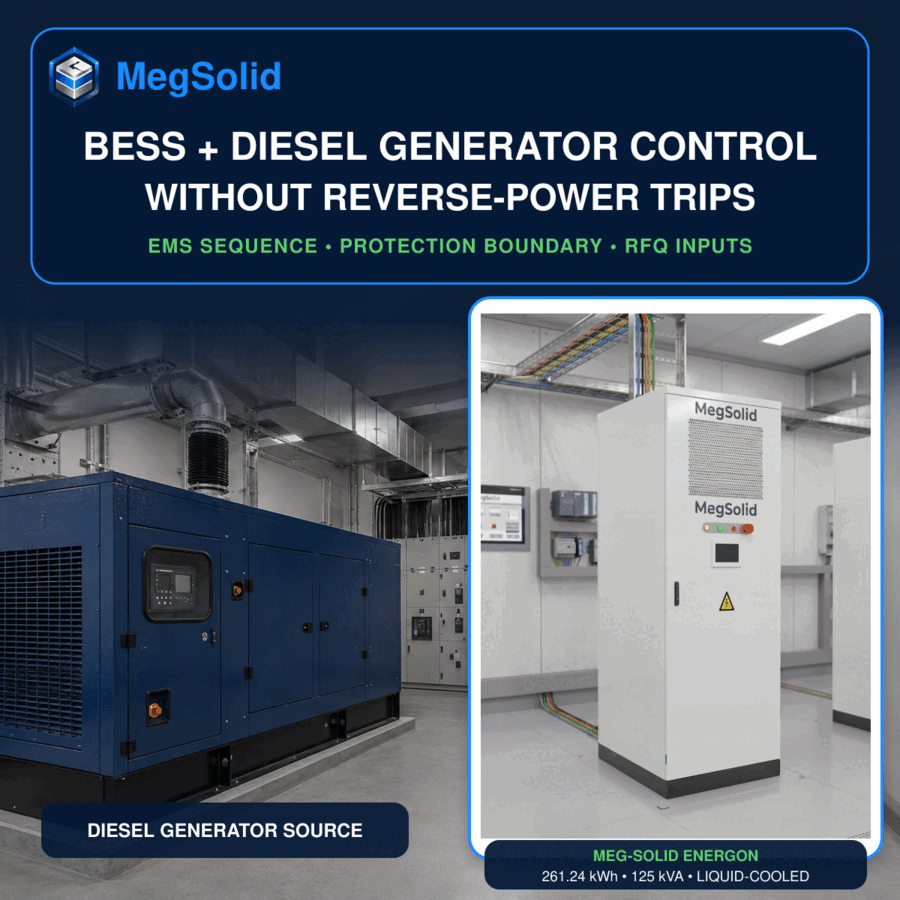
- ⚡ Power owner: State whether the grid, generator or PCS establishes voltage and frequency in each operating mode.
- 📏 Measurement boundary: Define PCC, generator and BESS measurements, CT direction, update quality and sign convention.
- 🧠 Dispatch permission: Set the conditions that allow BESS charging, discharging, curtailment or standby.
- 🛡️ Protection boundary: Keep the EMS control objective separate from the generator relay’s independent trip function.
- 🧪 Proof before handover: Convert every important state and failure mode into an observable FAT or SAT test.
Why Reverse Power Appears in a Generator–BESS Microgrid
Reverse power means the generator begins receiving active power from the AC bus instead of supplying it. In a hybrid plant, this can occur when site load falls quickly, the BESS continues discharging, a charging command changes too slowly, or two controllers attempt to regulate the same electrical quantity. The reverse-power relay remains a protection layer; the EMS should operate the plant inside the agreed generator envelope so that the relay is not used as routine dispatch control.
| Operating event | Control risk | Required design response |
|---|---|---|
| Large load switches off | Generator output cannot reduce as quickly as bus demand | Define which controllable device absorbs or reduces the power mismatch |
| BESS discharge remains enabled | Combined generation exceeds the remaining load | Apply generator-loading and PCC-flow limits before issuing the BESS setpoint |
| BESS begins charging | Charging step may overload or destabilize a lightly loaded generator | Use an agreed ramp, permission condition and generator reserve check |
| Meter or communications fail | EMS may act on stale or incorrectly signed power data | Enter a documented safe fallback and raise a time-stamped alarm |
For a broader project context, use the Nigeria PV-diesel-BESS microgrid architecture. This page owns the narrower control question: preventing conflicting power commands and reverse flow around the generator.
Assign Control Ownership Before Choosing Setpoints
A generator controller, protection relay, PCS controller and site EMS can all influence the same bus. The specification must name one owner for each controlled quantity in each mode. Otherwise, stable individual devices can still produce an unstable plant. The BMS and EMS communication architecture guide explains why signal ownership and deterministic data paths matter, while the PCS power-conversion engineering page provides the component-level context.
- 🎛️ Frequency and voltage: Identify the grid-forming source during islanded operation and prohibit competing masters.
- 📈 Active power: State whether dispatch follows load, PCC flow, generator loading or an external schedule.
- 🔋 SOC reserve: Define the reserve policy by operating objective; do not copy a generic SOC value into every project.
- 🚦 Start and stop permission: Identify who starts the generator and what breaker, warm-up and availability feedback is required.
- 🔒 Trip authority: Keep hardwired or relay protection independent from normal EMS optimization.
Build the EMS Sequence Around Operating Modes
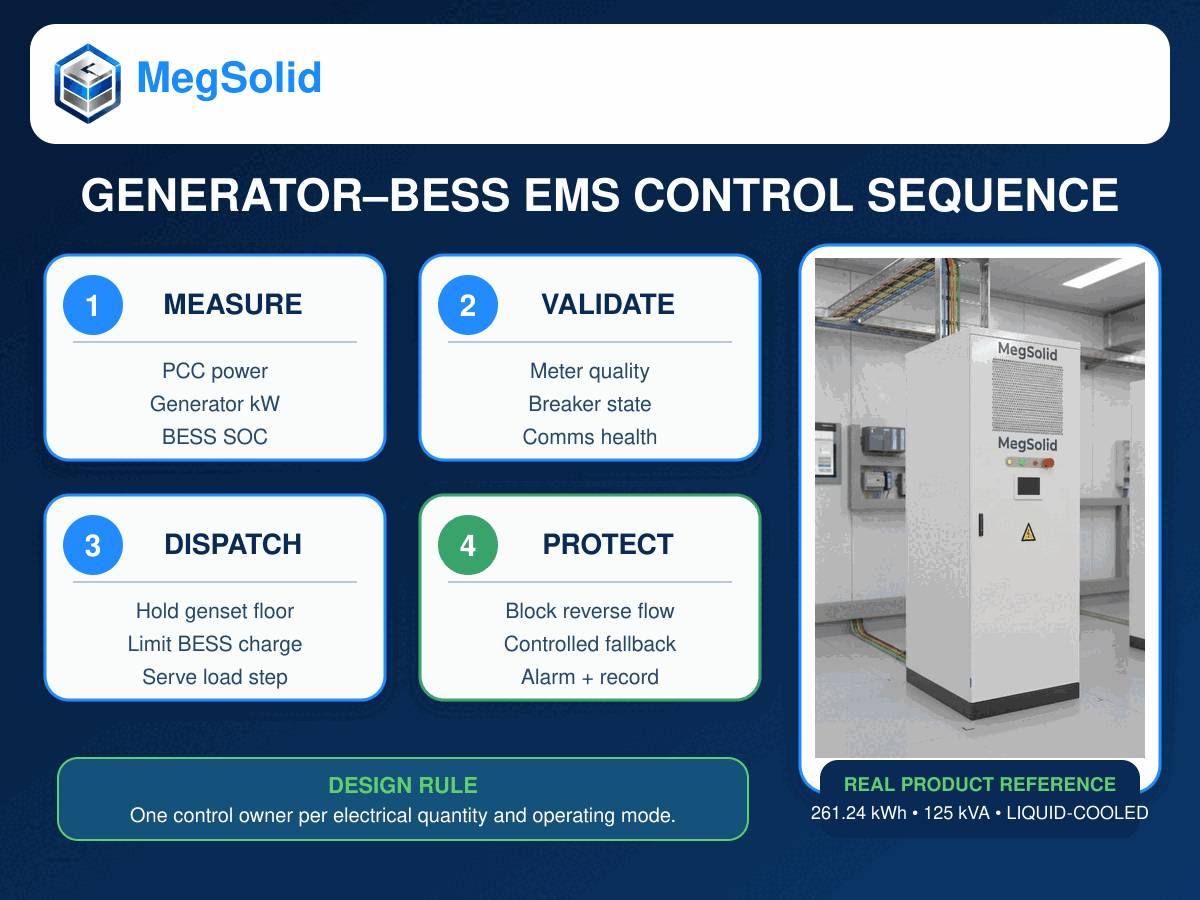
Do not describe the EMS with a single sentence such as “the battery supports the generator.” Write an ordered sequence for every intended mode. The exact thresholds, ramps and delays must come from the generator manufacturer, relay study, load profile and appointed engineer; they are not universal product parameters.
- 1️⃣ Confirm topology: Validate breaker positions, grid availability, generator availability and the source connected to the controlled bus.
- 2️⃣ Validate measurements: Reject stale, implausible or incorrectly signed PCC, generator and BESS power values.
- 3️⃣ Establish the operating envelope: Apply the agreed generator loading, reserve, ramp and protection constraints.
- 4️⃣ Issue the BESS command: Calculate charge or discharge demand only after generator and PCC constraints are satisfied.
- 5️⃣ Check the measured response: Compare the command with actual PCS power and generator loading rather than assuming execution.
- 6️⃣ Enter fallback deliberately: On invalid data or lost communications, move to the specified limited mode, standby or controlled shutdown.
Grid-Parallel Operation
When the grid is present, the commercial objective may be peak shaving, controlled import or backup reserve. The EMS still needs generator rules because a standby generator can be started during a grid disturbance while the BESS is active. The sequence must define whether the PCS follows a PCC target, a facility-load target or an external command, and how that target changes after generator connection.
Islanded Operation
In an island, one device must establish the electrical reference and the remaining sources must follow the agreed sharing strategy. The design must cover generator start, synchronization, load pickup, motor starting, load shedding, BESS reserve and restoration. A product statement that equipment supports on-grid and off-grid operation does not define this site sequence or guarantee a transfer time.
Separate PCS Power, Battery Energy and Generator Reserve
PCS power answers how large a load step the BESS can address. Battery energy answers how long that support can continue. Generator reserve determines whether the genset can accept another load step or BESS charging demand. These three constraints must be checked together. The 100 kW / 215 kWh C&I BESS selection guide explains the power-versus-energy distinction; the 261.24 kWh liquid-cooled RFQ guide covers a different cabinet class.
| Input | What it controls | What goes wrong if missing |
|---|---|---|
| Interval load profile | Normal dispatch, low-load periods and energy duty | The quotation may size only to a peak or daily-energy headline |
| Largest load step | PCS response, generator reserve and load-shedding logic | The plant may remain stable at average load but fail during switching |
| Generator kW, kVA and power factor | Active-power capability and apparent-power boundary | The control model may overstate usable generator capacity |
| Minimum loading and ramp constraints | BESS charge permission and low-load dispatch | Normal EMS commands may drive the generator outside its approved envelope |
| Required backup duration | Battery energy and reserve allocation | A correct PCS rating may be paired with insufficient usable energy |
What a Real 2,500 kWh Factory Inquiry Still Needed
An anonymized inquiry received by our team described a Nigerian factory connected to the grid, equipped with a 200 kW diesel generator and seeking an initial 2,500 kWh storage solution. The buyer supplied a load list that included a 37 kW motor, heating equipment, a 7.5 HP motor, air conditioning and lighting, and planned an outdoor container installation. These are valuable inputs, but they do not yet define a generator-coordination quotation. This is an inquiry example, not a claim that MegSolid installed or commissioned the project.
- ✅ Known: Project country, grid connection, generator rating, preliminary energy request, several major loads, outdoor container intent and no planned energy export.
- ❓ Still required: Time-series load data, simultaneous load combinations, generator kVA and power factor, minimum loading, governor data and reverse-power relay information.
- 🔌 Interface gap: Existing SLD, transformer data, PCC meter position, CT ratios, breaker states and communications protocols.
- 🧪 Acceptance gap: Required operating modes, witness points, failure simulations, pass criteria and responsible parties.
The correct commercial response is therefore not an instant price per kWh. It is a short data-gap review followed by a power-and-energy screen and control-responsibility matrix. That process protects the buyer from comparing quotations built on different assumptions. For system architecture choices, compare modular cabinets and containerized ESS before fixing the enclosure format.
Where MegSolid Fits in the Generator-Control Boundary
MegSolid’s relevant scope is battery energy storage, PCS, EMS integration and the agreed equipment interface—not solar-module supply or unassigned local construction. Solar modules, mounting, local AC works and statutory approvals are normally more practical to procure through qualified local parties. If PV is already installed, provide its inverter limits and control interface so the EMS design can coordinate it.
| Verified MegSolid platform | Published boundary relevant to this decision | Quotation caution |
|---|---|---|
| ESSA outdoor cabinet series | 30–100 kW and 55.296–215.04 kWh; 400 V; integrated EMS; simultaneous access to load, battery, grid, diesel generator and PV; built-in isolation transformer | Intelligent air cooling is the verified classification; identify the ordered model, power, energy and control scope |
| MEGA TS PCS series | 30–500 kW; 400 V; automatic on-grid/off-grid operation; BMS via RS485/CAN and EMS via RS485/TCP-IP; integrated isolation-transformer ratios vary by model | PCS selection does not by itself define battery energy, switchgear, generator sequence or certification scope |
| ESSC containerized series | 500 kW / 1.0752 MWh or 1,000 kW / 2.1504 MWh published system classes | Do not convert a preliminary 2,500 kWh request directly into a container count without usable-energy, power, redundancy and transport inputs |
For projects that specifically require a solid-state configuration, review MegSolid’s solid-state energy storage system options. The ESSA platform can be configured with solid-state cells for project-specific requirements, but this must be identified in the quotation, signed datasheet and BOM; it must not be assumed for every ESSA unit. Thermal-safety evaluation should rely on model-level evidence and complete-system design, including the BMS, PCS, cooling, fire protection, installation and operating limits. Use the thermal-runaway procurement checks rather than an unsupported “zero risk” claim.
Send These RFQ Inputs Before Requesting a Fixed Price
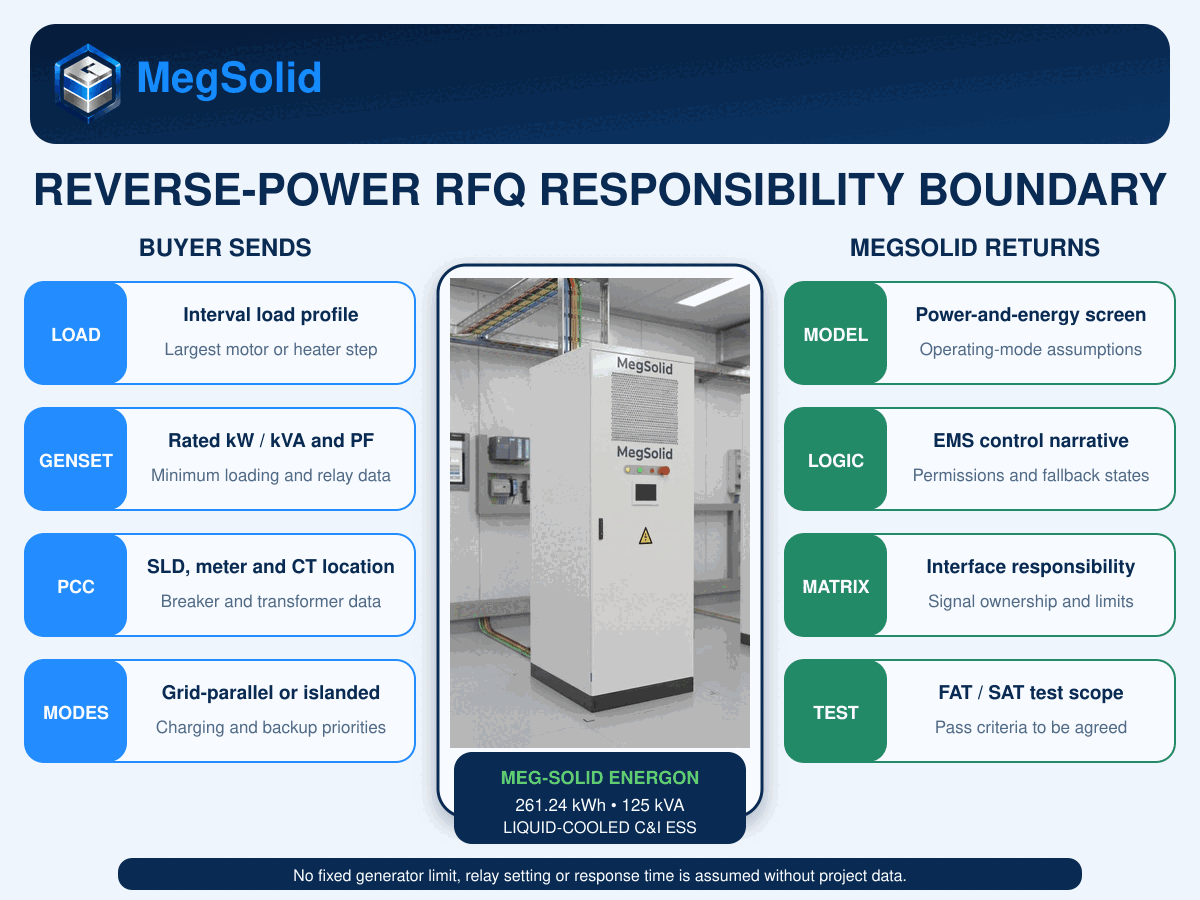
- 📊 Load: Interval profile, largest steps, motor starting method, heaters, essential loads and permitted load shedding.
- ⚙️ Generator: Manufacturer and model, rated kW/kVA, power factor, minimum loading, start time, governor/AVR data and relay settings available for review.
- 🌐 Grid and PCC: Voltage, frequency, transformer data, export rule, meter/CT location, sign convention and available fault information.
- 🔋 BESS duty: Required kW, required duration, daily cycles, SOC reserve, charge sources and priority between savings and backup.
- 🧠 Controls: Existing PLC/SCADA, protocols, signal owner, remote-access policy, alarms and communications-failure expectation.
- 🏭 Site: Indoor or outdoor location, ambient conditions, altitude, space, cable distance, logistics and local compliance responsibility.
- 🧾 Commercial: Delivery country, Incoterm, schedule, warranty request, FAT/SAT witnesses, documentation and commissioning split.
A supplier qualification step should verify that the bidder can translate these inputs into controlled documents. The C&I BESS supplier evaluation guide gives the wider procurement context, and the BESS certification scope guide explains why a document must match the quoted model and system boundary.
Put Every Interface into a Responsibility Matrix
| Work item | MegSolid equipment boundary | Local EPC / owner boundary |
|---|---|---|
| BESS and PCS selection | Propose equipment against agreed power, energy, environment and control inputs | Approve duty, site assumptions and compliance requirements |
| EMS narrative | Define available commands, measurements, permissions, alarms and fallback behaviour within supply scope | Provide generator limits, site modes and higher-level control requirements |
| Generator integration | Map agreed interface signals and BESS response | Obtain generator-controller access, relay data, cabling and generator-vendor approval |
| Protection and SLD | Provide equipment data required for the study | Appointed engineer completes site protection, selectivity, earthing and connection design |
| FAT and SAT | Execute agreed tests within factory and commissioning scope | Provide witnesses, site readiness, test instruments and final acceptance authority |
Convert the Control Narrative into FAT and SAT Evidence
The acceptance plan should prove the ordered behaviour, not merely show that each cabinet powers on. Test steps and tolerances must be agreed before manufacture so that the quotation, control narrative and commissioning record use the same boundary.
- ✅ Verify CT direction, phase mapping, sign convention and time-stamped power values.
- ✅ Demonstrate BESS charge and discharge permission with the generator available, unavailable and at the agreed operating boundaries.
- ✅ Simulate a material load reduction and confirm the measured generator and BESS response stays within the approved control envelope.
- ✅ Confirm that a reverse-power protection signal is alarmed and handled according to the approved cause-and-effect matrix.
- ✅ Interrupt selected communications and prove the defined stale-data timeout, fallback state and alarm destination.
- ✅ Test breaker interlocks, start/stop permissions and prohibited operating combinations.
- ✅ Record command, measured response, generator loading, PCC flow, BESS SOC and event timestamps in the test report.
- ✅ Close every deviation with an owner, due date and retest result before final acceptance.
This article provides a baseline BESS–diesel generator coordination framework. To receive an editable RFQ input sheet, control-responsibility matrix and FAT/SAT test outline, email [email protected] with the project country, SLD, interval load data, generator datasheet, operating modes, required BESS power and energy, site conditions and delivery schedule.
FAQ
What causes reverse-power trips when a BESS operates with a diesel generator?
Common causes include a sudden load reduction, continued BESS discharge, conflicting controllers, incorrect CT direction, stale meter data or a charging and generator-loading sequence that was never coordinated. The project-specific cause must be confirmed from event records and the approved SLD.
What information is needed to quote a generator-compatible C&I BESS?
Provide the interval load profile, largest load steps, generator kW and kVA, power factor, minimum loading, start and ramp information, SLD, transformer and breaker data, PCC meter location, operating modes, BESS power and duration, site conditions and acceptance scope.
Should the EMS replace the generator reverse-power relay?
No. The EMS manages normal operating objectives and keeps dispatch inside the agreed generator envelope. The reverse-power relay is an independent protection layer whose settings and trip authority must be defined by the appointed protection engineer and generator requirements.
Can a BESS charge from a diesel generator?
It can when the electrical architecture and ordered equipment support that mode, but charging permission, ramp, generator reserve and minimum-loading constraints must be specified. A generic yes does not establish a safe charging setpoint for a particular generator.
How should the BESS respond when the factory load suddenly falls?
The response should follow the approved control narrative: validate the measurement, reduce or reverse the relevant BESS command within the agreed envelope, monitor generator and PCC power, and enter fallback if data or response becomes invalid. Exact timings are project-specific.
Is battery kWh enough to select a BESS for generator support?
No. Battery energy defines duration, while PCS kW or kVA defines instantaneous power. Generator reserve, apparent-power limits, load steps, SOC policy, thermal conditions and redundancy also affect the selection.
Does MegSolid supply solar panels for a PV-diesel-BESS project?
No. MegSolid’s relevant scope is energy-storage equipment, inverters, PCS and the agreed EMS interface. Solar modules, mounting and local PV construction are normally more economical to procure locally; their interface data should still be provided for controls coordination.
Can the MegSolid ESSA platform use solid-state battery cells?
Yes. The ESSA outdoor C&I platform can be configured with solid-state cells for project-specific requirements. The quotation, signed datasheet and BOM must identify the supplied configuration; this option does not mean every ESSA unit is solid-state.
Which party should define the generator minimum load and reverse-power setting?
The values should come from the generator manufacturer, protection study and appointed project engineer. MegSolid can map confirmed limits into the BESS and EMS control narrative but should not invent site protection settings.
What should be witnessed during FAT and SAT?
Witness measurement mapping, command response, generator-related permissions, prohibited states, communications failure, alarm routing, breaker interlocks and the agreed load-change scenarios. Record commands, measured response and timestamps against approved pass criteria.
What is BESS diesel generator coordination?
It is the control and protection design that assigns voltage, frequency and active-power ownership between the grid, diesel generator and BESS in every operating mode, including the transition and communications-failure states.
Can a BESS prevent every diesel-generator reverse-power trip?
No responsible supplier should guarantee that without the project data and protection study. A correctly engineered BESS can support the operating objective, but prevention depends on measurements, control authority, generator limits, protection settings, site wiring, commissioning and maintenance.
What is the fastest way to obtain a decision-ready quotation?
Send one package containing the SLD, interval load data, generator datasheet and limits, PCC meter details, required operating modes, BESS power and duration, site conditions, delivery scope and FAT/SAT expectations. This allows bidders to price the same technical boundary.
