 Skip to content
A commercial battery storage system can carry the correct kW and kWh ratings and still miss the job if its environmental boundary is vague. At the point where MegSolid equipment meets the yard, a dust-loaded filter can force a cabinet to derate during the factory peak. Salt can reach hinges, coils and cable interfaces that were outside a test sample. A cooling system that passes a factory noise check can still exceed the night limit at the nearest home.
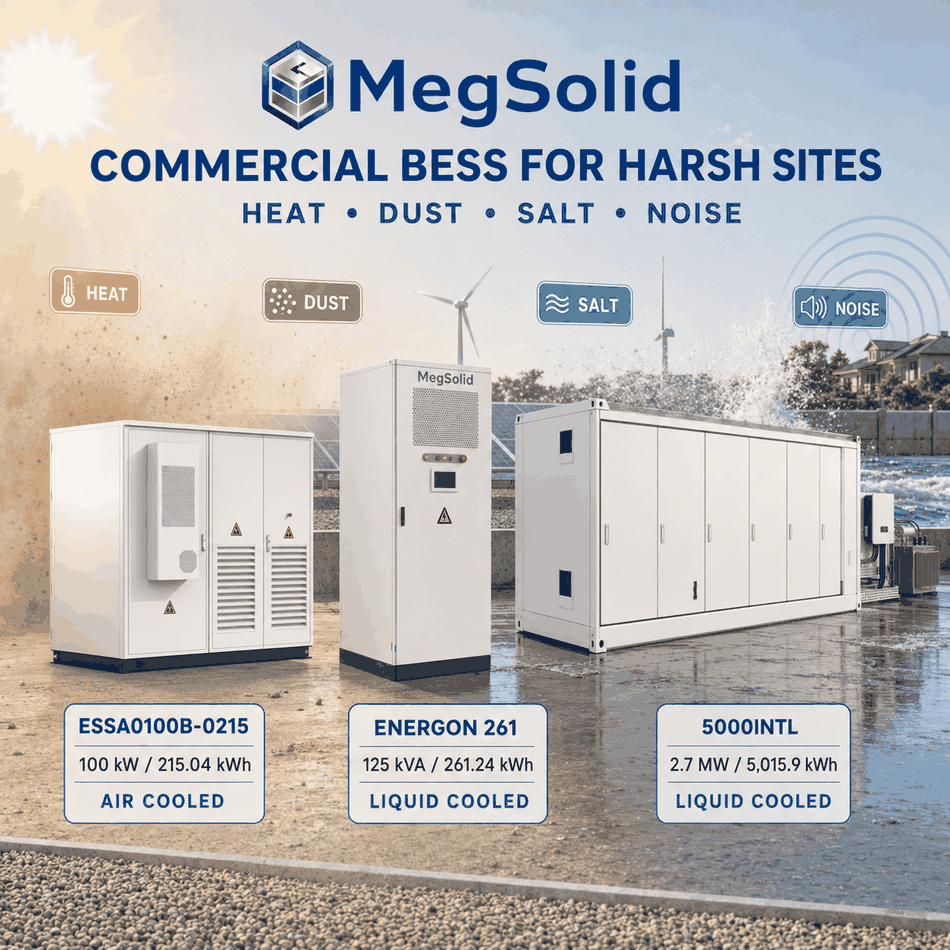
Commercial battery storage system selection begins with four site values: maximum equipment-intake temperature, atmospheric corrosivity, dust and water exposure, and the applicable noise limit at the receptor. Those values decide whether a 100 kW / 215.04 kWh air-cooled ESSA cabinet, a 261.24 kWh / 125 kVA liquid-cooled Energon system or a larger containerized BESS deserves detailed review.
Key decisions
- Use equipment-intake temperature for the thermal screen; weather-station air alone does not represent the cabinet boundary.
- Treat an IP code, salt-mist test, coating schedule and corrosion category as separate pieces of evidence.
- Compare sound power, spectrum and operating state before modelling sound pressure at a property line.
- Make environmental performance a FAT and SAT obligation with named measurements, alarms and remedies.
- Keep product chemistry, cooling method and electrical rating tied to the exact model and controlled document revision.
Start With the Load Profile and Then Review Battery Nameplate Ratings
Environmental design does not replace electrical sizing. It changes how much of the commercial battery storage system nameplate remains available at the site condition.
Start with the event the BESS must carry: peak shaving, generator bridging, a protected-load window or scheduled energy shifting. Record kW, kVA, power factor, duration and allowed load shedding. The 215 kWh versus 261 kWh commercial battery storage comparison provides the electrical screen before environmental limits are added.
Use two separate acceptance lines:
Required continuous AC power ≤ warranted available AC power at the project temperature, altitude and power factor
Required delivered AC energy ≤ validated usable AC energy within the approved SOC window and environmental condition
A 100 kW load does not automatically release a 100 kW cabinet. At the design condition, PCS derating, battery limits, cooling auxiliaries and power factor can reduce the available margin. Nominal kWh also stays separate from usable AC energy.
Turn Four Site Conditions into a Commercial Battery Storage System Screen
“Outdoor installation” is too broad for a purchase specification. A shaded inland warehouse and an exposed coastal concrete yard can have the same regional weather report and very different cabinet conditions.
| Site input | Value to record | Why it changes the buy | Evidence required |
|---|---|---|---|
| Heat | Design ambient, intake temperature, solar exposure, reflected heat and continuous duty | Sets derating, cooling load and auxiliary power | Output-versus-temperature curve and witnessed duty point |
| Salt and humidity | ISO 9223 category basis, airborne salinity, time of wetness and condensation pattern | Drives material, coating, coil, fastener and interface requirements | Material schedule, coating specification and scoped corrosion tests |
| Dust and water | Dust type, storm exposure, washdown, filter loading and drainage | Changes ingress risk, airflow resistance and service interval | IP evidence, dust test scope, filter limits and installed drainage check |
| Noise | Property-line criterion, time period, receptors, background and operating state | Changes equipment placement, barriers and operating schedule | Source data, acoustic model and site acceptance test |
The site plan also needs flood level, drainage, wind, seismic criteria, access and cable approach. Freeze those interfaces through the outdoor BESS foundation design inputs before issuing concrete drawings.
Heat: Separate Operating Range from Full Rated Output
An operating-temperature limit defines the permitted envelope. It does not state full power across that entire envelope. The accepted project rating needs an output-versus-temperature curve for the complete battery, PCS and cooling arrangement.
In a commercial energy storage system, the battery thermal management system and PCS can reach different limits. The accepted project rating follows the lowest live limit at the specified temperature, altitude, power factor and duty duration.
MegSolid has three relevant starting points:
| Product | Published electrical boundary | Cooling and enclosure | Published temperature boundary | Procurement use |
|---|---|---|---|---|
| ESSA0100B-0215 | 100 kW, 215.04 kWh nominal | Intelligent air cooling, IP54 | 0–45°C | Screen a 100 kW-class duty where intake temperature, airflow and filter service remain controlled |
| Energon 261 | 125 kVA, 261.24 kWh nominal | Liquid cooling, IP54 | −20–55°C; derating above 45°C | Review higher thermal duty after confirming active kW, power factor and the derating curve |
| Energon 5000INTL | 2.7 MW, 5,015.9 kWh nominal | Smart liquid cooling, IP55 | −30–55°C | Review multi-megawatt-hour projects with a complete container environmental and auxiliary-load package |
The Energon 261 value is 125 kVA. Active power follows the approved power factor and temperature condition. Its published 90% figure is maximum system efficiency; it is not a project round-trip-efficiency guarantee.
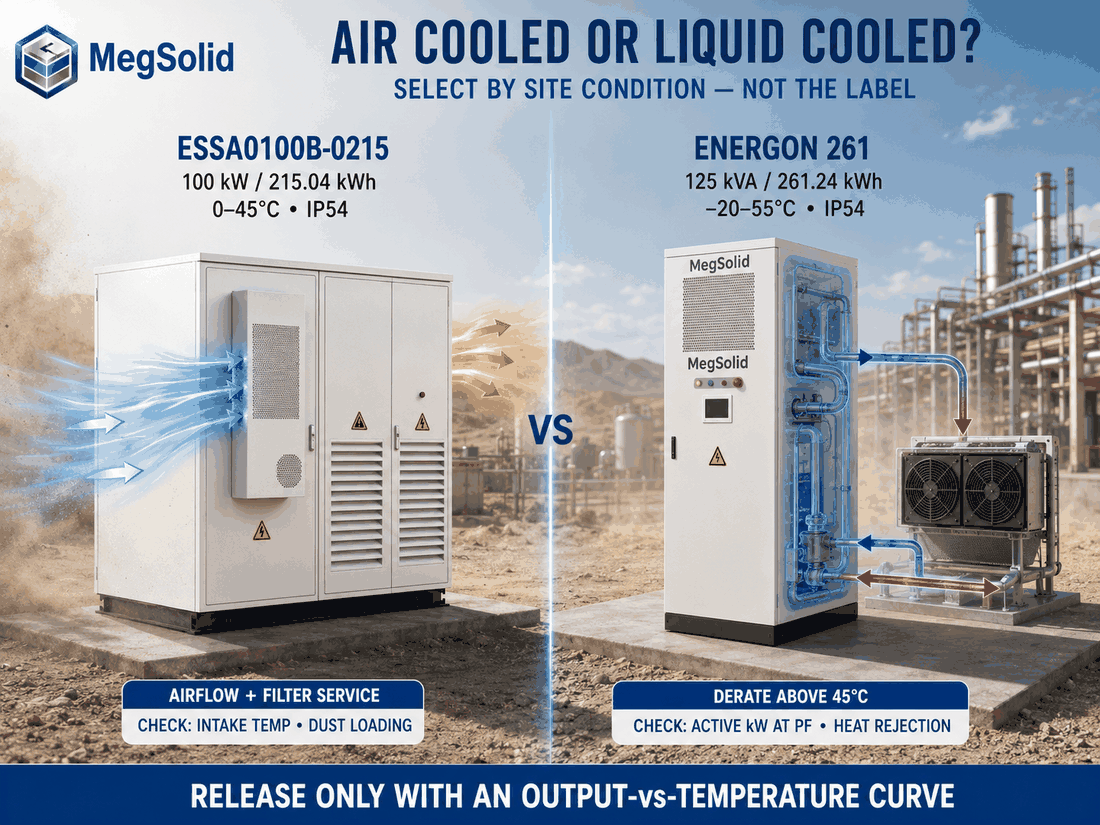
For a desert site, record air temperature at the manufacturer-defined intake. Direct sun, hot concrete, nearby transformers and recirculated discharge air can push that measurement above the weather-station value. Dust on a filter or heat exchanger then reduces heat rejection at the same hour the process load reaches its peak.
Large solar-storage developments in the Atacama Desert make the procurement problem easy to see: solar resource, heat exposure and airborne dust arrive at the same site. “Desert-rated” is therefore not a usable acceptance line. Put solar gain, maximum intake temperature, dust type, filter pressure-drop limit and output after filter loading on separate tender lines. ESSA remains the air-cooled option where the intake and filter service can be controlled; Energon 261 is the stronger cabinet starting point where the thermal window is wider, subject to its signed derating curve.
The Saudi high-temperature BESS procurement page sets the broader thermal evidence. The Riyadh ESSA versus Energon derating test turns 40°C, 45°C, 50°C and 55°C duty points into a witnessed selection decision.
Dust and Water: Read the IP Rating Within Its Scope
IEC 60529 classifies enclosure protection against solid objects and water. The IEC explanation of IP ratings confirms that the first numeral addresses solids and the second addresses liquids.
An IP54 BESS enclosure has a defined ingress rating. That rating does not establish filter life, full thermal output in blowing sand, resistance to every washdown method or protection after a service door is left open. Cable glands, field penetrations, drainage and post-installation seals also sit inside the installed boundary.
IEC 60068-2-68:1994 covers dust-and-sand test methods for electrotechnical products. A tender reference needs the test condition, specimen identity, operating state, pass/fail criteria and inspected interfaces. A certificate line with no scope cannot prove the delivered cabinet will hold output after a site-specific dust-loading interval.
For an air-cooled cabinet, follow the physical sequence:
- 1. Filter loading raises pressure drop.
- 2. Airflow falls or fan demand rises.
- 3. Internal temperature and temperature spread increase.
- 4. Cooling auxiliary consumption increases.
- 5. The controller warns, derates or trips according to the approved logic.
Put filter inspection, cleaning, replacement triggers and spare quantities in the O&M schedule. A “six-month service interval” needs site evidence; desert cement dust and light agricultural dust will not load an air path at the same rate.
Salt Mist and Condensation: Protect More Than the Outer Panel
Coastal suitability starts with exposure. ISO 9223:2012 classifies atmospheric corrosivity using factors that include the temperature-humidity complex, sulfur dioxide and airborne salinity. The standard remains current after confirmation in 2022. Record coastal distance, prevailing wind, elevation, salt deposition, time of wetness, rain washing and industrial pollutants.
IEC 60068-2-52:2017 specifies cyclic salt-mist testing for components or equipment intended for salt-laden atmospheres. The test report still needs to identify the method, severity, specimen, cycles, preconditioning and pass/fail criteria. A painted panel test does not automatically cover hinges, fasteners, fan coils, connectors, glands, busbar joints or the base frame.
Coastal corrosion often appears first at details, not across the middle of a painted panel. Chloride and retained moisture attack weld edges, bolt heads, door hinges, crevices and horizontal ledges where water sits. Coastal corrosion guidance therefore treats water traps, crevices, weld quality and dissimilar materials as inspection points. Apply the same discipline to the BESS door seam, hinge set, fasteners, base frame, cable-entry plate and exposed cooling coil; each item needs a named material, coating or protection method and an accessible field-inspection point.
Use ISO 12944-5:2019 when a protective paint system for steelwork belongs in the scope. Keep the corrosion category, durability expectation, surface preparation, dry-film thickness, edge treatment and repair process on controlled drawings and schedules.
Condensation deserves a separate line. Both ESSA and Energon product data state non-condensing humidity limits. A humid coastal night followed by rapid cooling can place a surface below the surrounding dew point. Tender controls should therefore identify humidity sensing, heater or dehumidification logic where supplied, drainage, pressure equalization, alarm points and the recovery state.
The Saudi coastal BESS corrosion page contains the component-by-component evidence schedule for C5/CX exposure and salt-mist review.
Noise: Move from a Cabinet Number to the Receptor
Continuous mechanical sound is what nearby residents remember. They do not separate a cooling fan from a pump, PCS or transformer; they hear the tonal hum that returns through the night. By the time that sound becomes a neighbour complaint, the project has a siting problem as well as an acoustic one.
Battery cells are not normally the dominant site-noise source. The equipment to model is the cooling fan or HVAC package, coolant pumps, PCS/inverters and transformer. A utility-scale BESS acoustic study uses the same source groups. Liquid cooling can reduce part of the battery-side airflow demand, but pumps and heat-rejection equipment remain; “liquid-cooled” does not mean silent.
Noise compliance is decided at the applicable receptor under the local method. A cabinet sound-pressure value measured at an unstated distance cannot be placed directly against a property-line limit.
The source package should state sound power, one-third-octave or octave-band spectrum, A-weighting, tonality, directivity, operating power, cooling state, ambient condition, test distance and uncertainty. ISO 3744:2025 provides an engineering method for determining sound power from sound-pressure measurements around a source in an environment approximating a free field over a reflecting plane.
Published MegSolid data gives early screening values: ESSA outdoor cabinets list noise emission below 75 dB, while the MEGA TS 30–500 kW PCS range lists equipment noise below 70 dB. The Energon 261 public page does not state a noise value, so its acoustic decision waits for configuration-specific source data.
Layout then controls the path to the receptor:
- Rotate fan and heat-rejection outlets away from sensitive boundaries.
- Increase source-to-receptor distance where the site allows it.
- Place quieter equipment near the boundary and louder PCS or transformers farther inside.
- Model barriers, gaps and reflections before release.
- Check acoustic louvres and silencers for pressure drop and thermal impact.
- Preserve fire access, maintenance clearance and drainage.
The BESS noise near homes product-selection page provides the detailed receptor model and acceptance checklist.
A Combined Site Example: The Nameplate Passes Before the Environment Does
Consider a food-processing plant three kilometres from the coast. The BESS must shave 98 kW for 90 minutes. The measured summer intake reaches 43°C. Fine process dust loads filters. The nearest residential receptor is 140 metres away, and the permit sets a 45 dBA night limit for this example.
The initial energy duty is:
98 kW × 1.5 h = 147 kWh AC before reserve, losses and auxiliary treatment
ESSA0100B-0215 clears the nominal power-nameplate screen by only 2 kW. Its 215.04 kWh nominal energy appears large enough for the first calculation. Release still waits on usable AC energy, 43°C continuous output, filter loading and auxiliary consumption. The 0–45°C published operating range leaves little intake margin during the hottest duty.
Energon 261 offers 261.24 kWh nominal energy and a wider −20–55°C operating range, with derating above 45°C. It becomes the stronger thermal starting point. The 125 kVA rating still needs conversion to approved active kW at the project power factor.
Neither route is released by the thermal comparison alone. Coastal corrosion evidence must cover cooling hardware and field interfaces. The 45 dBA receptor limit needs a configuration-specific acoustic model and SAT measurement. If either cabinet fails the signed acceptance boundary, the answer is a layout change, another product class or a revised operating duty.
Convert Each Environmental Risk into a Contract Hold Point
| Risk | Before quotation | FAT evidence | SAT evidence | Release condition |
|---|---|---|---|---|
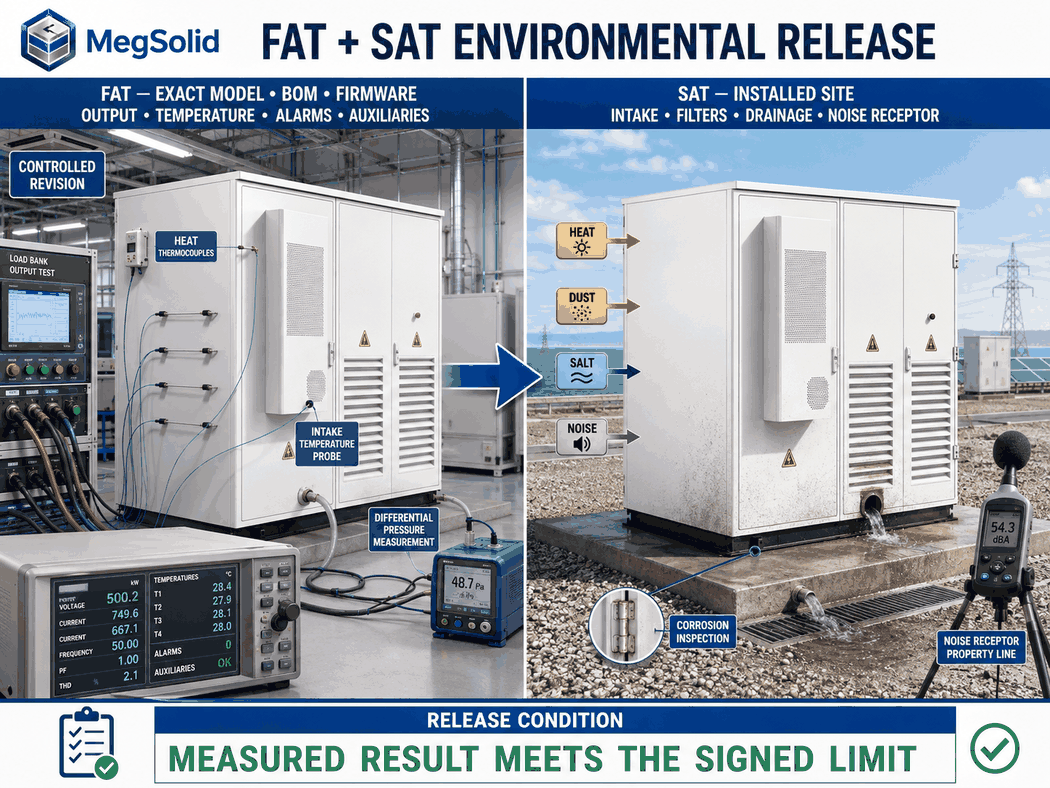
| Heat | Intake design value, load duration, power factor, altitude | Output, temperatures, auxiliaries, alarms and derating at agreed condition | Installed intake, solar exposure, recirculation and duty trend | Warranted power and energy available at design condition |
| Dust/water | Dust type, water exposure, filter interval, penetrations | Enclosure records, filter limits and alarm logic | Glands, drainage, doors, filters and installed penetrations checked | No uncontrolled ingress path; service plan accepted |
| Salt/condensation | Corrosivity basis, humidity cycle, coating and material schedule | Scoped salt-mist and coating records; humidity controls checked | Delivery damage, touch-up, drainage and condensation controls checked | Corrosion package matches delivered BOM and site interfaces |
| Noise | Receptors, criterion, background, operating states | Controlled source data for exact revision | Property-line test in agreed duty and weather window | Measured result meets criterion with agreed uncertainty treatment |
The BESS factory acceptance test framework provides the document-control and witness structure. Environmental tests should reference the same model, firmware, cooling configuration and BOM that will ship.
Split the Scope Before the Purchase Order
MegSolid can supply model-level product data, controlled drawings, battery/PCS/EMS interfaces, available environmental evidence, alarm points and agreed factory tests for the selected storage configuration.
The owner and EPC remain responsible for the approved site design basis, local permits, civil and structural design, drainage, cable routing, switchgear, earthing, fire access, receptor criteria, external barriers and installed acceptance method. PV modules, PV inverters and solar string design remain outside MegSolid's BESS product supply unless a signed project scope states otherwise.
| Party | Minimum controlled deliverables |
|---|---|
| Owner / developer | Operating duty, environmental design basis, receptor criteria, permit conditions and acceptance authority |
| EPC / local engineer | Layout, civil works, drainage, cable interfaces, barriers, protection, installation quality and SAT procedure |
| MegSolid | Selected-model data, approved product interfaces, declared limits, document revision, FAT records and storage-control support |
| Independent laboratory or specialist | Tests or models named by the contract, with method, equipment, uncertainty and signed report |
Environmental exposure also belongs in the warranty schedule. Review temperature, humidity, maintenance, throughput and operating limits through the C&I BESS warranty terms before the purchase order is released.
Send One Environmental Screen Instead of a Generic RFQ
For a preliminary ESSA, Energon 261 or containerized BESS screen, email [email protected] with the subject:
[Project country] + C&I BESS Environmental Screen
Attach these items:
- 1. Required kW, kVA, power factor and duty duration.
- 2. Maximum design ambient and equipment-intake temperature.
- 3. Solar exposure, shading, altitude and nearby heat sources.
- 4. Dust type, water exposure, humidity and condensation history.
- 5. Coastal distance, corrosion category basis and coating requirement.
- 6. Site plan with BESS location, boundaries and noise receptors.
- 7. Applicable day/night noise criteria and acceptance method.
- 8. Required service interval, local maintenance capability and spare strategy.
Missing fields can support a preliminary product band. They cannot lock a warranted environmental setting or final model.
A commercial battery storage system earns its place in a purchase order when each site risk has a measurement point, a responsible party and a release condition. That structure keeps a correct nameplate from becoming the wrong machine for the yard.
FAQ
1. Which temperature should control a C&I BESS selection?
Use the temperature at the manufacturer-defined equipment intake. Support it with design ambient, solar exposure, reflected heat, cabinet spacing, nearby heat sources and recirculation review.
2. Does a 55°C operating limit mean full output at 55°C?
No. The operating limit defines the permitted envelope. Available output at 45°C, 50°C and 55°C needs a model-specific derating curve and stated duty duration.
3. Can ESSA0100B-0215 be selected for a 43°C intake?
Its published range is 0–45°C, so 43°C sits inside that range. Final release requires continuous output, airflow, dust loading, auxiliaries and warning margin at the project duty.
4. Which MegSolid cabinet is the first screen above 45°C?
Energon 261 is the relevant cabinet starting point because its published range extends to 55°C with derating above 45°C. The signed output curve still controls selection.
5. Is 125 kVA the same as 125 kW?
Only at unity power factor and within the approved temperature and operating limits. Record active power, apparent power, reactive duty and power factor separately.
6. Does liquid cooling eliminate dust risk?
No. Liquid cooling changes the battery heat-transfer path. External heat rejection, cabinet seals, coils, service doors and electrical interfaces still face dust exposure.
7. Does IP54 prove performance in blowing sand?
No. IEC 60529 addresses enclosure ingress protection. Dust-loading rate, airflow restriction, thermal output and filter interval require separate evidence.
8. Does IP54 prove coastal corrosion resistance?
No. Corrosion selection needs an exposure category, material and coating schedule, component scope, salt-mist evidence and field-interface controls.
9. What should an IEC 60068-2-52 report identify?
Request the standard edition, method or severity, specimen, cycles, preconditioning, operating state, inspected components, pass/fail criteria, laboratory and report date.
10. Is an ISO 9223 category enough to release the cabinet?
It provides the atmospheric-corrosivity basis. The purchase order still needs a product-level material, coating, test and maintenance package tied to that exposure.
11. Why does condensation need its own requirement?
High relative humidity and rapid surface cooling can create water on internal or external interfaces. Specify non-condensing limits, sensors, heaters or dehumidification where supplied, drainage, alarms and recovery logic.
12. How should two BESS noise values be compared?
Compare the same quantity, weighting, spectrum, distance, operating state, cooling state, ambient condition and uncertainty. Sound power and sound pressure are different quantities.
13. Can an acoustic barrier be added after commissioning?
The barrier requires thermal, fire, structural, drainage and maintenance review. Restricted airflow can increase temperature and fan duty.
