 Skip to content
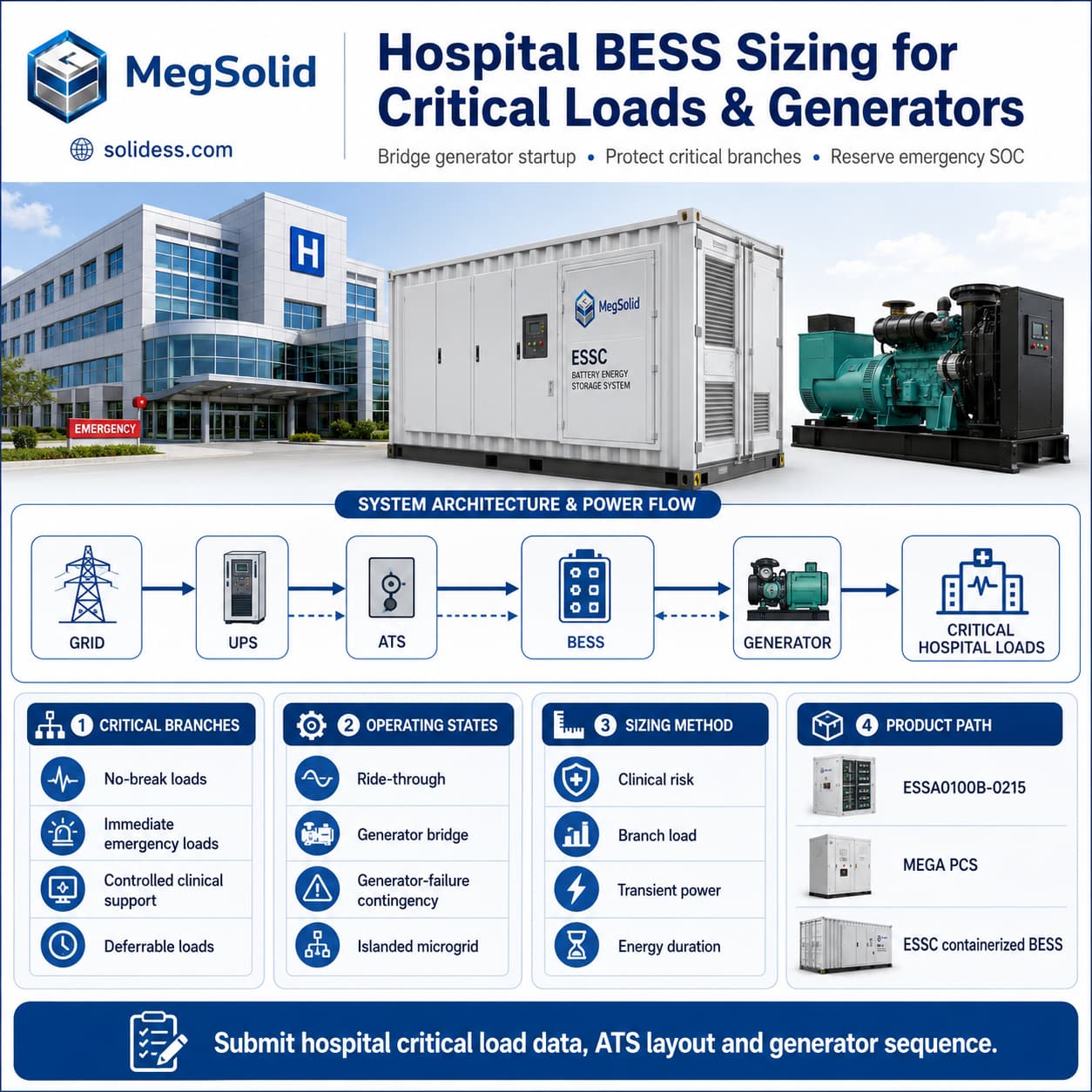
A hospital power outage is not a conventional commercial interruption.
Loss of electricity may affect emergency lighting, medical-gas controls, communications, monitoring systems, water circulation, ventilation and other services required to maintain patient care while the emergency-power system changes operating state.
The first hospital BESS sizing question is therefore not:
How large should the battery be?
It is:
Which electrical branches must remain energized, how much interruption can each branch tolerate, and what happens if the generator starts late or fails to accept load?
MegSolid evaluates hospital projects from the emergency operating sequence outward. The BESS connection point, UPS boundary, ATS sequence, generator controls and protected reserve must be defined before equipment capacity is selected.
A hospital BESS may:
- Bridge the interval before generators accept load
- Extend backup duration for selected clinical branches
- Support island operation during a prolonged outage
- Stabilize load transitions during generator operation
- Preserve selected services after a generator fault
Each role creates a different power, energy and switchgear requirement.
Request a Preliminary Hospital BESS Assessment
Submit:
- Branch-level critical-load schedule
- ATS, STS and UPS architecture
- Generator ratings and start sequence
- Required bridge and contingency duration
- Largest motor and transformer load steps
- Existing PV, fuel cell or CHP generation
- Single-line diagram
- Applicable healthcare electrical standards
The review can identify the preliminary connection boundary, operating sequence, product direction and missing data required before quotation.
Review the broader C&I Energy Storage portfolio before selecting an individual cabinet or container.
The Direct Answer: Define the Hospital Operating State First
One hospital may require several different BESS operating states.
| Operating State | BESS Responsibility | Main Design Driver |
|---|---|---|
| Grid-disturbance ride-through | Support selected sensitive loads | Transfer performance |
| Generator bridge | Carry emergency branches until generators accept load | PCS power and load step |
| Generator-failure contingency | Maintain a reduced clinical-load group | Battery duration |
| Islanded healthcare microgrid | Coordinate BESS, generation and prioritized loads | Energy balance and controls |
Sizing all four states from one total building load would produce an inaccurate specification.
The emergency plan should first identify what the hospital must continue operating during equipment and power failures. CMS emergency-preparedness guidance specifically includes equipment failures and power failures in the risk-assessment process for participating healthcare providers.
Map Critical Branches and Transfer Tolerance
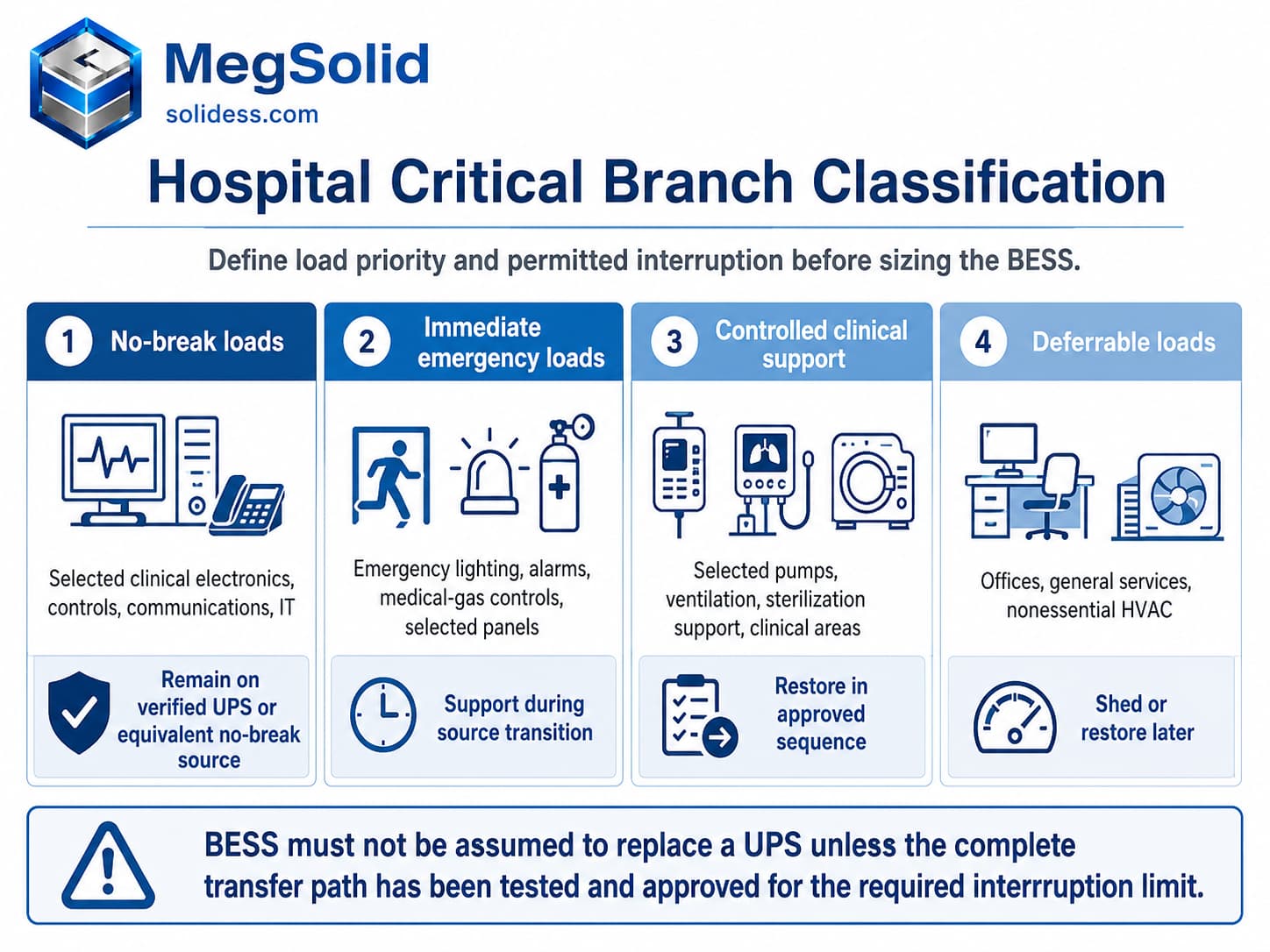
The hospital should classify both load priority and permitted interruption.
| Load Group | Typical Scope | Preliminary Power Strategy |
|---|---|---|
| No-break loads | Selected clinical electronics, control systems, communications and IT | Remain on a verified UPS or equivalent no-break source |
| Immediate emergency loads | Emergency lighting, alarms, medical-gas controls and selected panels | Support during source transition |
| Controlled clinical support | Selected pumps, ventilation, sterilization support and clinical areas | Restore in an approved sequence |
| Deferrable loads | Offices, general services and nonessential HVAC | Shed during constrained operation |
The BESS must not be assumed to replace an existing UPS merely because the system supports grid-connected and off-grid operation.
Loads with a strict no-break requirement should remain on an approved UPS, static transfer or equivalent architecture unless the complete BESS transfer path has been tested against the required interruption limit.
Hospitals comparing the two technologies can review the BESS for UPS and critical-power guide. Hospital compliance must still be assessed independently.
Divide Responsibility Between UPS, BESS and Generators
| System | Primary Responsibility | Procurement Limitation |
|---|---|---|
| UPS | No-break support for a defined load group | Usually limited duration and branch scope |
| BESS | Generator bridging, extended backup and microgrid support | Transfer and islanding capability must be verified |
| Generator | Long-duration emergency generation | Requires startup, fuel and maintenance |
| BESS-generator hybrid | Immediate response plus sustained operation | Needs coordinated controls and protection |
| PV, fuel cell or CHP | Additional outage energy | Availability and island capability vary |
| Microgrid controller | Coordinates sources and prioritized loads | Creates additional control and cybersecurity scope |
For US CMS-regulated facilities, the CMS healthcare microgrid categorical waiver permits qualifying alternate power sources when specified NFPA 99, NFPA 70 and associated conditions are satisfied. It does not mean that any battery installation automatically qualifies as an essential electrical source.
The Kaiser Permanente Richmond Medical Center demonstrates why branch boundaries matter. Its project combined 250kW of solar, a 1MW/1MWh battery, controls and existing diesel generation. The battery was designed to provide at least three hours of backup to the life-safety branch rather than the complete hospital load.
Convert the Emergency Sequence Into Electrical Ratings
After the supported branches are approved, calculate five quantities.
1. Continuous Critical Load
Add the coincident demand of the loads that remain energized in each operating state.
Do not add every panel nameplate. Use interval data, branch measurements or a validated emergency-load schedule.
2. Maximum Load Step
Identify the largest load applied to the BESS at one time, including:
- ATS block transfer
- Pump or fan starting
- Transformer energization
- VFD bypass operation
- Simultaneous restoration of multiple panels
3. Required Bridge Energy
Bridge Energy = Supported Load × Generator Transition Time
A short bridge may consume very little energy while still requiring a high-power PCS.
4. Contingency Energy
Contingency Energy = Prioritized Load × Required Battery-Only Duration
Apply the approved usable SOC window, conversion losses, auxiliary consumption and degradation reserve when converting AC energy into nominal battery capacity.
5. Recovery Capacity
Confirm that the BESS can restore emergency SOC after the grid or generator returns without overloading the source.
Before fixing a product model, use the commercial energy storage procurement guide to define PCS, EMS, protection, switchgear and commissioning responsibility.
Hospital BESS Sizing Example
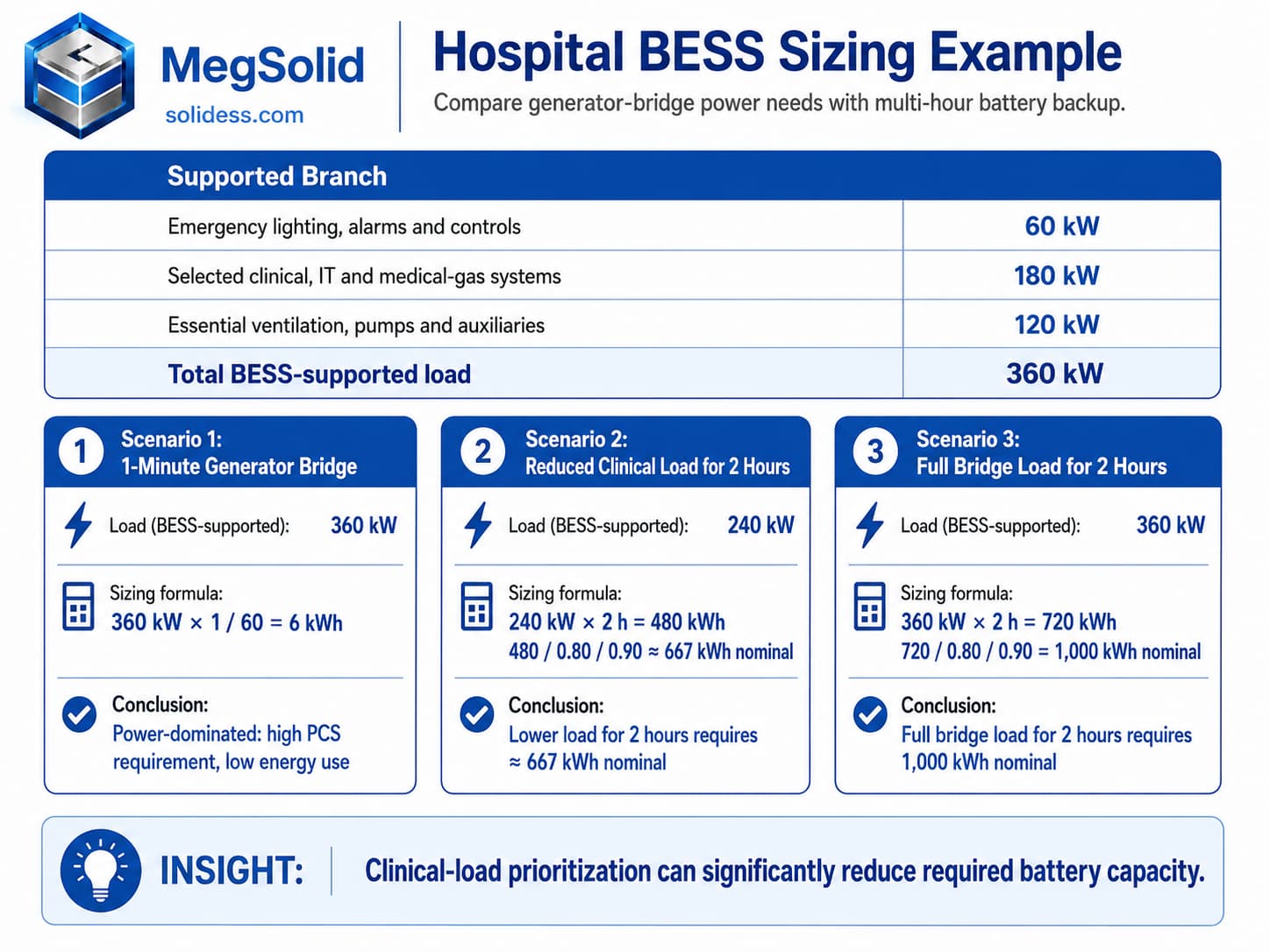
Assume the hospital approves the following bridge load:
| Supported Branch | Illustrative Power |
|---|---|
| Emergency lighting, alarms and controls | 60kW |
| Selected clinical, IT and medical-gas systems | 180kW |
| Essential ventilation, pumps and auxiliaries | 120kW |
| Total generator-bridge load | 360kW |
Scenario 1 — One-Minute Generator Bridge
Required AC Energy = 360kW × 1 ÷ 60 = 6kWh
Only 6kWh is discharged during the bridge.
However, the PCS must immediately support 360kW and any coincident load step. A 500kW-class PCS may therefore be a reasonable preliminary direction, subject to the apparent-power, overload and transfer study.
This scenario is dominated by instantaneous system capability rather than battery capacity.
Scenario 2 — Reduced Clinical Load After Generator Failure
Assume the emergency plan sheds selected ventilation and auxiliary loads after the generator fails, reducing the BESS-supported contingency load to 240kW.
For two hours:
Required AC Energy = 240kW × 2h = 480kWh
Using an illustrative 80% usable SOC window and 90% discharge-path factor:
Preliminary Nominal Energy = 480kWh ÷ 0.80 ÷ 0.90 ≈ 667kWh
Scenario 3 — Full Bridge Load for Two Hours
If all 360kW must continue for two hours:
Required AC Energy = 360kW × 2h = 720kWh
Preliminary Nominal Energy = 720kWh ÷ 0.80 ÷ 0.90 = 1,000kWh
| Contingency Strategy | Supported Load | Preliminary Nominal Energy |
|---|---|---|
| Reduced clinical branch | 240kW for 2 hours | Approximately 667kWh |
| Full bridge branch | 360kW for 2 hours | Approximately 1,000kWh |
This comparison shows why clinical-load prioritization must precede battery selection.
Verify Motors, Transformers and ATS Load Steps
Steady-state load does not establish whether the system can survive a source transition.
The study should review:
- Chilled-water and condenser-water pumps
- Air-handling and smoke-control fans
- Medical-air and vacuum equipment
- Elevators approved for emergency operation
- Transformer magnetizing inrush
- VFD bypass conditions
- Multiple ATS transfers
- Generator contribution during synchronization
A larger battery cannot compensate for insufficient converter current or apparent-power capability.
Use the BESS motor-starting engineering guide and the PCS and inverter engineering guide before approving PCS power.
Protect Emergency SOC From Daily Dispatch
Hospital batteries may also perform peak shaving, solar self-consumption or demand management.
Routine dispatch must not consume energy reserved for clinical continuity.
The EMS should define:
- Minimum emergency SOC
- Normal economic-dispatch window
- Generator-start threshold
- Maximum noncritical discharge
- Priority recovery charging
- Response to generator failure
- Response to meter or communication loss
- Manual emergency override
The control hierarchy should follow the BMS and EMS communication architecture.
Preliminary MegSolid Product Direction
| Verified Project Requirement | Preliminary Direction |
|---|---|
| Up to 100kW | ESSA0100B-0215 |
| Around 125kVA | 261.24kWh liquid-cooled C&I system |
| 150–500kW | Engineered battery system with MEGA PCS |
| 500kW–1MW | ESSC containerized BESS |
| Multi-MW hospital campus | Pooled containerized architecture |
Small facilities with an approved requirement within 100kW can evaluate the ESSA outdoor cabinet energy storage system.
The ESSA0100B-0215 is rated at 100kW and 215.04kWh. It uses LFP cells, intelligent air cooling and an IP54 enclosure. A project-specific transfer time must be confirmed rather than inferred from its on-grid/off-grid operating capability.
Projects requiring higher converter power can evaluate the MegSolid MEGA PCS range, which covers 30–500kW configurations. Larger applications can evaluate the ESSC containerized energy storage system, available in 500kW/1.0752MWh and 1MW/2.1504MWh configurations.
Hospitals comparing distributed load-centre cabinets with a central energy plant should review modular cabinets versus containerized ESS.
Compliance, FAT and SAT Requirements
Battery, PCS and cell documents do not by themselves prove that the complete hospital emergency-power system is compliant.
The procurement package should identify:
- Exact equipment models
- Certificate and test-report scope
- BESS connection point
- Essential branch boundary
- ATS and UPS interfaces
- Islanding and protection logic
- Fire-detection and suppression scope
- Cybersecurity and access control
- Witnessed FAT and SAT criteria
Review the NFPA 855 BESS compliance guide and the UL 9540A and IEC 62619 engineering guide when preparing the safety-document package.
The FAT should simulate grid loss, generator failure, critical-load steps, minimum SOC, communication loss and controlled recovery.
The SAT should verify the actual branch transfer, interruption performance, voltage, frequency, generator synchronization, motor starting, alarms and recharge logic.
Use the BESS Factory Acceptance Testing guide to convert the operating sequence into witnessed pass/fail criteria.
Hospital BESS RFQ Checklist
Submit:
- Critical branch and panel schedule.
- Twelve months of interval load data where available.
- ATS, STS and UPS manufacturer data.
- Generator rating, start time and load-acceptance sequence.
- Largest motors, transformers and starting methods.
- Required bridge and battery-only durations.
- Emergency SOC and daily dispatch requirements.
- Single-line diagram and protection architecture.
- Installation environment and fire-safety requirements.
- FAT, SAT, commissioning and warranty scope.
Final Procurement Recommendation
A hospital BESS should be selected from the approved emergency operating sequence—not total building demand.
The final design must prove:
- No-break loads remain on a verified no-break architecture.
- Critical branches are clearly identified.
- Source-transition and load-step requirements are satisfied.
- Emergency energy cannot be consumed by routine dispatch.
- UPS, BESS, ATS and generator responsibilities do not overlap ambiguously.
- The complete operating sequence passes FAT and SAT.
- Local healthcare, electrical and fire requirements are met.
FAQ
Q1: Can BESS replace a hospital generator?
Not automatically. BESS is commonly suited to immediate response and selected-duration support, while generators provide longer runtime.
Q2: Should the BESS cover the whole hospital?
Usually not. It should be sized from approved critical branches and operating states.
Q3: Can an outdoor BESS replace a clinical UPS?
Only when the complete transfer path has been tested and approved for the load’s interruption requirement.
Q4: Why can a one-minute bridge require a large PCS?
The energy used is small, but the converter must immediately carry the complete bridge load and its transients.
Q5: Can one 215kWh cabinet support a hospital?
Only when the verified power remains within 100kW and usable energy covers the required duration.
Q6: Can BESS start hospital pumps and fans?
Potentially, but starting current, power factor and converter overload capability must be verified.
Q7: Can hospital BESS perform peak shaving?
Yes, provided the emergency SOC reserve remains protected.
Q8: What happens if the generator fails?
The EMS should enter an approved contingency state, shed lower-priority loads and preserve selected clinical branches.
Q9: Is a central BESS better than distributed cabinets?
It depends on branch locations, redundancy, cable routes, fire separation and failure-domain requirements.
Q10: What is required for a firm quotation?
Provide branch loads, ATS and UPS data, generator sequence, motor details, backup duration and the single-line diagram.
Q11: How do you size a hospital BESS?
Define supported branches and operating states, verify transfer and transient requirements, and calculate energy for each contingency duration.
Q12: Is BESS or a generator better for hospitals?
BESS provides immediate response and stored energy. Generators normally provide longer-duration power. Hospitals may require both.
Q13: What is the most important hospital BESS input?
The approved branch-level emergency-load schedule and its permitted interruption times.
