 Skip to content
In Indian BESS procurement, “DC package” and “AC package” are commercial responsibility labels. They are not the same as DC-coupled and AC-coupled energy storage architectures.
This distinction matters because a DC package may include battery containers, PCS, EMS and long-term service, even though the PCS delivers AC output.
MegSolid therefore treats the package split as a responsibility map: it must show who supplies each subsystem, who integrates it and who remains accountable if the complete plant fails its MW, MWh or commissioning test.
SECI’s Nandiyal procurement provides a useful public example. The DC package covers the supply of a 600MW/1200MWh BESS with 15 years of comprehensive service and maintenance.
The separate AC package covers balance-of-system engineering, civil works, permits, installation, testing, commissioning and performance demonstration, while excluding the BESS containers, PCS, EMS and associated cables.
The direct procurement rule is:
Define the package boundary from the tender scope, responsibility matrix and POI guarantee—not from the words “DC” and “AC.”
What the DC and AC Package Split Actually Means
The DC package usually contains the equipment that stores, converts and controls energy. The AC or balance-of-system package connects those BESS blocks to the project substation and point of interconnection.
| Project Element | Typical DC-Package Scope | Typical AC/BoS Scope | Interface to Freeze |
|---|---|---|---|
| Battery containers | Supply and internal integration | Foundations and site installation | Dimensions, weight, cable entry and clearances |
| PCS | Supply, firmware and local control | MV connection | Voltage, fault data, harmonics and protection |
| EMS/BESS controller | Dispatch logic and operating limits | Plant SCADA and PPC integration | Command priority, point list and fallback mode |
| MV transformer | Required electrical input data | Supply and installation | Ratio, impedance, vector group and losses |
| Civil works | Equipment loading data | Design and construction | Tolerances, drainage, access and cable routes |
| POI performance | Equipment contribution | Network contribution | One contractual performance owner |
A preliminary single-line diagram cannot replace this responsibility matrix. The tender must assign both equipment supply and final performance liability.
Procurement teams should also review the risks created when batteries, PCS, EMS and site integration come from different parties. The Factory-Direct vs. Trading Company BESS Sourcing guide explains why fragmented technical authority frequently shifts commissioning and warranty risk back to the EPC.
Assign the POI Guarantee Before Comparing Suppliers
Individual component guarantees do not prove complete-plant performance.
A battery supplier may guarantee usable DC energy. The PCS supplier may guarantee conversion efficiency. The transformer supplier may guarantee electrical losses. The AC contractor may confirm cable sizing.
Every party can meet its own specification while the project still fails its point-of-interconnection test.
Use one project-level equation:
POI Deliverable Energy = Usable Battery Energy × PCS Performance × Transformer and Cable Performance − Auxiliary Consumption
The tender should state:
- The measurement point for guaranteed MW and MWh.
- The approved SOC window and test temperature.
- The charging and discharging power used during the test.
- Whether HVAC and auxiliary consumption are included.
- Whether the guarantee applies at beginning of life or end of life.
- The permitted tolerance and retest procedure.
- The party responsible for liquidated damages after a failed test.
For a 100MW/200MWh project, “200MWh installed battery capacity” is not a sufficient acceptance requirement.
The contract must state whether the plant must deliver 100MW for two hours at:
- The battery-container output.
- The PCS AC terminals.
- The medium-voltage bus.
- The final point of interconnection.
The POI boundary must be agreed before technical bids are compared. Otherwise, suppliers may quote different usable SOC windows, loss boundaries and auxiliary-load assumptions while presenting them as equivalent offers.
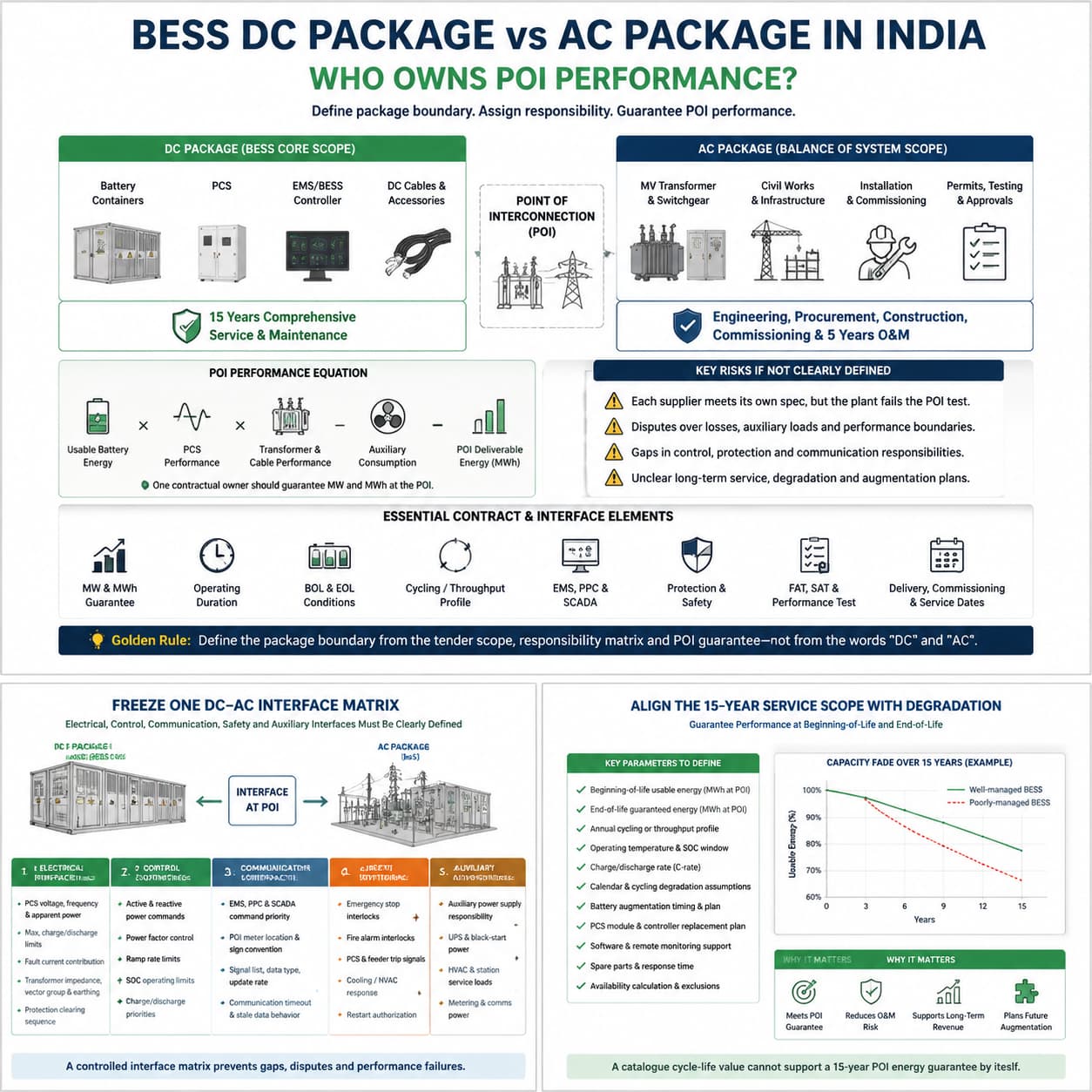
Freeze One DC–AC Interface Matrix
A single-line diagram shows the power path. The interface matrix defines control ownership, abnormal-event response and contractual liability.
The controlled interface should cover five areas.
Electrical interface
- PCS output voltage and frequency.
- Apparent-power rating.
- Maximum charging and discharging current.
- Fault-current contribution.
- Transformer impedance and vector group.
- Earthing arrangement.
- Protection clearing sequence.
Control interface
- Active-power commands.
- Reactive-power commands.
- Power-factor control.
- Ramp-rate limits.
- SOC operating limits.
- Charging and discharging priorities.
Communication interface
- EMS, PPC and SCADA command hierarchy.
- POI meter location.
- Import and export sign convention.
- Signal addresses and data types.
- Update rates and timestamps.
- Communication timeout response.
- Stale-data and fallback limits.
Safety interface
- Emergency-stop circuits.
- Fire-alarm interlocks.
- PCS and feeder trip signals.
- HVAC or cooling response.
- Restart authorization.
Auxiliary interface
- Station-service supply.
- Cooling and HVAC loads.
- UPS requirements.
- Black-start auxiliary power.
- Metering and communication power.
Protocol support alone is insufficient. The EPC still needs an approved point list containing signal names, units, scaling, ownership and fail-safe values.
The selected control philosophy must also match the PCS operating topology. The PCS and Grid-Forming Engineering Guide explains why reactive-power control, fault response, synchronization and black-start capability depend on both hardware and firmware architecture.
Separate Equipment Efficiency From POI Efficiency
Efficiency claims are often compared at different measurement boundaries.
| Reported Value | Measurement Boundary | Commonly Excluded |
|---|---|---|
| Battery DC efficiency | Battery terminals | PCS, transformer and site auxiliaries |
| PCS efficiency | PCS DC and AC terminals | Battery and MV losses |
| Container efficiency | Integrated BESS block | External transformer and collection system |
| POI round-trip efficiency | Final grid connection | Nothing outside the agreed plant boundary |
An EPC should reject comparisons where one bidder provides DC-to-DC efficiency while another provides AC-to-AC efficiency.
The RFQ should define:
- Charging measurement point.
- Discharging measurement point.
- Test power.
- Starting and ending SOC.
- Ambient and battery temperature.
- Inclusion or exclusion of HVAC.
- Meter accuracy.
- Calculation period.
The same rule applies to usable energy. A container’s nameplate capacity does not automatically equal its deliverable POI energy.
Align the 15-Year Service Scope With Degradation
SECI’s public DC-package description includes 15 years of comprehensive service and maintenance. The AC-package description includes five years of comprehensive O&M for the balance-of-system scope.
That difference creates a long-term responsibility gap unless the contracts address what happens after the AC contractor’s initial O&M period ends.
The DC-package proposal should define:
- Beginning-of-life usable energy.
- Guaranteed end-of-life POI energy.
- Annual cycles or energy throughput.
- Calendar-degradation assumptions.
- Cycling-degradation assumptions.
- Battery augmentation timing.
- PCS module and controller replacement.
- Software and remote-monitoring support.
- Spare-parts responsibility.
- Availability calculation and exclusions.
- Response time for critical failures.
A catalogue cycle-life value cannot support a 15-year capacity guarantee by itself.
The degradation model must reflect the project’s:
- Operating temperature.
- SOC range.
- Charge and discharge rate.
- Time spent at high SOC.
- Annual throughput.
- Dispatch profile.
- Planned maintenance periods.
Future augmentation also requires reserved site space, DC connection capacity, auxiliary supply and fire separation. A statement that the system is “expandable” is not sufficient unless the civil and electrical interfaces already support that expansion.
Coordinate Fire Safety, SCADA and Protection
Fire detection may begin inside a battery container, but the required response crosses the package boundary.
A confirmed thermal or fire alarm may need to:
- Block charging and discharging.
- Trip the affected PCS block.
- Open the relevant MV feeder.
- Change cooling or ventilation operation.
- Activate the approved suppression sequence.
- Send alarms to the plant SCADA.
- Prevent automatic restart.
- Record a synchronized event sequence.
CEA published a draft SOP for independent third-party BESS fire-safety audits in December 2025. In July 2026, CEA also listed public consultations concerning BESS plant safety audits and draft grid-connectivity standards. These materials may change before final notification, so the EPC must confirm the applicable versions at design freeze.
The fire and protection matrix must identify:
- The alarm level that stops the PCS.
- The event that opens the MV feeder.
- The party responsible for hardwired trips.
- Whether unaffected BESS blocks can continue operating.
- The party authorized to restart the system.
- The controller responsible for time-stamped event records.
Cybersecurity responsibilities must also be assigned. Remote access, software updates, user permissions and event logging should follow a controlled industrial architecture rather than relying on a shared vendor password. The IEC 62443 Cybersecurity Engineering for BESS article provides a framework for separating EMS, plant-network and remote-service responsibilities.
Match MegSolid Products to the Tendered Package
MegSolid’s published portfolio includes:
- 500kW/1.0752MWh air-cooled containerized BESS.
- 1MW/2.1504MWh air-cooled containerized BESS.
- 2.7MW/5.0159MWh liquid-cooled 5000INTL.
- 30–500kW energy storage PCS products.
These systems should be treated as modular building blocks, not as automatic compliance with a specific SECI tender.
| Project Requirement | Preliminary MegSolid Direction |
|---|---|
| 500kW/approximately 1MWh block | ESSC 500kW/1.0752MWh |
| 1MW/approximately 2MWh block | ESSC 1MW/2.1504MWh |
| 5MWh-class container | 5000INTL technical evaluation |
| Custom PCS segmentation | MEGA PCS with project-specific battery capacity |
| Large two-hour plant | Multiple BESS blocks with centralized PPC, EMS and MV collection |
The final configuration depends on:
- Guaranteed POI MW and MWh.
- Site voltage.
- Required duration.
- Ambient temperature.
- Annual throughput.
- Fire strategy.
- AC-package boundary.
- End-of-life capacity guarantee.
The Modular Cabinets vs. Containerized ESS comparison helps EPCs determine whether a project should use smaller repeatable blocks or fewer high-capacity containers.
For utility-scale projects, the 5MWh BESS Engineering Architecture explains the 5000INTL’s 5.0159MWh platform, liquid-cooling architecture and high-voltage system design.
MegSolid can be evaluated for modular BESS supply, PCS and EMS interface engineering, project-specific communication mapping and witnessed factory testing. Its public company profile presents containerized systems from approximately 1MWh to 5MWh and vertically integrated battery, PCS and ESS engineering capabilities.
A 600MW turnkey tender would still require project-specific qualification, local EPC resources and potentially a consortium structure. A standard product quotation should not be presented as a substitute for those requirements.
FAT and SAT Must Test the Package Interface
Factory testing should not stop after proving that the battery charges and the PCS starts.
The DC-package FAT should reproduce the signals expected from the AC package:
- Rated charging and discharging operation.
- Usable-energy and SOC reconciliation.
- Active- and reactive-power commands.
- POI-meter simulation.
- PPC command simulation.
- SCADA timeout and communication recovery.
- Low-SOC derating.
- High-temperature derating.
- PCS-block trip and restart.
- Fire-alarm interlocks.
- Emergency-stop interlocks.
- Event-log and operating-data export.
The SAT should repeat the critical sequences through the actual:
- Transformer.
- MV switchgear.
- Revenue and control meters.
- Protection relays.
- Plant SCADA.
- PPC.
- Grid interface.
Each test needs an approved measurement point, tolerance and pass/fail rule.
The BESS Factory Acceptance Test Guide explains how to convert approved drawings, firmware versions, communication maps and protection sequences into witnessed factory records before shipment.
Data Required for a Firm India BESS Proposal
An inquiry stating only “100MW/200MWh BESS for India” is not ready for a firm technical or commercial proposal.
Submit the BESS Package and Interface Data
Provide:
- Required MW and guaranteed POI MWh.
- Operating duration.
- Dispatch application.
- Beginning-of-life guarantee.
- End-of-life guarantee.
- Annual cycling or energy-throughput profile.
- Battery-container supply boundary.
- PCS, EMS and PPC responsibility.
- POI voltage.
- Approved single-line diagram.
- Transformer and MV-switchgear responsibility.
- SCADA protocol and communication point list.
- Fire-safety and third-party audit requirements.
- FAT and SAT acceptance criteria.
- POI performance-test procedure.
- Delivery, commissioning and service dates.
The engineering response should include:
- Preliminary container quantity.
- PCS and EMS responsibility boundary.
- Required MV interface data.
- Missing technical documents.
- Assumptions preventing a firm guarantee.
- Proposed FAT and SAT scope.
Final Procurement Recommendation
Splitting an Indian BESS project into DC and AC packages can increase competition and make specialist suppliers more accountable.
It also creates a serious risk: every contractor may meet its individual scope while the complete plant misses the required MW, MWh, availability or commissioning date.
Before issuing the equipment purchase order, approve one responsibility matrix covering:
- POI power and energy.
- Battery, PCS and transformer losses.
- Auxiliary consumption.
- EMS, PPC and SCADA control.
- Protection and safety interlocks.
- Degradation and augmentation.
- FAT and SAT.
- Failed-test liability.
- Long-term service ownership.
The commercial package split is successful only when the complete project retains one accountable route from the battery cell to the final POI performance test.
FAQ
Q1: Is a BESS DC package limited to DC electrical equipment?
No. In the SECI Nandiyal structure, the separate AC package excludes the BESS containers, PCS and EMS. The DC package therefore extends beyond a purely DC electrical boundary.
Q2: Is a DC package the same as a DC-coupled BESS?
No. A DC package is a commercial tender scope. DC coupling describes an electrical topology connecting batteries and other generation equipment on a shared DC bus.
Q3: Who should guarantee POI energy?
One contractually identified party should own the complete POI guarantee, supported by back-to-back obligations from the battery, PCS, transformer and AC-package suppliers.
Q4: Does battery nameplate capacity equal POI energy?
No. SOC limits, PCS losses, transformer losses, cable losses and auxiliary consumption reduce deliverable AC energy.
Q5: Who normally supplies the MV transformer?
It is commonly included in the AC or balance-of-system package, but final responsibility must follow the project-specific tender.
Q6: Who owns the EMS-to-SCADA interface?
The EMS supplier normally provides the BESS control points, while the AC contractor integrates plant SCADA and PPC. The command hierarchy must be jointly approved.
Q7: Why is a project duty cycle required?
Battery degradation depends on temperature, SOC, C-rate, dwell time and annual throughput. A generic cycle-life figure cannot support a firm 15-year capacity guarantee.
Q8: What should the DC-package FAT simulate?
It should simulate POI commands, meters, PPC, SCADA signals, communication failures, protection trips and fire-safety interlocks.
Q9: Can the transformer specification change after FAT?
Only after reviewing voltage, impedance, losses, fault levels, protection settings and the effect on POI performance.
Q10: What does MegSolid need for a preliminary proposal?
MegSolid requires project MW and MWh, duty cycle, package boundary, SLD, site voltage, environmental conditions, communication scope and performance guarantees.
Q11: What is a BESS DC package in an Indian tender?
It is a commercial package covering the core BESS equipment and defined service obligations. Its exact boundary must be read from the tender rather than inferred from its name.
Q12: What is an AC package in an Indian BESS project?
It commonly covers balance-of-system engineering, civil works, MV equipment, installation, approvals and commissioning, subject to the exclusions in the project tender.
Q13: How can an EPC prevent gaps between DC and AC packages?
Approve a controlled interface matrix and assign one contractual owner for POI power, energy and performance testing before releasing the equipment order.
