 Skip to content

A 100 kWh battery for a hotel in Nigeria may be enough for selected critical loads, but it cannot be approved from room count or battery capacity alone. MegSolid first separates the hotel's essential services from comfort and deferrable loads, then calculates PCS power, delivered energy, reserve SOC and recharge capability.
This article is based on an anonymized inquiry pattern in which a Nigerian hotel requested approximately 100 kWh of storage to reduce operating cost but had not supplied its load profile, generator data, grid mode or installation conditions. It is a procurement framework, not a completed MegSolid installation and not a quotation.
- ⚡ Power question: What simultaneous kW or kVA must the BESS carry?
- 🔋 Energy question: How many usable AC kWh must be delivered during the required window?
- 🕒 Runtime question: Is the objective a short generator bridge, an overnight reserve or partial hotel operation?
- ☀️ Recharge question: Can solar, grid or the generator restore the required SOC before the next outage?
- 🧠 Control question: Which source has dispatch priority and which hotel loads may be shed?
The Direct Answer: 100 kWh Is Not a Runtime Guarantee
Battery energy and backup duration are connected, but they are not interchangeable. The buyer must define whether 100 kWh means nominal DC energy, usable DC energy or guaranteed AC energy at the hotel distribution boundary. Supplier reserve settings, conversion losses, auxiliary consumption, temperature and ageing all affect what reaches the loads.
- 🔌 Nominal energy: The nameplate battery value before project operating limits are applied.
- 🛡️ Reserved energy: SOC held back for battery protection, emergency service or the next outage.
- ⚙️ Conversion allowance: Energy consumed through PCS and system auxiliaries before delivery to the AC load.
- 📉 Ageing obligation: Whether the required energy must be delivered at commissioning only or also at an agreed end-of-life condition.
- 📍 Meter boundary: The exact point where delivered energy and system performance will be measured.
| Customer statement | Why it is incomplete | Required clarification |
|---|---|---|
| We need 100 kWh | Energy does not define instantaneous power | Maximum and critical-load kW/kVA |
| The hotel has 30 rooms | Room count does not reveal AC, water-heating or kitchen demand | Feeder-level load schedule and occupancy pattern |
| We need backup all night | Night length is not the same as constant load | Time-sequenced critical-load profile |
| Solar will recharge it | PV output changes with weather, roof area and daytime hotel demand | Hourly PV yield and remaining charging surplus |
| A generator is already installed | Its rating does not define start delay, minimum load or charging headroom | Controller, rating, operating limits and synchronization method |
A packaged system advertised for a certain number of rooms may still be wrong when the hotel has central air-conditioning, electric water heating, lifts, laundry, cold rooms or large pumps. Use the 100 kW / 215 kWh outdoor BESS selection guide to see why power and energy must be checked independently.
Build a Hotel Load Priority Map Before Sizing the BESS
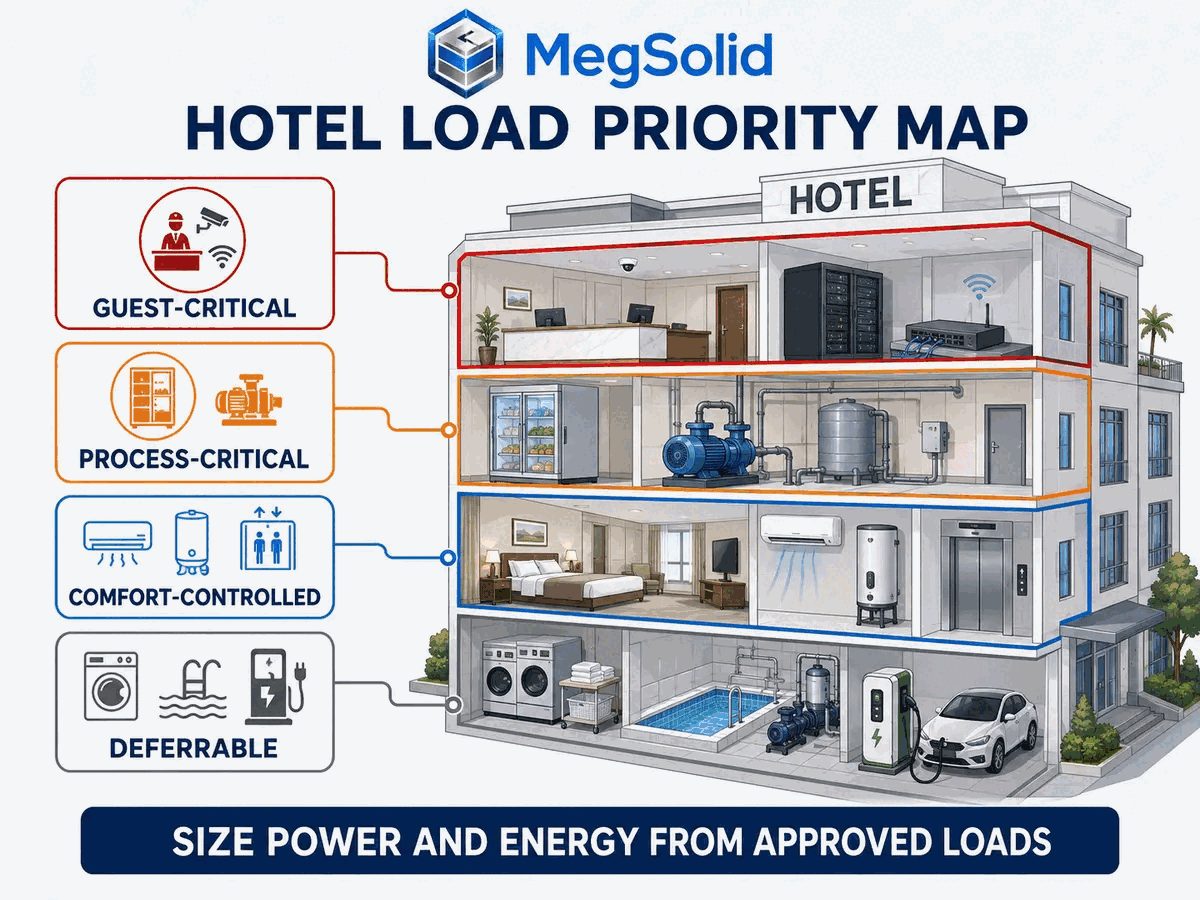
The hotel owner must decide what guests and staff should experience during an outage. Keeping reception, security, network equipment and refrigeration available is a different service promise from operating every guest-room air conditioner, water heater, lift and kitchen appliance.
- 🔴 Life-safety and statutory loads: Emergency systems identified by the project's electrical and fire-safety design; do not reclassify them through the BESS article.
- 🟠 Guest-service critical: Reception, access control, security, communications, selected lighting and payment systems approved by the operator.
- 🟡 Process critical: Refrigeration, cold-room controls, water pumps, sewage pumps and essential kitchen or laundry equipment selected by the site team.
- 🔵 Comfort controlled: Selected room air-conditioning, hot-water production and lifts operated under a written demand limit.
- ⚪ Deferrable: Pool systems, nonessential laundry, EV charging, decorative lighting and other loads that may wait for grid or generator recovery.
| Load group | RFQ data to collect | What changes the design |
|---|---|---|
| Air-conditioning | Unit kW, quantity, compressor type and operating schedule | Simultaneous demand, starting current and room-control policy |
| Water pumping | Motor kW/kVA, starter or VFD, flow schedule and tank capacity | Starting duty and whether pumping can be shifted |
| Refrigeration | Compressor data, temperature limits and restart sequence | Continuous energy and surge coordination |
| Lifts | Drive type, rated power, regenerative behavior and emergency mode | Short peaks, harmonics and controlled availability |
| Kitchen and laundry | Equipment list and operating timetable | Large resistive loads and avoidable coincidence |
A load priority map also creates the first EMS control requirement: every protected feeder needs a measurable state, a switching authority and a defined response when reserve SOC is low. The BMS and EMS communication architecture guide explains why commands, feedback and fallback states must be deterministic.
Size PCS Power Before Calculating the Backup Window
PCS power is driven by the highest approved simultaneous load, not by battery kWh. Hotel projects must also check reactive power, phase balance, compressor and pump starts, transformer limits and the transition between grid, BESS and generator.
- 📊 Measure maximum demand: Use interval data and a temporary power-quality recorder where available.
- ⚙️ Record motor events: Capture start method, current, duration and permitted voltage dip for pumps, lifts and compressors.
- 🔺 Check three-phase balance: Map single-phase guest and service loads to the actual distribution board.
- 🧮 Separate kW from kVA: Confirm power factor and harmonic duty instead of converting nameplate kVA with an assumed factor.
- 🛡️ Preserve headroom: Include approved transient and future-load allowances without turning them into unexplained oversizing.
- 🔁 Define transfer behavior: State which loads tolerate an interruption and which require a separate UPS or engineered transition path.
For smaller three-phase hotel loads, compare the verified ratings and battery-interface limits in the 30 kW, 40 kW and 50 kW three-phase hybrid inverter guide. Do not select an inverter only because its kW matches the estimated average load.
Calculate Energy from the Service Window
Build a time-sequenced load schedule for the required outage. For each time step, add the approved loads, multiply power by the operating interval, then apply the project's defined AC delivery boundary, reserve SOC, auxiliary load and ageing requirement. Ask bidders to show those values separately rather than hiding them inside one oversizing factor.
- ⏱️ Generator bridge: Carry selected loads only until the generator starts, stabilizes and accepts the bus.
- 🌙 Quiet-hours operation: Maintain an approved nighttime load set without promising whole-hotel operation.
- ☀️ Solar shifting: Store daytime surplus for evening demand after daytime hotel consumption is served.
- 🛑 Controlled load shedding: Disconnect comfort loads in stages as SOC reaches agreed thresholds.
- 🧯 Emergency reserve: Protect a defined SOC floor from routine cost-saving dispatch.
- 📅 Repeated outages: Confirm whether the system can recharge before another expected event.
| Service objective | Power input | Energy input | Acceptance evidence |
|---|---|---|---|
| Generator start bridge | Critical-load step and motor events | Measured start and qualification time | Automatic transition test |
| Selected overnight loads | Maximum coincident approved load | Hourly load schedule | Delivered AC energy at the agreed meter |
| Solar self-consumption | PCS charge/discharge limits | Hourly PV surplus and evening demand | Metered dispatch profile |
| Peak control | Target import ceiling | Length and frequency of peak events | PCC demand trend and SOC recovery |
Coordinate Grid, Solar, BESS and Generator Through the EMS
A Nigerian hotel often needs several operating modes rather than one fixed sequence. The controls narrative must define source priority, generator start and stop authority, BESS charging limits, reserve SOC, load shedding and recovery after a communication failure.
- Serve live hotel loads: Use available solar against permitted demand without violating the PCC or generator boundary.
- Charge under limits: Restrict grid or generator charging to the transformer, tariff and generator operating envelope.
- Hold backup reserve: Prevent routine peak shaving from consuming the SOC committed to guest-critical loads.
- Respond to outage: Island only through the approved protection and switching architecture.
- Start and qualify the generator: Confirm voltage, frequency and breaker states before transferring or paralleling.
- Restore by priority: Reconnect pumps, refrigeration and comfort loads through agreed ramps.
- Recover SOC: Recharge according to the next outage risk, solar forecast and generator constraints.
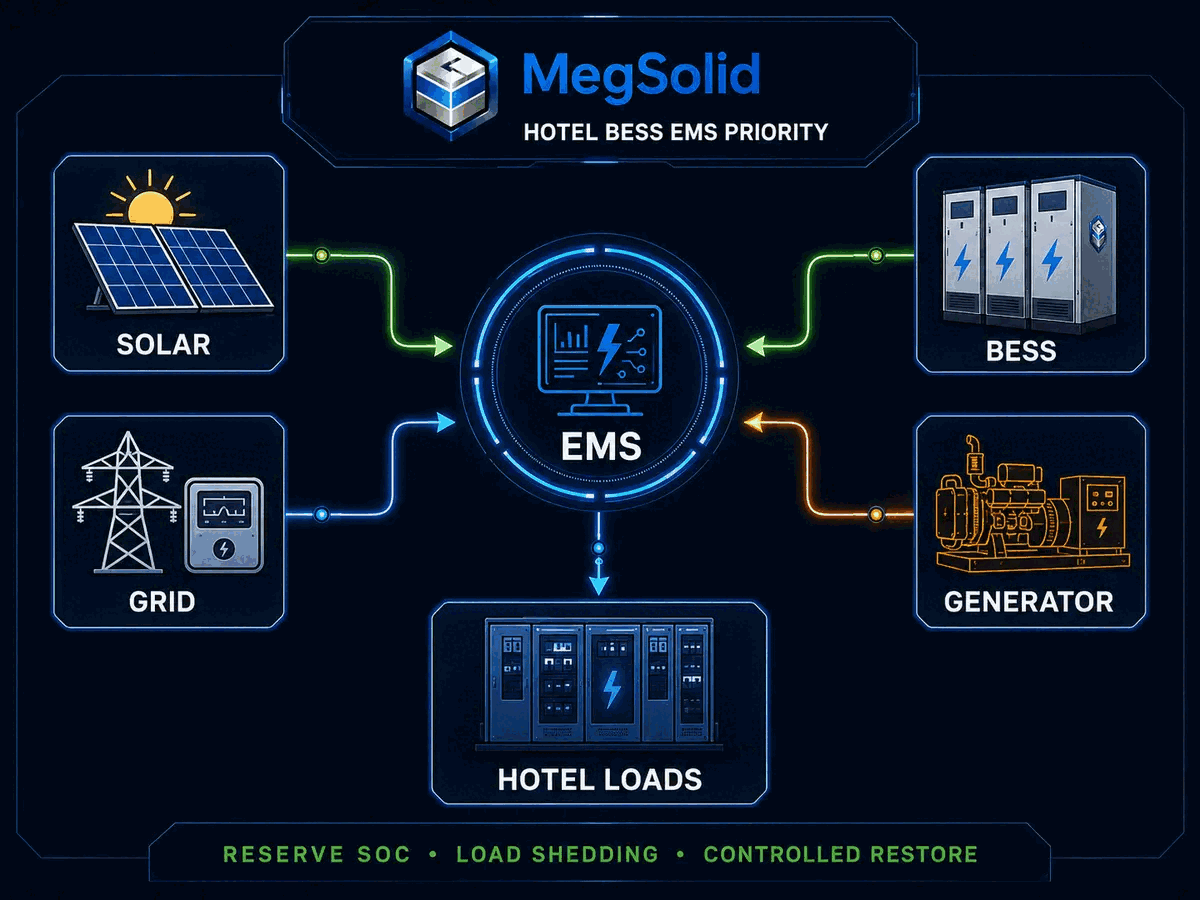
The Nigeria PV-diesel-BESS microgrid guide provides the wider hybrid architecture. This hotel page adds the occupancy, guest-service and load-priority decisions that a generic microgrid design does not resolve.
Which MegSolid System Should a Hotel Evaluate?
MegSolid should not convert a 100 kWh inquiry into an automatic product selection. The current catalog provides several verified C&I candidates, but the hotel load study must first confirm power, energy, cooling, voltage, installation environment and certification scope.
| Verified model or family | Published rating | Cooling and chemistry wording | Evaluation boundary |
|---|---|---|---|
| ESSA0050B-0100 | 50 kW / 100.352 kWh | Intelligent air cooling; LFP | Candidate only after peak kW, usable-energy window and motor duty are confirmed |
| ESSA0100B-0215 | 100 kW / 215.04 kWh | Intelligent air cooling; LFP | Evaluate when both AC power and required energy exceed the smaller cabinet boundary |
| Meg-Solid Energon C&I system | 125 kVA / 261.24 kWh | Liquid cooling; 314 Ah LFP | Evaluate voltage, thermal environment, delivered-energy duty and model-specific documents |
The ESSA platform supports simultaneous connection to load, battery, grid, diesel generator and PV, with integrated EMS functions. Its current model table also lists 400 V AC, on-grid/off-grid support, RS485 and TCP-IP communications. Review the MegSolid ESSA outdoor cabinet specifications and request the current controlled datasheet before design approval.
For projects considering higher energy and liquid cooling, use the 261 kWh liquid-cooled C&I RFQ guide. The published 90% value for that model is maximum system efficiency, not a stated round-trip efficiency.
Treat Solid-State Configuration as a Project Option, Not a Generic Claim
The standard ESSA model table identifies LFP cells. MegSolid confirms that the ESSA platform can be configured with solid-state battery cells for project-specific requirements, but that capability must not be rewritten as a claim that every ESSA cabinet is hybrid solid-state. The quotation, signed datasheet and BOM must identify the supplied cell and electrolyte architecture.
- 🧪 Cell evidence: Confirm the exact cell model, chemistry wording, electrolyte architecture and test conditions.
- 🌡️ Thermal evidence: Review model-level thermal behavior and system propagation evidence rather than relying on a chemistry label.
- 🧠 BMS limits: Verify voltage, current, temperature and SOC protection at the supplied configuration.
- 🧯 System protection: Confirm detection, fire suppression, ventilation, isolation and emergency-response interfaces.
- 🏨 Occupied-site layout: Coordinate separation distances, access, egress, noise and maintenance with the hotel and local authority.
- 📄 Certificate scope: Match every report or certificate to the cell, module, cabinet, PCS or complete system it actually covers.
Solid-state configuration may improve specific thermal-risk characteristics when supported by exact test evidence, but no battery should be described as fireproof or as eliminating thermal runaway. Compare the project evidence in the solid-state battery thermal-runaway approval checklist and review the broader MegSolid solid-state energy storage systems page.
Add Nigerian Inspection and Import Requirements to the RFQ
Equipment selection does not replace local electrical approval. NEMSA states that electrical installations and power systems in Nigerian workplaces are subject to technical inspection, testing and certification, and that installation personnel must be appropriately certified. Confirm the current project path with the responsible Nigerian professionals and the NEMSA inspection and certification mandate.
For imported regulated products, the Standards Organisation of Nigeria describes SONCAP as an offshore and pre-shipment conformity-assessment process. The importer and EPC should confirm whether each supplied component is regulated, which documents apply and who owns clearance responsibility under the official SONCAP explanation.
- 📐 Electrical design: Controlled SLD, earthing, protection, cable schedule, fault levels and switching philosophy.
- 📜 Document register: Model-specific datasheets, reports, certificate scope, manuals and revision status.
- 🚢 Import boundary: Incoterm, SONCAP responsibility where applicable, packing, insurance, port and inland delivery.
- 🧑🔧 Local execution: Responsible installer, inspection plan, commissioning support and training.
- ✅ Acceptance: FAT, site tests, performance meter, tolerances, punch-list closure and handover documents.
Before selecting a vendor, use the Nigeria battery energy storage supplier evaluation guide. Include witnessed testing using the BESS factory acceptance test checklist rather than accepting a generic factory test certificate.
Hotel BESS RFQ Checklist
A useful quotation begins with measured site data. Send the following information so MegSolid can separate the battery, PCS, EMS, PV, generator and EPC responsibilities instead of pricing an undefined 100 kWh package.
- 📍 Hotel location, installation area, indoor/outdoor requirement, ambient temperature and altitude
- ⚡ Grid voltage, frequency, transformer rating, phase arrangement and available fault data
- 📊 At least one representative interval load profile, plus monthly bills where available
- 🏨 Room count, occupancy profile and feeder-level equipment schedule
- 🔺 Largest motors, compressors, pumps and lifts with starting method and kVA data
- 🕒 Required service window for each protected load tier
- ☀️ Existing or planned PV capacity, inverter data and hourly yield model
- ⛽ Generator rating, controller, start time, minimum loading and charging permission
- 🔌 Grid-connected, off-grid and export operating requirements
- 🧠 Required EMS priorities, reserve SOC, load shedding and communication interfaces
- 📜 Required standards, inspection path, certificate scope and import documentation
- 📅 Delivery date, Incoterm, installation scope, FAT/SAT witnesses and warranty requirements
This article provides a baseline hotel BESS sizing framework. To receive the editable Hotel Load Schedule and EPC RFQ checklist, email [email protected]. Include the hotel location, load profile, generator and PV data, required backup window, grid voltage, installation environment and target delivery date.
FAQ
Is a 100 kWh battery enough for a hotel in Nigeria?
It may be enough for selected critical loads, but battery capacity alone cannot prove suitability. Confirm simultaneous kW/kVA, the time-sequenced load profile, required backup duration, reserve SOC, conversion boundary and recharge capability.
How many hotel rooms can a 100 kWh battery support?
Room count is not a reliable sizing input. Two hotels with the same room count can have very different air-conditioning, hot-water, lift, kitchen, laundry, refrigeration and pumping loads.
Should hotel BESS sizing use kW, kVA or kWh?
Use all three where relevant. kW describes active power, kVA captures apparent-power duty and power factor, and kWh defines energy over time. The RFQ must state the measurement and guarantee boundary for each.
Can the battery run every air conditioner in the hotel?
Only if the PCS, battery, distribution system and operating schedule are designed for that duty. Most buyers should first define which rooms or common areas remain available and how air-conditioning is staged during an outage.
How should a hotel generator work with the BESS?
Define generator start authority, qualification time, minimum loading, synchronization, charging limits, stop conditions and failure fallback. The EMS should prevent the battery and generator from responding to the same event without coordinated limits.
Can solar PV fully recharge a 100 kWh hotel battery every day?
Not from PV capacity alone. Calculate hourly PV production, daytime hotel demand, charging limits, weather variation and the SOC required before the next outage. Use only the surplus available after live loads and operating constraints.
Which hotel loads should receive backup priority?
The hotel and project engineers should approve the hierarchy. Typical groups include statutory or life-safety systems, reception and security, communications, refrigeration, water pumps, selected comfort loads and deferrable services.
Which MegSolid cabinet is closest to a 100 kWh request?
The published ESSA0050B-0100 rating is 50 kW / 100.352 kWh with intelligent air cooling and LFP cells. It is only a candidate; confirm hotel peak power, usable-energy duty, motor starting, voltage and installation conditions before selection.
Can a hotel order a MegSolid solid-state battery configuration?
The ESSA platform can be configured with solid-state battery cells for project-specific requirements. The quotation, signed datasheet and BOM must identify the exact supplied cell and electrolyte architecture; do not assume every ESSA cabinet is solid-state.
What should be witnessed during the hotel BESS FAT?
Witness the approved functional tests for protection, alarms, BMS/PCS/EMS communications, charge and discharge control, generator and grid interfaces, load-shedding sequence, meter accuracy, emergency stops and communication-loss fallback.
Who inspects commercial electrical installations in Nigeria?
NEMSA states that it enforces technical standards and performs inspection, testing and certification of electrical installations and power systems in Nigerian workplaces. Confirm the current project procedure with qualified Nigerian professionals and the responsible authority.
Does a hotel BESS imported into Nigeria require SONCAP documentation?
SON describes SONCAP as a conformity-assessment process for regulated imported products. The importer and EPC should confirm the classification and required documents for each component before shipment rather than assuming one certificate covers the complete system.
Where can a Nigerian hotel request a MegSolid BESS proposal?
Email [email protected] with the hotel location, interval load data, critical-load list, generator and PV details, required backup duration, installation conditions, grid voltage and target delivery date.
